Showing posts with label Daredevil. Show all posts

October 16, 2016

REVIEW: Marvel's Luke Cage


As the proverbial snowball that is Marvel Studios grows larger and larger with time, one has to wonder; when will the cracks begin to show? Even the weakest entry into the MCU  manages to be merely "okay" at worst. While I'm no fan of everything Marvel has put out (especially considering the current state of their comics), their entries in the realm of live-action entertainment have been reasonably air-tight. Captain America: Civil War was a fun, powerful second act break before the climax that is Infinity War and I'm finding myself more and more excited for Doctor Strange as time goes on. 2016 is shaping up to be a good year for Marvel, especially considering the most low-key offering from Kevin Feige and company, Luke Cage. Like Daredevil and Jessica Jones before it, the show helps to not only establish Netflix as a legitimate entertainment platform, but also to maintain the Marvel Studios stranglehold on the public consciousness.

Taking place after the events of Jessica Jones, the series focuses on the life of Luke Cage (Mike Coulter); wrongfully incarcerated, he participated in a risky prison experiment that imbued him with superhuman strength and bulletproof skin. After making his escape, Cage finds himself laying low in a Harlem barbershop owned by Henry "Pop" Hunter (Frankie Faison). After the criminal activity of local nightclub owner Cornell "Cottonmouth" Stokes (Mahershala Ali) begins to take its toll on Cage's neighborhood, he's forced to step out of the shadows and become a bonafide hero. Noble as his deeds are, Luke's actions have consequences; though he may be bulletproof, the same can't be said of the people caught in the crossfire.


The performances here are for the most part strong, despite dialog that tends to fluctuate from "powerful and engaging" to "trying a bit too hard for its own good". Coulter does a fine job as Luke, though his range occasionally leaves a bit to be desired. He can command attention like no one else when a scene requires him to be angry or passionate, but its when he needs to be more subtle and reserved that his performance lacks a certain energy compared to his supporting cast. Frankie Faison is sure to be a fan-favorite as Pop, and Simone Missick manages to be both flawed and endearing as Detective Misty Knight. Rosario Dawson returns again as Claire Temple, fulfilling her role as the unifying thread that ties each Netflix series together. Her role here is more prominent than ever before, easily a point in the show's favor considering how soundly Dawson manages to sell it every time. 

As is usual for Marvel's entries on Netflix, however, the heroes tend to pale in comparison to the villains. Mahershala Ali is a dynamo as Cottonmouth, playing the classic role of "despicably likeable gangster" to a T. Despite all the awful things this character does, you can't ever really bring yourself to totally hate him; he's just too endearing. Playing the part of his cousin/partner-in-crime, we have Alfre Woodard as "Black" Mariah Dillard, a local politician who hopes to use the racial divide of Harlem to deflect attention from her own criminal activities. She's a thoroughly modern, painfully relevant villain, and watching her slowly transition from crooked civil servant to full-on crime boss was definitely one of the highlights of this season. Both Cottonmouth and Dillard manage to be layered, sympathetic, and despicable; all the marks of a truly great villain.


The only antagonistic element I wasn't totally sold on was Willis "Diamondback" Stryker, played by Erik LaRey Harvey. While Harvey's performance commands attention whenever he's on screen, I felt as though not enough thought went into this character. He's built up for the first few episodes, then introduced practically out of the blue. He feels somewhat vestigial, compared to Ali and Woodard, as if the only reason he was introduced was so Luke could be faced with a more obvious physical threat to go up against. There's definitely a lot of potential with this character, but I can't help but feel that he should have either been introduced earlier or not at all, as what we have currently is somewhat half-baked in execution.

It's a prime example of what's becoming a recurring symptom of Marvel's Netflix shows; with the exception of Daredevil's first season, every one of these series is met with a mid-season slump. Roughly halfway through the thirteen episodes we're given, something abruptly changes the status quo and the entire season is left feeling somewhat stunted, as if it is two short seasons being passed off as one full-length arc. Both Jessica Jones and the second season of Daredevil are guilty of this, and Luke Cage is no exception. While I still enjoyed all of these shows overall, this trope tends to make the entire thing feel poorly thought-out in hindsight; it may just be a side-effect of marathoning the entire show in one sitting (rather than watching an episode a week, as though it were airing on network television), but it's still a wrinkle I would like to see ironed out as these shows continue on (especially with The Defenders just over the horizon).


Arguably the show's strongest feature, however, is the atmosphere. This is a series that is able to immediately distinguish itself from the rest of the MCU, as well as the rest of Marvel's Netflix series. The vast bulk of the story takes place in Harlem, and Luke Cage positively revels in the culture. Everything from the sets to the struggles to the dynamite soundtrack helps sell the setting, making this the most believable, down-to-earth thing to come out of the MCU. The only thing I can fault it for is an immersion-shattering scene in the latter half of the season involving Method Man. When your protagonist is a bulletproof black man in a hoodie, some social commentary is inevitable (if not openly expected). The show handles this touchy subject matter very well, with the exception of this one scene; it's the only thing that feels as though it was added in reshoots, coming right out of nowhere and interrupting the tense flow of the episode. This very well may be a personal gripe, but it completely took me out of the episode like a GI Joe PSA about avoiding downed power lines. It's the one smudge on the show's otherwise sterling sense of tone and immersion.


All things considered, I honestly really enjoyed my time with Luke Cage. While many seem to be dissatisfied with the ending, I felt as though it kept the tension and excitement going until the last second, leaving me genuinely engaged and eagerly awaiting Season 2. The argument could be made that a lot of the MCU is somewhat homogeneous in terms of theme and story; with that said, Luke Cage manages to be totally original and unique in its own right. Despite some hiccups here and there in terms of story and pacing, the show's strong tone and endearing characters more than make up for any issues I have with it. Whether you're a Marvel fanatic or someone who's starting to get burned out on the whole superhero thing, it's hard not to recommend Luke Cage.

April 10, 2016

REVIEW: Daredevil Season Two


Though I thoroughly enjoyed Jessica Jones, I must admit that I've been moreso eagerly awaiting the follow-up to the first season of Daredevil for some time now. While I found Marvel's original foray into the world of Netflix programming to be an overall well-crafted, well-executed piece of work, it left me wanting for a more satisfying Daredevil experience. As I mentioned when I reviewed it last year, it felt as though the entire season was one big pilot; a build-up to the ACTUAL adventures of Matt Murdock and company. Lucky for me, Daredevil Season 2 is exactly the payoff I've been waiting oh-so patiently for.


Months have passed since the law offices of Nelson and Murdock helped put Wilson Fisk (Vincent D'Onofrio) behind bars. While Matt Murdock (Charlie Cox) continues his crusade against crime as The Man Without Fear and the firm enjoys a new surge of popularity within Hell's Kitchen, a new client appears, the only survivor of one of several violent massacres, all targeting the various gangs that call the Kitchen home. Upon taking the case, the trio find themselves embroiled in the affairs of Frank Castle (Jon Bernthal), aka the Punisher, a former Marine who's taken it upon himself to clean up the streets one bullet at a time.

Let me say right off the bat that Bernthal's Punisher is by far the highlight of the entire season. Though I praised Thomas Jane's portrayal of Frank, this is a Punisher who manages to convey every ounce of complexity that the character presents. He's not a hero, nor is he a villain. He's simply a man on a mission; sometimes what he does feels right, other times not so much. He's the perfect foil for Daredevil, a devout Catholic who believes that there is potential for redemption in even the most loathesome criminals New York has to offer. Their interactions, both when debating philosophies and trading punches, ended up being my favorite scenes of the entire season. It's a compelling story that feels right at home in the overall plot of the show. Unfortunately, the other aspects of this season's various arcs seem to pale in comparison.


Joining the Punisher in an MCU debut is Elektra Natchios (once regrettably played by Jennifer Garner, here portrayed by Elodie Yung). A former flame of Matt's from college, Elektra drops back into the lawyer's life seeking his help regarding dealings between her father's corporation and the Yakuza. Truthfully, I could have done without this plotline this season; while it helps build the character of Matt Murdock to some degree, it's simply not as interesting as watching Foggy and Karen work on the Punisher case. The season opens strong, focusing purely on Daredevil attempting to muzzle Frank Castle; after a few episodes, Elektra is introduced and Matt feels very much separated from the rest of the cast. The Punisher plot line feels like the primary story here, while everything involving Elektra, Stick (Scott Glenn, reprising his role from season 1), and the Hand seems to mostly serve as foreshadowing for The Defenders (where all of these Netflix series converge). This would be all well and good, except that our protagonist spends decidedly more time in the B-story than the A-story. 

While it feels odd, it does provide a unique spin on the classic "superhero's do-gooding interferes with his personal life" trope; normally frustrating (since WE of course know why Peter Parker had to break curfew and disappoint his poor old aunt, but no one else is able to understand), here it is played completely straight. Foggy knows how Matt spends his evenings, and his nightly escapades with Elektra are treated exactly as they deserve to be. Yung gives a fantastically unhinged performance, truly bringing out the devil in Matt Murdock; when he forgoes his responsibilities as a lawyer and a friend in favor of fighting ninjas with his ex, it's clear that he's making the wrong decision for the right reasons. Our hero is consciously disappointing and inconveniencing the normal people in his life, rather than doing it by accident as we've seen a million times before. While I found the story arc to be comparatively boring to the Punisher killing his way through the gangs of New York, I will admit that it provided some excellent action, performances, and conflict.


Daredevil Season 2, while not devoid of issues, improves upon the first season in nearly every way. This time around, everything is already established and no time is wasted getting our hero into action; there's very little fat or filler to be found. Jon Bernthal, Elodie Yung, and Elden Hensen all shine here, giving standout performances that left me begging for more. My only issue is that the show still hasn't found that perfect balance just yet; in season 1, I found myself completely uninterested in the exploits of Karen Page, wishing things would go back to Matt Murdock. This time around, Karen and Foggy are involved in things profoundly more interesting than what Daredevil himself gets up to, extraordinary fight scenes aside. Regardless, I've only just finished watching and I'm already pumped and ready for season 3 and a standalone Punisher series alongside that. It seems I'll have to settle for Luke Cage first, debuting later this year; given Marvel's current batting average with Netflix shows, I'm confident that it should be more than enough to tide me over.

December 3, 2015

REVIEW: Marvel's Jessica Jones


After the rousing success of Daredevil, Marvel Studios has finally released the second of their Netflix-exclusive series, Jessica Jones. Marvel has become a money-making powerhouse in recent years; they've captured our wallets, ingrained themselves in the public consciousness, and now have free reign to introduce projects centered around characters that have little mainstream recognition (such as Ant-Man and the upcoming Inhumans). Regardless of the quality of what the studio pumps out, it's essentially guaranteed money at this point, leaving people asking when this superhero bubble will pop. Eventually there will come a project that falls short and begins to reveal the cracks in the genre, bringing the Marvel money-making formula to a shuddering halt. It begs the question, is Jessica Jones that project? Was Daredevil merely lighting in a bottle? The answer, as I happily found out, is no on both accounts. This is a show that works just as well as Daredevil, all while establishing itself as its own unique entity, both among Marvel's Netflix lineup and the rest of the MCU.


The basic storyline of the season follows the titular Jessica Jones (Krysten Ritter), a hard-drinking, foul tempered, super-powered private investigator attempting to escape the demons of her past. After a seemingly ordinary case turns bad and a young woman is framed for murder, Jessica finds herself attempting to track down and capture the real perpetrator, a mysterious figure known as Kilgrave (David Tennant). Compared to Daredevil, Jessica Jones is decidedly less action-heavy; there are a good amount of fight scenes, but nothing anywhere close to the level of Daredevil's now-famous hallway fight. Underwhelming action aside, Jones more than makes up for it with a wholly compelling plot and genuinely interesting characters. Kilgrave is an antagonist with the ability to compel people to do as he says; this is a powerset much more suited to, say, The Avengers' rogue's gallery rather than a street-level bruiser and friends. His powers are just as dangerous as they sound and the show seems to revel in exploring all of the interesting ways a malcontent with such abilities would affect people in the modern day. For example, at one point in the series, several of his former playthings form a support group in which they try to readjust to life after serving as a puppet for an egotistical rapist. It's a show that pulls no punches when it comes to matters of story and subject matter.


This is also another one of those productions where the entire cast give excellent performances. Ritter is wonderfully gruff as Jessica, showing just how hard it can be to be a hero. She isn't rich, she isn't bulletproof, and she has no Avengers or SHIELD to back her up. She's strong enough to handle most of her problems, but is mostly lacking in defense, both for herself and those close to her. David Tennant seems to be having a blast as Kilgrave, channeling personified spite, desire, and greed. The best kind of villain is one that you can understand; while Kilgrave is an abhorrent human being, he represents feelings present in every single person, taken to the extreme. Everyone has always desired love or wealth or power in some way, Kilgrave is simply that raw desire given form. He's relatable in the most disquieting kind of ways, making him by far my favorite of the villains Marvel Studios has committed to screen so far.

In the supporting cast, we have Rachael Taylor as Trish "Patsy" Walker (better known to comic book readers as Hellcat), Jessica's closest (and arguably only) friend. Taylor provides an excellent, upbeat attitude to contrast against Ritter's sardonic murkiness without diverting into "irritating sidekick" territory. There's also Carrie-Anne Moss as Jeri Hogarth, a ruthless shark of a lawyer. While her subplot has very little to do with the overall story, I just loved watching this character on screen. She's a lying, cheating, manipulative person, yet I still wouldn't classify her as a "villain" per-say (at least not next to Kilgrave). Her scenes feel like something we'd never otherwise see in a Marvel production and Moss just gives an excellently despicable performance. There's also Jessica's various neighbors who get roped into her business by proximity and association (Eka Darville, Colby Minifie, and Kieran Mulcare); each of them is really excellent, providing interesting perspectives on metahuman conflicts (considering they themselves are normal, everyday people). Even with Minifie and Mulcare's obvious comedic relief, their characters are far from static or one-note, adding tons to the overall feeling of the show. This is a show where the only time I didn't care about a particular subplot or group of characters is because David Tennant hadn't shown up in a while; everyone here is excellent, but Tennant was easily my favorite.


That said, there was also another very significant character in the supporting cast; Power Man himself, Luke Cage (as played by Mike Coulter). Cage is the next Marvel hero scheduled to receive his own Netflix series sometime in 2016, and his appearance acted as a good introduction to the character. We know very little about him (he mentions offhand that his abilities were obtained in "an experiment"), but Coulter's performance is impressive enough to get anyone who isn't already excited for Luke Cage hooked in before the show premieres. 

If I have to criticize anything about Jessica Jones, I'd probably go with the pacing. Each episode is about an hour long, but feels more like it was written and paced as two half-hour episodes instead. There's some filler here and there and some plot points are swept under the rug with little explanation. It does an incredibly good job of building up a despicable, powerful antagonist and establishing tension and anticipation when it comes to facing him, only for the finale to come off as a little lackluster. Its strongest episodes definitely lie in the middle-end of the season, as the series takes some time to set everything up and find its legs. Once Kilgrave becomes a regular player, things really pick up, considering he is arguably the most interesting character in the entire thing (thanks in no small part to the fantastic amount of gravitas his character is treated with, especially early on).


While it isn't perfect, Jessica Jones is yet another well-crafted Marvel Studios production. Despite the action being a tad lacking and episodes containing some degree of fluff, the tone, performances, and cinematography are all simply excellent and a good load of fun to witness. There are themes here which you won't find in many other superhero movies or shows and Marvel continues to grow and explore the already impressive world they've built on screen. If you're a Marvel fanatic or are just looking for a good, compelling detective-noir style program, I definitely think you owe it to yourself to give Jessica Jones a watch.

April 16, 2015

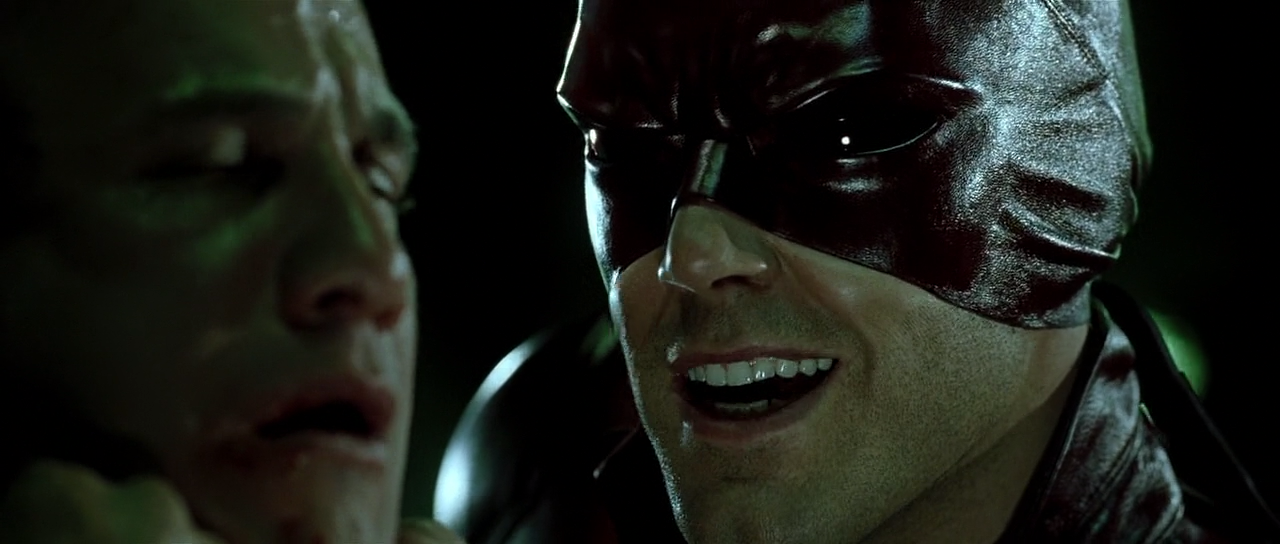
REVIEW: Daredevil (2004 Director's Cut)


Seeing how Marvel's Daredevil series premiered on Netflix last week, I thought it only fitting to revisit 2003's Daredevil, starring Ben Affleck. I remember watching the theatrical cut as a kid and not really knowing what to make of it; all I knew about Daredevil, I learned from times he'd teamed up with Spider-Man. He was blind, saw using a sort of radar sense, and carried around a billy club/grappling hook. Having come out in the Marvel superhero boom of the early 2000's, Daredevil is a lot darker than your standard Marvel fare like Spider-Man and X-Men, both literally and figuratively. It didn't leave much of an impression on me back then and I always figured it was just another crummy adaptation; which is why I was surprised to hear a while back that the R-rated director's cut (released in 2004) was apparently far superior to the original product. Admittedly, that's not saying much, but I feel as though this version still deserves a watch.

The plot is about as basic as they come; Ben Affleck plays Matt Murdock, a blind lawyer who moonlights as a satan-themed vigilante named Daredevil. He finds love in the form of a billionaire's daughter by the name of Elektra Natchios (Jennifer Garner) and goes up against the criminal forces of the Kingpin (Michael Clarke Duncan) and Bullseye (Collin Farrell). Some people die, there's a few fights, and it's all over in about two hours. The plot's nothing special, but it never really drags, so I'm in no position to complain. I wasn't impressed, but I certainly wasn't bored.


The interesting thing about this movie that I noticed right away is just how consistently inconsistent it is. For literally its entire runtime, it flip-flops between actually being legitimately good to being unintentionally hilarious. Take the beginning, for example. We get a really nicely put together look at Matt's childhood; it establishes his relationship with his father, his moral code, and the whole reason he was blinded in the first place. It's well shot and, for the most part, well acted. But then we get a scene where young Matt fights a group of bullies by whapping them with his walking stick. Later on, when he's all grown up and flipping around as Daredevil, he goes to a biker bar in order to enact justice on a rapist who got off scott-free. This sounds like a really cool premise, except that the biker bar in question looks like the Ninja Turtles will bust in at any moment to fight the Foot Clan. When the thugs notice Daredevil just hanging out in the rafters and ask what he wants, he replies "JUSTICE" in his best Batman voice and proceeds to kick a little butt. It's a really cool fight scene (he surfs down a flight of stairs on top of an unconscious perp, for God's sake), but there's little odd moments that break up the impressive stuff with something completely laughable. Even in the climax (which is honestly fantastic), where Ol' Hornhead is beating on the Kingpin. He's about to finish him off when he stops; "I'm not the bad guy", he says. This is literally less than ten minutes after Daredevil picked up a man who was on his knees, pleading for mercy, flung him through a stained-glass window, and made a little quip as he landed head-first on the hood of a car at least two stories below. The movie fluctuates from something legitimately good to complete and utter schlock so often it's downright fascinating.


Speaking of fascinating, I happened to notice that nearly every character who isn't adapted from the comics is just named after someone who worked at Marvel; there's Lee, Kirby, Romita, Millar, Quesada (just to name a few). I wonder how Joe Quesada felt about having his name assigned to a character who gloats about the fact that he was acquitted of rape, only to be murdered by a subway train a few minutes later. If I ever meet Mr. Quesada at a convention, I'll be sure to ask him.

But anyways, in the supporting cast we've got Happy Hogan himself, Jon Favreau as Foggy Nelson; honestly, he and Affleck have some legitimately good chemistry. The scenes they share are very obviously the "comedic" moments in between all the punching and Evanescence, but Favreau is good at what he does in this role. Unfortunately, the same cannot be said for Jennifer Garner. I honestly couldn't care less about her romance with Ben Affleck and as a result, felt next to nothing at the various emotional beats sprinkled throughout. I know that the two are married in real life, so this is especially unfortunate, but I'm just calling it like I see it; the romantic subplot in this movie is kinda garbage. Luckily, we don't need to care about the romance; it's a pittance compared to what I believe to be two of the most underrated villain performances ever committed to a film adaptation of a comic book.


Collin Farrell and Michael Clarke Duncan completely steal the show here; if there's one thing director Mark Johnson understood about the source material, it's the villains. Duncan's Kingpin is honestly the reason I felt so underwhelmed by Vincent D'Onofrio's turn in the recent Netflix series; this version of Wilson Fisk is a classic crime lord, raised in the Bronx, only to end up with all of New York City deep in his pocket. The very first time we're introduced to him, he's smoking a massive cigar in his office while Lapdance by N.E.R.D. blares in the background. The man exudes class, affluence, and influence. He can go from smooth and confident one second to raging and violent in the next. Underneath his pressed suit is a solid wall of muscle; he feels threatening and in control no matter what he's doing. On the other side is Farrell's Bullseye; the character in the comics has three basic traits that need to be retained in any adaptation. The first, he never misses. Second, he's almost comically Irish. Third, he's completely and utterly insane. Collin Farrell cranks all three of those traits up to eleven and the result is an utter joy to watch. He's a villain who absolutely loves what he does, and what he does is kill people in really showy, impressive ways. He's good at it and it gives him purpose. Villains who are sympathetic and relatable are all well and good, but there's something I love about a complete and utter bastard who just loves being a complete and utter bastard.


On the technical side, we get some really good cinematography for the most part; I can appreciate that the people behind this tried to make it something more than just another superhero blockbuster. For instance, there's a scene in which Daredevil chases down a crook and starts beating on him, only to notice the thug's son cowering in fear, terrified that Matt will turn his wrath on him. Just as Matt saw his dad suffer for getting involved with organized crime, now this kid gets to watch his father be beaten for working for the wrong guy. It gives him a good motivation to go after the Kingpin; it's not just that he's a big bad evil guy. Fisk's influence has poisoned the lifeblood of Murdock's neighborhood; this is why Daredevil does what he does. The way his radar-sense is portrayed is pretty neat too; we get to see things through Matt's eyes, watching sound waves ping across an environment, tracing out a sonar map. When the sound changes, so does his view of the world around him. It's a neat visual trick that helps make some moments have a little more impact that they would have had if they were shot normally. All that said, this is a movie from 2003; the action is for the most part pretty great, except for when Ben Affleck turns into a computer-generated puppet-man, flipping and flopping across rooftops and fire escapes. The soundtrack is painfully dated as well; the orchestrated stuff is fine, but the abundance of licensed early 2000's tween-metal is just insufferable. There's a training montage set to Evanescence's Bring Me To Life that is played 100% straight. That should sum up the state of the music in this film perfectly (though the songs that introduce Kingpin and Bullseye are both superb).

All in all, Daredevil is an interesting film. It's not exactly good overall, but that doesn't mean that there's nothing of value to be found. Michael Clarke Duncan and Collin Farrell are worth the price of admission alone, and there's enough stuff here that manages to be either legitimately cool or hilariously terrible that I was never really bored while watching it (which is better than I can say for some of the other things I've watched for this site). If you like the comics (or *gag* Evanescence) or you want to see an oddball leftover from the early days of Marvel movies (before the unstoppable juggernaut we know as the MCU was even a twinkle in Kevin Feige's eye), grab yourself a copy of the director's cut and give it a watch.

April 11, 2015

REVIEW: Marvel's Daredevil


After a great deal of anticipation, Marvel Studios has finally released the first of their 2015 offerings in the form of Daredevil, a series distributed through Netflix which ties into the ongoing Marvel Cinematic Universe. The series was promised to show a darker side of the world we see on screen, one that is fairly disconnected from the whiz-bang adventures of Iron Man and Captain America; having watched the entire thing, I can safely say that Drew Goddard and crew have definitely kept that promise. Anyone who was worried that Daredevil would be dumbed down for a wider audience, relying on references to the movies in order to stay relevant (like ABC's Agents of SHIELD) should be pleasantly surprised; this is a show that exists in the same world as Hulk and Groot, yet manages to be its own totally grounded thing.

The premise of the series revolves around Matt Murdock (Charlie Cox); blinded as a child, he is trained to use his heightened senses to his advantage. Donning a mask, he sets out to clean up his city as the vigilante known as Daredevil. By day, he is a lawyer alongside his best friend and business partner, Foggy Nelson (Elden Henson). The two set up shop in their childhood home of Hell's Kitchen, a seedy section of NYC that has fallen on particularly hard times following the Chituari invasion in The Avengers. Leading the cleanup effort is Wilson Fisk (Vincent D'Onofrio), better known to comic fans as the Kingpin of Crime. A shadowy crime lord/businessman, Fisk seeks to rebuild the city he grew up in into his own ideal vision, even if that means destroying the old one in the process. After defending a young woman by the name of Karen Page (Deborah Ann Woll), Murdock sets out to expose Fisk for the monster he is, dismantling his criminal empire bit by bit.


One thing that should be known before diving into this series is that this is not a show that follows a "character of the day" format. There are no appearances from Bullseye, Elektra, or Stilt-Man. This series is a thirteen episode-long origin story. Not just for Daredevil, but also for Wilson Fisk. D'Onofrio gives an interesting performance; this version of the Kingpin is a far cry from Michael Clarke Duncan's intimidating wall of muscle. Here we see Fisk as he first emerges into the public eye; he's essentially an extremely powerful child, unaccustomed to social situations. He's quiet, reserved, and awkward until he flies into a sudden fit of rage. This is a villain that feels very strongly and reacts in turn. That said, those looking for the confident, self-assured crime lord found in the comics will be disappointed; it isn't until the last episode that Daredevil appears in the iconic red suit and it isn't until the last episode that you really feel as though the Kingpin on screen is the same character as the one from the comics. As I said, it's an origin story in every sense of the word; a preamble to something bigger. It's a double-edged sword; on one hand, it's a bit of a cop-out that it ends just as it sets the stage for something bigger and better. On the other hand, the entire season was spent establishing characters, fleshing out their personalities, and building the world. There are some moments that don't relate directly to the plot, but it's hardly fair to call these moments filler, since they give us more time to get a feel for this cast of characters and how different an environment Hell's Kitchen is compared to Avenger's Tower (which doesn't appear in the skyline even once). To put it simply, this entire season feels like one long pilot.


Special consideration must be given to the action in this show; there are no alien lasers or vibranium shields to be found here. Every fight scene is impressive as it is brutal. If there was a Daredevil Drinking Game, it would definitely involve taking a sip every time Matt Murdock does a flip-kick or every time a bone pops out of a limb. This is precisely what I wanted out of this kind of series; while Thor is fighting frost giants and Captain America is punching techno-Nazis, characters like Daredevil are beating up junkies, rapists, and human traffickers. Hell's Kitchen is the seedy underbelly in which colorful costumed heroes are seldom found; it creates a stellar contrast to the dynamic adventures we see in theaters. One fight scene in particular is utterly spectacular, consisting of one, unbroken shot as the camera simply pans around a dumpy hallway. This happens relatively early on in the series, so it's a shame that we don't really get anything this impressive for the rest of the series (though several fights come close, especially if they involve Wilson Fisk).


The cast all play their parts well. Cox is likable and nuanced as Matt Murdock (I particularly enjoy his discussions with Father Lantom, played by Peter McRobbie). Elden Henson's Foggy Nelson manages to be both good comedic relief and an actual character; something that is sadly rare to find in the role of "not as good looking best friend to the protagonist" these days. Vondie Curtis-Hall joins the supporting cast early on as Ben Urich, a reporter for The New York Bulletin (sadly, The Daily Bugle is never mentioned) who works with Karen Page to dig up dirt on both Fisk's operation and his past. The role of the old reporter looking to make a difference in the world of fluff pieces is hardly a new convention, but Curtis-Hall makes Ben into a really enjoyable character, struggling between doing what he knows is right and what he feels is best for himself and his family. Rosario Dawson appears as Claire Temple, an ER nurse who tends to Murdock's wounds after his daring escapades; truthfully, I feel as though she didn't appear nearly as much as she should have. Her character explores some interesting themes in her first appearance, yet disappears less than halfway through the season, only to briefly show up later. Other highlights to the ensemble include Toby Leonard Moore as Wesley, Fisk's right hand man, Scott Glenn as Stick, the enigmatic blind man who trained Matt as a child, and John Patrick Hayden as Matt's father, Battlin' Jack Murdock. Out of a cast of enjoyable performances, I feel as though these three in particular did excellent work that I hope to see more of in Season 2.


While the entire thing feels like it's building to a payoff that we won't get to see until later, Daredevil definitely did not feel like a waste of time. It's full of twists and turns and brilliant little moments that I feel fills the gap for something a little more subtle and nuanced that has been missing from the MCU. It not only helps round out the world that has been established by the dozen or so blockbuster movies, it also stands alone as its own perfectly competent production. For anyone looking for something a little different than the usual superhero offerings from Marvel Studios, I highly recommend you take thirteen hours and give Daredevil a watch; just be prepared to be left wanting to see more.