Showing posts with label rom-com. Show all posts

August 27, 2018

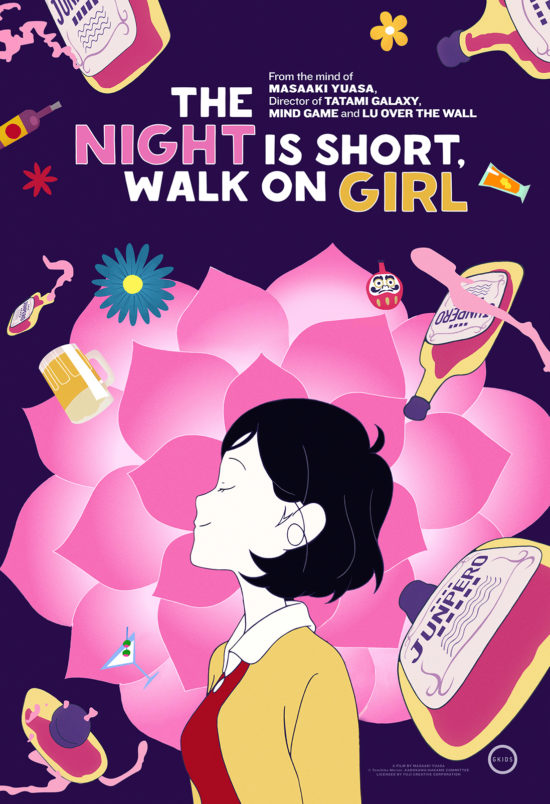
REVIEW: The Night is Short, Walk On Girl


For as much as I like to say I enjoy anime, the irrefutable truth of the matter is that I'm basically just a novice; I've watched Fooli Cooli and Gurren Lagann  a couple of times and I'm currently enjoying My Hero Academia, but it's safe to say that there are vast parts of the medium that I still need to explore. I was, for example, completely unfamiliar with the work of Masaaki Yuasa; that is, until I decided to check out The Night is Short, Walk On Girl (loosely adapted from the Japanese novel of the same name). I saw the trailer on Facebook just by chance (or perhaps it was fate), but the fluid animation, whimsical art design, and catchy music told me that I just had to go check this one out (especially since it would be in US theaters for two nights only). 90 minutes later and I'm not only convinced that I need to seek out the rest of Yuasa's work, but that The Night is Short, Walk On Girl is my personal pick for the best movie of 2018 (even though it was technically released in 2017, though only in the UK and its native Japan).

The plot is, shall we say, difficult to describe. This is one of those situations where I feel as though I'd be walking a fine line between describing the premise and simply recounting every scene; it's very much like Alice in Wonderland or The Wizard of Oz, where our protagonists move from situation to situation, encountering a host of unique characters as they go on their journey. The film follows a nameless girl with black hair (typically just referred to as Otome, the Japanese word for "maiden", and voiced by Kana Hanazawa) on a night of heavy-drinking through Kyoto. Meanwhile, a similarly nameless classmate of Otome's (referred to as Senpai, voiced by Gen Hoshino) is determined to confess his feelings towards her on this fatefull night. As he explains, he's implemented a long-term plan of crossing paths with Otome as often as he can manage, under the guise of their encounters being sheer coincidence. When the time is right, he will reveal his true intentions and it will seem as if the two had always been intertwined by the red string of fate. What follows is a delightfully charming, psychadelic rom-com that utterly annihilated my expectations in the best sort of way. This is just one of those movies that feels like a vivid dream, boasting the kind of atmosphere I'd like to curl up inside of for the rest of my life.


While the movie is, aesthetically-speaking, undeniably gorgeous, the real draw for me was the thematic subtext underneath it all. This is one of those films that focuses in on that sort of "quarter-life crisis" that twenty-something college students tend to go through. We've seen so many coming-of-age stories, but what happens after the protagonists have already grown up before the plot truly began? We're told from high school onward that we're "young adults", but that feeling honestly didn't kick in for me until after I'd completed my undergrad, got a job, and moved into a place of my own. For those who go right from high school into college, the question of what comes after is something that really starts to weigh on you after you get acclimated. We act like the transition from high school senior to college freshman is a massive change, but it's really nothing compared to spending the first 22 years of one's life adhering to a more or less consistent system of schooling and socializing, only to finally cross the finish line into the stage of your life when you have to start thinking about taxes and rent and insurance. You get your degree, then what comes next? Graduate school? A career? Or just another job to pay the bills? Should you get married? Start a family? Buy a house? Do you even have the means to do any of those things? These are all the questions you start to mull over as you begin to fully and finally transition into the adult world, and said questions tend to weigh heavily on the minds of chronic over-thinkers like Senpai (or myself, for that matter).


The character of Senpai manages to transcend the usual "awkward nerd who's hopelessly smitten with the girl of his dreams" trappings by really delving into his mindset. He isn't just another gawky buffoon in pursuit of his manic pixie dreamgirl; he's insecure to the point that he outright questions if he even deserves to have his insane plan work out, or if it would be more fitting that he just shrivel up and die alone. He's become accustomed to failure, putting up walls to protect himself from the terrifying idea of what might happen if he actually gets what he wants for once, the only outcome he's completely unprepared for. Otome, meanwhile, is in the exact opposite situation; she's naturally talented at everything she tries, resolved to simply go with the flow and see where the night takes her. While she hardly has to put in any effort in order for things to go her way, she's left with a life that, compared to Senpai, lacks any semblance of drive, ambition, or purpose. The film establishes that her easy-breezy attitude towards life tends to leave those around her in the dust, leaving her with her own kind of loneliness to deal with. They're two sides of the same coin, yin and yang, but that doesn't mean they don't need to grow and change in their own ways before they're fit to be together.

The film hypothesizes that who we are is but an amalgamation of those we meet in life; whether we know them for the rest of our days or just for one drunken evening, the impact and influence they leave us with is what determines who we are and how we grow as people. The emotions these people inspire and the stories they leave us with are the things that life is made of. Feelings of isolation, loneliness, and disassociation are hardly rare for young people, especially those who find themselves in the midst of a great transitory period in their lives, and The Night is Short, Walk On Girl goes to great lengths to remind us that no man is an island. Whether you believe in fate or not, your existence is immutably intertwined with those around you (and even those you've yet to meet). We're all players in the funny, tragic, oddball play that is the human race; everyone matters, no one is truly alone, and happiness will always inevitably win out over nihilism.


Although it's obvious that the underlying motifs this movie set forth resonated with me on a deep emotional level, I want to make it clear how much I adored everything else in this movie. Like I said before, the animation is absolutely stunning (putting Masaaki Yuasa on my radar in a big way) and I really love the use of color and sound to establish a sensory experience that's at the same time fantastical and immersive. As the night goes on, an entire year seems to pass; we begin on a warm spring evening, transition into summer heat, and by the time the climax rolls around, all of Kyoto is stuck inside with the flu as unforgiving winds and snow rip through the empty city streets. I also found myself surprisingly invested in the stories of the various side-characters Otome and Senpai come across, absurd as they are. My personal favorite would have to be Don Underpants ( Ryûji Akiyama), a writer and hopeless romantic who has pledged to not change his underwear until he reconnects with a girl he had a fated encounter with some time ago. At first we assume he's just there for a one-off joke about his self-appointed nickname, but then he shows up again much later on, setting up guerrilla plays at the student festival as a means of attracting his mystery love's attention. These side-characters are all bit players compared to our two main leads, but their stories are told in such a way that it truly feels as though the plot thread doesn't end the moment they walk off-screen. We really get the feeling that this isn't just an extraordinary night for Senpai and Otome; everyone has their tale to tell, and that's really the entire message of this movie in a nutshell.


The Night is Short, Walk On Girl is really just a remarkable little movie. It's a surprisingly conventional, feel-good love story that's conveyed in the most unconventional of ways; pair that with sublime animation, supremely comfy atmosphere, a killer soundtrack, and loads of endearing and memorable characters, and you've got a winning recipe for my personal favorite movie of 2018 thus far. Yes, I know, it technically came out in 2017 everywhere but the USA, but I'd be outright lying if I said that, out of everything I've seen in theaters this year, The Night is Short, Walk On Girl wasn't my favorite. If it wasn't clear already, I absolutely adore this lovely, lovely film and would like nothing more than to just immerse myself in all the charm and good vibes it's constantly putting out. If you're a fan of anime or animation in general, you owe it to yourself to give this one a watch.

July 15, 2017

REVIEW: The Spectacular Spider-Man


Everyone has experienced the kind of pain I'm about to share with you all. That hopeless longing for the one that got away; that one perfect show that was mercilessly struck down in its prime. Plotlines left unresolved, questions left unanswered, so much potential gone right down the drain. And even though it hurts to remember that such a great story is left without an ending, you keep coming back, again and again, because even though it's unfinished, it's just that good. Everyone has that one show; so what was her name? For me, it was a little cartoon by the name of The Spectacular Spider-Man. It premiered back in March of 2008, on the CW's Kids' WB block before moving to Disney XD after the Marvel acquisition of 2009 (more on that later).

It had been five years since the last animated Spider-Man show (MTV's more teen-oriented take, starring Neil Patrick Harris) and nearly a decade since the classic "spider blood, spider blood, radioactive spider blood" Spider-Man of the late 90's; the webhead was due for a return. Enter Greg Weisman, of Disney's Gargoyles fame. Together with his crew, they set out to make the definitive Spider-Man cartoon, blending elements from classic Lee/Romita/Ditko storylines with the contemporary works of the Ultimate universe. The end result is exactly what they were going for; this is, unquestionably, the best Spider-Man adaptation of all time. If you'll allow me to gush further, I'll be happy to explain why.


Internally, the series was referred to as "the education of Peter Parker", with episodes taking the name of subjects from highschool classes (the first arc, comprised of the episodes Survival of the Fittest, Interactions, and Natural Selection all fall under Biology 101, for example). This approach had a dual meaning, however, as the series not only follows Peter trying to learn and grow as a human being, but as a superhero as well. This is a Spider-Man who, despite his inherent cleverness and upstanding nature, still makes mistakes from time to time, some as simple as missing curfew, others as severe as indirectly giving rise to villains such as Electro and Venom. He's flawed, but he's not hopeless, we sympathize with Peter because he has more on his plate than anyone his age should be expected to handle. It's a classic element of the Spider-Man character and the show goes out of its way to throw us one emotional curveball after another, to the point that the more reserved character drama of Peter's highschool life can at times become more engaging than the slickly-animated action sequences.


The show manages to strike the perfect balance between fresh and innovative and the kind of classic storytelling one might expect from a Spider-Man show. There's a clear reverence for the source material, namely the old-school Amazing Spider-Man comics of the 60's and 70's, yet certain elements (such as the roles, personalities, and ethnicities of the supporting cast) are updated for the modern era, all while keeping the spirit of those classic comics very much alive. As the show's producers put it, "we tried to follow what we came to call "The Five Cs": Contemporary, Cohesive, Coherent, Classic and iConic." Through the benefit of hindsight, the showrunners were able to look back on the decades of Spider-Man stories and determine what was truly essential, boiling down the myriad interpretations of each and every character into their base essence. The result is a concentrated bomb of spider-goodness; despite the modern approach to these classic characters and scenarios, everything feels exactly as it should be. Seldom does an adaptation truly "get" its source material as well as with Spectacular; it's a show that prioritized understanding the tone and characterization of what it was working with, and the result is, well, spectacular.

That said, the show's strengths don't exclusively lie in the realm of engaging characters and plotlines. The art direction (care of Sean "Cheeks" Galloway) lends the show a very smooth, stylized art style that animates superbly well. Spider-Man feels far more lithe and flexible than he ever has before, so the moments where the action ramps up truly feel (as clichéd as this comparison is) like the panels of a comic book brought to life, full of energy and excitement. This is helped along by a superb vocal cast, namely Josh Keaton as Peter Parker. I may alienate some people when I say that Keaton is, without a doubt, the superior Spider-Man. As Kevin Conroy is to Batman, so is Josh Keaton to the webhead. His is a voice that will invade your head whenever you read a Spider-Man comic (or at the very least, one set during Peter's high school years). The rest of the cast is a veritable who's-who of voice acting talent; Clancy Brown, John DiMaggio, Lacey Chabert, Kevin Michael Richardson, Daran Norris, Ben Diskin, Steve Blum, and even the likes of Peter MacNicol, Robert Englund, Keith David, and Ed Asner. Each voice is utterly perfect, further cementing that original vision of making the definitive Spider-Man show. There's also the show's habit of constantly tossing hints and teasers at more comic-savvy viewers; frequently, villains will appear ahead of time in their civilian guise, doing whatever it is they do before the horrible accident that condemns them to a life of villainy. It's touches like these that really make the show feel alive, as though episodes don't necessarily start and end with the supremely catchy theme song. Even aside from being an amazing Spider-Man show, Spectacular ends up being an amazing show, period.

So what happened?


In December of 2009, the Walt Disney Company purchased Marvel Entertainment for the whopping sum of $4.24 billion. Given Marvel's (still to this day) tricky web of broadcasting and distribution rights among its myriad properties, the film and television rights for Spider-Man remained in the hands of Sony. Although Spectacular Spider-Man was critically-acclaimed and saw financial success through the sale of toys and home video releases, Sony relinquished the television rights to Spidey back to Marvel, in exchange for a hefty cash settlement. However, the specific rights to Spectacular remained with Sony, leaving either company unable to continue the series in any way, shape, or form. Disney would eventually go on to create their own Spider-Man cartoon in the form of Disney's Marvel's Ultimate Spider-Man, a disgustingly low-effort 20-minute toy commercial that served to do nothing but remind us what we had lost with Spectacular


As it stands, it seems as though the show will never again see any kind of continuation. Despite a strong cult following and the support of an enthusiastic crew, it's unlikely we'll see the likes of Spectacular Spider-Man ever again. Then again, Samurai Jack just wrapped up its fifth season after a twelve-year hiatus, and Young Justice (also from Weisman) is poised to return in 2018 on a new DC streaming platform; anything is possible. In the meantime, I highly recommend picking up the Blu-Ray box set of the complete series; unless a revival is seen as profitable, there's no reason for anyone, whether it be Sony or Disney, to go through the trouble of giving us a continuation. At the end of the day, we got less than half of what we were supposed to with Spectacular Spider-Man; the only upside of having so little time with this series is that 100% of it is pure quality. Some have compared this to Batman The Animated Series, saying it's nearly as good; I'd go as far to say it's even better, seeing as how Spectacular doesn't have a single episode like I've Got Batman in My Basement. The show starts out solid, but truly picks up once the Green Goblin is introduced in episode 7. From that point on, it's nothing but pure, unadulterated nirvana for Spider-Man fanatics like myself. Take it from me, if you consider yourself a fan of the wall-crawler in any capacity, there's exactly zero reasons not to seek this show out immediately. 'Nuff said!

November 25, 2016

REVIEW: Snow Day


There was a time when Nickelodeon was the undisputed king of children's programming. It was the first major network devoted entirely to kids and, at the time, it wasn't a stretch to say it was the best. While my mind may be somewhat clouded by nostalgia, conjuring visions of green slime and elusive magazine subscriptions, it's still safe to say that the late 90's boasted a pretty objectionably excellent lineup of programming on Nick. We saw the rise of Spongebob Squarepants (before it became the shambling corpse it is today), as well as classic shows like Hey Arnold, Rugrats, KaBlam!!, and Rocko's Modern Life. There were so many strong, recognizable properties they had to work with back in the day, which is why I'm utterly confused as to why Nickelodeon Films decided to make a movie like Snow Day; a film that can't decide which demographic it wants to appeal to. In the end, it chooses to appeal to no one.

The movie, as the title implies, takes place on a snow day and follows the members of the Brandston family. Teenage son Hal (Mark Webber) is a high school loser who pitifully stalks the most popular girl in school in hopes that she'll come around and start dating him. The dad, Tom (Chevy Chase), is a small-time weather man hoping to one-up his eternal rival, Chad Symmonz (John Schneider). Meanwhile, the middle child, Natalie (Zena Grey) teams up with her friends to try and take down the notorious Snowplowman (Chris Elliot), bane of children and destroyer of snow days. The whole time this is all going on, workaholic mom Laura (Jean Smart) is stuck at home with her energetic toddler, snowed in and unable to get to the office to finalize her big business deal. If you think this sounds like a half dozen movies all crammed into one, you'd be exactly right. It's an absolute mess that tries to act like a sampler platter of plots, but botches the execution spectacularly.


The first thing that's worth noting is the odd sort of mysticism that the movie tries to assign to the idea of a snow day. Maybe I was just a social pariah as a kid, but snow days weren't particularly "magical" when I was little; it was just a lucky occurrence where I got to miss school and pelt hunks of ice at passing FedEx trucks with my friends. The movie is constantly reminding us that "anything can happen on a snow day", as if it's the passing of some sort of millennium comet that was predicted by ancient soothsayers. In the world of this movie, a snow day basically means society pauses for 24 hours, allowing adults, teens, and children alike to hit the streets and frolic through the powder like a department store Christmas display. The only context in which this idea sort of works is found with the Snowplowman story; the film's director, Chris Koch, also worked on The Adventures of Pete & Pete, and that influence is felt strongest in this plot line. If the entire movie possessed that uniquely Nickelodeon brand of kidlike absurdity, it all just might have worked. Unfortunately, every other character's story is totally mundane in the worst kind of way.


Hal's story is a crash course of every lazy highschool cliché in the book. Dorky loser wants to get with unattainable popular girl. Popular girl has rich jerk boyfriend. Dorky loser ends up with modestly attractive gal pal who was right in front of him all along. They kiss, roll credits. The only remotely memorable thing about this plot is the popular girl's choice in wardrobe (which, in all honesty, makes me wonder how this managed to keep a PG rating). Meanwhile, the mom's story is practically nonexistant. We get glimpses into her day every now and then, basically just to see her try and get work done while her worryingly rambunctious toddler interrupts with comic hijinks. I'm all for togetherness and familial bonding, but some things just take precedent over frolicking in a winter wonderland. The kid is completely in the wrong here, no matter what the film says. He strips down to his skivvies, makes his mom drop her phone in a snowbank during an important conference call, and doesn't receive so much as a stern talking to. The woman is trying to put bread on the table and this kid has exactly no respect for that. Why he couldn't just play in the snow with his sister (or why the mom couldn't just get a sitter for an afternoon), I'll never know.


Chevy Chase's story is literally just the continuing adventures of Clark Griswold. Chevy Chase feels underappreciated at his job, does stupid, pigheaded things to get his dues, suffers comic consequences, and finally earns the recognition he deserves. Do you see the recurring theme of "character wants end goal, scenes happen, character gets what they want"? The most interesting story by far is Natalie's war against Snowplowman; why the movie wasn't entirely about that, I have no idea. The film spreads itself way too thin in trying to appeal to everyone, sacrificing the elements of it that had the potential to be fun. I'd really like to hear about the making of this movie, since I refuse to believe that it was anything but the Snowplowman story to begin with. The additional plots positively reek of executive meddling, attempting to rope in more demographics aside from the Salute Your Shorts crowd. Really, an anthology following a group of characters in different age groups with different problems on a snow day is an idea that has legs, but it doesn't amount to much when the execution is so horrendously botched as it is here.


Snow Day is just a bland, bad, forgettable movie. Parents won't like it because of all the annoying kid stuff. Kids won't like it because of all the boring grown-up stuff. Teens won't like it because the romance is shallow, juvenile, and at times really creepy. The only positive things about it are a pretty fun Iggy Pop cameo and Snowplowman; Chris Elliot is acting to the rafters and his entire character feels like something in the same wheelhouse as The Beast from The Sandlot. Again, maybe if the Snowplowman story had been the entire film, we'd have had something here. Unfortunately, we instead have a half-baked hodgepodge of genres that doesn't result in anything worth remembering. Apologies to my mom for renting this endlessly from Blockbuster. Upon rewatching it, I really don't know what I ever saw in this that required more than one viewing, but yet here I am. I guess anything really can happen on a snow day.

November 3, 2016

REVIEW: Tangled


With Moana right around the corner, it seemed an ideal time to explore a modern animated Disney film that I had somehow never bothered to watch up until just now. To be perfectly honest, Tangled hit theaters when I really couldn't have cared less what was coming out of the Disney Animation Studios; direct-to-video sequels were being pumped out at every turn and their theatrical efforts by and large struggled to fill the shoes of the classics that had come before. The Renaissance had ended and Disney found itself somehow reverted to the Dark Ages. Perhaps a bit hyperbolic (considering this era gave us quality films like The Princess and The Frog and, I can't believe I'm saying this, Cinderella 3: A Twist in Time), but one only has to compare a movie like Chicken Little to a movie like Mulan to get an idea of how the studio had changed over a few short years. It may seem shocking, considering it's been three years since Frozen was released and we still can't seem to let it go, but it wasn't long ago that the prospect of a new Disney film wasn't all that exciting. Pixar figurehead John Lasseter was put in charge of Disney Animation in 2006, signaling a turnaround in the studio's output. While The Princess and The Frog was Disney's true contemporary return to form, it was the studio's next film, Tangled, that is often credited with kickstarting the new Disney Renaissance.


Originally titled Rapunzel Unbraided, the film's name was changed to better represent the story's dual protagonists (as well as to appeal to the young male demographic that would later motivate the House of Mouse to spend several billion dollars acquiring Marvel and Lucasfilm). Kidnapped as a baby and confined to a tower for her entire life, Princess Rapunzel (Mandy Moore) longs to see and explore the outside world. She ends up crossing paths with one Flynn Rider (Zachary Levi), a would-be dashing rogue on the run from the royal guard after a daring heist. He finds himself shanghaied into helping the young princess escape her confinement to see the annual lantern festival in a nearby kingdom. Meanwhile, the duo are pursued by the sinister Mother Gothel (Donna Murphy), a conceited witch who wishes to keep Rapunzel imprisoned forever, so that she may use the girl's magical hair to continually grant herself eternal youth.

While the concept of "spunky girl and tough guy with a heart of gold" is slowly becoming a recurring theme with modern Disney movies, the dynamic here between Rapunzel and Flynn is utterly delightful, making for plenty of Romancing the Stone-esque action and adventure. Both are endearing, capable characters in their own right, playing to each others strengths in every situation. They're a bonafide power couple; while their occasional use of modern slang can get a bit distracting, Moore and Levi's chemistry more than makes up for it in the long run. Theirs is a relatable, enjoyable romance that definitely sets the tone for films to come.


For me personally, the character who stole the show was Donna Murphy as Mother Gothel. Memorable villains are a trademark of Disney's animated features, and this is no exception; she's narcissistic, self-absorbed, and manipulating, playing an excellent foil to the naive-but-good-natured Rapunzel. Their dynamic is easily one of the most engaging aspects of the film; this isn't some ditzy girl falling for the villain's obvious scheme. For all intents and purposes, Gothel raised Rapunzel as if she were her own; it was far from an ideal upbringing, but we see Rapunzel struggle between feeding her own dreams and desires and betraying the closest thing to family she's ever known. We see her come to terms with the fact that their relationship is an abusive one and are able to sympathize with her plight. It's a more intimate, tighter-knit hero/villain relationship than one usually sees in movies like this. Maybe its because there's no climactic action sequence, maybe it's because the character gets nowhere near as much screentime as I would have liked, but I can't shake the feeling that Mother Gothel is one of the utmost underrated Disney villains of all time.


As strong as the characters are (make no mistake, they carry this movie), I can't help but feel left wanting in regards to the soundtrack. That's not to say any of the songs are bad (I honestly enjoyed all of them), it's just that there's not as many memorable numbers as one would expect from Disney regular, Alan Menkin. The majority of the songs here are merely passable; there's no Let It Go, no I'll Make a Man Out of You, no Part of Your World. The "main" song, I See the Light, is more or less a perfectly ordinary romantic duet, completely saved by the gorgeous lanterns sequence which accompanies it. That said, I did in particular enjoy I've Got a Dream, which conjured up distinct vibes reminiscent of Monty Python and the Holy Grail and Blazing Saddles. The best song by far, however, comes unsurprisingly from Donna Murphy. Mother Knows Best was written to be a Sondheim-esque broadway number, and it shows. Murphy utterly kills this track (in particular the reprise later on in the film), imbuing it with a passionate energy that's lacking from most of the other songs on display. The world went mad for Idina Menzel's vocals in Frozen, but I can't help but feel that Donna Murphy does just as good a job here, to say the very least.


While it stumbles occasionally, Tangled is still a delightful, charming, and thoroughly heartfelt film through and through. This is a Disney fairy tale at its finest, easily ranking among the studio's best work. As Disney made the transition to computer-generated animation, they felt the need to directly compete with Dreamworks' trendier, more sardonic offerings. This led to a number of oddball projects (like the aforementioned Chicken Little) that attempted to revamp the Disney brand into something hip and thoroughly modern. The Princess and The Frog symbolized a return to form, but Tangled is where the studio really found its footing in the modern era, embracing that classical Disney magic that never truly goes out of style. It's a feel-good timeless adventure that I truly regret not seeing in the theaters; if you somehow haven't watched it already, definitely check this one out.

July 11, 2016

REVIEW: Mike and Dave Need Wedding Dates


I was originally not going to even bother with a formal review of this movie. Seeing as how I'm a tremendous fan of the main cast, it seemed like a natural move to check it out, even though I really didn't know what to expect quality-wise as I bought my ticket. What followed was a pure and simple screwball comedy; subtle and nuanced it was most certainly not, but damned if I wasn't laughing like an idiot for most of the runtime.

The premise is just the kind of Hollywood absurd to perfectly compliment the personalities of our main characters. Twenty-something bros Mike and Dave Stangle (Adam Devine and Zac Efron) have a history of ruining family gatherings with their fratboy antics. In a desperate plea to keep them in line, their parents demand that they each bring a date to their sister's upcoming wedding in Hawaii (the logic here being that some nice, well-spoken ladies should keep the terrible twosome preoccupied so the event can go off without a hitch, rather than devolve into liquor-fueled debauchery). The brothers decide to create an ad on Craigslist, which attracts the attention of similarly immature gal pals Alice and Tatiana (Anna Kendrick and Aubrey Plaza); recently unemployed and looking for something fun to do, they decide to take on the guise of "good girls" in hopes of accompanying these two naive dopes on an all expenses paid trip to a tropical paradise. Naturally, they end up being chosen and hilarity ensues.


Really, the main reason I'd decided to write this review was because of an article in the New York Times by critic Manohla Dargis. Far be it from me, a humble blogger who makes minimum wage, to think that I have the expertise or experience to question the New York Times, but I found myself disagreeing pretty strongly with Ms. Dargis' review. It criticizes the plot (which is fair; it's as predictable as they come), but also cites the humor as being a series of "thuddingly leaden, patchily strung together bits in service to the underlying theme: Mike and Dave’s fear of sexualized women." The article goes on to state that the film is sexist in its depiction of women, though it doesn't really go into much detail how it does so. While there are a number of gags based around the immature bros' reactions to women embracing their sexuality (such as Mike's fairly justified horror at witnessing his little sister receive a particularly blissful massage from Kumail Nanjiani), I feel as though this is ignoring the greater themes of the movie; namely themes of insecurity and immaturity, and how these traits go hand-in-hand, regardless of one's gender.

Mike and Dave are not positive characters. Neither are Alice and Tatiana. They're impulsive, manipulative, excessively bohemian twenty-somethings with no real direction in their lives. Mike is subconsciously holding Dave back, insisting that he go into the liquor business with him under the guise of "bros sticking together" and Dave complies out of a sense of duty and gratitude towards his older sibling (despite his true passions lying in the realm of drawing and illustration). It's a similar situation with Kendrick and Plaza; Alice was left at the altar and Tatiana has assumed the role of her "you need to get your mind off him and have some fun" gal pal. Alice stays with Tatiana because living it up with her best friend keeps her mind off of the comically-painful ghosts of her past; meanwhile Tatiana subconsciously feeds off of Alice's vulnerability out of a desire to feel needed. The film shows two common examples of well-intentioned but toxic cycles that can emerge from the "bro/gal pal" dichotomy; in order to grow as people, it is sometimes necessary to break free from our comfort zones and take a long, hard look at ourselves. 


As horrible and selfish as these characters appear, this is of course a redemption arc (much like Scott Pilgrim); our protagonists start out wholly misguided, justifying their actions through a series of mental gymnastics, shifting the blame on everyone and everything but themselves. As immature as the humor is, the underlying theme shows that literally anyone can be a manipulative jerk, no matter how innocent or pure their intentions may be. Despite how transparently selfish their actions are, the main quartet all share the same flaw; at their core, they're wholly insecure and choose to cover up these insecurities with a litany of bombastic antics meant to enchant and delight those around them. In reality, these antics have exactly the opposite effect, but admitting that would mean coming to terms with ones own faults and flaws, which is something that these four simply cannot bring themselves to do. Truthfully, I feel as though the message of this movie is actually quite progressive, considering all the raunchy bro-humor found within; this is a movie that says that anyone can feel insecure and act immature as a result, regardless of gender. Toxic behaviors are not exclusive to guys OR gals; everyone has the potential to be a misguided jerk. It even ducks the Hollywood cliché of having our formerly fun-loving simpletons become bland, responsible adults in the end; by the time the credits roll, all four of our protagonists are still the goofball party animals we've come to know thus far, just with a much stronger sense of empathy and understanding for both themselves and those around them. It adopts an almost Cat in the Hat-esque message of "it's alright to have fun, so long as you aren't hurting anyone". The plot is predictable and pedestrian, but the message behind it is anything but.


I know I've said very little about the comedy in this comedy movie, but that's because there's honestly not much to say. Laughs came hard and consistently and I had a fantastic time with it. It feels as though at least half of the dialog was improvised to some degree (to the point that I could probably point out which scenes were scripted and which ones weren't), so if you're a fan of anyone in the main cast, you'll likely enjoy yourself. Comedy is a very hit-or-miss genre, depending on the viewer, but I found everyone here to have superb chemistry, bouncing an infinite number of quotable lines off one another at a rapid-fire pace. While the quartet of Devine, Efron, Kendrick, and Plaza definitely made this movie for me, I must also compliment Sugar Lyn Beard and Alice Wetterlund (who played Mike and Dave's sister Jeanie and cousin Terry, respectively); I'd never seen these actresses in anything before, but their hilarious performances definitely captured my attention here. Mike and Dave Need Wedding Dates is hardly groundbreaking or original, but at the end of the day, the default goal of a comedy is to illicit laughter from an audience. I can only speak for myself, but I found that it completely and utterly accomplished that goal. It's ribald and silly and I had a smile on my face the whole time, check it out.

February 18, 2016

REVIEW: Amélie


Amélie was one of those films that I knew absolutely nothing about, yet seemed to be ever present wherever I went. It's been on Netflix for as long as I can remember and it's never long before someone recommends it to me or cites it as one of their favorite movies. At long last, I took it upon my self to sit down and see what all the hubbub was about. What I watched turned out to be a thoroughly charming modern fairy tale that takes a unique look at the life of the time-honored role of the quirky misfit protagonist.

Taking place in 1997, our story follows one Amélie Poulain (Audrey Tautou), an introverted young woman living in Paris. Raised in a lonely environment by her eccentric parents, Amélie develops an active imagination, taking delight in life's small pleasures while not fully understanding the more pedestrian concerns of those around her. After uncovering an old box of toys stashed in her apartment by the previous tenant, she takes it upon herself to return the childhood mementos to their rightful owner. What begins as an isolated act of kindness becomes something of a personal crusade, as Amélie sets out to improve the lives of those around her by way of her unique brand of mischief, hoping to find happiness and meaning for herself in the process.


It's a truly charming setup that helps further what may be this movie's strongest suit; its dream-like atmosphere. The whimsical storyline compared with the gorgeous set-design, vibrant color scheme, and clever cinematography give the film a look and feeling all its own (a look that would eventually inspire the overall aesthetic of Pushing Daisies). From the second it begins, it grabs your attention and completely immerses you in a version of reality that is just slightly more fantastical than the one we already inhabit. Everything pops and falls into place just so, giving each environment its own feel and tone; from Amélie's musty, cluttered childhood home to the stuffy, emerald flat of the mean old greengrocer. It's difficult to properly sell a film's aesthetic without this becoming a bona-fide essay of sorts, so I'll simply say that this is a very cozy film; I foresee me revisiting this in the future, should I find myself laid up in bed with a particularly nasty cold.


Aside from the stunning visual design of this movie, I simply have to praise the substance that lies within. The character of Amélie is presented as a true outsider; while she enjoys people from time to time, she rarely feels a strong connection with anyone, save for a select few misfits like herself. Being homeschooled by a high-strung mother and distant father left her something of an introvert; she had no friends growing up and takes little pleasure in romantic relationships. However, despite her apparent happiness at the myriad simplicities of life, she feels as though something is missing. The fact stands that human beings are social creatures; we instinctively crave connection with one another in one form or another. Amélie is, at its heart, a film about a person looking to secure that connection despite her deep-rooted fear of abandonment.

For a majority of the film, Amélie is presented as something of a story-book character; she's quirky and clever in a way befitting that of Puss in Boots or Br'er Rabbit. It's only as the film goes on that we begin to identify with her as a human being. Despite her mischievous little plots and her uncanny ability to have such a powerful-yet-unseen impact on the lives of those around her, she still has hopes and desires and fears like the rest of us. There are a number of times in the film where her quest for happiness is entirely self-sabotaged; what appears at first to be cowardice or foolishness quickly becomes apparent as a very human vulnerability which we all share. It's a film that paints a portrait of a young lady who attempts to build a wall around herself. Even though this wall is built purely out of positivity and kind intentions, it is still merely an attempt to close herself off from the rest of the world for fear of being hurt. It's a story that shows us that anyone can have a monumental impact on a human life; and even so, we all have our own obstacles to scale which stand in the way of our own happiness.


Amélie is an absolute delight; with its engrossing visual design, utterly charming protagonist, and warm-blanket atmosphere, I can't help but recommend this quirky, unique fairy tale of a film. It's the kind of film that validates and invigorates you as you watch it and I honestly enjoyed about every moment of it. Check it out, turn on the subtitles, and settle in for a genuine feel-good experience.

December 10, 2015

REVIEW: A Very Murray Christmas


In recent years, Netflix has been working hard in establishing itself as a legitimate entertainment network, complete with original programming. However, one thing has been noticeably absent from the streaming service's lineup; an exclusive Christmas special. At long last, the gap has been filled with A Very Murray Christmas, Sofia Coppola's festive throwback to the variety shows of old. The question still stands, however; does A Very Murray Christmas have the chops to become a holiday staple? The answer is a resounding "eh, sorta".


The story begins promisingly enough; the city of New York is effectively closed for the holidays thanks to a raging Christmas Eve blizzard. With the streets deserted and the airports closed, there's hardly anyone to attend poor ol' Bill Murray's Christmas special, broadcasting live out of the Carlyle Hotel. It's a strong start; Bill Murray manages to embody pure loneliness and discomfort while still managing to elicit genuine laughs. It gives off the impression that this is going to be a sardonic, cynical Christmas special about making a terrible Christmas special. We get some excellent cameos from the likes of Amy Poehler, Michael Cera, and Chris Rock and the stage is set for a hilariously dour good time, packed to the brim with songs and tinsel. But then it moves into the second act and the tone takes an abrupt, sloppy 180 out of nowhere.


Once a power outage dashes any hopes of actually finishing the special, Bill Murray (along with his sidekick/musical accompaniment for the evening, Paul Shaffer) finds himself snowed in with everyone in the Carlyle's bar. Whereas the first act was dark and funny, the second act is essentially just twenty minutes of celebrity cameos and musical numbers framed around the plight of a young couple played by Jason Schwartzman and Rashida Jones. It's a tonal shift roughly equivalent to an episode of Louie suddenly diverting into A Muppet Christmas Carol; while it's not necessarily bad, it feels like an entirely different kind of special. Act One is Murray lamenting how alone he feels while forcing Chris Rock to engage in a stunning duet of "Do You Hear What I Hear". Act Two is him dispensing schmaltzy, saccharine wisdom in a dimly lit bar. There's no blending between the two, causing the whole thing to feel scattered and disorganized. It's not entirely without merit, seeing as how this segment contained my two favorite songs of the special (a cover of the Beach Boys' "Alone on Christmas Day" by the band Phoenix, and Maya Rudolph putting on a spectacular, powerful rendition of "Baby Please Come Home"), but if A Very Murray Christmas has a low point, it's definitely this.

Things are brought back into focus for the third act, which is composed of an absurd dream sequence featuring Miley Cyrus and George Clooney (the latter of whom got what may have been the biggest laugh of the evening, but I won't dare spoil it here); it feels like this is more in line with what the beginning set up so well, so it's a shame that everything in the in-between ended up plodding along as it did. It hooked me, lost me, then hooked me again, but by then it didn't matter because the special was already over.


A Very Murray Christmas is a perfectly adequate Christmas special. There are parts of it that are good and parts of it that are bad. Everyone seems to be having a nice enough time, turning in good performances, though nothing to write home about. While some of the songs end up feeling somewhat uninspired, there are a few musical numbers here that really steal the show, despite the fact that the cast features only a few celebrities known for their singing ability. A Very Murray Christmas is the kind of thing that manages to be just alright, not by being just alright consistently, but by either being quite good or quite bad in more or less equal amounts. In the end, it averages out to something totally, well, average. I've added a few of the songs to my Christmastime playlist and I absolutely adore that it references The Monument Men more than once, but I don't think this is one that I'm going to be revisiting next year.

September 17, 2015

REVIEW: Seeking A Friend For The End Of The World


It's a rare thing for a movie to illicit a physical emotional response out of me. I'm by no means made of stone, but there's a difference between something that's funny and something that makes me laugh, the same way there's a difference between something that's tragic or touching and something that actually makes me cry. Seeking A Friend For The End Of The World is a film that managed to do both before the credits rolled.

The film opens with a news report informing us of a massive meteor that is set to collide with Earth in a mere three weeks. The impact will end all life on the planet and people are reacting to the prospect of imminent doom better than one would imagine. This is the first little detail that I truly enjoyed about this movie; it's easily the most down-to-earth portrayal of the apocalypse that I've ever seen. Things don't go from "fine and dandy" to "Mad Max but somehow worse" within the span of a day; in the early stages, people even still attend their boring desk jobs, as evidenced with our protagonist, Dodge (Steve Carell). After his wife leaves him, he's left without purpose. The realization slowly sinks in that he is going to die alone and totally unfulfilled once the meteor hits. His outlook begins to change after he meets Penny (Keira Knightley), a neighbor from upstairs. She reveals that the mailman had been delivering Dodge's mail to her apartment for the past few months by mistake (she just hadn't gotten around to returning it yet). After finding a letter from Dodge's old high school sweetheart proclaiming that she still loves him, the two set out on a journey to reunite Dodge with the one that got away while at the same time attempting to reunite Penny with her family in England.


At its core, this is a simple roadtrip movie. A lonely sadsack and his optimistic friend race against time to get to an emotionally significant location, encountering all sorts of strange characters along the way. The thing that really makes this movie unique is the backdrop; it really plays around a lot with how different people react to the end of the world (the most pedestrian example being the riots that cause our protagonists to leave New York in the first place). Instead of killing each other and declaring martial law, mankind remains in some semblance of order (at least in the part of the world we see during the film). As the meteor approaches, people are let off of work, the police are more lax, the news stays on to give people updates. It's a very mellow kind of end that you really don't see that often in apocalypse movies. This is the kind of movie where doomed people do comical amounts of drugs and engage in casual sex rather than eat each other alive; it's both funny, refreshing, and interesting at the same time. It makes you wonder, what would you really be doing in a situation such as this? This is less armageddon and more Friday night; characters are either out engaging in shallow, overindulgent fun, or they're sitting at home, contemplating what remains of their life. The aspect of the ticking clock in this movie is unique, in that it's not some shallow plot device. If they arrive too late, the love of Dodge's life isn't going to marry some stuck-up rich guy or move to Europe; human existence will simply cease to be. They are given a time limit; once it expires, literally everything ends. As an audience, it's very easy to connect our own mortality with those of the characters on screen. It's a movie about people making the absolute best out of the absolute worst scenario possible.


The reason it works as well as it does is mostly in part to the performances of Steve Carell and Keira Knightley. I can't think of two actors who would be better suited to take on these roles; not that the characters are particularly unique in concept, but the chemistry on display between the two is what makes this film work as well as it does. The focus here isn't on the apocalypse; as interesting as that aspect is, it's merely the staging for these characters to work around. It's not a movie about the world ending so much as it is about the people who will be there when it does. The apocalypse is always shown in film as something in the far-off future, something we would never have to deal with. And even if there is something afterwards, there will definitely be survivors fit to go on all kinds of badass adventures. In this case, the end is here NOW, and as far as we know, there isn't anything afterwards. This is a film that says "here is the amount of time you and literally every other human on the planet has left, do what you will with it". The result of such a scenario manages to be a stellar mix between hilarious, touching, and heartbreaking.


Seeking A Friend For The End Of The World is a fantastic film that raises the question, "if it was all going to end tomorrow, would you be happy with your life?", before pointing out that, if the answer is "no", there's no time like the present to go out and fix it. It puts into perspective just how little time we have on this planet; as far as I'm concerned, the time I spent watching this movie was time well spent.

July 23, 2015

REVIEW: (500) Days of Summer


Director Marc Webb's (500) Days of Summer has become one of my absolute favorite movies of all time. I remember the first time I ever watched it, having been assigned the first fifteen minutes to watch as part of a course on media aesthetics. Ten minutes in, I decided I was seeing this through until the end, because never before had a movie grabbed my attention in such a way. This is a film that, for me, says all the right things at all the right moments. 

Told through a nonlinear narrative, we see Tom Hansen (Joseph Gordon-Levitt) fall head-over-heels for his coworker, Summer Finn (Zooey Deschanel); Tom is convinced he will never truly be happy until he finds "the one" while Summer, on the other hand, dislikes labels and doesn't believe in the concept of love. Naturally, they're headed for disaster; in the very beginning of the movie, we jump right to the moment in their relationship where Summer suggests the two of them stop seeing each other. From that point on, we get to see bit by bit how their relationship grew and changed to the point that it simply stopped existing all together. It's a brilliant way to tell a story such as this, since it manages to present the time-tested story of "boy meets girl" in a really unorthodox, cynical way, while at the same time managing to present an uplifting message. Had this been conveyed in chronological order, we'd get a depressing story about a happy relationship that falls apart, only for a hamfisted ray of false hope to attempt to lift the mood before it ends. When things are scattered around some, we know where everything is going right from the start, so the value lies more in finding out how things get to the point we know they end up at. It's a creative way to tell a basic story, allowing the fleshed-out, well-written characters to do all the heavy lifting.


In the starring roles we have Joseph Gordon-Levitt and Zooey Deschanel; they both work superbly together. Gordon-Levitt is able to fluctuate seamlessly between wide-eyed optimist and disheveled sad sack, depending on the point in time that the scene is focusing on. He's a wholly relatable guy whom we want to see succeed, even if all of his woe was brought on by his own poor judgement. Deschanel manages to be both down-to-earth and completely unattainable at the same time, a combination that works out perfectly for the character of Summer. I feel as though everyone has had a Summer in their life at some point, which really highlights what makes this movie work so well; it's extremely easy to align our own failed romantic experiences with those of the characters on screen. When you think about it, bad relationships are far more common than someone finding "the one". Because it's so relatable, it's that much easier to become invested on an emotional level.


In supporting roles, we have Clark Gregg as Vance (Tom's boss), Geoffery Arend as McKenzie (Tom's coworker), Matthew Gray Gubler as Paul (Tom's friend), and Chloë Grace Moretz as Rachel (Tom's little sister). While the main focus is clearly on Gordon-Levitt and Deschanel, all of these actors give stellar performances nonetheless. I especially enjoyed Clark Gregg's cheery, soft-spoken CEO of the greeting card company Tom works at; while all of these characters are funny, none of them are comic caricatures of real people. When Tom is hanging out with Paul and McKenzie, it sounds like a couple of twenty-something friends hanging out. When he discusses his relationship troubles with his sister, it sounds like two siblings trying to level with each other. This is thanks in part to the talented actors and also to the incredibly tight script. This movie is a well-oiled machine, in that all the components mesh seamlessly together to churn out a really impressive product.

I particularly enjoyed the message behind the movie as well. It's not entirely cynical, but it doesn't leave us with the same old fairy tale nonsense that so many romantic comedies rely on. It doesn't completely shut down the notion of believing in a one true love, but enforces the importance of having some backbone; Tom is clearly not entirely comfortable with his relationship with Summer, constantly wanting more despite her having told him that she's not interested in anything serious. In his eyes, once they reach a certain point, the wall will come down and they'll live happily ever after. He assumes everything will work out for the best because he projects everything he wants to see onto Summer; he clings to a few minor things they have in common, using that as justification for overlooking the fact that she is looking for something completely different than he is. They both enjoy The Smiths, so of course it's fate that they end up together. The two are flawed people who gravitate towards opposite, unhealthy extremes when it comes to relationships; in the end, they both discover that they were wrong. Summer is, for the most part, oblivious and selfish while Tom is far too eager to bend over backwards when faced with the slightest chance of finding "the one". It stresses how vital it is to look at things with some objective when dealing with matters of the heart; while it may hurt, it's sometimes necessary to admit that a situation isn't working out the way it was intended to. No life is free of pain or heartbreak, but that doesn't mean that it's not worth it to keep on trying.


(500) Days of Summer is a wonderful film and, in my opinion, one of the greatest stories about love ever told (since, as the opening narration points out, this is not a love story). It's shot with a great attention to detail, the nonlinear timeline keeps things interesting, and the performances are top-notch all around the board. It manages to be hilarious, heartfelt, and smart, making for an all-around fantastic time. If you haven't seen it yet, definitely give it a watch; this one is most assuredly an underrated classic that shouldn't be missed.

May 7, 2015

REVIEW: Knights of Badassdom


Knights of Badassdom is a flick that I've been curious about for some time now. On one hand, the title is utter garbage, making this sound like a low-budget package of "nerd humor" for the Big Bang Theory crowd. On the other hand, Peter Dinklage. I spent this past winter watching the entirety of Game of Thrones, so I figured that anything with Peter Dinklage in it must surely be worth my time. I was wrong, but good lord does he try.

The plot involves a group of pals (Ryan Kwanten, Steve Zahn, and Peter Dinklage) who embark on a LARP (Live-Action Role Play) after our protagonist, Joe (Kwanten) is dumped by his girlfriend (Margarita Levieva). Once they're in the woods amongst their fellow adventurers, Eric the mage (Zahn) accidentally summons a succubus who promptly takes the form of Joe's ex (and begins killing off the assembled geeks). It sounds like a fun premise that can be easily accomplished with a small budget; for the most part, it is. The greatest problem with the film lies in the fact that it's simply too short for its own good; at 85 minutes (counting the credits), this is not a long picture by any means. As such, plot points are glossed over left and right and the film deteriorates in quality as it goes along. The first half is honestly quite enjoyable; once it turns into a slasher flick is where things really begin to go wrong. For example, we're told offhand that Joe lives with one of his friends who is "an accidental millionaire". We assume it's either Dinklage or Zahn, but we never really find out who it is or how they accidentally stumbled onto such a fortune. The succubus is summoned through the use of an ancient magical tome (as explained through the great opening, in a loving homage to Army of Darkness), but we never find out how Zahn's character even came into possession of the book in the first place. Once the protagonists encounter the succubus (who still looks like Joe's former girlfriend), they immediately know something supernatural is afoot and have no qualms with running her through with a longsword. Afterwards, another character explains to them everything that we already know about the book (from the aformentioned opening sequence). The movie feels like it's way too excited to move on to a payoff that isn't nearly as great as it thinks it is; as a result, our characters aren't nearly as fleshed out as they need to be and the pacing suffers tremendously. I'm thinking back to what I just watched and it honestly all feels like a blur after the first fifteen minutes.


Rounding out the cast is Danny Pudi as Lando (the cleric), Jimmi Simpson as Ronnie (the game master), and Brett Gibson as Gunther (the hulking brute who never breaks character). They're all wholly underdeveloped (like the rest of the cast), but Simpson at least provides a good deal of laughs in the later half of the film. Filling the role of the love interest is Summer Glau's character, Gwen. She's the token "girl who does something a sheltered person would assume only nerdy guys would do" character, and as such she is super cool and tough and hot and awesome and amazing. It's the most basic "GRRL POWER" cliche in the book and she's completely devoid of any amount of depth or character growth (even moreso than the rest of the cast). Glau can hardly be blamed for this though, since I'm sure this character would have been terrible no matter who donned the leather studded miniskirt.


For the most part, I enjoyed Ryan Kwanten in the lead role, though I find the best way to describe his performance is "not quite Chris Pratt". He's not quite as handsome or funny or likeable as Chris Pratt, but he's pretty good. As one would expect, Peter Dinklage is the highlight here. You really get the feeling that he had a good time making this, which is never a bad thing (especially in a movie with this kind of tone). The only problem is that he's clearly the biggest actor in the cast; therefore, it's reasonable to say that he's the most expensive actor in the cast. As such, he doesn't have nearly as much screentime as I would have liked; the same goes for Danny Pudi. I feel as though the budget really limited this picture, but for all the wrong reasons; like the filmmakers spent too much money on things that didn't matter in lieu of things that did. For instance, the special effects. Minimalist practical effects would work perfectly for a film like this; when the film employs such effects, they look great (there's a gag involving a decapitated head that I found to be one of the highlights). However, the other half of the time, it uses incredibly dodgy CGI worthy of the SyFy channel. One would think that, had the filmmakers spent less money on nonessential details (like the main characters' lavish castle home), there would have been more room in the budget for additional scenes featuring more plot, character development, and Peter Dinklage.


The one positive quality I can attribute to this film is that it portrays role-playing nerds in a semi-realistic way; while there are still a few throwaway jokes about noobs and level 27 sorcerers, these characters are far more accurate portrayals of the modern melvin than one would find on The Big Bang Theory. There's gratuitous swearing and drug use and a healthy love of the various subgenres of metal; this isn't a movie that looks down on nerd culture for the sake of a punchline, which is appreciated. It's just a shame that the rest of the movie didn't have as much care put into it. It's not offensively bad or anything (as I said, the beginning is quite fun for anyone who's ever rolled a D20), but I feel as though this is a film I'll never end up watching again. Take that as you will.