Showing posts with label book adaptation. Show all posts

September 1, 2018

REVIEW: The Meg


Honestly, what did you even expect? Am I supposed to talk about The Meg like it's a real movie, and not just an absurd pile of schlock made to milk millions and millions of dollars out of the ever-growing Chinese movie market? We've all watched the trailer, we all know what this movie is about. There's a giant prehistoric shark and Jason Statham is gonna go deck it in the schnoz. I knew what I was getting into when I bought my ticket, and I got exactly what I expected. It's a curious kind of situation, since this is a blatant cash-grab without an ounce of creative intent behind it; one could very easily make the case that movies like this are causing the death of cinema the world over. But then again, I didn't exactly have a bad time with The Meg, so that raises the question of whether or not there's a place for big-budget trash, so long as it at least manages to be enjoyably entertaining.


The plot is, as one might expect, basically just an excuse to get Jason Statham to duke it out with a giant shark. I actually wasn't expecting it to take so long to really get going; this is a movie that, surprisingly enough, sticks by the genre convention of not showing the monster until after the first act is finished. An exploratory expedition is sent to the bottom of the Marianas Trench on the off-chance that the bottom of the ocean isn't actually the bottom; it turns out that the researcher's hypothesis was correct, and that the "bottom" of the trench was really just a cloud of super-cold hydrogen-sulfide or whatever. It's B-movie science, so I don't really feel the need to pick it apart that much, the important thing is that there's megalodons in them hills, and wouldn't you know it the submarine they've sent down to investigate just so happens to be piloted by Jason Statham's ex-wife (Jessica MaNamee). After rescuing the submarine, the megalodon follows the team up through the resulting gap in the thermocline, entering into an all-you-can-eat buffet of whales, boats, and tasty tasty humans. The Meg's got a hankering for some Chinese food, and it's up to Jason Statham to make it extinct all over again.


Let's talk about Jason Statham for a bit, because he's honestly the lynchpin that makes this movie work at all. I'm not sure if he legitimately thought this was a good script or if he's just a true professional, but while literally everyone else is yukking it up and not even trying (except for Li Bingbing, who I'm sure isn't as terrible when she doesn't have to speak English), Jason Statham is taking his role as a submarine-driving shark fighter 110% seriously. See, my problem with movies like Sharknado and the like is how they're so obviously made to be comedies. You can't intentionally make a movie that's so bad it's good. That's just not how it works. A person slipping on a banana peel is funny. A person throwing themselves to the ground intentionally with the intended goal of making people laugh is just embarrassing.

With Statham putting in a totally stone-faced performance, he ends up acting as the straight-man to literally everything else in the movie, and the end result provided more than a few laugh-out-loud moments. Sure, it's not exactly low-concept humor, but I defy anyone to watch Jason Statham throw on a wetsuit and dive into the ocean to go confront a shark the size of a Greyhound bus and not at least crack a smile at how absurd a visual it is. Tonally, it very much reminded me of something like Deep Blue Sea or TriStar's 1998 Godzilla reboot. I grew up loving these schlocky monster movies, as mediocre as they may be, and I could very much see someone getting the same kind of enjoyment out of seeing Jason Statham take on the Meg in the same way I got a kick out of watching Saffron Burrows and LL Cool J take on a gang of super-smart makos. The only problem is that, for as big and bombastic as The Meg tries to make itself appear, the action we get comes off as totally toothless, especially for a B-movie about a giant shark.


It's safe to say that, after serving as the villains in so many monster movies, sharks have gotten something of a bad rap. As I'm sure we've heard time and time again from various Snapple facts, you're actually about 23 times more likely to die from being struck my lightening than you are to die from a shark attack. Ever since Jaws came out, they've been portrayed mostly as mindless eating machines, despite even species as fearsome as the great white coming close to becoming endangered. Shark finning is a serious problem (as The Meg takes the time to tell us about in an odd, tonally-dissonant moment) and it's important to remember that sharks aren't monsters; they're simply animals doing what animals do. With all that said, The Meg is a monster movie about a giant dino-shark terrorizing the Pacific. As far as sharks go, it's not a stretch to say that they're just swimming mouths; biting, gnashing, and eating are about the only means of attack they have. So, to quote the film's lead, "Where’s the f---ing blood? It’s like, 'There’s a shark.'"

Half the fun of these kinds of monster movies is watching a cast of paper-thin characters eat it when the titular terror decides to eat them. While we do get a few good deaths here and there, they're all completely bloodless; the film avoids showing any humans getting chomped or ripped apart, opting instead for everyone to just be cartoonishly swallowed whole. It really puts a damper on an otherwise perfectly enjoyable B-movie, since well-done gore can add a ton to the enjoyment factor of an otherwise unremarkable movie. The only problem with turning a movie like The Meg into a blood-soaked gore-fest is that such violence would inevitably result in an R rating, greatly cutting into the film's potential profit margins. Seeing as how The Meg has already managed to out-perform the latest Star Wars movie, I suppose this gambit paid off. I can honestly say I'd have had more fun with it if I also got to see some blood and gore (and let's be honest, some tongue-in-cheek nudity never hurt anyone either), but those box office numbers don't lie. I saw a 9:45 showing with some friends at our local cinema, and just one row in front of us was a pair of parents with two kids who couldn't have been older than 6 or 7. They even brought blankets and stuffed animals, presumably for if the kids got bored (or fell asleep, considering we left the theater just after midnight); truly, The Meg is a movie with universal appeal. The only problem is that the movie's attempt to please every single paying demographic leaves it without a real sense of identity, and its hesitation to commit to a singular tone or audience leaves the whole thing feeling somewhat middling overall.


All in all, The Meg is a fun enough time, I suppose. It's surprisingly competently made (there's a fake-out just after one of the larger action sequences that actually got me) and the effects look pretty solid for something that was mostly shot in massive water tanks surrounded by green screens. At the end of the day, I paid for my ticket to see Jason Statham fight a giant shark and got to watch Jason Statham fight a giant shark. All in all, not a bad way to spend an evening; I know "I don't regret spending my money" isn't exactly the highest praise a film can receive, not every movie I've paid to see this summer can make the same boast. There are definitely better B-movies out there (and certainly better shark movies), but The Meg is an altogether inoffensive excuse to get together with some friends and share some laughs. Just don't expect anything even remotely memorable, original, or intelligent.

August 27, 2018

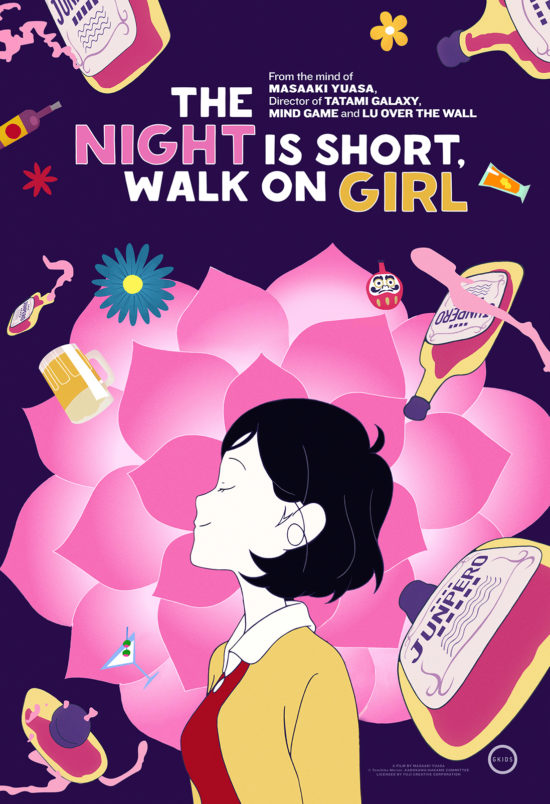
REVIEW: The Night is Short, Walk On Girl


For as much as I like to say I enjoy anime, the irrefutable truth of the matter is that I'm basically just a novice; I've watched Fooli Cooli and Gurren Lagann  a couple of times and I'm currently enjoying My Hero Academia, but it's safe to say that there are vast parts of the medium that I still need to explore. I was, for example, completely unfamiliar with the work of Masaaki Yuasa; that is, until I decided to check out The Night is Short, Walk On Girl (loosely adapted from the Japanese novel of the same name). I saw the trailer on Facebook just by chance (or perhaps it was fate), but the fluid animation, whimsical art design, and catchy music told me that I just had to go check this one out (especially since it would be in US theaters for two nights only). 90 minutes later and I'm not only convinced that I need to seek out the rest of Yuasa's work, but that The Night is Short, Walk On Girl is my personal pick for the best movie of 2018 (even though it was technically released in 2017, though only in the UK and its native Japan).

The plot is, shall we say, difficult to describe. This is one of those situations where I feel as though I'd be walking a fine line between describing the premise and simply recounting every scene; it's very much like Alice in Wonderland or The Wizard of Oz, where our protagonists move from situation to situation, encountering a host of unique characters as they go on their journey. The film follows a nameless girl with black hair (typically just referred to as Otome, the Japanese word for "maiden", and voiced by Kana Hanazawa) on a night of heavy-drinking through Kyoto. Meanwhile, a similarly nameless classmate of Otome's (referred to as Senpai, voiced by Gen Hoshino) is determined to confess his feelings towards her on this fatefull night. As he explains, he's implemented a long-term plan of crossing paths with Otome as often as he can manage, under the guise of their encounters being sheer coincidence. When the time is right, he will reveal his true intentions and it will seem as if the two had always been intertwined by the red string of fate. What follows is a delightfully charming, psychadelic rom-com that utterly annihilated my expectations in the best sort of way. This is just one of those movies that feels like a vivid dream, boasting the kind of atmosphere I'd like to curl up inside of for the rest of my life.


While the movie is, aesthetically-speaking, undeniably gorgeous, the real draw for me was the thematic subtext underneath it all. This is one of those films that focuses in on that sort of "quarter-life crisis" that twenty-something college students tend to go through. We've seen so many coming-of-age stories, but what happens after the protagonists have already grown up before the plot truly began? We're told from high school onward that we're "young adults", but that feeling honestly didn't kick in for me until after I'd completed my undergrad, got a job, and moved into a place of my own. For those who go right from high school into college, the question of what comes after is something that really starts to weigh on you after you get acclimated. We act like the transition from high school senior to college freshman is a massive change, but it's really nothing compared to spending the first 22 years of one's life adhering to a more or less consistent system of schooling and socializing, only to finally cross the finish line into the stage of your life when you have to start thinking about taxes and rent and insurance. You get your degree, then what comes next? Graduate school? A career? Or just another job to pay the bills? Should you get married? Start a family? Buy a house? Do you even have the means to do any of those things? These are all the questions you start to mull over as you begin to fully and finally transition into the adult world, and said questions tend to weigh heavily on the minds of chronic over-thinkers like Senpai (or myself, for that matter).


The character of Senpai manages to transcend the usual "awkward nerd who's hopelessly smitten with the girl of his dreams" trappings by really delving into his mindset. He isn't just another gawky buffoon in pursuit of his manic pixie dreamgirl; he's insecure to the point that he outright questions if he even deserves to have his insane plan work out, or if it would be more fitting that he just shrivel up and die alone. He's become accustomed to failure, putting up walls to protect himself from the terrifying idea of what might happen if he actually gets what he wants for once, the only outcome he's completely unprepared for. Otome, meanwhile, is in the exact opposite situation; she's naturally talented at everything she tries, resolved to simply go with the flow and see where the night takes her. While she hardly has to put in any effort in order for things to go her way, she's left with a life that, compared to Senpai, lacks any semblance of drive, ambition, or purpose. The film establishes that her easy-breezy attitude towards life tends to leave those around her in the dust, leaving her with her own kind of loneliness to deal with. They're two sides of the same coin, yin and yang, but that doesn't mean they don't need to grow and change in their own ways before they're fit to be together.

The film hypothesizes that who we are is but an amalgamation of those we meet in life; whether we know them for the rest of our days or just for one drunken evening, the impact and influence they leave us with is what determines who we are and how we grow as people. The emotions these people inspire and the stories they leave us with are the things that life is made of. Feelings of isolation, loneliness, and disassociation are hardly rare for young people, especially those who find themselves in the midst of a great transitory period in their lives, and The Night is Short, Walk On Girl goes to great lengths to remind us that no man is an island. Whether you believe in fate or not, your existence is immutably intertwined with those around you (and even those you've yet to meet). We're all players in the funny, tragic, oddball play that is the human race; everyone matters, no one is truly alone, and happiness will always inevitably win out over nihilism.


Although it's obvious that the underlying motifs this movie set forth resonated with me on a deep emotional level, I want to make it clear how much I adored everything else in this movie. Like I said before, the animation is absolutely stunning (putting Masaaki Yuasa on my radar in a big way) and I really love the use of color and sound to establish a sensory experience that's at the same time fantastical and immersive. As the night goes on, an entire year seems to pass; we begin on a warm spring evening, transition into summer heat, and by the time the climax rolls around, all of Kyoto is stuck inside with the flu as unforgiving winds and snow rip through the empty city streets. I also found myself surprisingly invested in the stories of the various side-characters Otome and Senpai come across, absurd as they are. My personal favorite would have to be Don Underpants ( Ryƻji Akiyama), a writer and hopeless romantic who has pledged to not change his underwear until he reconnects with a girl he had a fated encounter with some time ago. At first we assume he's just there for a one-off joke about his self-appointed nickname, but then he shows up again much later on, setting up guerrilla plays at the student festival as a means of attracting his mystery love's attention. These side-characters are all bit players compared to our two main leads, but their stories are told in such a way that it truly feels as though the plot thread doesn't end the moment they walk off-screen. We really get the feeling that this isn't just an extraordinary night for Senpai and Otome; everyone has their tale to tell, and that's really the entire message of this movie in a nutshell.


The Night is Short, Walk On Girl is really just a remarkable little movie. It's a surprisingly conventional, feel-good love story that's conveyed in the most unconventional of ways; pair that with sublime animation, supremely comfy atmosphere, a killer soundtrack, and loads of endearing and memorable characters, and you've got a winning recipe for my personal favorite movie of 2018 thus far. Yes, I know, it technically came out in 2017 everywhere but the USA, but I'd be outright lying if I said that, out of everything I've seen in theaters this year, The Night is Short, Walk On Girl wasn't my favorite. If it wasn't clear already, I absolutely adore this lovely, lovely film and would like nothing more than to just immerse myself in all the charm and good vibes it's constantly putting out. If you're a fan of anime or animation in general, you owe it to yourself to give this one a watch.

June 23, 2018

REVIEW: Captain Underpants: The First Epic Movie


Call me a cheater for doubling-down on children's animated superhero films two weeks in a row, but this is something I've been meaning to watch for some time now. As a kid, I was a tremendous fan of Dav Pilkey's Captain Underpants series; I got a copy of Captain Underpants and the Perilous Plot of Professor Poopypants for my birthday one year, and from that point on, I was hooked. So naturally, when I heard that a film was being produced by Dreamworks (who have been putting out better and better animated films in recent years) and featured an art-style reminiscent of the 2015 Peanuts movie, it's safe to say I was on-board without hesitation. I've finally got around to watching it and can safely say that it's about everything I expected it to be, which is by no means a bad thing.

Our story follows two kids named George Beard (Kevin Hart) and Harold Hutchins (Thomas Middleditch). George is the one with the tie and the flat top. Harold is the one with the t-shirt and the bad haircut. Remember that now. The two attend Jerome Horwitz Elementary School in the city of Piqua, Ohio, creating comic books and pulling various pranks and in order to enrich the miserable lives of their fellow classmates. After sabotaging the school's Invention Convention, the two find themselves in the principal's office, at the mercy of the monstrous Mr. Krupp (Ed Helms). As punishment, Krupp plans on having George and Harold placed in separate classes, effectively destroying their friendship; in desperation, the two use a 3-D Hypno Ring (found in a box of cereal) to hypnotize Krupp into letting them off the hook. Unbelievably, the ring actually works and leaves Krupp susceptible to George and Harold's commands. The boys decide to turn their mean old principal into their self-made comic book hero, Captain Underpants, only for Krupp to immediately strip down to his tighty-whiteys and dive out the window in search of crime. What follows is a series of comic misadventures that sees the Captain going up against Jerome Horwitz Elementary's new science teacher, the nefarious Professor Poopypants (Nick Kroll), a vengeful mad scientist who wants to rid the world of laughter.


Speaking as someone who poured over the Captain Underpants books back in elementary school, I love the amount of care and detail that went into making this film feel authentic to the source material. This definitely isn't a case of "we've got the license, just crank out whatever"; the team behind it clearly had a certain degree of respect and reverence for the original books that I think really helped elevate this beyond just another kids' movie. The CG art style perfectly emulates Dav Pilkey's simplistic illustrations, bringing the books to life in the best kind of way. It feels like we're entering a new Renaissance of computer-generated animation, and films like this, The LEGO Movie, and the upcoming Spider-Man: Into the Spider-Verse are all proof of that. It's clear that the animators had a lot of fun experimenting with various mediums and art styles, telling some parts of the story through traditional 2-D animation, paper cut-outs, and even sock puppets. There's even a section during the climax where, much like in the books, all of the graphic violence is portrayed via the iconic process of Flip-O-Rama; the characters in the film even accidentally tear the page, a constant danger for anyone who got a little too enthusiastic with their books back in the day.

It's this attention to detail that really makes Captain Underpants something endearing for anyone familiar with the series of books; tons of classic running gags are scattered throughout (my personal favorite being the return of the infamous "Everything Except Fabric Softener" store), and there's not a doubt in my mind that this would have been one of my favorite movies, had it come out when I was growing up. There's just a striking level of authenticity that feels really respectable here. It's perfectly possible to make a good movie that strays far from the source material, just as it's possible to make a bad movie that strives to be as accurate as possible, but you get the feeling that, with Captain Underpants, the filmmakers went out of their way to make something specifically catered to the children who read these stories. This is a film that children can call their own, moreso than most other children's films I've seen as of late.


If you're over the age of 12 and have never read a Captain Underpants book, there's next to no reason for you to watch this. Unless you're an animation student or you have kids of your own, you aren't going to get anything out of this. And, oddly enough, I'm perfectly okay with that. Just because a movie caters to a niche audience or isn't immediately accessible to everyone who watches it doesn't make it bad by default (see The VVitch, The Lobster, and Wizards). This isn't one of those animated children's movies that attempts to appeal to adults by referencing Taxi Driver or The Godfather for a cheap laugh; sure, Nick Kroll gets a few really excellent lines that anyone can enjoy, but the humor is, for the most part, very much focused at a younger demographic. It knows who it wants to please and how it wants to go about doing that, all without resorting to spastic yelling and chaotic visual noise. The plot is straightforward and easy to grasp, the characters are exaggerated and cartoony, and the jokes are sure to elicit fits of giggles from anyone who's ever had a hard time keeping a straight face when learning about Uranus.

It's a movie that's sure to make more than a few grown-ups roll their eyes (I mean, the villain is literally named Professor Pee-Pee Diarrheastein Poopypants Esq.), but that's okay. Not because children's films get a free pass to be lazy or overly-simplistic, but because, at the end of the day, the goal of this film is to make children laugh (a goal it is fiercely and admirably dedicated in pursuing). It has exactly zero interest in pandering to any adults who may be watching, and that's perfectly alright; this is one for the kids. Underneath the veneer of seemingly simplistic potty humor, Captain Underpants has always been a series that thrives on wordplay, fourth wall gags, and lampshading various clichĆ©s found in children's literature; for as unapologetically silly as the books and movie are, I have no doubt that this is a series that left a hefty impact on my sense of humor from a young age. It covers healthy morals and themes such as one's obligation to question authority, the value of freedom of expression, and being able to see the funny side of a seemingly-dire situation. The books have had grumpy old people shaking their fists for years now, but looking back, Captain Underpants was a series that not only inspired me to read, but to create stories of my own, and I feel like this film is going to inspire today's kids to do much of the same. George and Harold are two characters who value friendship and humor above all else, reveling in the wondrous freedom that comes with just being a kid; despite all their mischief-making, I can't help but feel that their misadventures with the Captain can impart a number of valuable lessons on the kids who come along for the ride. After all, if a children's book has been banned, then that just means that there's a good chance it contains something beneficial that will help your child grow into an intelligent, independent, well-rounded human being.


To make a long story short, I really admire what Captain Underpants: The First Epic Movie sets out to do. It's a charming and irreverent little movie that is sure to be a hit with the youngsters, even if things get a little too silly for those in the older demographics. If you're a parent, I implore you to expose your kids to material like this; while you might not find the idea of a gigantic robot toilet all that funny, I guarantee that it's going to make your little ones crack up. Ridiculous as it may sound, it's important that children be allowed to laugh at farts and boogers and other assorted potty-humor. Laughter is simply one of those things that makes life worth living; an unquestionable force for good and positivity, capable of uniting people across all manner of socio-political backgrounds. This is, at it's core, a very punk-rock children's movie, celebrating artistic freedom and healthy rebellion in the face of the man. If that sounds like something you wouldn't want to expose your child to, then I wish you luck on raising your boring, boring kid.

February 19, 2018

REVIEW: Fantastic Planet


As I've gotten older, I've developed a growing fascination with outsider animation. Don't get me wrong, I still greatly enjoy the annual fare from Disney and Pixar, but there's something special about the outlandish, surreal, and decidedly more adult-oriented animated films of the 70's and 80's; something that was definitely lost around the time of the Disney Renaissance. With Disney cornering the market on squeaky-clean family fun, there existed a clear niche for animation that explored themes and ideas that the House of Mouse wouldn't dare touch; a niche that was soundly filled by filmmakers like Ralph Bakshi and Don Bluth. It was imagination unrestricted by the limits of the MPAA, and it pains me to see such fantastic examples of creative expression dragged down by the most braindead form of praise art can possibly recieve; "woah, they must have been on drugs to think of this!" Whenever anyone says this, it essentially means that they have such a limited imagination that the only conceivable way a human could create anything even the slightest bit innovative or out of the ordinary is by way of a hefty dose of psychedelics. Which, to clarify, doesn't mean that drug-use didn't influence some of these films (especially considering the era they were born from). But the fact of the matter is that movies like today's film, Fantastic Planet, have far more to offer than just some trippy visuals. Behind all the surreal imagery and whacked-out animation lies subtext, and it's this vital facet of storytelling that elevates films like Fantastic Planet above simply being the cinematic equivalent of a lava lamp.

An adaptation of the 1957 French novel, Oms en sƩrie, the film takes place in the distant future, on the far-away alien world of Ygam. Long after wiping out their own civilizations on Earth, humans were brought to Ygam by the Draags, an advanced race of blue giants. On Ygam, humans (known as Oms, a play on the French word "homme") are regarded as little more than common vermin; while a good number of Draags have domesticated Oms they keep as pets, there are also roaming colonies of savage Oms who are routinely exterminated (not unlike rats or mice). The film follows one Om in particular, Terr (voiced by Barry Bostwick in the English dub); orphaned as a baby, he finds himself adopted by the daughter of a Draag diplomat, eventually escaping and joining a wild colony of Oms with the intent of ending the oppression of his species once and for all.


The most immediately striking aspect of the entire movie (and the detail which lead me to eventually watch it) is the art design, care of painter/writer Roland Topor. Given the setting and themes of the story, it's immensely important that Topor was able to create a world that looks truly and honestly alien in nature; none of the creatures on Ygam even remotely resemble anything on Earth, and the eerie landscapes help foster an atmosphere of unfamiliarity and foreboding. It all really adds to the situation the Oms find themselves in; you're able to get a powerful sense of how far humanity has fallen and how separated they are from the civilization we know today (even if their base instincts and motivations remain more or less the same, but more on that later). Admittedly, there are moments here and there where the design falters and aspects of the Draag civilization end up looking as though they're simply meant to appear strange for strange's sake; this isn't a film like Treasure Planet where every single aspect of the film's visuals are designed with the idea that it must serve some sort of in-universe purpose. Then again, one must think of the artist's intent when judging aspects like this; world-building isn't exactly meant to be the main takeaway of Fantastic Planet. The subtext is meant to be the primary focus here, and in that area it very much succeeds (but again, more on that later).

My only other gripe with the design of this film is the limited animation. Whereas films like Yellow Submarine give the impression of a watercolor painting brought to life, Fantastic Planet feels much more akin to the work of Terry Gilliam (who, coincidentally, would release his animated short, The Miracle of Flight, just a year later). While Topor's designs are hauntingly beautiful, the animation at play simply doesn't do them justice; everything moves in a very stilted, deliberate manner and character movements tend to lack any and all sense of weight. I also wasn't overly fond of the soundtrack (care of French jazz pianist, Alain Goraguer); while some praise the psychedelic atmosphere the score brings to mind, I found that it just didn't work for me. This is a thoughtful, surreal experience filled with haunting visuals and themes drenched in existential dread. It feels like exactly the sort of concept that would be best complimented by an equally eerie orchestral or prog-rock score, only to be undercut by a dated and altogether unfitting collection of funky beats and wah-wah guitars. This is a score that would have worked perfectly in just about any other film, but just feels wrong here. Then again, it could also be argued that the ill-fitting music and limited animation only serve to enhance the existing atmosphere of unfamiliarity and unease, so these are aesthetic details that (much like the all-important subtext) are free to be left up to the viewer's individual interpretation.


As I mentioned before, inspired visuals can only support so much. While it's very much true that film is a visual medium, it is the way that movies are able to combine all manner of sensory expression that sets film aside from other artistic outlets. When a film ignores any of the tools provided, focusing purely on visuals and ignoring its story (or vise-versa), it is doing itself a disservice. In the case of Fantastic Planet, you come for the tripped-out visuals, but stay for the thought-provoking subtext. The film raises a number of intriguing (and, depending on your perspective, uncomfortable) questions about the nature of life and sentience. What makes the life of one being inherently more valuable than another? By what standard do we judge if a living thing is sentient, or civilized, or even alive? There's obviously a clear "how would you like it?" aspect regarding man's relationship with the natural world, but in truth there's so much more here to unpack and explore. It's very easy to feel inherent sympathy for the Oms, the same way it's very easy to feel a deep resentment towards the Draags. We want to side with the downtrodden and oppressed humans over the beady-eyed, emotionless aliens, despite the fact that the Draags are us. They adhere to their own, odd social rituals and exert callous control over the natural world without a care, simply because they've deemed themselves the most advanced race and that gives them the right to do as they please

There's an obvious environmentalist tilt to the whole thing, but it never feels so cut-and-dry, so narrow in scope. One could also easily view the conflict between the Oms and the Draags (in which one species, deemed inferior by those with more power and technology, is systematically exterminated) as an allegory for genocide and racism. The Draags don't think much of the Oms until the Oms become educated and organized; then the downtrodden and oppressed suddenly become a legitimate threat to their oppressors, and only then is peace and equality considered to be an option. Personally, I took the film as a metaphor for how humanity is often manipulated into destroying itself by any number of higher powers (be it competing governments, religions, or what have you); the Draags often make their domesticated Oms fight for each other's amusement, inspiring internal conflict and squabbling among the oppressed, preventing actual progress from being made towards freedom, enlightenment, and prosperity. Whatever your personal interpretation, they all feel equally valid. Not in a half-baked, lazy kind of way, as though the filmmakers didn't put enough thought into what they actually wanted to say with this film, but rather in a sense that denotes extreme care taken on the part of the filmmakers to ensure that the underlying messages could be conveyed to any number of perspectives. The fact that this film is open to so many interpretations could easily come off as needlessly vague in theory; in practice, however, it feels like anything but, and it's this kind of potential for exploration that represents what I consider to be Fantastic Planet's true worth as a film.


In terms of entertainment, I'm not 100% certain I'd recommend Fantastic Planet to just anyone. While I definitely took a lot away from it, I wouldn't exactly call this an "entertaining" movie; despite being just over an hour long, it's quite slow-paced and very dense from a conceptual standpoint. It's not the kind of thing I see myself ever throwing on to unwind after a long day at the office. That said, as a film, I consider this to be mandatory viewing, especially if you consider yourself a fan of animation. The art direction is worth the investment alone and the underlying themes and messages are sure to stick with you well after the credits finish rolling. This is the kind of movie I can't help but recommend everyone watch at least once (although I'm sure repeat viewings will do nothing but enhance one's overall experience). If you feel as though you're in the proper mindset for something in this wheelhouse, you'd be hard pressed to go wrong with giving Fantastic Planet a watch.

February 3, 2018

REVIEW: A Futile and Stupid Gesture


The practice of tackling a biopic is often an interesting beast. Like with adaptations of fictional works, filmmakers need to find ways to skirt around the inherent conflict that tends to arise between staying accurate to the source material and the story's ability to stand on its own as a work of film. It's (usually) not enough to just reenact real-world events without some kind of creative spin; this was one of my main issues with The Disaster Artist. A tremendously well-acted and entertaining movie, yes, but with disappointingly modest ambitions. Some of my favorite films of all time, such as Ed Wood and American Splendor, find unique and interesting ways to tell the (mostly) true stories of notable individuals. Even though the bulk of the story has been written by life itself, it's still the filmmaker's responsibility to turn someone's life into a story worth telling (and more importantly, worth watching). Which brings us to one of the more recent independent films released through Netflix, A Futile and Stupid Gesture.

The film tells the story of the life and times of Doug Kenney (Will Forte), the main creative force behind the iconic humor magazine, National Lampoon. The film covers Kenney's rise and fall, from his time at Harvard through the creation of films like Animal House and Caddyshack. I will admit, I wasn't exactly well-read on the subject of Doug Kenney before watching this movie, and I feel my overall experience was better off for it. I'd recommend at least being familiar with the classic Lampoon films, as well as the early days of Saturday Night Live to fully appreciate the context that the story takes place within, but any research into Kenney's actual life risks spoiling the movie. Shocker, I know; if you already know the true story, then you'll be able to predict how the biopic ends. Without going too deep into spoiler territory, I'll simply say that, taking certain narrative devices the film uses into account, entering altogether unfamiliar with Doug Kenney as a person (as I did) will only serve to enhance the viewing experience. I'll say this and nothing more.


When you're working with adapting a real-life story, it's important to understand that your main character needs to function as more than just an excuse to adapt the events of their life to the screen; it doesn't matter how fascinating their situation is if they don't work properly as an engaging protagonist. Thankfully, director David Wain (of Wet Hot American Summer fame) understands this and spends ample amounts of time building Kenney up as a complex and nuanced character. As a human, he's deeply flawed; we see the darker side of a humorous personality, as he's always starved for attention and affirmation. This underlying desire to be loved is the driving force that fuels nearly all of the misfortune Doug manages to make for himself over the course of the film. At the same time, we also see why Doug is like this; every creative choice he makes seems to be either an appeal or attack directed towards his estranged father (played here by Harry Groener). This doesn't excuse the less-savory decisions Doug makes, but it does offer some insight as to why he makes them. That trace amount of context, explaining his actions without attempting to condone them, is what allows us to effectively sympathize with our protagonist. Although this is the story of the man behind the National Lampoon, it's worth noting that this story is much less a comedy and moreso a sardonic tragedy.

Don't get me wrong here, there are a good number of jokes in this film, they're simply not the main focus. The humor present in this film is a symptom of its subject matter rather than the primary focus, so anyone looking for something as bombastic and laugh-out-loud funny as Animal House is going to be left wanting (and likely a little depressed). The film uses comedy to effectively paint a portrait of a man who, deep down inside, is hurting. My only complaint is that we don't get too many "real" moments with the extended cast; to be fair, I almost feel as though that's what the filmmakers were going for. Every other comedy writer at the Lampoon has a hard time turning it off, spitting out one-liners even when a situation clearly calls for anything but. It illustrates how an environment of sarcastic misfits and misanthropes often isn't the best place for someone who truly needs help (sharply contrasting with the camaraderie we see among the endearing slobs of Animal House and Caddyshack). At the same time, this also leaves Doug Kenney and Henry Beard (Doug's college collaborator, played by an unrecognizable Domhnall Gleeson) feeling like the only fleshed-out, three-dimensional characters in the entire movie. Suffice to say, it's something of a double-edged sword.


Speaking of, I also foresee some of the casting being quite hit-or-miss for some people. The main cadre of lead actors is relatively airtight; Forte continues to demonstrate his chops as a legitimate dramatic actor, giving us a raw, decidedly un-Hollywood look at the kind of misanthropic personality that is usually obscured behind a series of well-meaning gags. Kenney strikes you as the kind of class-clown personality everyone wishes they knew; quick with a joke, down to party, and chock full of potential for amazing stories down the line. But Forte manages to pull the curtain back and expose just how much pain and damage is hiding behind such a bombastic facade. This is where Gleeson compliments Forte perfectly, keeping all of his frustration inside. We see Henry forced to clean up after Doug time and time again, making their friendship feel much more flawed (and much more realistic) than the frat boy antics one might expect going in. The two work in tandem, illustrating just how dangerous it can be to have something to prove without the perspective needed to understand when a lifelong passion devolves to just being work. We also have Martin Mull, but I don't want to say too much; he's very much a part of that narrative device I mentioned earlier, and the less you know about his purpose in this film going in, the better. But it's Martin Mull, so of course he does a good job.


On the more controversial side, we have every other supporting cast member portraying comedic icons like Gilda Radner (Jackie Tohn), Chevy Chase (Joel McHale), and Christopher Guest (Seth Green). The film even breaks the fourth wall (as it frequently does) to address the audience and point out how these actors don't look exactly like the people they're meant to be portraying (before presenting a lengthy list of other creative changes the filmmakers made over the course of production); while not everyone is going to be totally sold on these performances (there's nothing here that even comes close to Martin Landau's take on Bela Lugosi, for example), I still had my fun picking out who was meant to be who. It almost feels like voices played a greater role here than appearance; while some members of the cast definitely look the part (Lonny Ross and Rick Glassmen are dead-ringers for Ivan Reitman and Harold Ramis), there are others who definitely struggle to blend in. Joel McHale looks nothing like Chevy Chase; really, he looks more like Joel McHale about to attend a 70's theme party in a wig he bought for $5 at the local Spirit Halloween. At the same time, when he reads off his lines on the The National Lampoon Radio Hour, he does sound startlingly like Chevy Chase. The same goes for Jon Daly as Billy Murray; there's little to no physical resemblance, but damned if he doesn't have Murray's Lounge Singer voice down perfectly. Like I said, these performances are going to be much more hit-or-miss depending on who's watching, but I definitely had my fun with them. You get the impression that everyone is having fun paying tribute to the comedic minds that influenced them from an early age, and that sense of fun and reverence really elevates these performances beyond the simple impressions they appear to be at first glance.


While I definitely foresee the slow pace, dry humor, and offbeat presentation alienating some, I still found A Futile and Stupid Gesture to be anything but. I can't emphasize enough; this is not a comedy. It is a drama about comedy. All that said, there's still an oddly feel-good undercurrent to the whole thing. It's a bittersweet story with all manner of emotional ups and downs, the kind of film where the viewer is left either feeling touched or depressed or both (depending entirely on who happens to be watching it). That kind of parity makes it a challenge to recommend to just anyone, so I'll close by saying this; this is a film about creative types, for creative types. Beneath every comedian and class clown, there's often years upon years of bottled-up pain. A deep-seated need for not only attention, but affirmation and acceptance. It's a film about insecurity, abuse, and the kind of humor that, to this day, makes the upper-crust of society spit out their champagne and clutch at their pearls. We see a man with a clear set of goals and aspirations build himself up, then question if he's strong enough to continue living the dream he himself has made. If you've ever wondered if your work truly matters, regardless of what field you're in, you owe it to yourself to check this one out.

If you liked this, be sure to check out The Jurassic Mark Podcast!

January 27, 2018

REVIEW: Otto is a Rhino


Look, I said I was gonna do it, and by God I'm a man of my word. This is the end; the final entry from Crone Film that I'm subjecting myself to. I thought it would be good for a laugh at first, watching Freddy Frogface and Ivan the Incredible, but I think it's safe to say that I've simply said all I can say about these films. This is the final nail in the coffin; my obsession with Crone Film ends with Otto is a Rhino (yes, I know what the poster says, but the title card at the beginning of the movie says Otto is a Rhino, so there). Like the other films in this cracked-out trilogy, this is based on a Danish children's book, only it's been stretched out to fill just over an hour runtime. Again, I'm not sure if it's just a poor adaptation or if the books these films are based off of are equally as intolerable, but I'm also not sure it matters. Otto is a Rhino is an outright chore to get through, and I wouldn't expect anything but at this point.

The plot involves the same gross, ugly kid that appears in every one of these movies. Only this time, he finds a magic pencil that he uses to make a giant, yellow rhino. That's about the entire plot in a nutshell; a rhino appears in an apartment building and the entire rest of the movie is simply characters reacting to this oddball occurrence. There's no adventure or fantasy or anything at all engaging, just a bunch of unlikeable characters attempting to benefit from a sentient being born from someone's wall. "Let's bring a rhino to life" is the farthest this story wishes to experiment with the idea of a magic pencil that can make anything real, and I'm not sure if we're better off or not for that lack of imagination.


Really, "lack of imagination" sums up the entire film. There's no amount of whimsy or wonder like one might expect from a plot like this. The titular rhino isn't anyone's friend; it's a big, gormless animal with all the situational awareness of a houseplant. You look at all the other children's films where our kid protagonist makes a fantastical friend, films like The Iron Giant and Pete's Dragon, and you can get a sense of all the hard work that went into making the Giant and Elliot into actual characters rather than just plot points. Here, Otto the Rhino is just a prop for our host of equally dim characters to react to. It's not even made clear that he understands who the children are or how they brought him to life. It's Frosty the Snowman if the titular character was brought to life with a sub-zero IQ; we can't feel any sympathy for something that displays all the sentience and personality of a bootleg Chia Pet. Otto doesn't even get into any comic hijinks. He's tremendously docile for a rhino, content to just stand in one place and eat the drapes. It's the cinematic equivalent of an imaginary friend who does nothing but teach children how to do their taxes.


The human characters aren't much better, each one displaying a dizzying single personality trait. The cowardly kid is scared. His father is a jerk. The firemen are all idiots. It's not like I was expecting Alan Moore's Watchmen or anything, it's a children's film adapted from a children's picture book. It's okay to have flat or static characters, as long as they have something interesting to do, and that's where this film really shoots itself in the foot. They present a world of literally endless possibilities, where anything you can draw can come to life, and decide to waste that potential trying to get a rhinoceros out of an apartment building. Even that barebones description sounds too imaginative and exciting for this movie, considering most of the conflict revolves around the success of an independently-run cafĆ©.

Let's pretend this isn't a problem; say this is meant for actual toddlers with the attention spans of goldfish. Sometimes a children's book doesn't really need to have a point or message, so long as it gives young kids something novel and interesting to latch onto that will get them interested in reading. Curious George is a series built entirely around the concept of a monkey being a monkey in different places, we don't always need to inspire an epiphany in every four year old just before nap time. But if this is truly meant to be something mom and dad can throw on for an hour of peace while Junior sits in the playpen, why is it so all-around unpleasant? Why does every character have beady little eyes and bulging Gary Busey teeth? Why are there references to casual sex, binge-drinking, and polygamy? It's a children's film where the only people who are going to get anything out of it are those who imbibe copious amounts of mind-altering substances beforehand. Believe me, for as much as I'm bashing this abomination, I can't imagine it's anything but a rollicking good time if you and your friends find yourselves half in the bag (especially if there are any animation students present).


It's about now that I wonder if there's even any point in giving my final thoughts on Otto is a Rhino. Like I'm going to actually recommend this to anyone but drunk or stoned twenty-somethings who have nothing better to do. Look, I'll be blunt; if you're a parent, give your child something better than Otto the Rhino. When you find yourself in a position to decide what entertainment your child gets exposed to, take care enough to give them something better than this. Sure, sometimes you really just need them to sit in front of the TV and shut up for a few minutes so you can hyperventilate into a paper bag (and maybe scarf down some uneaten mac and cheese) without being hounded. Believe me, I get it. But it can't really be understated how much of an impact the media we consume has on the people we end up becoming, especially as children. I can't even compare Otto is a Rhino to something like McDonald's, that's how unsubstantial it is as a piece of children's content. If you make the decision to fill your child's head with garbage like this, you're potentially depriving them of extraordinary parts of our culture. Films can change our lives, and it's your responsibility as a parent to make sure that it's for the better. Rather than... whatever the hell this is.

If you liked this, be sure to check out The Jurassic Mark Podcast!

January 20, 2018

REVIEW: Batman (1989)


It's pretty insane when you think about just how long the superhero genre has been around. Movies like those in the MCU and DCEU feel like a relatively recent trend, but the groundwork for what we've come to know as the modern superhero genre was laid decades ago with films such as today's subject, Tim Burton's 1989 Batman film. It's important to understand just how revolutionary this adaptation of DC's dark knight was at the time. Aside from comic readers, most associated Batman with the 60's Adam West show, despite how comics like The Killing Joke and The Dark Knight Returns had long since moved past the camp of the Silver Age. There was strong demand from the fanbase for a darker, more modern take on the character; hot off the success of Beetlejuice, Tim Burton was brought on to direct, and the rest is cinematic history.

Despite being one of the founding fathers of the modern superhero genre, the plot here is hardly the stock origin story most would expect. Really, we get more focus on the origin of the Joker (played famously by Jack Nicholson) than we do Batman (Michael Keaton). After a mob enforcer by the name of Jack Napier falls into a vat of toxic chemicals, he resurfaces under the ghoulish guise of the Joker. Feeling jilted by the amount of press given to the mysterious Batman, Joker sets out on a spree of terror, poisoning the populace of Gotham City. It's up to the caped crusader (with a little help from Vicki Vale, played by Kim Basinger, and his loyal butler, Alfred, played by Michael Gough) to foil the Joker's sinister schemes once and for all. Simplistic enough conceptually, but the real meat of this film lies in the way that this story is executed.


As I mentioned, such a dark, stylistic approach to a superhero property was all but unheard of at the time of the film's release. Compared to Richard Donner's squeaky-clean Superman (which came out a decade earlier), Batman represents a bold new shift in the boundaries of the genre. Looking behind the scenes, it's clear that some people (particularly hairdresser-turned-producer, John Peters) attempted to go a bit too far with this mindset; the Batsuit was originally meant to include footwear sponsored by Nike, and Keaton's iconic "I'm Batman" line originally contained a few more expletives than the finished product we see today. It's for reasons like these that it's important for studios to bring visionary creators on board, in order to even out the money-men. Enter Tim Burton; to this day, I'm still hard-pressed to name a director better-suited for this particular job. Despite this being a massive blockbuster that endured years of rewrites and executive meddling, Burton's distinct style still shines through, and that is what I feel makes Batman such a memorable entry into the annals of film history. Just about anyone can make a film about a superhero who dresses like a bat and fights crime, but only Tim Burton could have made this film the way that it turned out (much like how Bill Finger is responsible for making the original Batman into something more than another disposable pulp vigilante).

Gotham City (care of production designer Anton Furst) positively reeks of Burton's trademark flair. We're treated to clashing architectural styles, gothic vistas, and more gargoyles and statues than any planning committee would know what to do with. Perhaps this is just a side-effect of nostalgia (since this and the 90's Animated Series were my official introduction to the character of Batman), but whenever I think of Gotham City, this is the Gotham I envision. A bleak, grey, foggy hellscape, perpetually stuck in a sort of anachronistic limbo between the roaring 20's and the 1980's. Aside from the Prince music, there's absolutely nothing here to date this film; as is expected of early Burton, he creates a fantasy dreamscape and invites the audience to lose themselves in his world. While some may say that The Dark Knight is far more in-tune with the spirit of the source material from a character standpoint (and I'd be inclined to agree), I think it's safe to say that this film is far more fascinating stylistically. The Dark Knight will forever take place in 2008 Chigago, while the events of Batman unfold in a Gotham City ripped straight from the Bronze Age of DC comics.


That's not to say that this is a perfect interpretation by any means; there are a number of changes from the source material that are sure to make comic readers' heads spin (the most egregious of which is Batman's willingness to flat-out murder any criminals he comes across), but I feel as though these are minor details that don't really detract from what is otherwise a very well-made film. The atmosphere here is tight enough that no amount of adaptational inconsistency can really totally shatter it. It's of course helped along by what might just be Danny Elfman's finest work as a composer. The score here is just magnificent, and is the song that comes to mind whenever I think of Batman (even moreso than the Adam West theme). Of course, all the atmosphere in the world isn't worth much if the cast is lackluster; fortunately, that's not the case in the slightest.

Michael Keaton's casting as Bruce Wayne was the subject of widespread controversy back in the day; after a series of primarily comedic roles in films such as Mr. Mom, fans assumed Keaton would be a poor choice for the dark knight. The reaction was so vitriolic that petitions were actually formed to have the role recast (keep in mind, this was well before the heyday of the internet). Fortunately for all involved, Keaton gives what may be the strongest performance in the entire film. As Bruce Wayne, he is quiet and reserved. He keeps all of his emotions bottled up inside and comes off as a man who appears totally unassuming, despite his lavish background. Under the cowl, Keaton's Batman is cool and collected, always in control of the situation. Compared to other live-action Batmen (namely Bale and Affleck), Keaton feels by far the most natural. He doesn't need to growl or scream to instill fear in the hearts of criminals (who are, after all, a superstitious and cowardly lot), and this innate sense of confidence helps elevate the character to the status of superhero (despite not being able to turn his neck around). This is a character who feels much more comfortable underneath his cape and body armor than he does in a tuxedo, and Keaton's performance conveys that dual identity to a T.


On the other hand, we have Jack Nicholson as the Joker. This is the true star of the movie; his origin gets the most attention from the plot, he steals every scene he's in, and he even gets top billing over the lead actor. A common criticism of Nicholson's performance is that he doesn't seem to act like the Joker, so much as he just acts like himself in clown makeup. While I can definitely see this (for as enthusiastic as he gets, he never really disappears into the role the way Keaton does), it doesn't change the fact that he gives a dynamite performance as one of the most iconic villains of all time. Burton really hones in on the narcissistic side of the Joker's personality; everything he does is motivated by ego. He is a villain who, in every sense, wouldn't exist without Batman. At the same time, it was a young Jack Napier (rather than the seminal Joe Chill of the comics) who killed Bruce Wayne's parents, creating a sort of hero/villain Ouroboros. While it's not a 100% accurate portrayal, I'd say that it's arguably the perfect performance for this interpretation of the character. He's got a great look, a great laugh, and contrasts brilliantly as a foil for our titular hero. This is a film full of strong performances and likeable characters, but it's obvious that Batman and the Joker are far and above the main event here.


I hadn't watched this movie in years and, upon revisiting it, I'm glad to say that it holds up. There are a few nitpicky issues I had concerning elements like the sound mixing, some of the editing, and of course the inconsistencies with the source material, but I feel as though I can safely say that this is an iconic classic that holds up, even without the help of nostalgia-goggles. When this film came out, it was revolutionary for its dark tone and clearly-defined stylistic choices. Nowadays, in a world of committee-planning and cinematic universes, it's refreshing for those same reasons. As much as I love the MCU, every film is basically a comedy at this point and the Guardians of the Galaxy films are the only ones with any real amount of dynamic color or directorial flair. The DCEU positively reeks of Zack Snyder's distinctive influence, but in a way that hampers any character who doesn't mesh well with washed-out colors and pseudo-intellectual platitudes. Batman is the perfect blend between blockbuster comic book adventure and a director's singular vision. It's a product born of all the right kinds of compromises, and I feel like many modern studio executives could (and should) look back to it for inspiration. If you somehow haven't seen this film by now, right your wrongs as soon as possible. Just make sure you stop after Batman Returns unless you've got something potent in your cup.

If you liked this, be sure to check out The Jurassic Mark Podcast!

January 3, 2018

REVIEW: The Disaster Artist


Every once in a while, a movie comes along that changes everything. Something magical, that captures the hearts and imaginations of people from all walks of life, all around the world. When it comes to the realm of "so bad it's good", few movies can compare to 2003's The Room, a film so spellbindingly inept, it's been called the Citizen Kane of bad movies. There have been many pretenders, films that aim for the gutter in an attempt to score ironic laughs with bad performances and cheap production values, but they all lack the one thing that truly makes The Room special. See, there's a trick to making a film that ends up being so bad it's good; the key is to do it by accident. The Room was born of passion, not parody, everything you see on screen is the result of people unironically trying their best, yet failing miserably anyway. It's this sense of raw effort that people latch onto, that oh-so human feeling of seeing our best efforts laid to waste, that makes The Room so engaging. Anyone can give a bad performance, but the fact that the person giving the performance is a man like Tommy Wiseau, an enigmatic cartoon character who truly believes with all his heart that he's the next Tennessee Williams, is what makes The Room work in the way that it does. There's no cynicism to it whatsoever, and the cult of personality that's formed around it in the years since its release has finally come to a head with The Disaster Artist.

Taking place over the course of several years, the film tells the story of how Greg Sestero (the author of the book on which the film is based and co-star of The Room, played here by Dave Franco) came to meet the man who would change his life forever, Tommy Wiseau (played uncannily by his brother, James Franco). Young and insecure, Greg finds himself fascinated with Tommy's fearlessness on stage (despite his clear lack of talent); the two form an oddball friendship and move to Los Angeles with dreams of making it big in Hollywood. After striking out time and time again, Tommy decides to simply make his own movie; his personal magnum opus, a classical drama known as The Room


It's obvious from the get-go that The Disaster Artist is very much a passion project for James Franco; much like The Room itself, this is a film where the director is also the producer and the producer is also the star. I've also heard that apparently Franco directed this in-character as Tommy Wiseau (how that worked out is anyone's guess). There's a clear admiration for the source material, almost to the point that it interferes with the story. James Franco is a dead-on Tommy Wiseau, but there are also times where this whole thing feels just like an excuse for him to play this role (such as the tremendously fun but somewhat pointless montage during the credits, where the Disaster Artist cast recreates scenes from The Room). Thankfully, the focus of the film tends to revolve moreso around Greg and Tommy's weirdly codependent relationship than the actual making of The Room itself. This is where the film really shines, in showcasing what happened behind the camera rather than what happened in front of it. While it's certainly fun to see people reenact famous scenes and moments from such an iconic trainwreck, it doesn't really bring anything new to the table. If I wanted to watch The Room, I'd watch The Room; it's when we gain extra insight into the emotions and motivations of the people responsible for such an infamous bomb that things really start to get interesting.

There's a detail in this film that really resonated with me after having watched it; in The Room, there's a character known as Denny (played originally by Philip Haldiman, and here by Josh Hutcherson). Of every weird, inexplicable thing in The Room, Denny may have been my favorite. He's an awkward wimp of indeterminate age who treats Johnny (Wiseau's character) like a surrogate father. He shows up out of nowhere and it's really never explained what his and Johnny's hilariously uncomfortable relationship is actually supposed to be. However, having seen the way The Disaster Artist portrays Tommy and Greg's relationship, the character of Denny (a confused, insecure young man whom Tommy Wiseau's character takes under his wing out of the goodness of his heart) suddenly starts to make a lot more sense. We see the parallels between reality and Wiseau's incomprehensible fiction, and it's details like this that really exemplify what I wanted this movie to be.


The only problem is that we end up seeing these events unfold through the eyes of Greg Sestero, rather than Tommy Wiseau. No offense to Greg, but I feel like even he'd agree that his side of the story is likely far less interesting than Tommy's. Given how secretive the real Tommy Wiseau is (to this day, his age and country of origin remain a mystery), we don't get a lot of his perspective over the course of the story; our two leads end up having very little screentime apart from one another, so it feels like the main characters aren't exactly explored to their fullest potential. Little insights that give a sort of method to the madness of The Room are far more fascinating and engaging (both in a biographical and a narrative sense) than simple recreations of scenes. This problem is exasperated by the two lead actors; being real-life siblings, they exhibit excellent chemistry, yet I couldn't help but feel that Dave Franco was constantly getting overshadowed by his older brother. It can't be easy to show off one's screen presence when sharing the stage with a character as emotive and bombastic as James Franco's take on Tommy Wiseau, but Dave's range still felt, for the most part, lacking (despite an admittedly respectable effort).

Really, despite enjoying this movie for what it was, I can't help but feel as though it was weighed down by its association with the real-life Tommy Wiseau. Unlike something like Ed Wood, the main subject of The Disaster Artist was very much alive and well at the time of production, meaning that Wiseau was involved in promoting this film (as well as putting together his post-credits cameo scene). As such, it almost feels like The Disaster Artist pulls its punches when it comes to the less-savory aspects of Tommy's character (especially when compared to its source material). There's a lot of implicit ugliness with Tommy; we're never sure where he gets his money (but can assume it's through less than legitimate means), he's shown to be emotionally unstable and manipulative, as well as being prone to aggressive outbursts while constantly mistreating his actors and his crew. Even with all this in mind, the film still frames him as a sympathetic, misunderstood dreamer. This approach worked well in Ed Wood (which all but ignored the titular character's steady decline into poverty, pornography, and alcoholism), since that portrait of a hopelessly flawed filmmaker took on an almost fairytale-like tone. With The Disaster Artist, things are presented with a much more naturalistic approach in terms of cinematography, performance, and atmosphere, so this kind of flattering portrayal ends up feeling somewhat forced and out of place. I can't fault Franco and company for wanting to be civil in their depiction of Tommy Wiseau (considering he gave the film his blessing), but I can't help feeling that a more realistic, flawed portrayal would have been infinitely more interesting, as well as much more in-line with what the rest of the movie had to offer.


Historical inaccuracies and dubious romanticization aside, I still managed to really get something out of  James Franco's take on the creation of The Room. There's something classically compelling about a character who strives fruitlessly for an unattainable ideal, only to fall short thanks to their own personal faults and flaws. Tommy is completely oblivious to how inept he is; as far as he's concerned, he'd be the next James Dean or Alfred Hitchcock if only the rest of the world would stop getting in his way. We see how persecuted he feels, constantly failing in real life, and how that translates to everyone "betraying" Johnny in The Room. Eventually, we start to understand just what he means when he takes the stage at the premiere during the film's climax and declares in his broken, unplaceable accent, "this my movie, and this my life". What's been known up to this point as one of the most absurdly hilarious things ever committed to film suddenly starts to look a lot more like therapy for its writer/director/producer/star, and regardless of how accurate it is to real-life events (realistically speaking, we may never know the full story about Tommy Wiseau and The Room), it still manages to take one of the funniest bad movies ever made and use it to generate compelling character drama. The character of Tommy Wiseau exhibits such an undeniably human blend of blind optimism and raw ego that you can't help but root for him (even if the real-life events were far less of a feel-good story than what we see here). This all comes to a head at the premiere, when we finally see the finished product, the film that all of these characters have struggled and suffered for; you find yourself laughing along with the characters in the movie (because come on, it's The Room), but you've also come to understand the passion that Tommy had for his vision. Every chuckle comes at an emotional price, and I found myself feeling surprisingly sorry for someone who I should, by all accounts, hold very little sympathy for.


If you're looking for a documentary that tells the untold story of The Room, you're not going to find what you're looking for here. The goal of The Disaster Artist is not to unravel the mystery surrounding Tommy Wiseau. While I do wish it had perhaps focused on more of the inherently interesting aspects of the true story, this is still a tremendously entertaining parable about an outcast and his art. There's something magical about making movies; the vision, passion, and struggle that goes into creating something from nothing and committing it to film. This is a feeling that The Disaster Artist totally understands. Sure, I would have liked a bit more in terms of style, substance, and focus, but the end result is still a hilariously enjoyable time that I see myself revisiting many times down the line. Whether or not you've ever seen The Room, you'd be remiss not to give this one a look.