Showing posts with label summer. Show all posts

September 1, 2018

REVIEW: The Meg


Honestly, what did you even expect? Am I supposed to talk about The Meg like it's a real movie, and not just an absurd pile of schlock made to milk millions and millions of dollars out of the ever-growing Chinese movie market? We've all watched the trailer, we all know what this movie is about. There's a giant prehistoric shark and Jason Statham is gonna go deck it in the schnoz. I knew what I was getting into when I bought my ticket, and I got exactly what I expected. It's a curious kind of situation, since this is a blatant cash-grab without an ounce of creative intent behind it; one could very easily make the case that movies like this are causing the death of cinema the world over. But then again, I didn't exactly have a bad time with The Meg, so that raises the question of whether or not there's a place for big-budget trash, so long as it at least manages to be enjoyably entertaining.


The plot is, as one might expect, basically just an excuse to get Jason Statham to duke it out with a giant shark. I actually wasn't expecting it to take so long to really get going; this is a movie that, surprisingly enough, sticks by the genre convention of not showing the monster until after the first act is finished. An exploratory expedition is sent to the bottom of the Marianas Trench on the off-chance that the bottom of the ocean isn't actually the bottom; it turns out that the researcher's hypothesis was correct, and that the "bottom" of the trench was really just a cloud of super-cold hydrogen-sulfide or whatever. It's B-movie science, so I don't really feel the need to pick it apart that much, the important thing is that there's megalodons in them hills, and wouldn't you know it the submarine they've sent down to investigate just so happens to be piloted by Jason Statham's ex-wife (Jessica MaNamee). After rescuing the submarine, the megalodon follows the team up through the resulting gap in the thermocline, entering into an all-you-can-eat buffet of whales, boats, and tasty tasty humans. The Meg's got a hankering for some Chinese food, and it's up to Jason Statham to make it extinct all over again.


Let's talk about Jason Statham for a bit, because he's honestly the lynchpin that makes this movie work at all. I'm not sure if he legitimately thought this was a good script or if he's just a true professional, but while literally everyone else is yukking it up and not even trying (except for Li Bingbing, who I'm sure isn't as terrible when she doesn't have to speak English), Jason Statham is taking his role as a submarine-driving shark fighter 110% seriously. See, my problem with movies like Sharknado and the like is how they're so obviously made to be comedies. You can't intentionally make a movie that's so bad it's good. That's just not how it works. A person slipping on a banana peel is funny. A person throwing themselves to the ground intentionally with the intended goal of making people laugh is just embarrassing.

With Statham putting in a totally stone-faced performance, he ends up acting as the straight-man to literally everything else in the movie, and the end result provided more than a few laugh-out-loud moments. Sure, it's not exactly low-concept humor, but I defy anyone to watch Jason Statham throw on a wetsuit and dive into the ocean to go confront a shark the size of a Greyhound bus and not at least crack a smile at how absurd a visual it is. Tonally, it very much reminded me of something like Deep Blue Sea or TriStar's 1998 Godzilla reboot. I grew up loving these schlocky monster movies, as mediocre as they may be, and I could very much see someone getting the same kind of enjoyment out of seeing Jason Statham take on the Meg in the same way I got a kick out of watching Saffron Burrows and LL Cool J take on a gang of super-smart makos. The only problem is that, for as big and bombastic as The Meg tries to make itself appear, the action we get comes off as totally toothless, especially for a B-movie about a giant shark.


It's safe to say that, after serving as the villains in so many monster movies, sharks have gotten something of a bad rap. As I'm sure we've heard time and time again from various Snapple facts, you're actually about 23 times more likely to die from being struck my lightening than you are to die from a shark attack. Ever since Jaws came out, they've been portrayed mostly as mindless eating machines, despite even species as fearsome as the great white coming close to becoming endangered. Shark finning is a serious problem (as The Meg takes the time to tell us about in an odd, tonally-dissonant moment) and it's important to remember that sharks aren't monsters; they're simply animals doing what animals do. With all that said, The Meg is a monster movie about a giant dino-shark terrorizing the Pacific. As far as sharks go, it's not a stretch to say that they're just swimming mouths; biting, gnashing, and eating are about the only means of attack they have. So, to quote the film's lead, "Where’s the f---ing blood? It’s like, 'There’s a shark.'"

Half the fun of these kinds of monster movies is watching a cast of paper-thin characters eat it when the titular terror decides to eat them. While we do get a few good deaths here and there, they're all completely bloodless; the film avoids showing any humans getting chomped or ripped apart, opting instead for everyone to just be cartoonishly swallowed whole. It really puts a damper on an otherwise perfectly enjoyable B-movie, since well-done gore can add a ton to the enjoyment factor of an otherwise unremarkable movie. The only problem with turning a movie like The Meg into a blood-soaked gore-fest is that such violence would inevitably result in an R rating, greatly cutting into the film's potential profit margins. Seeing as how The Meg has already managed to out-perform the latest Star Wars movie, I suppose this gambit paid off. I can honestly say I'd have had more fun with it if I also got to see some blood and gore (and let's be honest, some tongue-in-cheek nudity never hurt anyone either), but those box office numbers don't lie. I saw a 9:45 showing with some friends at our local cinema, and just one row in front of us was a pair of parents with two kids who couldn't have been older than 6 or 7. They even brought blankets and stuffed animals, presumably for if the kids got bored (or fell asleep, considering we left the theater just after midnight); truly, The Meg is a movie with universal appeal. The only problem is that the movie's attempt to please every single paying demographic leaves it without a real sense of identity, and its hesitation to commit to a singular tone or audience leaves the whole thing feeling somewhat middling overall.


All in all, The Meg is a fun enough time, I suppose. It's surprisingly competently made (there's a fake-out just after one of the larger action sequences that actually got me) and the effects look pretty solid for something that was mostly shot in massive water tanks surrounded by green screens. At the end of the day, I paid for my ticket to see Jason Statham fight a giant shark and got to watch Jason Statham fight a giant shark. All in all, not a bad way to spend an evening; I know "I don't regret spending my money" isn't exactly the highest praise a film can receive, not every movie I've paid to see this summer can make the same boast. There are definitely better B-movies out there (and certainly better shark movies), but The Meg is an altogether inoffensive excuse to get together with some friends and share some laughs. Just don't expect anything even remotely memorable, original, or intelligent.

August 27, 2018

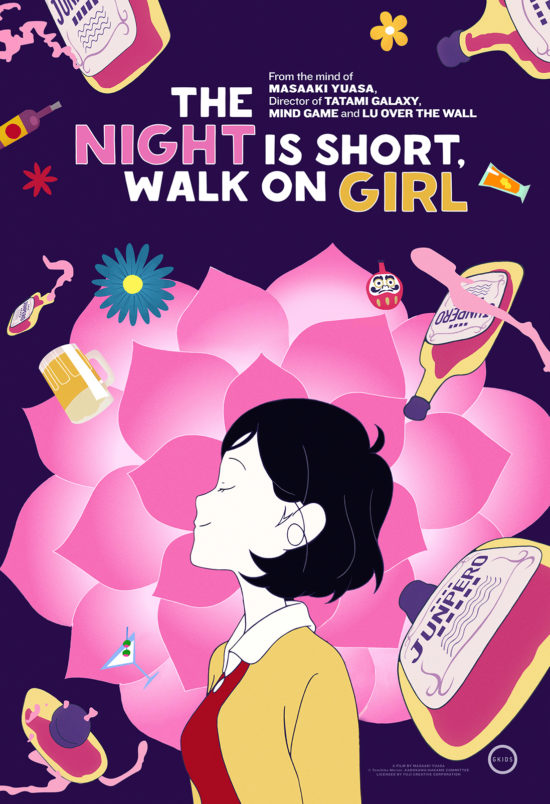
REVIEW: The Night is Short, Walk On Girl


For as much as I like to say I enjoy anime, the irrefutable truth of the matter is that I'm basically just a novice; I've watched Fooli Cooli and Gurren Lagann  a couple of times and I'm currently enjoying My Hero Academia, but it's safe to say that there are vast parts of the medium that I still need to explore. I was, for example, completely unfamiliar with the work of Masaaki Yuasa; that is, until I decided to check out The Night is Short, Walk On Girl (loosely adapted from the Japanese novel of the same name). I saw the trailer on Facebook just by chance (or perhaps it was fate), but the fluid animation, whimsical art design, and catchy music told me that I just had to go check this one out (especially since it would be in US theaters for two nights only). 90 minutes later and I'm not only convinced that I need to seek out the rest of Yuasa's work, but that The Night is Short, Walk On Girl is my personal pick for the best movie of 2018 (even though it was technically released in 2017, though only in the UK and its native Japan).

The plot is, shall we say, difficult to describe. This is one of those situations where I feel as though I'd be walking a fine line between describing the premise and simply recounting every scene; it's very much like Alice in Wonderland or The Wizard of Oz, where our protagonists move from situation to situation, encountering a host of unique characters as they go on their journey. The film follows a nameless girl with black hair (typically just referred to as Otome, the Japanese word for "maiden", and voiced by Kana Hanazawa) on a night of heavy-drinking through Kyoto. Meanwhile, a similarly nameless classmate of Otome's (referred to as Senpai, voiced by Gen Hoshino) is determined to confess his feelings towards her on this fatefull night. As he explains, he's implemented a long-term plan of crossing paths with Otome as often as he can manage, under the guise of their encounters being sheer coincidence. When the time is right, he will reveal his true intentions and it will seem as if the two had always been intertwined by the red string of fate. What follows is a delightfully charming, psychadelic rom-com that utterly annihilated my expectations in the best sort of way. This is just one of those movies that feels like a vivid dream, boasting the kind of atmosphere I'd like to curl up inside of for the rest of my life.


While the movie is, aesthetically-speaking, undeniably gorgeous, the real draw for me was the thematic subtext underneath it all. This is one of those films that focuses in on that sort of "quarter-life crisis" that twenty-something college students tend to go through. We've seen so many coming-of-age stories, but what happens after the protagonists have already grown up before the plot truly began? We're told from high school onward that we're "young adults", but that feeling honestly didn't kick in for me until after I'd completed my undergrad, got a job, and moved into a place of my own. For those who go right from high school into college, the question of what comes after is something that really starts to weigh on you after you get acclimated. We act like the transition from high school senior to college freshman is a massive change, but it's really nothing compared to spending the first 22 years of one's life adhering to a more or less consistent system of schooling and socializing, only to finally cross the finish line into the stage of your life when you have to start thinking about taxes and rent and insurance. You get your degree, then what comes next? Graduate school? A career? Or just another job to pay the bills? Should you get married? Start a family? Buy a house? Do you even have the means to do any of those things? These are all the questions you start to mull over as you begin to fully and finally transition into the adult world, and said questions tend to weigh heavily on the minds of chronic over-thinkers like Senpai (or myself, for that matter).


The character of Senpai manages to transcend the usual "awkward nerd who's hopelessly smitten with the girl of his dreams" trappings by really delving into his mindset. He isn't just another gawky buffoon in pursuit of his manic pixie dreamgirl; he's insecure to the point that he outright questions if he even deserves to have his insane plan work out, or if it would be more fitting that he just shrivel up and die alone. He's become accustomed to failure, putting up walls to protect himself from the terrifying idea of what might happen if he actually gets what he wants for once, the only outcome he's completely unprepared for. Otome, meanwhile, is in the exact opposite situation; she's naturally talented at everything she tries, resolved to simply go with the flow and see where the night takes her. While she hardly has to put in any effort in order for things to go her way, she's left with a life that, compared to Senpai, lacks any semblance of drive, ambition, or purpose. The film establishes that her easy-breezy attitude towards life tends to leave those around her in the dust, leaving her with her own kind of loneliness to deal with. They're two sides of the same coin, yin and yang, but that doesn't mean they don't need to grow and change in their own ways before they're fit to be together.

The film hypothesizes that who we are is but an amalgamation of those we meet in life; whether we know them for the rest of our days or just for one drunken evening, the impact and influence they leave us with is what determines who we are and how we grow as people. The emotions these people inspire and the stories they leave us with are the things that life is made of. Feelings of isolation, loneliness, and disassociation are hardly rare for young people, especially those who find themselves in the midst of a great transitory period in their lives, and The Night is Short, Walk On Girl goes to great lengths to remind us that no man is an island. Whether you believe in fate or not, your existence is immutably intertwined with those around you (and even those you've yet to meet). We're all players in the funny, tragic, oddball play that is the human race; everyone matters, no one is truly alone, and happiness will always inevitably win out over nihilism.


Although it's obvious that the underlying motifs this movie set forth resonated with me on a deep emotional level, I want to make it clear how much I adored everything else in this movie. Like I said before, the animation is absolutely stunning (putting Masaaki Yuasa on my radar in a big way) and I really love the use of color and sound to establish a sensory experience that's at the same time fantastical and immersive. As the night goes on, an entire year seems to pass; we begin on a warm spring evening, transition into summer heat, and by the time the climax rolls around, all of Kyoto is stuck inside with the flu as unforgiving winds and snow rip through the empty city streets. I also found myself surprisingly invested in the stories of the various side-characters Otome and Senpai come across, absurd as they are. My personal favorite would have to be Don Underpants ( Ryƻji Akiyama), a writer and hopeless romantic who has pledged to not change his underwear until he reconnects with a girl he had a fated encounter with some time ago. At first we assume he's just there for a one-off joke about his self-appointed nickname, but then he shows up again much later on, setting up guerrilla plays at the student festival as a means of attracting his mystery love's attention. These side-characters are all bit players compared to our two main leads, but their stories are told in such a way that it truly feels as though the plot thread doesn't end the moment they walk off-screen. We really get the feeling that this isn't just an extraordinary night for Senpai and Otome; everyone has their tale to tell, and that's really the entire message of this movie in a nutshell.


The Night is Short, Walk On Girl is really just a remarkable little movie. It's a surprisingly conventional, feel-good love story that's conveyed in the most unconventional of ways; pair that with sublime animation, supremely comfy atmosphere, a killer soundtrack, and loads of endearing and memorable characters, and you've got a winning recipe for my personal favorite movie of 2018 thus far. Yes, I know, it technically came out in 2017 everywhere but the USA, but I'd be outright lying if I said that, out of everything I've seen in theaters this year, The Night is Short, Walk On Girl wasn't my favorite. If it wasn't clear already, I absolutely adore this lovely, lovely film and would like nothing more than to just immerse myself in all the charm and good vibes it's constantly putting out. If you're a fan of anime or animation in general, you owe it to yourself to give this one a watch.

August 14, 2018

REVIEW: Eighth Grade


I'm honestly surprised it's taken this long for Bo Burnham to venture into feature films. He's a remarkably talented guy, so you can understand how excited I was for Eighth Grade, his first foray into the world of writing/directing for the big screen. Comparing the trailers for Eighth Grade to Burnham's stand-up specials, it struck me as not the sort of thing one would necessarily expect from his typical musical-comedy wheelhouse. Really, that only made me more excited to see it; I love watching comedians step outside of their comfort zones to make something that's not necessarily meant to be laugh-out-loud funny, first and foremost. The most successful comedians tend to have a knack for tapping into other base emotions aside from just laughter, and I'm happy to report that Eighth Grade does nothing to dispel that hypothesis.

The film follows eighth-grader Kayla Day (Elsie Fisher) through her final week of middle school, just before summer vacation (and the move to high school after that). It's worth noting that this isn't your typical "teen" movie; there's no big dance or talent show that Kayla needs to prepare for, and the popular girls don't go out of their way to make Kayla's life a living hell (rather, they hardly even acknowledge her existence). The plot foregoes every adolescent trope by being as purposefully mundane as possible, casting aside theatrical dramatization in favor of just being real. And not in the "omg that's literally me" kind of way, either; there are moments where Eighth Grade almost feels like a nature documentary on the middle school ecosystem, rather than an attempt to forcibly relate to a younger audience. I'm well beyond my middle school years, but this film still felt like a time-capsule based on its atmosphere alone. It takes us back to a time in our lives when pool parties and trips to the mall weren't just run-of-the-mill, everyday occurrences, but events where everything (especially image) mattered. There are small details that are sure to strike a chord with everyone for different reasons; for me, it was an unseen class clown shouting "are you my mom?" after the principal handed the mic off to a teacher during a school assembly. The film doesn't need to go out of its way to make these little moments feel important or theatrical, because they already are for Kayla; she's the focal point of the entire story. We care about her, and by extension everything she cares about (even if we're old enough to know better).


The film displays a remarkable knack for inspiring its audience to empathize with Kayla's adolescent struggles, thanks in part to the incredibly naturalistic writing and dialog. However, the factor that carries this entire film is the performances, Elsie Fisher's shining above all else. The character of Kayla is the rock on which the entire film is built; if she doesn't work, the entire thing falls apart. It's a tricky balance, given the premise of the movie, to write a protagonist who is both endearing and believably flawed. If Kayla was portrayed as overly self-aware and wise beyond her years, she'd cease to feel like an everygirl on the brink of young adulthood and start to feel more like every other stock "insecure tween" character in existence. On the flip-side, if she acted too childishly, older audiences would be alienated from her struggles with the pressures of social media and prepubescent peer interaction. It's thanks to Fisher's performance that this balance is kept intact; we'll shake our heads when Kayla makes a mistake, but we never stop rooting for her to succeed.

I honestly saw a surprising amount of myself in her, both now and looking back to my middle school years. I can remember being in middle school, making YouTube videos in my spare time (which I've naturally long since deleted, seeing as how you can watch my voice change a little bit with each upload). Middle school was a time of insecurity and immaturity, where we simultaneously don't care about anything but also care about literally everything. I remember the moments in my childhood, attending parties I wasn't sure I was wanted at, stressing out over nothing, and wanting to be treated like both an adult and a kid at the same time. The film hits a lot of easily-relatable beats without coming off as generic or clichƩd, which isn't exactly an easy thing to do. I'm really looking forward to revisiting this as time goes on, maybe even after I've had kids of my own, to see how I respond to it then.


It's worth noting that the supporting cast is excellent as well; suffice to say, there are no bad performances in this entire film (a credit not only to the cast, but to Bo Burnham's skills as a first-time director, working primarily with relative unknowns and children). Jake Ryan is a delight as Gabe, the gawky cousin of one of Kayla's more popular classmates. I like to think I wasn't this much of a dweeb back in middle school, but the way I both smiled and cringed at his Rick and Morty impressions imply otherwise; his performance was yet another of the things in this movie that hit very close to home in a fun, endearing kind of way without feeling as thought it was trying too hard to make me relate. I also utterly adored Josh Hamilton as Kayla's dad; his chemistry with Elsie Fisher is fantastic, and I find that he carries a deceptively large amount of the emotional weight in this film; you get the sense that he's got his own story going on behind the scenes, as though he's the star of his own, unseen movie. I'll always cheer on the death of the idea that father figures in movies must be incompetent, pigheaded idiots, and Hamilton's performance is yet another nail in that proverbial coffin. Not to say that he's an ineffectual pushover either; he's just a man who desperately wants his daughter to be the happy person she was a few scant years ago. Arguably my favorite scene in the entire movie is what could loosely be called the climax (in a film as low-key and down-to-earth as this), and Hamilton's performance solidified it as one of the most heartfelt things I've ever seen.


Eighth Grade is the kind of movie I wish I had back in middle school (kudos to any theater that organizes all-age screenings of this film, incidentally). Heck, it's the kind of movie I wish I had in high school. Regardless, I'm glad I have it now; despite some odd pacing and unambitious cinematography, the film really has a talent for hitting you with moments that makes you realize just how emotionally invested you are in Kayla's journey into adolescence. One scene in particular had me clenching my fist so hard I'm surprised I didn't draw blood (incidentally, I'm also a little disappointed we didn't get any kind of closure regarding what happens therein, but I digress). It's definitely going to hit hard for people in my generation and younger, who found (or find) themselves growing up in an age of social media, where the forced social interaction doesn't necessarily end when school lets out. We've reached a point as a society where we're constantly bombarded with the absolute prettiest moments of everyone else's lives, and that kind of 24/7 connectivity has a unique way of making one feel completely and utterly alone. Eighth Grade is the kind of movie I intend to show my kids (if I ever have any) when they're old enough, and that's just about the highest praise I can give it. It'll make you laugh, it'll make you cry, and it'll make you look back on some of the worst years of your life with a twisted, nostalgic sort of fondness. If there's one movie this summer that deserves your hard-earned money, Eighth Grade is it. Go check it out.

August 6, 2018

REVIEW: Sorry To Bother You


One of my favorite things about film as a means of artistic expression is the way in which it allows filmmakers to present a sort of funhouse mirror version of our own reality. Where certain aspects of everyday life are tweaked and exaggerated in order to convey some sort of social commentary; it's the kind of style you find in films such as Robocop and Office Space, concealing a bittersweet truth about society behind a veneer of sardonicism and parody. After catching the trailer for Boots Riley's Sorry To Bother You before a showing of Deadpool 2 back in May, I knew it was the kind of slick-looking indie flick I just had to check out. Having finally seen it, I can definitely say that, as far as style goes, I got exactly what I was hoping for and then some. As far as everything else... well, let's just say there's a reason this particular Review took so long to post. This is the kind of movie I had to sleep on for a good long while, and I wouldn't be surprised if my opinion of it continues to change after I've hit publish. It's a very unique beast of a film, and while I'm not entirely sure that's 100% a compliment in this case, it definitely gives me a lot to talk about.

The film is set in an alternate-present version of Oakland; it's more or less the same as our world, just, shall we say, less subtle. Mega-corporations are essentially pushing exportable slave labor (seen as a fairly sweet deal by many members of the lower class), advertising has devolved to the point that brands are simply named after whatever product they're designed to move (such as "Soda Cola"), and America's number one television show is an assault on human dignity aptly titled "I Just Got the Sh*t Kicked Out of Me!"; it's a dystopia in the most mundane, everyday sense, where our collective doom is brought about by sterilized corporate overreach, rather than murderous robots or nuclear armageddon. It's here that we meet our protagonist, Cassius "Cash" Green (Lakeith Stanfield, who is way too good here to have also starred in Death Note). Low on funds and unable to find a job, Cash begins working at a telemarketing firm known as RegalView. Initially, he feels as though the job isn't cut out for him, struggling to close sales and climb the corporate ladder. That is, until one of his coworkers (Danny Glover) suggests that he use his "white voice" (a squeaky-clean overdub provided by David Cross); not so much an imitation of white people, per sey, but rather a means of code-meshing that gives off the impression that Cassius is living a worry-free life where things can only get better. With the power of his white voice, Cash becomes a superstar at RegalView, ascending to the almighty and mysterious position of "Power Caller"; however, this promotion just happens to coincide with his coworkers (along with his girlfriend, Detroit, played by Tessa Thompson) organizing a labor strike in search of better wages and benefits. I don't want to go any further into the plot, as this is definitely the kind of movie you want to go into blind, but suffice to say tensions rise between Cash and those around him after he earns his first taste of what could modestly be called success.


Like I said, I've got a lot to say about this movie, so I'd like to get everything I liked about it out of the way first. As far as visuals go, this is a strong contender for the most inventive film I've seen thus far in 2018; the cinematography gets insanely creative at times, whether it's to convey a subtextual message or to simply help sell a joke. When Cassius is on the phone with a client, he's violently transported to wherever they may be when their phone starts ringing, whether they're eating dinner or having sex on the couch. It's an inventive way to make something as milquetoast as telemarketing engaging and interesting, fully taking advantage of the visual medium they're working in. It's definitely a film with a very distinct look to it, especially when it comes to details like Tessa Thompson's various outfits and earrings (her character is an independent artist, and the film takes full advantage of this opportunity to play dress-up). This is a movie about income inequality and racially-coded language and corporate America, yet it finds a way to be fascinating from a visual standpoint, rather than just from a narrative standpoint, and that's definitely a feather Sorry To Bother You wears proudly in its cap.

I also loved the sense of humor and overall tone/atmosphere; like I said before, it exaggerates key elements of our reality, calling specific attention to details we're more or less used to seeing in our day to day lives. There's a joke later on in the film involving a rap song that made me both laugh and wince until it hurt; really, it's the film's ability to pull off moments like that that make it such an enjoyable watch. For as surface-level as some of the commentary can be, it's very smart in the way it doles it out for the first two acts. Despite how absurd things appeared, I found myself seriously invested in the moral dilemma at the heart of the plot. A lot of this is not only due to the smart dialog and writing, but also to Lakeith Stanfield; he's the perfect everyman for a movie like this, fitting right into this absurd, exaggerated universe while also staying totally down-to-earth and relatable. Just about every character aside from Cash ends up being a little hyperbolic in one way or another, so it was a smart move to cast someone so naturalistic as the focal point of the entire plot. 

SPOILER ALERT: While I don't spoil that twist (the one everyone is going nuts over), I do mention a few minor plot points. If you're looking to go in as blind as possible (which is really the only way to see this movie), be warned!


Now, if you've heard anything about this movie, you've probably heard people raving about the curveball it throws in later on in the plot; I'm going to respect the wishes of the filmmakers and not spoil it here, but I can't just pretend like I can discuss this movie without talking about it (albeit in the vaguest possible terms I can manage). While I can definitely see what Riley was going for with this plot point, I can't help but feel as though it was a punch-line to a joke nobody was telling. When the twist happened in the theater, I literally thought I was being pranked, that the entire conceit of the movie was to get people invested in an oddball but compelling dramedy about the price of success before completely going off the rails into straight-up monkey cheese territory. Now, all that said, I want to make it perfectly clear that, while it didn't really work for me, I still have to give Boots Riley and company some tremendous props for doing something so ballsy and out-there. It's really the kind of thing you have no way of predicting; if you sat 1,000 monkeys at 1,000 typewriters, they would eventually guess the plot twist to Sorry To Bother You. It's definitely a "your mileage may vary" type thing, something that no major studio would ever let a filmmaker get away with. We all act like the end of Infinity War was shocking, but it honestly has nothing on this.


While I greatly respect a filmmaker's decision to throw his audience for a loop, I still can't help but think that taking such a radical turn ended up damaging the overall narrative in the long run. In doing some research after leaving the cinema, I learned that apparently Riley had intended for the film to have a Communist message, which I found a bit concerning (for more reasons than the obvious); namely that, as far as I could tell, the film did a remarkable job of offering solid refutations to that mindset. The moral quandary that the first two acts are entirely based around involves Cash's desire to succeed, even if it means turning his back on his friends and coworkers. It's easy to see his decision as selfish at first, but we also see that he has people in his life (like his uncle, played by Terry Crews) whom he has to provide for. When Cash's friends (who aren't particularly good at their job) shame him for working hard and succeeding on his own merits, they come off as remarkably petty and hypocritical, as if Cash should allow his uncle to lose his house in order to add another body to the picket line. At one point in the movie, we learn that Detroit has a "white voice" of her own that she uses during her art installation (which is really just a more pretentious version of "I Just Got the Sh*t Kicked Out of Me!"), after she's spent the entire movie up to that point talking down to Cash for using his white voice outside of work. Steven Yeun's character (who organizes the strike in the first place) spends all of his time moralizing about unity and brotherhood and the shared struggle of the proletariat, only to act like a duplicitous, incompetent goober when no one important is watching. 

Make no mistake, Cash's hands aren't clean either (he consciously goes along with some pretty deplorable things in pursuit of a white-collar paycheck, after all), but it felt to me like the movie was doing everything in its power to avoid coming off as one-sided; all the players in the central conflict had moments where they were given realistic, human flaws, and that added a lot in terms of making this moral dilemma feel multi-faceted and real. It feels like you could make a reasonable case for either side of the argument, and it's that kind of conflict that makes for compelling drama. But then the twist happened and the film started beating us over the head with its message (which only took the form of playful and flirtatious love-taps before). When there's such a large gap between what I took away from Sorry to Bother You and what the filmmaker intended I take away from it, I seriously have to wonder where things started to get lost in translation. I certainly don't want to place this entirely on the shoulders of the film itself (Boots Riley is the one who wrote and directed it, I just paid for my ticket and interpreted what I saw from my own, lowly perspective), but I can't help but feel that something's amiss in terms of how the story is conveyed when the director's supposed intentions feel so divergent from what actually played out on screen.


For all my personal hang-ups with Sorry To Bother You, I can't really bring myself to not recommend it. There were major elements of it that just didn't land for me, but that still doesn't change the fact that this is one of the most unique films I've seen in a theater in a good long while. This doesn't feel like just another surrealist comedy, this feels like someone's unique, inspired artistic vision, and that's something I can always commend (even if, at the end of the day, it feels like it presents themes and ideas that I've seen done before and done better). The title, Sorry To Bother You, isn't only meant as a reference to the world of telemarketing, but also as something of a warning to the audience; as if to say, "sorry to bother you, but this film is gonna force you to wake up and see things as they are". I can't say for sure that Sorry To Bother You woke me up, but it sure as hell didn't put me to sleep. Avoid all spoilers, go in as blind as possible, and see what you take away from it.

July 14, 2018

REVIEW: Ant-Man and the Wasp


Speaking as someone who liked the first Ant-Man, I feel like even I have to agree with everyone else in saying "who even cares about Ant-Man and The Wasp after THAT?" I mean, can you blame us? I figured I'd change my mind and come around after the hype from Infinity War died down, but it's two months later and I still can't fathom why Marvel decided to release their biggest and most-awaited film to date before their sequel to Ant-Man. I was reasonably excited for this movie, yet I still found myself saying "oh yeah, that did just came out, didn't it?" last weekend. I went to the theater, grabbed my ticket, and settled in with low expectations for an offbeat, inoffensive sci-fi/comedy romp. Unfortunately, I feel like the filmmakers approached this project with those same expectations in mind, and therein lies the problem.

Set two years after the first film, we find Scott Lang under house arrest after the airport incident in Captain America: Civil War. He hasn't worn the Ant-Man suit since, spending his sentence making up for lost time with his daughter, Cassie (Abby Ryder Fortson); this all changes when he's contacted once again by Hope Van Dyne (Evangeline Lilly) and her father, Hank (Michael Douglas). After the events of the first Ant-Man film, the two have been working on a device capable of accessing the Quantum Realm, the mysterious, sub-atomic dimension where Hope's mother (and Hank's wife), Janet (Michelle Pfeifer), is thought to be lost. Seeing as how Scott successfully navigated the Quantum Realm in the first movie, Hank and Hope believe him to be the key to locating and rescuing Janet. Naturally, it's not quite that easy; things are complicated, not only by Scott's incarceration, but by the Ghost (Hannah John-Kamen), a sinister operative with the ability to phase through solid matter and a keen interest in Hank's research on Quantum energy. With Janet's life hanging in the balance, it's up to Ant-Man and The Wasp to save the day without violating the terms of Scott's plea arrangement.


If this movie has a strong-suit, it's most definitely the character interactions. Scott Lang continues to be one of the most likeable protagonists in the MCU, and his dynamic with Hope reaches new heights this time around. It would have been so simple to go with the old clichƩ of "inept but loveable man/capable but angry woman", but instead we're allowed moments to see that Hope genuinely cares about Scott. This isn't a one-sided attraction, meant to act as wish-fulfillment for any divorced dads in the audience; they work well together, both as superheroes and human beings, and this is all thanks to Rudd and Lilly's charming "workplace romance"-style chemistry. I also really liked Scott's family dynamic this time around; his relationship with Cassie continues to be tooth-achingly adorable, and it's really nice to see a divorced couple interact in a realistic yet positive manner. There's no glimmer of hope that Scott and his ex-wife (played by Judy Greer) are going to get back together, but they're both totally invested in putting their daughter first, despite the circumstances of their family situation. There isn't any of that "my ex-wife is a shrew and her new man is a tool, they're gonna get some gratifying comuppance" nonsense to be found here; it's a genuinely sweet (if a tad idyllic) portrayal of how parents and step-parents can overcome personal drama and past disputes to make a positive impact in their child's life.

Really, this movie does a lot of interesting things regarding morality and the way people overcome personal conflicts with one another. Ghost is another excellent antagonist in the modern MCU, doing questionable things for perfectly understandable reasons. Her life is at risk, the same as Janet's, so our heroes are placed in a tricky spot; if they do as Ghost asks, they're throwing away their chance at saving Hope's mother. But if they "beat" Ghost the way a superhero usually might, they're essentially condemning her to a painful death, as her condition worsens to the point that it literally causes her to phase out of existence. It's a curious predicament that leads to an admittedly inventive outcome, albeit by way of a conflict resolution that completely dismisses any and all intrigue generated by this catch-22 of a situation (not unlike the way things were resolved in Black Panther). It gives us a host of charming character interactions and a villain who plays with the story and cast in ways you wouldn't necessarily expect, only to handicap itself with a complete and utter lack of any and all ambition in every other respect.


It's a film that, compared to its predecessor, feels much more confident and self-assured of its own identity. Typically, this would be a positive thing, except that the identity in question is painfully unremarkable in nearly every way. The first Ant-Man felt like a truly daring experiment for Marvel Studios; it's the film that made everyone say "okay, I liked The Avengers and Guardians of the Galaxy, but really? Ant-Man?" It had an uphill battle to fight in winning over mainstream audiences, and it more than succeeded. Ant-Man and The Wasp, however, feels like exactly what you'd expect if you asked someone to make a generic Marvel movie. It feels like it lacks an identity of its own, especially in a visual sense, which leads me to believe that everything I found so impressive and imaginative about the first Ant-Man was just left-over details from the original Edgar Wright draft. Unlike its predecessor, Ant-Man and The Wasp has no groundwork to build off of, so everything feels noticably flatter as a result.

The action in particular suffers the worst here; outside of a fun and engaging chase sequence through the streets of San Francisco, the fight scenes here are nothing to write home about. We rarely see things from Ant-Man or Wasp's tiny perspective (which, visually speaking, was the best thing about the first movie); instead, get ready to watch that "shrink, dodge, grow, kick, shrink, dodge, grow, kick" maneuver over and over and over again. I understand that it can be challenging to showcase shrinking powers when the main villain is a normal-sized human 100% of the time, but then that's sort of the challenge, isn't it? There's also next to no ant-based action, which was a huge disappointment for me, seeing as how that's easily Ant-Man's most unique ability. Remember that insane sequence in the first movie where Scott learned about all the different types of ants he'd be using during the heist? Here, the ants are purely set dressing and transportation, nothing more (in a movie called Ant-Man and The Wasp, no less). It's a nitpick, sure, but again, why do it at all if you're not even going to try? Ant-Man is a challenging character to bring to life on the big screen, but that's supposed to be the appeal; a movie about Ant-Man isn't going to be as straightforward in terms of its action, direction, or visuals as a movie about Captain America or The Hulk. Instead of rising to the occasion like the first movie did, Ant-Man and The Wasp puts all of its chips on its (admittedly endearing) cast and ends up feeling lesser overall because of it.


All of those flaws, however, more or less fell within my expectations. I came in expecting a lighthearted, low-stakes sci-fi adventure, nothing anywhere near on the same level as Infinity War, and that's basically what I got. I can excuse some preference-based hang-ups and nitpicks for a situation like this, where the film in question isn't really aspiring to be anything more than an enjoyable, down-to-earth romp. What I can't excuse, however, is the numerous plot holes, conveniences, and outright examples of laziness found within this film's storyline. I love Michelle Pfeifer and think she's a perfect choice for the role of Janet Van Dyne, but it's not hyperbole to say that her chunk of the story is held together with chewing gum and dental floss. Everyone's talking about the amount of technobabble in this film, which, to be fair, is to be expected from a character as deeply-rooted in the world of fantastical super-science as Ant-Man. Normally, a character like Scott Lang would act as the everyman, giving Hank and Hope an excuse to put everything in layman's terms for the audience. It's a well-worn trope, but it's more or less forgivable, seeing as how it plays a practical purpose in conveying plot details to the audience (i.e. the scene in Event Horizon in which Sam Niell sticks a pencil through a folded sheet of paper to explain warp-travel). 

The only problem is that we never really get that explanation. The constant repetition of the word "quantum" is just filler, to the point that the film itself makes it the punchline of a joke. You could make the argument that this is meant to be a clever subversion of a classic sci-fi trope (since, in reality, Hank Pym probably wouldn't waste his time explaining the ins and outs of quantum science to a schmo like Scott, especially while on the clock), but I feel that it's much more likely that the filmmakers realized that if they attempted to explain the technobabble, the entire plot would fall apart. The whole point of sci-fi is that it's fiction rooted in science; it's fascinating because, even though concepts like laser guns and robot suits are fantastical, we can more or less rationalize how they might work. Here, the Quantum Realm is essentially magic; if you were to remove every instance of the word "quantum" from the script, you'd end up with a story that answers every pertinent question with "because". How did Janet survive in the Quantum Realm for 30 years without starving or going insane? Because. Why do our heroes only have a set amount of time to rescue her? Because. I'd be fine if the Ant-Man series started to become more fantasy than sci-fi (hey, the opposite worked out alright for Thor), but this just feels indefensibly lazy. Any time a plot point has to happen, the film forces it through by way of some made-up science-y sounding words. It's the same issue I had with the black goo in Prometheus, and I honestly wouldn't care if all of these conveniences didn't occur in places that are integral to the plot we're supposed to care about. You can have harmless conveniences in your movie; it's convenient that Scott happened to be robbing a house with a shrink suit in the basement in the first Ant-Man, but the film isn't lesser for it. You can use coincidence to get your characters into a predicament, but you should never use it to get them out of it, which is something Ant-Man and The Wasp does at all the worst moments. A movie can be off-beat and endearing without insulting the viewer's intelligence, but then that's a balance that this film struggles to grasp (despite a few clever moments here and there).


Despite some really enjoyable performances and some occasionally fun action, Ant-Man and The Wasp only manages to feel painfully average at best. It's inoffensive, but altogether unremarkable, which is a shame, seeing as how this is the 20th film in the MCU. If you're just looking for an excuse to go to the cinema this summer, you could most definitely do worse, and I know kids are gonna love this just as much as they loved the first one (if you have small children, it's sure to inspire less awkward conversations about the nature of mortality than Infinity War did). That said, I'm not sure I need another Ant-Man adventure after this, if this is all they're going to aspire to be. There's nothing wrong with having more low-key entries in something as massive as the MCU; movies like Ant-Man can provide some much needed levity and breathing room in-between the larger blockbusters. But just because a movie aims to be fun and laid-back doesn't mean it has to feel this unambitious and lazy. It's just a victory lap after Infinity War, and I really hope Marvel Studios avoids this kind of attitude in the future. With how much time, effort, and money they've poured into crafting the MCU into an interwoven narrative of annual blockbusters, the one thing they should never aspire to be is "fun enough, but nonessential viewing", which is exactly what Ant-Man and The Wasp turned out to be.

July 8, 2018

REVIEW: Hereditary


This is going to be awkward. Many a time on this blog, I've sung the praises of A24, the company responsible for distributing some of the best films I've seen in recent years (The VVitch, The Lobster, and The Disaster Artist, among others). It's gotten to the point that I get excited whenever I see an A24 logo in a trailer; the films they put out vary in terms of tone and genre, but it's safe to say that I haven't seen anything from them that I haven't completely loved. That is to say, until now. Horror is one of my favorite genres and 2016's The VVitch is one of my all-time favorite horror films; so when I heard that A24 was putting out another low-key horror film helmed by a first-time director that relied heavily on atmosphere and tension, I was all-in from the very beginning. The media push didn't hurt either, with critics calling Hereditary one of the scariest films of all time, comparable to classics like The Exorcist. I was chomping at the bit to see it, hoping for something that would surely haunt my dreams for countless nights to come. What I got instead is a somewhat clunky yet spectacularly well-acted thriller that unfortunately doesn't amount to more than the sum of its parts.

Without giving too much away, the story focuses on Annie Graham (Toni Collette, giving the performance of her career), a mother of two and independent artist working through the loss of her mother. That's honestly just about all I can say, without giving away vital plot details (or just outright lying), but I think the strong points of the film's narrative definitely lie moreso in the themes it attempts to convey rather than the actual story itself. This is a film that is very much about the grieving process, as well as the less concrete things we inherit from our parents. In case the title wasn't clear enough, I'm talking about mental illness; we're told in the opening scene that Annie's mother suffered from dissociative identity disorder and dimentia, and we gradually come to learn as the film goes on that Annie herself (as well as her children) are definitely struggling with their own issues and conditions (as such things are typically, all together now, hereditary). It's a fascinating concept to base a horror film off of; the idea that mental illness is something we're saddled with against our will from the day we're born, almost like it's been decided for us by some sinister, unknown power. The film definitely has fun with the ways in which it weaves these underlying themes into its base plot, but whether the way it does so is effective or not will definitely vary depending on one's personal tastes and expectations.


Before I delve into the elements of this film that left me feeling somewhat let-down, I think it would be a good idea to discuss what this film does right; horror (especially horror built heavily around a thematic metaphor) tends to be a subjective beast, but there are definitely several areas in which Hereditary objectively succeeds. Despite a meager budget of only $10 million, the film looks stunning. Cinematographer Pawel Pogorzelski has his work cut for him on this project, his eerily still, symmetrical framing mirroring the posed precision found within Annie's various miniature models. Combined with Ari Aster's superb direction (much like Robert Eggers with The VVitch, this is a shockingly strong debut that's sure to leave a lasting impression), the film presents a truly distinct visual style. The Graham house looks completely mundane in the best kind of way, making the eerie atmosphere hit all the more closer to home, and the stark day-to-night cuts are used to remarkable effect in the film's final scenes. It's definitely a film that, visually-speaking, knows exactly what it wants to be; it's as beautiful as it is haunting, leaving the audience with a legitimately creepy atmosphere that had me curling into my seat on more than a few occasions. This is, of course, helped along by one of the finest performances in a horror film (or indeed, any film) I've ever seen.

Everyone here more or less gives an excellent performance (in particular young Milly Shapiro, who makes her feature film debut as Annie's creepy daughter, Charlie), but they're all a distant second place to Toni Collette as our lead. I'll be honest and say I'm not 100% sure I've ever seen her in anything before this, but she's most certainly on my radar now and forever more. I can't think of any other way to describe this performance other than simply "real", in both the best and worst kind of ways (and I of course mean "worst" in the best kind of way). As one might expect, there are those moments where we simply get to see life go on as usual (lulling us into a false sense of security before things get ominous), and Collette pulls those off with aplomb. She feels like any average woman we might cross paths with at the store. And sure, once things start to get spooky, she can play scared as well as anyone. But then there are the moments where she has to completely break down, and this is when the movie becomes pure gold. Again, I'm completely avoiding spoilers here, but there's a moment around the end of the first act (those who have seen the movie know exactly what I'm talking about) where we really see her disappear into her role as this grieving, troubled mother of two. And that's not even the only moment where her performance completely blew me away; it's merely the first, where I suddenly understood that there simply had to be some sort of award nomination in her future. I'll be frank; for me, Toni Collette's performance is basically the only thing elevating Hereditary in my mind from being nothing more than a very pretty mess.


While there are undoubtedly some elements at play here that transcend the vast majority of horror films in recent years, there are also those that, as far as I'm concerned, have a much harder time getting off the ground. First and foremost is the runtime; at just over two hours, this is a film that very much feels its length. While a slow pace is often beneficial when it comes to building tension (which, as I mentioned, is something this film admittedly does very well), there has to be some sort of payoff in order for that time to come off feeling like a good investment. You have horror classics like Alien that most definitely fall under the mantle of "slow burn", but the buildup is used efficiently, generating momentum to propel us from scene to scene (and from scare to scare). With Hereditary, there isn't really much payoff to that tension until the last ten or so minutes, when the film becomes a very traditional modern horror film. Those like myself who have spent the whole film waiting for something scary to happen will feel cheated, and those who enjoyed the quiet, tense atmosphere will be disappointed in the film's regression into more conventional "haunted house" style scares. Whether you were enjoying the film or not, everyone will feel in some way dissatisfied by the time the credits roll, which is unfortunate, considering how effective some parts of this film can be.

I also wasn't entirely taken with the overall plot; the long runtime is only exasperated by the film's reluctance to show even a hint of its hand until it's far too late (and, again, rushing out an entire film's worth of exposition during the climax). I don't need my films (especially my horror films) to be predictable or straightforward, but I need a hook in order to stay engaged. The film takes a shocking turn at one point that I truly didn't see coming, and then proceeds to do nothing even remotely as interesting or unexpected until the very end. With other metaphor-driven horror films, it's typically not too difficult to get from point A to point B when dissecting the underlying themes and motifs buried within. This doesn't mean that the film lacks depth, but rather that it's conveyed in such a way that the audience doesn't have to strain themselves in order to connect the dots. For example, take The Babadook, another atmospheric horror film that is essentially one big metaphor for mental illness. The film doesn't need to dumb itself down in order for the viewer to understand what it's really about; the filmmaker makes it look easy. But Hereditary just keeps getting in its own way, bouncing from story beat to story beat without really honing in on anything specific. Instead, it places all its chips on mood and atmosphere, which, while strong, makes the entire thing feel somewhat aimless and needlessly obtuse from a plot perspective. It places story cohesion on the backburner so that, once it's all explained in the last five minutes, the audience can go "ohhhhhh, I get it" and it ends up working out about as well as you'd expect. After the first act, you spend the remainder of the film waiting for the other shoe to drop, only for the film to then spend the next hour and a half pretending like it's about to drop before gently placing it on the ground and immediately cutting to credits.


In spite of everything, I still think I would recommend Hereditary. While it definitely didn't click with me, I definitely can't speak for everyone in this case. Every element of this film that isn't related to the way the story unfolds (the camerawork, the direction, the performances, etc.) is sheer brilliance, absolute 10/10 filmmaking. The issues come in when you try to combine the haunting visuals and stellar cast with the clunky, unintuitive story. It feels like a product composed entirely of gourmet ingredients that was left in the oven for about 20 minutes longer than intended; while you can definitely appreciate the individual components on their own, it's the execution that leaves the whole experience feeling not quite as good as it should have been. But then again, I happened to see this movie with a friend of mine (who utterly loathed it, I might add). After the credits rolled, we spent a good couple of hours discussing the various themes and metaphors at play, so there's definitely something to it (though your mileage may vary). It's simply a matter of whether or not it will click for you better than it did for us. I think The VVitch is a masterpiece, yet didn't care much for this, and I'm sure there are plenty of people out there who would champion the exact opposite. If you're looking for a horror film that definitely favors the road-less-traveled in this age of generic, jump-scare-filled ghost flicks, give Hereditary a shot and see how it leaves you.

July 4, 2018

REVIEW: Jurassic World: Fallen Kingdom


Let's talk about the current state of Hollywood, shall we? Not in the "surprise, everyone is a sex monster" kind of way, more in the "your profits are eventually going to reflect your lack of effort" kind of way. It's a situation, ironically enough, not dissimilar from the one presented in Jurassic Park; a big corporation bankrolls something stupid and indulgent, "spares no expense", tries to cash in on an entity they don't even begin to understand, and eventually has to suffer the consequences when the whole thing comes tumbling down. Ever since The Avengers proved that audiences were capable of following a shared-universe, multi-film narrative, every big studio under the sun has been trying to replicate that success without stopping for one moment to actually consider what made that success possible in the first place, forgetting that it took ten whole years and nearly 20 movies for the MCU to become what it is today. Modern studios seem to think that building a successful franchise is as simple as slapping a recognizable brand on literally whatever and calling it a day, when it's really far more complex than that. I'll tell you the problem with the cinematic power that they're using here; it didn't require any discipline to attain it. They saw what others had done, and they took the next step. They didn't earn the knowledge for themselves, so they don't take any responsibility for it. They stood on the shoulders of geniuses to accomplish something as fast as they could, and before they even knew what they had, they patented it and packaged it and shipped it off to theaters, and now they're selling it. They wanna sell it. 

Well... Jurassic World: Fallen Kingdom.


Set 3 years after Jurassic World, the film follows the increasingly convoluted adventures of Owen Grady (Chris Pratt) and Claire Dearing (Bryce Dallas Howard). After the dormant volcano that Jurassic Park was apparently built on top of begins to erupt, Claire is approached by a mysterious businessman (Rafe Spall), who represents John Hammond's old friend and business partner, Benjamin Lockwood (James Cromwell, as a character we've never heard of up until just now). He proposes that Claire and Owen join a slightly less-than-legal expedition back to Isla Nublar in order to save what dinosaurs they can before the entire thing goes up in smoke (literally this time). Although reluctant to go at first, Owen decides to tag along in order to rescue Blue the velociraptor from certain doom; their reunion is short-lived, however, as it's revealed that the supposed rescue mission was actually a front for far seedier activities. With the island destroyed, it's up to Owen, Claire, and a group of side-characters (who are somehow more bland than our already impressively-bland protagonists) to save the dinosaurs from Rafe Spall's immoral business dealings, all while avoiding the jaws of Henry Wu's (B.D. Wong) latest genetically-altered murdersaur, the Indoraptor.


The first and most strikingly bad thing about this movie, I think, is the script. Jurassic World was nothing revolutionary, but it did its job; it was cool finally seeing the park open and we got one of the most blissfully absurd climaxes I'd ever seen in a big-budget action movie. I left the theater more or less happy, if not exactly impressed. This, however, is just painfully bad. You get the impression that everything's been dumbed down even moreso, as though this movie has no pretense that it's just something meant to sell toys to children. The characters are one-note, the leaps in logic are downright olympian, and the story truly spares no expense in outright disregarding the recurrent themes and lessons presented in literally every previous Jurassic film. I'm not going to pretend that any of these movies were exactly head-scratchers, but they at least posed an interesting question about the potential ramifications of tampering with genetic power. One of the best scenes in the original film involves everyone simply eating dinner while debating whether or not a dinosaur theme park is an ethical idea in the first place. It's a multifaceted issue; for all of Ian Malcolm's moralizing, even he is stricken with a sense of childlike awe and excitement upon seeing a live dinosaur for the first time. And despite John Hammond's fatal shortsightedness, he's never portrayed as a "bad" guy; we completely understand why he would want to open Jurassic Park, even while understanding why it's a bad idea to do so. In Fallen Kingdom, the entire point of the movie basically boils down to "yeah yeah tampering in God's domain is immoral and junk, but wouldn't it be sad if da dinosauws died? :,(".

This is essentially Bryce Dallas Howard's entire arc in this movie; I guess the controversy her character stirred up last time around scared the studio execs bad enough that they'd rather she do basically nothing at all from this point on. In Jurassic World, her character progressed from a cold, profit-oriented businesswoman to someone who was prepared to take responsibility for the abomination she was complicit in creating. In Fallen Kingdom, she's essentially just an affluent white lady who wants to save the animals because it's sad when animals die; well-done, moral guardians, another victory for the rights of fictional women. We also have Chris Pratt at possibly his most boring. Owen, as a character (though I hesitate to even call it that), doesn't really have much of a personality, something Chris Pratt possesses a "deplorable excess" of. I know this is basically a carry-over from a few years ago, when Guardians of the Galaxy made more money than anyone could have possibly predicted and Chris Pratt was forcibly inserted into everything and anything, but taking a man who's been described as the human equivalent of a golden retriever and casting him as a straight-laced, rough and tumble, military manly man just doesn't work (and I can't imagine why anyone might think it would). His performance comes off like an audition tape for a store-brand version of Indiana Jones and it's honestly impressive how this movie manages to capture exactly none of Chris Pratt's natural charm or charisma. The only actor who's properly utilized throughout the whole thing is Jeff Goldblum, returning for a few minutes as Dr. Ian Malcolm to explain why the entire plot to the movie is a generally bad idea. Out of all the characters we're shown, his is the only one that makes a lick of sense. He's the true hero of this movie (which makes sense, seeing as how this is essentially a soft-reboot of The Lost World), even though he shows up, reads his lines, and leaves in less time than it takes for me to eat a Wawa sandwich.


Aside from the miserable script (which includes such gems as "It needs a mother!" and "What a nasty woman...") and the flat, incompetent characters, the film's pacing is also all over the place. It definitely falls into your traditional three-act structure, but still finds a way to divide its story directly down the middle. It's essentially two hour-long movies mashed together, making the entire thing feel even more like a pilot for a children's cartoon series. The situation isn't helped by the over-complicated mess of a plot; I excused some of the sillier bits in Jurassic World because I was just happy to see this franchise return from extinction, but the levels of outright stupidity Fallen Kingdom achieves feel like attempts to take advantage of my good nature. Jurassic Park is a premise that, like most metaphor-driven narratives, works best when there's as little fat to trim as possible. There's a theme park full of dinosaurs; the power gets shut off due to industrial espionage, nature runs amok, don't play God, life finds a way. Simple and clean. Then you have Fallen Kingdom, in which an evil businessman needs a team of mercenaries to save a velociraptor from an exploding island so that it can teach his weaponized super-dinosaur how to feel empathy, only for said super-dinosaur to run amok inside a Scooby-Doo mystery mansion, and also conservation is important or whatever. I get the impression that the people behind these movies have no idea why Jurassic Park is as good as it is beyond "WOAH COOL DINOSAURS".

To be perfectly fair, however, none of this is the fault of the director, J.A. Bayona. In fact, I'd say that the direction is one of the few things in this movie that I unironically liked; hell, I loved it. Bayona is, first and foremost, a horror director (having directed films like The Orphanage), so he's able to bring his own, unique style to the table (rather than just attempting to ape Spielberg like so many before him). The opening sequence in particular is unironically excellent, one of the best scenes in any Jurassic movie (if you can ignore them moving the mosasaur lagoon from the center of the island to the shoreline for plot reasons). There's a great amount of emphasis placed on the use of color and lighting, helping this corporate-designed product feel a little bit more like an actual film, rather than something meant to sell baby raptor toys to all the kids in the audience. For as schlocky as it is, the climax (in which the film essentially becomes a gothic monster movie) is actually a pretty fun time, thanks entirely to Bayona's fresh perspective. The action, while not exactly deep or emotionally engaging, is well-shot and exciting, which definitely kept me from outright hating this movie. I'm all but convinced by this point that Colin Trevorrow is responsible for everything wrong with Jurassic World, as he's relegated to script duty for this one and, as I've covered, that's where all of the film's problems occur. If there's one thing the executives at Universal should take away from this experience, it's the benefit that having a fresh face in the director's chair can bring to a project. With how well Fallen Kingdom is doing financially, a sequel is inevitable, and I truly hope that Bayona gets another shot at bat (hopefully to make something less inane than what we have here).


Jurassic World: Fallen Kingdom is an easy lock for the stupidest thing I'm going to see in theaters in 2018. Normally, I'll be the first to champion the use of suspension of disbelief (especially in a summer blockbuster about genetically-altered dinosaurs), but even I have my limits. Much like with Disney's handling of Star Wars, the pendulum has swung way too far and now things are getting out of hand; the studios were so preoccupied with whether or not they could, that they didn't stop to think if they should. When it comes to these modern mega-blockbusters, the goal is no longer to make an enjoyable, accessible film, so much as it is to replicate the financial success of the first Jurassic World and break $1 billion at the box office.  In order to make a sustainable franchise, it's important that the product itself is more or less something of quality; this is why, after an entire decade of Marvel movies, everyone who saw Infinity War is excited and eager for what comes next. Meanwhile, you have Star Wars, which has had exclusively mediocre to outright bad movies since The Force Awakens and, surprise, now has to be completely reevaluated only three short years after they got the ball rolling. It'll happen to Jurassic World as well; they'll make their money now, but they're only postponing the inevitably embarrassing crash-and-burn that awaits all franchises tackled in this manner. Jurassic World made a ton of money, and Fallen Kingdom appears to be on the same track. But at the end of the day (and after adjusting for inflation), the original Jurassic Park is still the top dog of the franchise, both critically and financially. That kind of success is well within Universal's reach, they simply need expend the effort needed to seize it. And as we've learned time and time again, sloppy work in the name of maximizing profit only leads to catastrophic failure.