Showing posts with label set design. Show all posts

January 19, 2019

REVIEW: The Favourite


It may be jumping the gun to say something like "Yorgos Lanthimos is one of my all-time favorite filmmakers" after only seeing two of his films, but... here we are. While I still have yet to see The Killing of a Sacred Deer or Dogtooth (they're on the list, alongside the rest of his filmography, I promise), The Lobster put him on my radar in a big way. When I heard that he would be directing The Favourite, I leapt at the opportunity to see one of his films in theaters. Again, it may be premature to say that he is one of my favorite filmmakers of all time (and indeed, one of the finest filmmakers working today), but saying the man is two for two in my books would be an understatement. I was excited to see what he had to offer with The Favourite and left the theater not only satisfied, but fairly confident that I had just seen the best film of 2018.

Set during the War of Spanish Succession right around the start of the 18th century, the film focuses on the tumultuous relationship between Queen Anne (Olivia Coleman) and her close adviser/secret lover, Sarah Churchill, the Duchess of Marlboro (Rachel Weisz). Ill and eccentric after a life of tragedy, Anne cares little for governing or warfare, delegating the majority of her decision-making to Sarah (much to the dismay of Earl Robert Harley (Nicolas Hoult) and his fellow Tories in Parliament). This all changes with the arrival of Abigail Hill (Emma Stone), a former lady of status and Sarah's younger cousin. Hoping that her connection to Sarah will allow her to gradually re-build her social standing, Abigail eventually begins to usurp her cousin's role as the Queen's favourite. What follows is a brutal, hilarious ballet of deception, blackmail, and wit as the two women vie for the affections of the ailing Queen (and all the privileges that come with it).


The most immediately striking thing about this film has got to be the performances. Everyone in the supporting cast does a fine job (shout-out to Horatio, the fastest duck in the city), but the main trio of women absolutely make this film. Olivia Coleman gives one of the best performances of the year as Queen Anne, playing the sickly monarch in a way that's as hilarious as it is multifaceted. She's damaged and crazy and unpredictable, but you never get the impression that she's nothing more than a punchline. She's very much an active player in the conflict between Abigail and Sarah, even if it doesn't appear as such at first glance. She's a character who could have been little more than a plot device, a living maguffin for Stone and Weisz to quarrel over and manipulate, but Coleman imbues her with a true sense of pathos; we get occasional glimpses into her world, revealing her to be a flawed, pitiable person who's suffered repeated and tremendous loss in her time as Queen. There's a strong undercurrent of mockery directed at aristocracy and the ruling class, but Anne is still primarily painted as a truly sympathetic character. "The Queen is crazy" isn't the fullest extent of the joke, as The Favourite goes for something a little more conceptually ambitious in how it deals with conflict and drama.

Nowhere is this more evident than in the relationship between Abigail and Sarah. I'm a big fan of movies that subvert audience expectations, when done properly. It's a tricky business to get right, and I always see people defending poor examples of subversion by insisting naysayers only want movies to break the mold in ways that they were already expecting (and therefore comfortable with). In reality, it's far from being so simple. Anyone can do something unexpected; I could write the rest of this Review in Mandarin, because surely you wouldn't normally expect that to happen, but doing so wouldn't give my work an inherent value for that reason alone. Well-crafted subversions of audience expectations serve to enhance the story, taking things in a new and exciting direction that adds a new dimension to the events playing out on-screen. This is something screenwriters Deborah Davis and Tony McNamara understood when crafting the characters that Stone and Weisz brought to life.


When we're introduced to Emma Stone's Abigail, she's a polite and filthy young girl, having just been shoved out of a moving carriage into the mud. It's a sharp contrast to Weisz's Lady Sarah; cold, manipulative, and at times downright cruel in her indifference towards the Queen's problems. It establishes a clear protagonist/antagonist situation with Queen Anne stuck in the middle. Abigail has been used and abused her entire life, robbed of her birthright and reduced to working as a scullery maid. She's a humble yet ambitious young lady who's found herself in a particularly low place in life through no fault of her own, so she's easy to root for at first. Meanwhile, Sarah enacts her will on the country by whispering in the Queen's ear and slipping into her bedchamber behind her husband's back, seemingly looking out for none but her own interests. At first glance, it all appears very cut and dry, but that's where the truly gripping elements of the plot come into play.

As the story progresses, we notice a gradual shift in character dynamics as more and more comes to light. We learn that, although she exploits her position as the Queen's favourite for personal gain, Sarah truly does care for Anne, both as a friend and lover. What on the surface appears to be a simple lust for power is eventually revealed to be a legitimate sense of duty; the Queen is far more concerned with playing with her rabbits than she is with waging war on the French, leaving Sarah with the responsibility of maintaining a nation. It's Sarah's dedication to the war effort that leaves her momentarily unavailable to stay by Anne's side, allowing Abigail the chance she needs to hook her claws into the sad and lonely Queen. What first appeared to be the story of an underdog hoping to improve her station in life soon becomes the tale of a malicious schemer, drunk on power and status, eventually resorting to truly abominable actions to ensure her position is secured. We really get to see a 360 view of this seemingly straightforward conflict, with first impressions dissolving before our very eyes as we learn more and more about who these characters actually are.


Of course, the actors aren't the only element of this film worth praising. As with The Lobster, Lanthimos exhibits his truly distinctive directorial eye, creating a style that compliments both the dry, comedic elements and the more serious, dramatic elements of this story. From a stylistic standpoint, the film is very unique without feeling as though it's trying too hard to stand out from the crowd. There's a real sense of creative confidence at play here; nothing is presented the way it is for a purely superficial reason, and you never lose the feeling that Lanthimos (along with cinematographer, Robbie Ryan) knew exactly what he was doing with every scene and shot.

The whole thing is shot on-location at Hatfield House in Hertfordshire, England, so nothing feels like a set. The spaces these characters inhabit feel appropriately lived-in, lending the whole thing a real air of authenticity (even though the actual historical accuracy of the plot is questionable at best). I admittedly found myself getting a lay of the land as the film went on, becoming very familiar with spaces such as the Queen's bedroom and the lush, well-kept grounds. The strong reliance on naturalistic lighting and use of classical music only adds to the authenticity, and that atmosphere of historical realism contrasts wonderfully with the dry, absurdist humor at play. It's a relationship summed up in a visual sense through the film's occasional use of a fish-eye lens, moving away from the many spacious wide-shots the film is littered with and portraying things from a warped, exaggerated perspective. It's like a metaphor for the presentation of the film as a whole; aesthetically, this is but one or two degrees away from your standard period drama, yet the dry sense of humor and use of visual comedy keep things skewed just enough to stand out from the herd, at least on a subconscious level.


Overall, I don't really have anything remotely negative to say about The Favourite. It's a hilarious comedy, a compelling drama, and a gorgeously-shot period piece all in one. Brought to life by a remarkably talented cast of actors all giving award-worthy performances and helmed by one of the most unique and talented directors working today, I can't very well think of a reason not to recommend this to just about anyone. I suppose, as with The Lobster, the unorthodox presentation may at times seem intimidating to those in search of something more by-the-numbers, but like The Lobster, I feel this is absolutely a film worth engaging with, even if it's outside of your typical comfort zone. I'd go as far to say it's a modern classic and absolutely can't recommend it enough, go check it out.

July 8, 2018

REVIEW: Hereditary


This is going to be awkward. Many a time on this blog, I've sung the praises of A24, the company responsible for distributing some of the best films I've seen in recent years (The VVitch, The Lobster, and The Disaster Artist, among others). It's gotten to the point that I get excited whenever I see an A24 logo in a trailer; the films they put out vary in terms of tone and genre, but it's safe to say that I haven't seen anything from them that I haven't completely loved. That is to say, until now. Horror is one of my favorite genres and 2016's The VVitch is one of my all-time favorite horror films; so when I heard that A24 was putting out another low-key horror film helmed by a first-time director that relied heavily on atmosphere and tension, I was all-in from the very beginning. The media push didn't hurt either, with critics calling Hereditary one of the scariest films of all time, comparable to classics like The Exorcist. I was chomping at the bit to see it, hoping for something that would surely haunt my dreams for countless nights to come. What I got instead is a somewhat clunky yet spectacularly well-acted thriller that unfortunately doesn't amount to more than the sum of its parts.

Without giving too much away, the story focuses on Annie Graham (Toni Collette, giving the performance of her career), a mother of two and independent artist working through the loss of her mother. That's honestly just about all I can say, without giving away vital plot details (or just outright lying), but I think the strong points of the film's narrative definitely lie moreso in the themes it attempts to convey rather than the actual story itself. This is a film that is very much about the grieving process, as well as the less concrete things we inherit from our parents. In case the title wasn't clear enough, I'm talking about mental illness; we're told in the opening scene that Annie's mother suffered from dissociative identity disorder and dimentia, and we gradually come to learn as the film goes on that Annie herself (as well as her children) are definitely struggling with their own issues and conditions (as such things are typically, all together now, hereditary). It's a fascinating concept to base a horror film off of; the idea that mental illness is something we're saddled with against our will from the day we're born, almost like it's been decided for us by some sinister, unknown power. The film definitely has fun with the ways in which it weaves these underlying themes into its base plot, but whether the way it does so is effective or not will definitely vary depending on one's personal tastes and expectations.


Before I delve into the elements of this film that left me feeling somewhat let-down, I think it would be a good idea to discuss what this film does right; horror (especially horror built heavily around a thematic metaphor) tends to be a subjective beast, but there are definitely several areas in which Hereditary objectively succeeds. Despite a meager budget of only $10 million, the film looks stunning. Cinematographer Pawel Pogorzelski has his work cut for him on this project, his eerily still, symmetrical framing mirroring the posed precision found within Annie's various miniature models. Combined with Ari Aster's superb direction (much like Robert Eggers with The VVitch, this is a shockingly strong debut that's sure to leave a lasting impression), the film presents a truly distinct visual style. The Graham house looks completely mundane in the best kind of way, making the eerie atmosphere hit all the more closer to home, and the stark day-to-night cuts are used to remarkable effect in the film's final scenes. It's definitely a film that, visually-speaking, knows exactly what it wants to be; it's as beautiful as it is haunting, leaving the audience with a legitimately creepy atmosphere that had me curling into my seat on more than a few occasions. This is, of course, helped along by one of the finest performances in a horror film (or indeed, any film) I've ever seen.

Everyone here more or less gives an excellent performance (in particular young Milly Shapiro, who makes her feature film debut as Annie's creepy daughter, Charlie), but they're all a distant second place to Toni Collette as our lead. I'll be honest and say I'm not 100% sure I've ever seen her in anything before this, but she's most certainly on my radar now and forever more. I can't think of any other way to describe this performance other than simply "real", in both the best and worst kind of ways (and I of course mean "worst" in the best kind of way). As one might expect, there are those moments where we simply get to see life go on as usual (lulling us into a false sense of security before things get ominous), and Collette pulls those off with aplomb. She feels like any average woman we might cross paths with at the store. And sure, once things start to get spooky, she can play scared as well as anyone. But then there are the moments where she has to completely break down, and this is when the movie becomes pure gold. Again, I'm completely avoiding spoilers here, but there's a moment around the end of the first act (those who have seen the movie know exactly what I'm talking about) where we really see her disappear into her role as this grieving, troubled mother of two. And that's not even the only moment where her performance completely blew me away; it's merely the first, where I suddenly understood that there simply had to be some sort of award nomination in her future. I'll be frank; for me, Toni Collette's performance is basically the only thing elevating Hereditary in my mind from being nothing more than a very pretty mess.


While there are undoubtedly some elements at play here that transcend the vast majority of horror films in recent years, there are also those that, as far as I'm concerned, have a much harder time getting off the ground. First and foremost is the runtime; at just over two hours, this is a film that very much feels its length. While a slow pace is often beneficial when it comes to building tension (which, as I mentioned, is something this film admittedly does very well), there has to be some sort of payoff in order for that time to come off feeling like a good investment. You have horror classics like Alien that most definitely fall under the mantle of "slow burn", but the buildup is used efficiently, generating momentum to propel us from scene to scene (and from scare to scare). With Hereditary, there isn't really much payoff to that tension until the last ten or so minutes, when the film becomes a very traditional modern horror film. Those like myself who have spent the whole film waiting for something scary to happen will feel cheated, and those who enjoyed the quiet, tense atmosphere will be disappointed in the film's regression into more conventional "haunted house" style scares. Whether you were enjoying the film or not, everyone will feel in some way dissatisfied by the time the credits roll, which is unfortunate, considering how effective some parts of this film can be.

I also wasn't entirely taken with the overall plot; the long runtime is only exasperated by the film's reluctance to show even a hint of its hand until it's far too late (and, again, rushing out an entire film's worth of exposition during the climax). I don't need my films (especially my horror films) to be predictable or straightforward, but I need a hook in order to stay engaged. The film takes a shocking turn at one point that I truly didn't see coming, and then proceeds to do nothing even remotely as interesting or unexpected until the very end. With other metaphor-driven horror films, it's typically not too difficult to get from point A to point B when dissecting the underlying themes and motifs buried within. This doesn't mean that the film lacks depth, but rather that it's conveyed in such a way that the audience doesn't have to strain themselves in order to connect the dots. For example, take The Babadook, another atmospheric horror film that is essentially one big metaphor for mental illness. The film doesn't need to dumb itself down in order for the viewer to understand what it's really about; the filmmaker makes it look easy. But Hereditary just keeps getting in its own way, bouncing from story beat to story beat without really honing in on anything specific. Instead, it places all its chips on mood and atmosphere, which, while strong, makes the entire thing feel somewhat aimless and needlessly obtuse from a plot perspective. It places story cohesion on the backburner so that, once it's all explained in the last five minutes, the audience can go "ohhhhhh, I get it" and it ends up working out about as well as you'd expect. After the first act, you spend the remainder of the film waiting for the other shoe to drop, only for the film to then spend the next hour and a half pretending like it's about to drop before gently placing it on the ground and immediately cutting to credits.


In spite of everything, I still think I would recommend Hereditary. While it definitely didn't click with me, I definitely can't speak for everyone in this case. Every element of this film that isn't related to the way the story unfolds (the camerawork, the direction, the performances, etc.) is sheer brilliance, absolute 10/10 filmmaking. The issues come in when you try to combine the haunting visuals and stellar cast with the clunky, unintuitive story. It feels like a product composed entirely of gourmet ingredients that was left in the oven for about 20 minutes longer than intended; while you can definitely appreciate the individual components on their own, it's the execution that leaves the whole experience feeling not quite as good as it should have been. But then again, I happened to see this movie with a friend of mine (who utterly loathed it, I might add). After the credits rolled, we spent a good couple of hours discussing the various themes and metaphors at play, so there's definitely something to it (though your mileage may vary). It's simply a matter of whether or not it will click for you better than it did for us. I think The VVitch is a masterpiece, yet didn't care much for this, and I'm sure there are plenty of people out there who would champion the exact opposite. If you're looking for a horror film that definitely favors the road-less-traveled in this age of generic, jump-scare-filled ghost flicks, give Hereditary a shot and see how it leaves you.

June 10, 2018

REVIEW: Pan's Labyrinth


Chalk this up as yet another film I've known about for ages, but have yet to seek out until just now. Much like with the Coen Brothers, I consider myself a huge fan of Guillermo Del Toro. Also much like the Coen Brothers, the amount of his filmography I've experienced firsthand is embarrassingly small. Crimson Peak just oozed style out of every pore, Pacific Rim was a ton of fun, and Hellboy 2 remains a personal favorite of mine, but I can't help but feel as though this is the film that really put the director on everyone's radar. Even before sitting down and watching it, the various creatures and images from Pan's Labyrinth were the first things that came to mind whenever I thought about Del Toro's work as a filmmaker. Having finally sat down and experienced it for myself, I feel confident in saying that, of all the Del Toro films I've seen, Pan's Labyrinth may just be the best of them all.

Set in Spain just after the end of the Spanish Civil War, the film follows a young girl by the name of Ofelia (Ivana Baquero), who is traveling with her pregnant mother (Ariadna Gil) to meet her new step-father, Captain Vidal (Sergi López). Vidal has been stationed in the woods, tasked with hunting down any remaining rebels, a job he approaches with both malice and enthusiasm. It's here that Ofelia discovers an ancient stone labyrinth, home to a mysterious faun (Doug Jones). The Faun informs Ofelia that she is actually a reincarnation of the long-lost princess of the underworld, and that she must complete a series of tasks before the next full moon in order to return to her kingdom and claim her birthright. 


I'll be honest and say that I was wholly surprised to see just how much of the plot focused on the aftermath of the Spanish Civil War, compared to Ofelia's magical adventure. I was expecting something moreso along the lines of Alice in Wonderland or Labyrinth, where we spend all of a few minutes in the normal world before transitioning to a bizarre fantasy land for the remainder of the plot. Instead, the fantastical elements feel much more like an undercurrent than a primary focus; Ofelia is the only character who has any direct interactions with anything remotely not-of-this-world, so we're left wondering if what we're seeing is actually happening or if it's all simply the result of a young girl's imagination running wild while she struggles to cope with her less than ideal situation. Thankfully, the conflict between Vidal and the rebels is both interesting and compelling; this is one of the few times where, although my initial expectations were unmet, I'm not left feeling at all disappointed or wistful that we didn't get to see more of the fantasy world implied by the story. The brief glimpses we see only serve to make this fantastical realm feel all the more immeasurable. When we're given a look at what lies beyond, it doesn't feel like a soundstage, but rather a small part of a world that very much transcends the film's modest $19 million budget.

Truth be told, it feels as though Ofelia doesn't even receive that much screentime or focus from the primary plot; I was very much fascinated by Sergi López's portrayal of Captain Vidal, more than anything else. Rather than simply being an evil fascist military man, Vidal is given a rich and subtle backstory, conveyed entirely through visual indicators and context clues. He's a deeply insecure individual, obsessed with living up to the legend of his father (much like Ofelia, he's constantly preoccupied with believing in fairy tales of his own, creating a lovely contrast between protagonist and antagonist). There are brief moments where Vidal feels vulnerable and human, perhaps even relatable, but the film in no way presents these moments as an excuse for his monstrous and cowardly actions. He's a villain meant to help convey the storyteller's purpose and inner feelings, yet he never once feels at all stock, clichéd, or heavy-handed. López gives (arguably) the best performance in the entire film, and Vidal's story arc is honestly worth the price of admission alone.


Aside from the skillful way in which Del Toro tells his story, it's no surprise to anyone familiar with his work that the art direction is beyond stunning. Visually-speaking, this is a film you can completely and totally lose yourself in; the opening scenes showcasing the mountainous pine forests of Spain filled me with an urge to go hiking I haven't felt since I watched Pete's Dragon, and the cinematography of longtime Del Toro collaborator Guillermo Navarro leaves a striking impression. Everything is shot and lit superbly, in a way that feels totally natural, while also taking full advantage of film as a visual medium. It's difficult to explain, but picture something with all the visible style and flair of an early Tim Burton film, but captured within a completely naturalistic lens; a visual style that is, without a doubt, stylized, yet not in a way that's immediately noticeable or distracting.

In addition to the technical aspects of the film, I'd be remiss if I didn't mention the top-knotch creature work of Doug Jones (another name that constantly appears in Del Toro's work). Jones pulls double-duty here as both the enigmatic Faun and the monstrously unpleasant Pale Man, seamlessly blending into the mountains of prosthetics and makeup he's been covered in (care of David Martí, Montse Ribé, and Xavi Bastida). When I said earlier that Sergi López arguably gives the best performance in the movie, I mean that the only other contender for that title is Jones himself. So much is conveyed through movement and body language alone, it's no wonder that Jones is considered one of the biggest names in modern creature performances. It's a true display of dedication to one's craft, making good use of the resources at hand and managing to still look impressive over the years since its release; despite being over a decade old and costing nearly half of what it took to make Snakes on a Plane (which came out that same year), the creature effects shown here still hold up (and then some), blending live actors, puppeteers, animatronics, and CGI touch-ups to create visuals that are fine-tuned to capture the imaginations of all who watch.


It's also worth noting that, while Pan's Labyrinth is most assuredly a feast for the eyes, there's also a great deal worth unpacking in terms of symbolism and metaphor. The film provides commentary on themes such as the nature of innocence and youth, sacrifice, personal independence, and the sins of past generations. Ofelia's personal story is more thematically in-tune with the Civil War plot unfolding around her than one might initially believe, and much of this can be difficult to see on a first-time viewing. The futility of war is juxtaposed alongside the often dark and cruel undertones found in many classical fairy tales and myths, merging these two seemingly divergent genres together in a way that works better than just about anyone could have predicted. It's definitely the kind of film that requires active participation on the audience's part in order to shine, I think. Many details are left open for interpretation, and to leave these threads unfollowed would be a disservice both to the film itself and the viewer.

That said, this is also a surprisingly digestible film, not overly-reliant on obtuse symbolism or deeper meaning. The story, visuals, and characters are easily engrossing enough to carry a viewing all on their own; the deeper elements are there, should you choose to seek them out (and by all rights you should choose to seek them out), but it's also perfectly reasonable to enjoy this film as just a story all on its own. I could see myself throwing this on in the afternoon, just to have something to watch, just as easily as I could see myself actively engaging in the elements that are at play just below the surface. It's my favorite kind of film, much like The Big Lebowski or Spirited Away; there are seemingly endless depths to plumb, should you feel the need to explore, but you can also involve yourself as much or as little as you'd like and still find something to enjoy. This is a dense, rich film, but by no means is it a chore to watch. That, I believe, is the mark of a truly skilled filmmaker.


What else needs to be said about Pan's Labyrinth? Incorporating classic fairy tale tropes (a wicked step-parent, a sleeping potion, etc.) with allusions to classic horror and fantasy films (The Shining, Alice in Wonderland, etc.), juxtaposed against a tale of war and rebellion, bursting at the seams with relevant (but not remotely overwrought) symbolism and metaphor, this is simply one of those films that acts as a true testament to the power of imagination. It will suck you in and place you under its spell, as it did me; I'm already eager to revisit it and see what's changed. I make no exaggeration when I say this is arguably Del Toro's finest work and you'd be remiss to wait even nearly as long as I did to give this one a watch. Definitely check it out, if you haven't already. If you already have, check it out again; there's indescribable value in revisiting films such as this, visible only to those who know where to look.

February 10, 2018

REVIEW: The Cloverfield Paradox


I've said it before and I'll say it again; Netflix really will greenlight just about anything. True as that is, they can almost be forgiven for pulling the trigger on The Cloverfield Paradox, the latest entry in J.J. Abrams' Cloververse. After 10 Cloverfield Lane (my personal favorite film of 2016), a sci-fi horror anthology series seemed like a sure thing. With J.J. Abrams' considerable funds and studio clout being used to thrust smaller directors with new and original ideas into the spotlight, I found myself incredibly excited to see what would come out of this fresh take on the rapidly-aging "cinematic universe" gimmick. I remember being so excited during the Superbowl last Sunday; the next Cloverfield movie is already finished, and I can watch it right after the game. Even if you're not particularly a fan of these movies, it's impossible to deny how well J.J. Abrams and company understand the ins and outs of stunt marketing. Unfortunately, I'd later discover that stunt marketing is about all that The Cloverfield Paradox gets right as I took in what might be the first major disappointment of 2018.

The setting of The Cloverfield Paradox is something of a paradox in and of itself. It takes place in the year 2028; the world is caught in the grip of an energy crisis and war looms over the horizon. Orbiting around Earth is the aptly-named Cloverfield Space Station, manned by a team of scientists tasked with successfully activating a particle accelerator that could provide free, unlimited energy for the entire planet. And herein lies the first problem; we aren't certain if this is the same universe as the original Cloverfield or if it's a totally separate timeline (as was the case with 10 Cloverfield Lane). If this is the same timeline as the original Cloverfield, then the canon narrative is left with more retcons, plot holes, and timeline disparities than the Star Wars prequels and OT Special Editions combined. However, if this is it's own original universe, then the film is exposed for being a shallow cash-grab, incorporating existing elements from the first Cloverfield movie for marketability's sake and nothing more. As I said, it's a paradox (where neither outcome particularly works in the film's favor). I don't want to say much more regarding the plot, as the story is easily the most interesting and engaging aspect of this entire mess. 


This is a movie where the plot is driven moreso by the novel concept rather than the characters. The situation that the crew of the Cloverfield Station have been placed in is a frightening and fascinating one; imagine floating through the emptiness of space, only to look out the window to discover that planet Earth has disappeared. It reminds me a lot of Event Horizon in this regard, but done in a much more interesting, coherent way. The station  doesn't just turn into a haunted mansion, there's a steady rhythm of mystery and gradual payoff that keeps the viewer invested until the final act. However, the film also suffers from many of the same pitfalls that befell Event Horizon, namely paper-thin characters and tonal inconsistency.

The only actor really pulling their weight is Gugu Mbatha-Raw as our main character, Ava Hamilton. She gets all of the characterization and backstory, while everyone else gets basically nothing. There was one point in the story where I was certain her arc was going to take a sudden dark turn, only for things to play out in a much more conventional way. In fairness, I can't really hold that against the film; Gugu Mbatha-Raw gives a really solid performance whereas everyone else is passable at best, and while her character arc is nothing revolutionary, at least it's something. She's the only person we see with some kind of backstory and emotional stake in the events of the plot (aside from Elizabeth Debicki's character, but she hardly gets enough screentime to make it worthwhile).


The Cloverfield Paradox also commits the cardinal sin of utterly wasting Daniel Brühl. He's proven in films like Inglorious Basterds and Captain America: Civil War that he's capable of giving an intense, impactful performance (even when confined to a mere supporting role), but here he's given absolutely nothing to do. His character is the German guy, and that's it. There's a moment early on where the Russian crew member (played by Askel Hennie) accuses Brühl's character of sabotaging the particle accelerator; they've been trying to get it working for the past two years, and Germany is on the verge of taking military action against Russia. The implication here being that Brühl's character may be a German operative planted in the Cloverfield Station in order to ensure Germany has justification to invade Russia. It's a really fascinating idea with a lot of potential for engaging character drama, only to be dropped within minutes and never referenced again (except for a brief fake-out scene during the second act, which is similarly brushed aside without any fuss or muss).

That said, the hands-down weakest element in this entire cast is Chris O'Dowd as Mundy, the comic-relief Irish engineer. Look, I love The IT Crowd as much as the average person (considering the continent I'm on, likely more than the average person). And I totally get where they were coming from with this character; in films like this, it can help to introduce a little levity so the audience doesn't get burned out on tension. Even films like Alien (which Paradox takes obvious influence from in a number of areas) had moments of comedic banter to help endear the doomed crew to the audience. I get it. But O'Dowd just feels completely out-of-place in this movie, cracking jokes and one-liners at the most horrendously inappropriate of times. Again, I understand levity, but one doesn't typically pull out a wacky quip immediately after watching one of their friends and co-workers convulse to death, vomiting up blood and earthworms as they go. The rest of the characters weren't fleshed out in the slightest, but they at least generally acted like human beings might act when met a horrific or distressing circumstance. The material given to O'Dowd actively drags the rest of the movie down and completely kills what could have been a really solid sense of atmosphere.


The paper-thin characters are nothing, however, to this film's true fatal flaw. Like with 10 Cloverfield Lane, this was not originally a Cloverfield movie. Rather, it was to be a standalone film titled God Particle; it wasn't until part-way through production that J.J. Abrams decided it should be a sequel to the original Cloverfield, adding additional scenes during filming to tie the two stories closer together. Which brings us to our B-story, where we follow Hamilton's husband, Michael (Roger Davies) on Earth where (presumably, it's never 100% confirmed) the events of the first Cloverfield film are taking place. This side-plot is the death-knell for this movie; whenever it shows up, it distracts from the main plot, adding nothing substantial beyond a series of potential plot holes. The only purpose it serves is to justify billing this half-decent sci-fi film as a Cloverfield movie. 

It's worth noting that a similar thing happened with 10 Cloverfield Lane (originally a spec-script known as Cellar), but it's also worth noting that 10 Cloverfield Lane wasn't a direct continuation of the Cloverfield story. It took place in a totally different universe, and while some were naturally disappointed not to get any further context on the mysteries established in the first movie, it managed to stand on its own as a well-made film. The Cloverfield name was slapped on for marquee value, but the overall plot and script were more or less unchanged. Compare this to The Cloverfield Paradox where (prepare for the most obvious spoiler of all time) the iconic Cloverfield monster does make an on-screen appearance. Now normally I might write this off as a creative choice; the filmmakers laying the groundwork for more films to come. But we know explicitly why this thing was put in the movie. We know that J.J. Abrams and director Julius Onah didn't plan for this to be a Cloverfield movie when they started filming. Which brings me to a major problem I've noticed with a lot of Abram's recent work.


Looking at Star Wars: The Force Awakens and now this, it's clear that J.J. Abrams doesn't think long-term when it comes to plotting out his stories. The Force Awakens seemed ripe with set-up for future films, but after The Last Jedi came out, we learned that that wasn't the case at all. Abrams simply wrote a bunch of unanswered questions and passed the buck to Rian Johnson, assuming it would all work out. It's a storytelling technique Abrams refers to as "the mystery box"; while I can appreciate the intentions behind wanting to preserve a sense of wonder and mystery to surprise the audience, there's a fine line between creating engaging mysteries and simply making things up as you go. And that's not to say that filmmakers can't create something great by accident; we only remember Jaws as a masterpiece of suspense because Steven Spielberg couldn't get the mechanical shark to work. He didn't intend to shoot the film the way he did, the end product is simply the result of a filmmaker having to creatively work around a technical problem on-set. 

With The Cloverfield Paradox, I'm reminded of the Halloween franchise; originally intended to be an anthology of horror films (each telling a different story set on Halloween), the series turned back to relying on the established characters and story of the first two films after Halloween 3 had people wondering where Michael Meyers was. It's the same exact situation here, but with the Cloverfield monster. As the film ended, I was left thinking less about the actual plot and characters and more about how this could possibly fit into the existing canon of the first film (if it even does at all). Shoehorning in all these elements from Cloverfield comes off as nothing more than a cheap and transparent marketing gimmick; I know I likely wouldn't have given this a chance, had it not been called The Cloverfield Paradox. I don't like to admit it, but it's true. They got me, hook, line, and sinker. The film pretends like it's going to explain the origins of the Cloverfield monster in order to distract from the weaker elements of the main plot, but in doing so only serves to introduce the most flagrant flaws of the entire film. They soundly shot themselves in the foot on this one and the end result is downright embarrassing.


The Cloverfield Paradox is not a good film. Granted, it's not terrible, but it's certainly not good. The only reason I'm not angrier about it is that I didn't pay money to see this in a theater; Abrams and company made the right decision in unloading this on Netflix. I feel like most people lower their expectations for anything labeled a "Netflix Original", and while the reviews for The Cloverfield Paradox are hardly glowing as is, I guarantee the response would have been downright brutal had it actually gone to cinemas. This works out great for J.J. and pals, covering up their lazy storytelling with a soundly lowered-bar, but the real victim here is Netflix. They've worked so hard in recent years to establish themselves as the next big entertainment outlet, only to constantly put their energy behind projects like this. Granted, there are gems on there if you're willing to look, but constantly giving top billing to its more mediocre fare like The Cloverfield Paradox is what keeps people from taking Netflix seriously as a legitimate media empire. It's why "Netflix original movie" has all the punch and legitimacy of "made-for-TV movie". There was a time when everyone assumed Netflix was ahead of the curve, taking risks with their content and thinking outside the box. But now, much like with J.J. Abrams, it's clear that they're just throwing everything at the wall to see what sticks. Which is fine, until things just stop sticking. If you're a fan of the Cloverfield series thus far, there's a good chance you've already watched The Cloverfield Paradox. If you're just tuning in, this is without a doubt the weakest entry in the series. As far as horror/sci-fi films go, you could certainly do worse, but you could also objectively do better. My advice? Just watch 10 Cloverfield Lane. If you've already seen it, watch it again. You'll get more out of it than I did with this.

January 20, 2018

REVIEW: Batman (1989)


It's pretty insane when you think about just how long the superhero genre has been around. Movies like those in the MCU and DCEU feel like a relatively recent trend, but the groundwork for what we've come to know as the modern superhero genre was laid decades ago with films such as today's subject, Tim Burton's 1989 Batman film. It's important to understand just how revolutionary this adaptation of DC's dark knight was at the time. Aside from comic readers, most associated Batman with the 60's Adam West show, despite how comics like The Killing Joke and The Dark Knight Returns had long since moved past the camp of the Silver Age. There was strong demand from the fanbase for a darker, more modern take on the character; hot off the success of Beetlejuice, Tim Burton was brought on to direct, and the rest is cinematic history.

Despite being one of the founding fathers of the modern superhero genre, the plot here is hardly the stock origin story most would expect. Really, we get more focus on the origin of the Joker (played famously by Jack Nicholson) than we do Batman (Michael Keaton). After a mob enforcer by the name of Jack Napier falls into a vat of toxic chemicals, he resurfaces under the ghoulish guise of the Joker. Feeling jilted by the amount of press given to the mysterious Batman, Joker sets out on a spree of terror, poisoning the populace of Gotham City. It's up to the caped crusader (with a little help from Vicki Vale, played by Kim Basinger, and his loyal butler, Alfred, played by Michael Gough) to foil the Joker's sinister schemes once and for all. Simplistic enough conceptually, but the real meat of this film lies in the way that this story is executed.


As I mentioned, such a dark, stylistic approach to a superhero property was all but unheard of at the time of the film's release. Compared to Richard Donner's squeaky-clean Superman (which came out a decade earlier), Batman represents a bold new shift in the boundaries of the genre. Looking behind the scenes, it's clear that some people (particularly hairdresser-turned-producer, John Peters) attempted to go a bit too far with this mindset; the Batsuit was originally meant to include footwear sponsored by Nike, and Keaton's iconic "I'm Batman" line originally contained a few more expletives than the finished product we see today. It's for reasons like these that it's important for studios to bring visionary creators on board, in order to even out the money-men. Enter Tim Burton; to this day, I'm still hard-pressed to name a director better-suited for this particular job. Despite this being a massive blockbuster that endured years of rewrites and executive meddling, Burton's distinct style still shines through, and that is what I feel makes Batman such a memorable entry into the annals of film history. Just about anyone can make a film about a superhero who dresses like a bat and fights crime, but only Tim Burton could have made this film the way that it turned out (much like how Bill Finger is responsible for making the original Batman into something more than another disposable pulp vigilante).

Gotham City (care of production designer Anton Furst) positively reeks of Burton's trademark flair. We're treated to clashing architectural styles, gothic vistas, and more gargoyles and statues than any planning committee would know what to do with. Perhaps this is just a side-effect of nostalgia (since this and the 90's Animated Series were my official introduction to the character of Batman), but whenever I think of Gotham City, this is the Gotham I envision. A bleak, grey, foggy hellscape, perpetually stuck in a sort of anachronistic limbo between the roaring 20's and the 1980's. Aside from the Prince music, there's absolutely nothing here to date this film; as is expected of early Burton, he creates a fantasy dreamscape and invites the audience to lose themselves in his world. While some may say that The Dark Knight is far more in-tune with the spirit of the source material from a character standpoint (and I'd be inclined to agree), I think it's safe to say that this film is far more fascinating stylistically. The Dark Knight will forever take place in 2008 Chigago, while the events of Batman unfold in a Gotham City ripped straight from the Bronze Age of DC comics.


That's not to say that this is a perfect interpretation by any means; there are a number of changes from the source material that are sure to make comic readers' heads spin (the most egregious of which is Batman's willingness to flat-out murder any criminals he comes across), but I feel as though these are minor details that don't really detract from what is otherwise a very well-made film. The atmosphere here is tight enough that no amount of adaptational inconsistency can really totally shatter it. It's of course helped along by what might just be Danny Elfman's finest work as a composer. The score here is just magnificent, and is the song that comes to mind whenever I think of Batman (even moreso than the Adam West theme). Of course, all the atmosphere in the world isn't worth much if the cast is lackluster; fortunately, that's not the case in the slightest.

Michael Keaton's casting as Bruce Wayne was the subject of widespread controversy back in the day; after a series of primarily comedic roles in films such as Mr. Mom, fans assumed Keaton would be a poor choice for the dark knight. The reaction was so vitriolic that petitions were actually formed to have the role recast (keep in mind, this was well before the heyday of the internet). Fortunately for all involved, Keaton gives what may be the strongest performance in the entire film. As Bruce Wayne, he is quiet and reserved. He keeps all of his emotions bottled up inside and comes off as a man who appears totally unassuming, despite his lavish background. Under the cowl, Keaton's Batman is cool and collected, always in control of the situation. Compared to other live-action Batmen (namely Bale and Affleck), Keaton feels by far the most natural. He doesn't need to growl or scream to instill fear in the hearts of criminals (who are, after all, a superstitious and cowardly lot), and this innate sense of confidence helps elevate the character to the status of superhero (despite not being able to turn his neck around). This is a character who feels much more comfortable underneath his cape and body armor than he does in a tuxedo, and Keaton's performance conveys that dual identity to a T.


On the other hand, we have Jack Nicholson as the Joker. This is the true star of the movie; his origin gets the most attention from the plot, he steals every scene he's in, and he even gets top billing over the lead actor. A common criticism of Nicholson's performance is that he doesn't seem to act like the Joker, so much as he just acts like himself in clown makeup. While I can definitely see this (for as enthusiastic as he gets, he never really disappears into the role the way Keaton does), it doesn't change the fact that he gives a dynamite performance as one of the most iconic villains of all time. Burton really hones in on the narcissistic side of the Joker's personality; everything he does is motivated by ego. He is a villain who, in every sense, wouldn't exist without Batman. At the same time, it was a young Jack Napier (rather than the seminal Joe Chill of the comics) who killed Bruce Wayne's parents, creating a sort of hero/villain Ouroboros. While it's not a 100% accurate portrayal, I'd say that it's arguably the perfect performance for this interpretation of the character. He's got a great look, a great laugh, and contrasts brilliantly as a foil for our titular hero. This is a film full of strong performances and likeable characters, but it's obvious that Batman and the Joker are far and above the main event here.


I hadn't watched this movie in years and, upon revisiting it, I'm glad to say that it holds up. There are a few nitpicky issues I had concerning elements like the sound mixing, some of the editing, and of course the inconsistencies with the source material, but I feel as though I can safely say that this is an iconic classic that holds up, even without the help of nostalgia-goggles. When this film came out, it was revolutionary for its dark tone and clearly-defined stylistic choices. Nowadays, in a world of committee-planning and cinematic universes, it's refreshing for those same reasons. As much as I love the MCU, every film is basically a comedy at this point and the Guardians of the Galaxy films are the only ones with any real amount of dynamic color or directorial flair. The DCEU positively reeks of Zack Snyder's distinctive influence, but in a way that hampers any character who doesn't mesh well with washed-out colors and pseudo-intellectual platitudes. Batman is the perfect blend between blockbuster comic book adventure and a director's singular vision. It's a product born of all the right kinds of compromises, and I feel like many modern studio executives could (and should) look back to it for inspiration. If you somehow haven't seen this film by now, right your wrongs as soon as possible. Just make sure you stop after Batman Returns unless you've got something potent in your cup.

If you liked this, be sure to check out The Jurassic Mark Podcast!

October 18, 2017

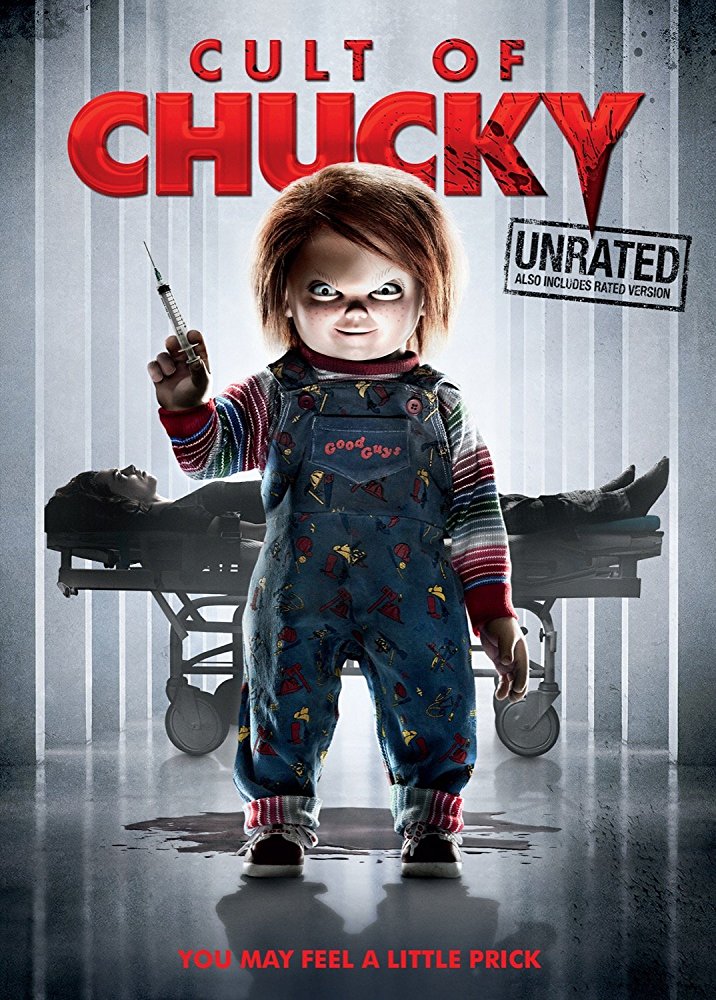
REVIEW: Cult of Chucky


It's sort of an unspoken rule that franchises tend to get worse and worse as they go on (especially when it comes to horror). Of course, this isn't true of all sequels, but the number of follow-ups that actually innovate and improve upon the groundwork laid by the first film is a proverbial drop in the bucket compared to the raging tidal wave of mediocre, derivative retreads pumped out of the Hollywood machine. Typically when a horror franchise makes the jump straight-to-video, it's a sign that the series is all but dead and buried (see Hellraiser, Leprechaun, and countless others). It signals an admission of weakness; the studio does not feel confident enough in their product's money-making potential to justify the cost of a theatrical release, so the best they can manage is to recoup their cost by skipping theaters altogether and going straight to home video. Sometimes, however, a direct-to-video sequel can surprise you. Like I've explained, it's fairly rare that a non-theatrical sequel to a classic horror franchise ends up any good, especially when said franchise dates back well over a decade, and especially when the sequel in question is movie number seven. Which brings us to Cult of Chucky, a follow-up to 2013's Curse of Chucky, which in and of itself was something of a revival of the Child's Play franchise (after its steady descent into comedy schlock during the late 90's/early 2000's).


Right off the bat I've got to commend the filmmakers for not taking the easy way out; this is by no means a soft-reboot. It's a clear benefit of smaller-profile releases such as this; while large-scale blockbusters like The Force Awakens and Jurassic World are forced to retread old ground in order to appeal to younger demographics, movies like Cult of Chucky are free from such boardroom legislature. The movie picks up essentially right where Curse of Chucky left off, and assumes you're familiar with every film in the series thus far (if you're a bit rusty, as I was, a quick trip to Wikipedia is invaluable before viewing; alternatively, just marathon the entire series, it's a fun time). We find our protagonist from Curse, Nica (Fiona Douriff), serving time in a psych ward after the justice system deemed her a more likely murderer than a knock-off Cabbage Patch Kid. After transferring to a new facility to continue her treatment, it isn't long until Chucky (Brad Douriff) comes calling to settle his debts. 

The movie isn't nearly as straightforward as one might expect, subverting the formula beyond the usual "THE DOLL IS ALIVE, I TELLS YA, I SWEAR I'M NOT CRAZY" schtick one might expect from such a premise. In our opening scene, we see Andy Barclay (Alex Vincent, reprising the role he played at the age of six in the first Child's Play) living in a remote cabin in the woods, his only company being Chucky's severed head (whom he routinely tortures when he's got nothing better to do). With Chucky seemingly in two places at once (and our protagonists being a mental patient and a man who experienced severe, Chucky-related trauma at a young age), the viewer is left wondering what is real and what isn't. The movie plays fast and loose with our perceptions, adopting a much more psychological bent than the standard slasher fare one would expect from this franchise. By the third act, I was able to more or less guess what was going on, but there were still enough red herrings and misdirects that I was never 100% certain that I had this movie pinned down. It never gives the viewer the chance to become totally comfortable in their assumptions until the climax, when the film finally tips its hand and clues us in on what exactly has been going on all along; the result is imaginative, original, and thoroughly engaging.


I also need to compliment the film on its sense of tone, toeing the line with expert finesse between horror, mystery, and black comedy. There's never a moment where a joke breaks the tension completely or pulls the viewer out of a moment; it all feels very homogenous and natural, which is so often the downfall of genre-benders such as this. There's bits of humor and levity, but the threat is still very much real; we're able to laugh at Chucky's sarcastic wise-cracks, but we still feel tense when he's in the same room as characters we've come to care about. It's a delicate balance that not every film can pull off, but which Cult really displays a fine mastery of. I feel like a lot of this is thanks specifically to writer/director Don Mancini; he's been heavily involved in the Child's Play franchise since the very beginning, so it's clear he has a deep and intimate understanding of how this particular monster works.

It's also worth noting that this is a very good-looking movie, not only in terms of set design and special effects, but in terms of cinematography as well. The camera really has fun with its environments, implementing PoV shots, dolly zooms, and even some split-screen from time to time. It's a film with style to spare, helped along by the cold, sterile environment the bulk of the story takes place in. The clean, white surfaces of the mental institution are just begging to be hosed down with fake blood, the perpetual snowfall outside lending a sense of eerie calm and isolation. Pair that with the old-fashioned uniforms of the nurses and orderlies and you're left with a place that feels both alien and familiar, like something out of a dream. It's not necessarily the first environment I'd think of to set a smart-mouthed killer doll loose in, but damned if it doesn't work.


Speaking of, Chucky himself is looking better than ever. He's still 100% practical, portrayed by a series of animatronics and puppets; it almost feels like cheating, since a doll is expected to have a sort of artificial, plastic-y look to it, but it's clear that the effects team went above and beyond. Chucky is just so expressive, especially when it comes to his eyes, to the point that he's more believable as a living character than many of the big-budget creatures I've seen in recent years (I'm looking at you, surprisingly fake-looking apatosaurus from Jurassic World). Part of this is helped along by the vocal performance of Brad Douriff, still the only actor to ever portray Chucky on-screen. It's the role he was born to play, yet I still find myself questioning who I think was the strongest part of this cast, Brad Douriff, or his daughter, Fiona. Nica, as a protagonist, is so easy to root for (beyond the sympathy she earns off the bat for being confined to a wheelchair, terrorized by a killer doll, and framed for the murder of her family) and Fiona Douriff really brings so much more to the role beyond the usual "beleaguered horror protagonist whom no one believes" (especially during the final act).


All in all, Cult of Chucky is far better than I think it has any right to be; granted, it offers essentially nothing to those unfamiliar with the series thus far, but it works fervently against all odds to deliver an engaging, interesting, and above all original entry in a decades-old slasher franchise. It's a real testament to the power of love in filmmaking; Child's Play hasn't been a theatrically-viable franchise since the early 2000's. It's clear that everyone who worked on this project, from Douriff to Mancini to Jennifer Tilly, is here because they want to be. This is no quick cash-grab or tax write-off, there's legitimate passion and enjoyment for what they're doing, even though what they're doing is part seven in a slasher series about a serial killer who sealed his soul inside a doll through the use of voodoo magic. There's a self-awareness to it (it wouldn't really feel like Chucky if there wasn't), but there's absolutely zero cynicism, and I feel like that makes all the difference in the world.

May 19, 2017

REVIEW: Alien (2003 Director's Cut)


Film, being an art form, is largely a subjective medium. Different movies appeal to different people with different tastes. The vast majority of things I write about here is entirely opinion-based, built off of my own thoughts and personal experiences. However, there are some instances where a film's quality can be measured on an objective scale (for better or for worse). Ridley Scott's 1979 film, Alien, is one such movie, in that it is unquestionably an objective masterpiece, seamlessly blending the genres of horror and sci-fi. The late 70's saw something of a revival for sci-fi movies; the novelty of space travel had worn off in the years since man walked on the moon and most science fiction was regarded as childish and cornball. Much like the titular creature in Alien, the genre was primed for rapid and radical evolution. Star Wars brought the concept of space adventures back into the public eye, re-framing classic story elements in a fantastical and imaginative world. Kubrick's 2001: A Space Odyssey presented a view of a future that could very well happen, albeit in a far-out, shiny, and sterile fashion. Out of all the films of this sci-fi resurgence, Alien was the first to approach the concept of futuristic space travel as something not only mundane, but as something we might want to reconsider altogether.

The plot is as classic and straightforward as can be, incorporating age-old haunted house tropes in a new and fascinating locale. The crew of the space-freighter Nostromo is awakened from hyper-sleep after the ship's computer picks up a distress signal. As per company guidelines, the crew is required to investigate, touching down on a barren, primordial planet. An away-team is assembled to explore the source of the signal, a massive and foreboding derelict space craft. Once the crew is back on the ship, they discover that a hostile alien creature has stowed away on the Nostromo, skulking through its claustrophobic corridors and picking people off one by one. It's essentially a slasher in space, but to simply describe it as just that and nothing more would be a gross oversimplification, ignoring just why this film works as well as it does.


The most immediately striking element is the set design, care of Michael Seymour. The Nostromo is an industrialized maze, filled with tight hallways, dangling wires, and deceptive shadows. It's the perfect hiding place for a biomechanical creepy-crawly like the Xenomorph, in that we never know what could be lurking around each corner (or in the walls, or in the ceiling, or in the vents, or, well, anywhere for that matter). By contrast, the derelict ship (designed alongside the creature by the brilliant H.R. Giger) takes inspiration from Gothic architecture, boasting high, vaulted ceilings and intricate details. We spend the first part of the film getting acquainted with the cramped, manmade halls of the Nostromo; by the time we enter the derelict, the change in scenery is so radical that we immediately know something isn't quite right. The film revolves around a fear of the unknown and exhibits a tremendous talent for subverting audience expectations.

Alien is very much a slow burn; it isn't until a good half hour in that anything even remotely out of the ordinary happens. This sense of routine, of making space travel into something totally mundane, plays a big part in just what makes the movie work. The Nostromo isn't an intrepid starship in search of adventure and discovery, so much as it is the outer space equivalent of a big rig, hauling freight from one destination to another. The crew isn't a gang of strange and exotic spacemen; instead, they're simply a bunch of blue-collar working joes. The first time we meet them, they've just woken up from stasis and are making small talk over the breakfast table, discussing their pay and the quality of the coffee, cigarettes in hand. The film goes a long way to sell the audience on its premise by making the world feel both believable and organic. In doing so, the premise becomes that much more real, a vital component of any effective horror movie. 


The film is also masterfully adept in manipulating an audience's expectations. I've said before that a well-crafted horror film will find a way to "train" the viewer to respond subconsciously to specific cues, only to subvert those expectations when delivering the scare. For example, there's a scene early on in the second act in which Ripley (Sigourney Weaver), Parker (Yaphet Kotto), and Brett (Harry Dean Stanton) are looking for the newborn alien. The tension builds and builds as they open up a locker, only to find Ripley's cat, Jones, instead (in what is possibly the movie's only totally pedestrian jumpscare). Soon after, Brett wanders off to find the cat, only to come across the newly-grown alien instead. By now, a subconscious pattern has been established; looking for the alien means that they'll find the cat, looking for the cat means that they'll find the alien. Which is why, near the end of the film, we fully expect Ripley to run into the alien when she hears a noise she assumes to be her cat. Instead, the noise actually was the cat this time; cut to the alien menacing Parker and Lambert (Veronica Cartwright) instead.


For this particular Review, I decided to revisit the 2003 Director's Cut of the film, seeing as how I usually just default to the 1979 theatrical version. For all the praise I could heap upon this film, there's just very little that hasn't been said before; entire books have been written on why Alien is one of the greatest films ever made. That said, I find the Director's Cut to be quite intriguing in its own right (even if I still prefer the original version that released some 38 years ago). The changes are largely superficial and, for the most part, totally inconsequential. A few shots are added, some are removed, but there are only a handful of changes that drastically affect the picture itself. There's a shot that Ridley Scott decided to add back in that I sincerely wish remained in the theatrical version, in which we see the creature hanging from the rafters just moments before it attacks Brett. I'm a huge fan of the multiple "hiding in plain sight" moments in this movie, and this shot completely took me by surprise; the effect is chilling. There's also a strong moment where we see Lambert attack Ripley for not opening the airlock; while it helps feed the tension of the scene, it's understandable why it was cut, as it tends to draw attention away from the recently-facehugged Kane (John Hurt).


Most notable of these changes is a moment during the climax, in which a fleeing Ripley discovers the cocooned bodies of Brett and Dallas (Tom Skerritt). This scene was originally cut because it completely killed the pace of Ripley's frantic escape, but its inclusion in Scott's personal Director's Cut of the movie says something interesting, I feel. In the scene, we see Dallas and Brett slowly turning into alien eggs; from a modern context, we can say that this somewhat clashes with the since-established mythos of the creature (since the sequel, Aliens, introduces the idea of an egg-laying Queen). Scott has often referred to Alien as his baby, and expressed his distaste that the series has gone on to be nothing more than cheap, action/horror schlock. The Director's Cut was released in 2003; by then, the Alien franchise had long since gone down the drain with critical flops like Alien 3 and Alien: Resurrection (not to mention, the utterly braindead Alien VS Predator was but one year away). By reinstating the cocoon scene in the Director's Cut, Scott is separating his vision from everything that came after it; there is no Queen Alien, there are no Colonial Marines, there is no Dog Alien or Predalien or anything of the sort beyond that which he himself created. Just as with Prometheus, the inclusion of this cut scene feels like an attempt by Ridley Scott to exert some degree of personal control over his creation that has long since gotten away from what he originally intended it to be. 


Alien is a bonafide classic, one of the greatest films ever made both in terms of horror and science fiction. Everything about it, from the subtle, sweeping camerawork, to the naturalistic performances, to the beautiful and horrfying art design and special effects work of artists such as H.R. Giger, Carlo Rambaldi, and Ron Cobb, is just an unending joy to take in. The Director's Cut, while just slightly inferior to the original theatrical version, offers a fascinating look at what could have been. We can see not only what was originally planned for the film, but what Ridley Scott might have done differently after nearly 30 years of gestation and rumination. No matter what way you shake it, the film is mandatory viewing for anyone who loves the art of cinema. If you somehow haven't seen this one yet, turn out all the lights and settle in for a gorgeous nightmare that remains unrivaled to this day.