Showing posts with label comedy. Show all posts

January 19, 2019

REVIEW: The Favourite


It may be jumping the gun to say something like "Yorgos Lanthimos is one of my all-time favorite filmmakers" after only seeing two of his films, but... here we are. While I still have yet to see The Killing of a Sacred Deer or Dogtooth (they're on the list, alongside the rest of his filmography, I promise), The Lobster put him on my radar in a big way. When I heard that he would be directing The Favourite, I leapt at the opportunity to see one of his films in theaters. Again, it may be premature to say that he is one of my favorite filmmakers of all time (and indeed, one of the finest filmmakers working today), but saying the man is two for two in my books would be an understatement. I was excited to see what he had to offer with The Favourite and left the theater not only satisfied, but fairly confident that I had just seen the best film of 2018.

Set during the War of Spanish Succession right around the start of the 18th century, the film focuses on the tumultuous relationship between Queen Anne (Olivia Coleman) and her close adviser/secret lover, Sarah Churchill, the Duchess of Marlboro (Rachel Weisz). Ill and eccentric after a life of tragedy, Anne cares little for governing or warfare, delegating the majority of her decision-making to Sarah (much to the dismay of Earl Robert Harley (Nicolas Hoult) and his fellow Tories in Parliament). This all changes with the arrival of Abigail Hill (Emma Stone), a former lady of status and Sarah's younger cousin. Hoping that her connection to Sarah will allow her to gradually re-build her social standing, Abigail eventually begins to usurp her cousin's role as the Queen's favourite. What follows is a brutal, hilarious ballet of deception, blackmail, and wit as the two women vie for the affections of the ailing Queen (and all the privileges that come with it).


The most immediately striking thing about this film has got to be the performances. Everyone in the supporting cast does a fine job (shout-out to Horatio, the fastest duck in the city), but the main trio of women absolutely make this film. Olivia Coleman gives one of the best performances of the year as Queen Anne, playing the sickly monarch in a way that's as hilarious as it is multifaceted. She's damaged and crazy and unpredictable, but you never get the impression that she's nothing more than a punchline. She's very much an active player in the conflict between Abigail and Sarah, even if it doesn't appear as such at first glance. She's a character who could have been little more than a plot device, a living maguffin for Stone and Weisz to quarrel over and manipulate, but Coleman imbues her with a true sense of pathos; we get occasional glimpses into her world, revealing her to be a flawed, pitiable person who's suffered repeated and tremendous loss in her time as Queen. There's a strong undercurrent of mockery directed at aristocracy and the ruling class, but Anne is still primarily painted as a truly sympathetic character. "The Queen is crazy" isn't the fullest extent of the joke, as The Favourite goes for something a little more conceptually ambitious in how it deals with conflict and drama.

Nowhere is this more evident than in the relationship between Abigail and Sarah. I'm a big fan of movies that subvert audience expectations, when done properly. It's a tricky business to get right, and I always see people defending poor examples of subversion by insisting naysayers only want movies to break the mold in ways that they were already expecting (and therefore comfortable with). In reality, it's far from being so simple. Anyone can do something unexpected; I could write the rest of this Review in Mandarin, because surely you wouldn't normally expect that to happen, but doing so wouldn't give my work an inherent value for that reason alone. Well-crafted subversions of audience expectations serve to enhance the story, taking things in a new and exciting direction that adds a new dimension to the events playing out on-screen. This is something screenwriters Deborah Davis and Tony McNamara understood when crafting the characters that Stone and Weisz brought to life.


When we're introduced to Emma Stone's Abigail, she's a polite and filthy young girl, having just been shoved out of a moving carriage into the mud. It's a sharp contrast to Weisz's Lady Sarah; cold, manipulative, and at times downright cruel in her indifference towards the Queen's problems. It establishes a clear protagonist/antagonist situation with Queen Anne stuck in the middle. Abigail has been used and abused her entire life, robbed of her birthright and reduced to working as a scullery maid. She's a humble yet ambitious young lady who's found herself in a particularly low place in life through no fault of her own, so she's easy to root for at first. Meanwhile, Sarah enacts her will on the country by whispering in the Queen's ear and slipping into her bedchamber behind her husband's back, seemingly looking out for none but her own interests. At first glance, it all appears very cut and dry, but that's where the truly gripping elements of the plot come into play.

As the story progresses, we notice a gradual shift in character dynamics as more and more comes to light. We learn that, although she exploits her position as the Queen's favourite for personal gain, Sarah truly does care for Anne, both as a friend and lover. What on the surface appears to be a simple lust for power is eventually revealed to be a legitimate sense of duty; the Queen is far more concerned with playing with her rabbits than she is with waging war on the French, leaving Sarah with the responsibility of maintaining a nation. It's Sarah's dedication to the war effort that leaves her momentarily unavailable to stay by Anne's side, allowing Abigail the chance she needs to hook her claws into the sad and lonely Queen. What first appeared to be the story of an underdog hoping to improve her station in life soon becomes the tale of a malicious schemer, drunk on power and status, eventually resorting to truly abominable actions to ensure her position is secured. We really get to see a 360 view of this seemingly straightforward conflict, with first impressions dissolving before our very eyes as we learn more and more about who these characters actually are.


Of course, the actors aren't the only element of this film worth praising. As with The Lobster, Lanthimos exhibits his truly distinctive directorial eye, creating a style that compliments both the dry, comedic elements and the more serious, dramatic elements of this story. From a stylistic standpoint, the film is very unique without feeling as though it's trying too hard to stand out from the crowd. There's a real sense of creative confidence at play here; nothing is presented the way it is for a purely superficial reason, and you never lose the feeling that Lanthimos (along with cinematographer, Robbie Ryan) knew exactly what he was doing with every scene and shot.

The whole thing is shot on-location at Hatfield House in Hertfordshire, England, so nothing feels like a set. The spaces these characters inhabit feel appropriately lived-in, lending the whole thing a real air of authenticity (even though the actual historical accuracy of the plot is questionable at best). I admittedly found myself getting a lay of the land as the film went on, becoming very familiar with spaces such as the Queen's bedroom and the lush, well-kept grounds. The strong reliance on naturalistic lighting and use of classical music only adds to the authenticity, and that atmosphere of historical realism contrasts wonderfully with the dry, absurdist humor at play. It's a relationship summed up in a visual sense through the film's occasional use of a fish-eye lens, moving away from the many spacious wide-shots the film is littered with and portraying things from a warped, exaggerated perspective. It's like a metaphor for the presentation of the film as a whole; aesthetically, this is but one or two degrees away from your standard period drama, yet the dry sense of humor and use of visual comedy keep things skewed just enough to stand out from the herd, at least on a subconscious level.


Overall, I don't really have anything remotely negative to say about The Favourite. It's a hilarious comedy, a compelling drama, and a gorgeously-shot period piece all in one. Brought to life by a remarkably talented cast of actors all giving award-worthy performances and helmed by one of the most unique and talented directors working today, I can't very well think of a reason not to recommend this to just about anyone. I suppose, as with The Lobster, the unorthodox presentation may at times seem intimidating to those in search of something more by-the-numbers, but like The Lobster, I feel this is absolutely a film worth engaging with, even if it's outside of your typical comfort zone. I'd go as far to say it's a modern classic and absolutely can't recommend it enough, go check it out.

October 15, 2018

REVIEW: Tusk


There's something to be said in favor of films that seem to revel in their own stupidity. Movies that completely and utterly understand what they're about and make no pretense about being anything more. Tusk, released in 2014, was inspired entirely by a gag hypothetical on director Kevin Smith's podcast, Smodcast. Smith had stumbled upon a bizarre personals ad (later revealed to be the work of poet/prankster Chris Parkinson) which described a room for rent; lodging was free of charge, on the condition that whatever would-be tenant wear a handmade walrus costume for several hours every day. Taken with the idea, Smith then immediately pitched a horror/comedy film built around the same basic concept. Judging from the excerpt of the podcast we hear during Tusk's credits, it was to have its tongue planted firmly in its cheek, presenting something absurd and idiotic in the most over-the-top serious fashion manageable. To some extent, the end result succeeds in what Smith and pals were going for; I love the fact that the line, "Is man indeed a walrus at heart?" made it into the final cut, as moments such as that demonstrate everything a film like Tusk should be. If only it could maintain such an overwrought facade for the entirety of its slightly-excessive 101 minute length. Whereas certain elements of this film capture the tone of a straight-faced genre parody flawlessly, the majority of its runtime left me feeling as though I was watching a comedian who couldn't stop laughing at his own joke before he'd even gotten the punchline out.

The story follows jerkass podcast host, Wallace Bryton (Justin Long), as he travels to the Great White North to interview the beleaguered star of a famous viral video. After the kid in question is revealed to have killed himself out of embarrassment, Wallace is left without a subject for his podcast segment (not to mention, any and all sympathy for the deceased or his family). That is, until he stumbles upon a personals ad hanging in a dive bar bathroom that promises free room and board to anyone willing to listen to the life stories of a former maritime explorer. Intrigued by the amount of mean-spirited web content he could generate from such a meeting, Wallace travels to Bifrost, Manitoba to interview the enigmatic Howard Howe (Michael Parks), who regales an enraptured Wallace with tales of his past adventures. Naturally, things take a turn for the absurd as Howard eventually drugs Wallace's tea and begins surgically transforming him into a walrus. Meanwhile, it's up to Wallace's co-host and girlfriend (Haley Joel Osment and Genesis Rodriguiez) to travel to Canada and, with the help of a painfully unfunny Johnny Depp cameo, rescue their friend before it's too late.


As I said before, the origin and mission statement of this movie are arguably the best things about it. There's something pure and wonderful about the idea of a filmmaker coming up with a hilariously stupid idea, gathering some friends, and saying "this sounds fun, let's make it". Honestly, good for Kevin Smith; he started at the bottom and has long-since shilled his way to the top, finally amassing enough disposable wealth and studio clout that he can make literally whatever he wants. That's every filmmaker's dream, and I don't blame him for utilizing the advantages he's accumulated over the course of his career in order to make that dream a reality. I just wish he'd take it even slightly seriously; Tusk is designed from the ground up to be something nonsensical and absurd, which I get. The only problem is a terminal lack of commitment. It tries to be a horror/comedy and fails on both fronts, deciding to be nothing instead.

There are moments in Tusk in which the horror is legitimately effective (namely when, spoiler-alert, Wallace is completely transformed into a grotesque approximation of a human walrus). There are also moments where the deadpan "I'm not sure if this is supposed to be a joke" style comedy works well (see the aforementioned "Is man indeed a walrus at heart" line). The problem is, these moments are few and far between. Tusk clearly aims to lampoon the Human Centipede school of horror films, in which irritating protagonists suffer comically grotesque consequences at the hands of mad doctors who scream inane platitudes over classical music, acting to the rafters while covered in buckets of fake blood. The foundation is there, but the execution is what kills this experiment in its tracks. You get the impression that Smith and company are just screwing around; while a sense of behind-the-scenes fun can often enhance lesser films and make for a more entertaining, enjoyable experience, here it just feels like a millionaire wasting everyone's time. I'm totally down for a self-aware genre parody about Justin Long getting turned into a walrus, but I found myself wishing that Kevin Smith would just stop dimly giggling into a bag of Funyuns and tell an actual joke for once.


Nowhere else is this feeling of frustration more evident than the scene where Johnny Depp appears as a former inspector who has been hunting Howard down for several years. Imagine a friend of a friend telling a supposedly hilarious story of the last time they were drunk; it drags on forever and ever and is not once even remotely entertaining, only to end with "well I guess you just had to be there". That's Johnny Depp's character in this movie. It's Johnny Depp doing a bad Québécois accent and eating a cheeseburger while he tells a monotonous story. Every time he says someone's name, he says their full name and title. Every. Single. Time. This is the joke, please laugh.

Really, the only notable performance here is Michael Park as Howard, and I get the feeling that he only stood out because he's a dignified-looking older gentleman with a very nice voice saying completely ridiculous things. His part could have been played just as well by any kindly-looking actor, a John Hurt or Jim Broadbent type. He does his job well, but it's not anything mind-blowing. Justin Long pulls off the insufferable fame-hog role a little too well, but I will give him credit for how well he tapped into his inner walrus once he was sewn inside the massive, stitch-covered suit. There are honestly some things I liked about Tusk; they just had nothing to do with the script, performances, or overall execution of the film itself.


Tusk is a movie I sincerely wish I could love. The entire reason it was made in the first place is that some friends came up with something that made them laugh, they said "we should make this into a movie", and then they went and did it. That's a remarkable, beautiful thing that should be celebrated and lifted up as a paragon of artistic expression. The key words being should be. The reality of the situation is that Tusk is nothing more than a self-indulgent waste of time that thinks it's far more clever and hilarious than it really is. The concept is solid in an unapologetically silly kind of way, but that's where the thought process on this project started and ended; Kevin Smith said "wouldn't it be funny if we made a horror movie about a man getting turned into a walrus?", dug three million dollars out of his couch cushions, and the end result is Tusk, a movie that provides nothing especially entertaining to anyone but the people who made it. That said, I've heard that it's still far better than Yoga Hosers, so maybe I shouldn't be so quick to judge.

September 21, 2018

REVIEW: The Predator


There are a few notable trends that I keep noticing in modern movies that I'd like to talk about for just a bit. The first (and most irritating) is Hollywood's obnoxious over-reliance on 80's nostalgia. G.I. Joe, Transformers, Ninja TurtlesRobocop, Terminator, Thundercats, Ghostbusters; if it existed in the 1980's, you're probably gonna see its fetid corpse unearthed and propped up by a hack studio to make a quick buck. We've also witnessed the rise of the soft-reboot; a film that is, for all intents and purposes, a remake/reboot of a classic film franchise, except it's stated to take place in the main series continuity, making it a sequel, and thus okay. I feel like the most notable of these is The Force Awakens, but it's hardly a rarity nowadays, especially for big-budget franchises with a lot of brand recognition. We've also been seeing a lot of movies get utterly destroyed through reshoots. Normally, reshoots are a relatively innocuous practice, but it feels like as of late, more and more big-budget projects are suffering the slings of studio interference, producing an end result that turns out worse than anyone could have possibly predicted. The reason I choose to mention all of these phenomena is that Shane Black's The Predator manages to be a sterling example of all three with shockingly little effort.

The film opens as one would expect a Predator film to, with a spaceship hurtling towards Earth. After crash-landing in the South American jungle, everyone's favorite human-hunting space monster has a run-in with an Army Ranger by the name of Quinn McKenna (Boyd Holbrook). Battered from the crash, the Predator (Brian A. Prince) is actually incapacitated by the hard-boiled sniper, who makes off with the creature's mask and wrist gauntlet. Sensing that he's seen something he wasn't meant to have seen, Quinn mails the alien tech back home before he's taken into custody by government agents. Naturally, the government has captured the Predator as well, who inevitably escapes and sets out in search of his stolen gear (which has since ended up in the hands of McKenna's autistic son, Rory, played by Jacob Tremblay). With the help of a renegade biologist (Olivia Munn) and a ragtag gang of disabled veterans, it's up to Quinn to keep his son out of the way of an interplanetary blood war, all while avoiding the shadowy government agents who want him disappeared. Despite how exciting that may sound, I assure you large chunks of this movie are dull as all get-out.


When this movie was first announced, I was understandably optimistic. Shane Black is a solid director (who also starred in/wrote parts of the original Predator), and a natural choice to helm the next entry in the franchise (redundant title notwithstanding). Predator is one of those rare films like Robocop that works both ironically and unironically well; it's the movie that made Arnold Schwarzenegger an action superstar, and it's chock-full of all the hilariously dated tropes and clichés one would expect from such a film. At the same time, it executes its deceptively simple premise startlingly well, balancing both action and suspense until things reach a head at the surprisingly small-scale climax. It's got all the excess that 80's action movies are lauded for to this day, but it also understands and appreciates the effect some quieter, more intimate moments can have when establishing atmosphere and tone. If they wanted to have a soft reboot of Predator that took itself seriously for the most part, they could certainly do so and have it work out nicely; 2010's Predators is living proof of this.

Alternatively, if Shane Black wanted to turn the whole thing into an utter farce, lampooning the various action tropes that the original Predator helped establish, I could see that working out as well; plenty of relatively serious films have successfully made the transition to more comedic fare as time's gone on (the most notable example that comes to mind being the Evil Dead trilogy). Black has a penchant for snappy dialog, and his role as Hawkins in the original film provided much of the early comedic relief. This appears to be the approach that The Predator is going for, but unfortunately the whole thing runs into a critical error; it's not particularly funny. There's a few one-liners that got a sensible chuckle out of me, and the gore has the tendency to reach Monty Python and the Holy Grail levels of cheap, slapstick-y excess, but I doubt anyone would describe The Predator as a rollicking good time (unless a character saying "get to da choppa" before escaping on a bunch of stolen motorcycles is your idea of clever writing). Really, the script here is so bad that it gives Jurassic World: Fallen Kingdom a run for its money, with such winners as "Motherf-cker hacked our vehicles" and "F-ck me in the face with an aardvark".


In the film's defense, the first act is more or less exactly what I wanted it to be; it's by no means groundbreaking, but it's a reasonably fun monster movie with some solid action (in particular, the sequence in which the Predator escapes from a government lab). But everything goes downhill quickly soon after that scene, up until the point that our bigger, badder, entirely CGI rival Predator shows up. After this new monster is introduced, the entire film breaks and goes down the drain, devoid of any intellect or charm it may have possessed beforehand. Before that point, the lackluster performances, groan-worthy one-liners, and bland, forgettable characters were just sort of there, but it was around this time that it all compounded and started actively making the movie worse, dragging it down into the realm of pure trash. From what we've learned, apparently the entire third-act of the movie was rebuilt from the ground up at the behest of 20th Century Fox, so it seems as though this is another film that may have had the potential to actually be something not terrible before a bunch of studio suits decided to stick their slimy paws all over it. Honestly, I'd have happily accepted a Predator movie that was "just okay", but instead got something that appears to put active effort into being terrible. And that's not even touching the way The Predator attempts to tackle such weighty topics as mental illness and climate change.

There was a clear attempt at having some subtext, pitting a team of mentally-disturbed veterans and a young child with Asperger's up against an alien menace who has modified his own DNA to become a genetically-perfect being. Truth be told, giving the main group of heroes in an action/slasher flick a host of neuroses and disorders to deal with in addition to the impending extraterrestrial threat is a pretty fascinating idea that could really result in something spectacular if handled properly by a talented filmmaker (like, say, Shane Black). Instead what we get is a series of jokes where the punchline is "the guy with Tourette's said something profane" and a kid who can use the power of autism to operate alien technology as if he were R2-D2. The disorders in this movie are treated as either a punchline or a plot convenience; I'm not even going to harangue The Predator for how potentially offensive such a portrayal is, that's just lazy writing. I'm still struggling to wrap my head around how this even turned out so bad; this is a movie written by Shane Black and Fred Dekker. These are the guys who gave us The Monster Squad for crying out loud, what the hell happened? Was this a Producers-esque scam? Or did the studio seriously interfere that much? No amount of explanation is really going to save this trainwreck, but I'll admit that I'm the least bit curious.


I'll admit, for all of its problems, The Predator would actually make for a pretty good bad movie. I can easily see this working well in a room full of intoxicated friends, or with a rowdy audience at the local theater; but at the same time, it's important that everyone understand that statements such as these aren't exactly points in the film's favor. If the kindest thing you can say about a movie is "it's not offensively bad, it's just stupid and forgettable", there's clearly a problem, especially when talented people are involved. It could be fun with the right audience, but then again so is the first Predator. Predator didn't need to be "ironically good", it was just "good". Every idea we see here (Predator hounds, genetic modification, a crazed government alien-hunter, a ragtag gang of ex-military guys throwing out vulgar banter, etc.) was already done far better in other Predator movies (yes, even Predator 2). Is it the worst thing ever? No. But is there a solid reason to run out and watch it? Also no.

August 27, 2018

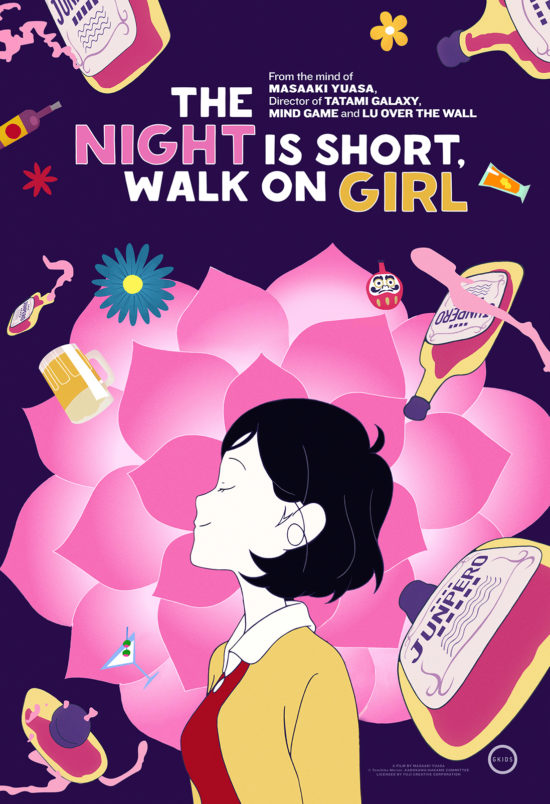
REVIEW: The Night is Short, Walk On Girl


For as much as I like to say I enjoy anime, the irrefutable truth of the matter is that I'm basically just a novice; I've watched Fooli Cooli and Gurren Lagann  a couple of times and I'm currently enjoying My Hero Academia, but it's safe to say that there are vast parts of the medium that I still need to explore. I was, for example, completely unfamiliar with the work of Masaaki Yuasa; that is, until I decided to check out The Night is Short, Walk On Girl (loosely adapted from the Japanese novel of the same name). I saw the trailer on Facebook just by chance (or perhaps it was fate), but the fluid animation, whimsical art design, and catchy music told me that I just had to go check this one out (especially since it would be in US theaters for two nights only). 90 minutes later and I'm not only convinced that I need to seek out the rest of Yuasa's work, but that The Night is Short, Walk On Girl is my personal pick for the best movie of 2018 (even though it was technically released in 2017, though only in the UK and its native Japan).

The plot is, shall we say, difficult to describe. This is one of those situations where I feel as though I'd be walking a fine line between describing the premise and simply recounting every scene; it's very much like Alice in Wonderland or The Wizard of Oz, where our protagonists move from situation to situation, encountering a host of unique characters as they go on their journey. The film follows a nameless girl with black hair (typically just referred to as Otome, the Japanese word for "maiden", and voiced by Kana Hanazawa) on a night of heavy-drinking through Kyoto. Meanwhile, a similarly nameless classmate of Otome's (referred to as Senpai, voiced by Gen Hoshino) is determined to confess his feelings towards her on this fatefull night. As he explains, he's implemented a long-term plan of crossing paths with Otome as often as he can manage, under the guise of their encounters being sheer coincidence. When the time is right, he will reveal his true intentions and it will seem as if the two had always been intertwined by the red string of fate. What follows is a delightfully charming, psychadelic rom-com that utterly annihilated my expectations in the best sort of way. This is just one of those movies that feels like a vivid dream, boasting the kind of atmosphere I'd like to curl up inside of for the rest of my life.


While the movie is, aesthetically-speaking, undeniably gorgeous, the real draw for me was the thematic subtext underneath it all. This is one of those films that focuses in on that sort of "quarter-life crisis" that twenty-something college students tend to go through. We've seen so many coming-of-age stories, but what happens after the protagonists have already grown up before the plot truly began? We're told from high school onward that we're "young adults", but that feeling honestly didn't kick in for me until after I'd completed my undergrad, got a job, and moved into a place of my own. For those who go right from high school into college, the question of what comes after is something that really starts to weigh on you after you get acclimated. We act like the transition from high school senior to college freshman is a massive change, but it's really nothing compared to spending the first 22 years of one's life adhering to a more or less consistent system of schooling and socializing, only to finally cross the finish line into the stage of your life when you have to start thinking about taxes and rent and insurance. You get your degree, then what comes next? Graduate school? A career? Or just another job to pay the bills? Should you get married? Start a family? Buy a house? Do you even have the means to do any of those things? These are all the questions you start to mull over as you begin to fully and finally transition into the adult world, and said questions tend to weigh heavily on the minds of chronic over-thinkers like Senpai (or myself, for that matter).


The character of Senpai manages to transcend the usual "awkward nerd who's hopelessly smitten with the girl of his dreams" trappings by really delving into his mindset. He isn't just another gawky buffoon in pursuit of his manic pixie dreamgirl; he's insecure to the point that he outright questions if he even deserves to have his insane plan work out, or if it would be more fitting that he just shrivel up and die alone. He's become accustomed to failure, putting up walls to protect himself from the terrifying idea of what might happen if he actually gets what he wants for once, the only outcome he's completely unprepared for. Otome, meanwhile, is in the exact opposite situation; she's naturally talented at everything she tries, resolved to simply go with the flow and see where the night takes her. While she hardly has to put in any effort in order for things to go her way, she's left with a life that, compared to Senpai, lacks any semblance of drive, ambition, or purpose. The film establishes that her easy-breezy attitude towards life tends to leave those around her in the dust, leaving her with her own kind of loneliness to deal with. They're two sides of the same coin, yin and yang, but that doesn't mean they don't need to grow and change in their own ways before they're fit to be together.

The film hypothesizes that who we are is but an amalgamation of those we meet in life; whether we know them for the rest of our days or just for one drunken evening, the impact and influence they leave us with is what determines who we are and how we grow as people. The emotions these people inspire and the stories they leave us with are the things that life is made of. Feelings of isolation, loneliness, and disassociation are hardly rare for young people, especially those who find themselves in the midst of a great transitory period in their lives, and The Night is Short, Walk On Girl goes to great lengths to remind us that no man is an island. Whether you believe in fate or not, your existence is immutably intertwined with those around you (and even those you've yet to meet). We're all players in the funny, tragic, oddball play that is the human race; everyone matters, no one is truly alone, and happiness will always inevitably win out over nihilism.


Although it's obvious that the underlying motifs this movie set forth resonated with me on a deep emotional level, I want to make it clear how much I adored everything else in this movie. Like I said before, the animation is absolutely stunning (putting Masaaki Yuasa on my radar in a big way) and I really love the use of color and sound to establish a sensory experience that's at the same time fantastical and immersive. As the night goes on, an entire year seems to pass; we begin on a warm spring evening, transition into summer heat, and by the time the climax rolls around, all of Kyoto is stuck inside with the flu as unforgiving winds and snow rip through the empty city streets. I also found myself surprisingly invested in the stories of the various side-characters Otome and Senpai come across, absurd as they are. My personal favorite would have to be Don Underpants ( Ryûji Akiyama), a writer and hopeless romantic who has pledged to not change his underwear until he reconnects with a girl he had a fated encounter with some time ago. At first we assume he's just there for a one-off joke about his self-appointed nickname, but then he shows up again much later on, setting up guerrilla plays at the student festival as a means of attracting his mystery love's attention. These side-characters are all bit players compared to our two main leads, but their stories are told in such a way that it truly feels as though the plot thread doesn't end the moment they walk off-screen. We really get the feeling that this isn't just an extraordinary night for Senpai and Otome; everyone has their tale to tell, and that's really the entire message of this movie in a nutshell.


The Night is Short, Walk On Girl is really just a remarkable little movie. It's a surprisingly conventional, feel-good love story that's conveyed in the most unconventional of ways; pair that with sublime animation, supremely comfy atmosphere, a killer soundtrack, and loads of endearing and memorable characters, and you've got a winning recipe for my personal favorite movie of 2018 thus far. Yes, I know, it technically came out in 2017 everywhere but the USA, but I'd be outright lying if I said that, out of everything I've seen in theaters this year, The Night is Short, Walk On Girl wasn't my favorite. If it wasn't clear already, I absolutely adore this lovely, lovely film and would like nothing more than to just immerse myself in all the charm and good vibes it's constantly putting out. If you're a fan of anime or animation in general, you owe it to yourself to give this one a watch.

August 14, 2018

REVIEW: Eighth Grade


I'm honestly surprised it's taken this long for Bo Burnham to venture into feature films. He's a remarkably talented guy, so you can understand how excited I was for Eighth Grade, his first foray into the world of writing/directing for the big screen. Comparing the trailers for Eighth Grade to Burnham's stand-up specials, it struck me as not the sort of thing one would necessarily expect from his typical musical-comedy wheelhouse. Really, that only made me more excited to see it; I love watching comedians step outside of their comfort zones to make something that's not necessarily meant to be laugh-out-loud funny, first and foremost. The most successful comedians tend to have a knack for tapping into other base emotions aside from just laughter, and I'm happy to report that Eighth Grade does nothing to dispel that hypothesis.

The film follows eighth-grader Kayla Day (Elsie Fisher) through her final week of middle school, just before summer vacation (and the move to high school after that). It's worth noting that this isn't your typical "teen" movie; there's no big dance or talent show that Kayla needs to prepare for, and the popular girls don't go out of their way to make Kayla's life a living hell (rather, they hardly even acknowledge her existence). The plot foregoes every adolescent trope by being as purposefully mundane as possible, casting aside theatrical dramatization in favor of just being real. And not in the "omg that's literally me" kind of way, either; there are moments where Eighth Grade almost feels like a nature documentary on the middle school ecosystem, rather than an attempt to forcibly relate to a younger audience. I'm well beyond my middle school years, but this film still felt like a time-capsule based on its atmosphere alone. It takes us back to a time in our lives when pool parties and trips to the mall weren't just run-of-the-mill, everyday occurrences, but events where everything (especially image) mattered. There are small details that are sure to strike a chord with everyone for different reasons; for me, it was an unseen class clown shouting "are you my mom?" after the principal handed the mic off to a teacher during a school assembly. The film doesn't need to go out of its way to make these little moments feel important or theatrical, because they already are for Kayla; she's the focal point of the entire story. We care about her, and by extension everything she cares about (even if we're old enough to know better).


The film displays a remarkable knack for inspiring its audience to empathize with Kayla's adolescent struggles, thanks in part to the incredibly naturalistic writing and dialog. However, the factor that carries this entire film is the performances, Elsie Fisher's shining above all else. The character of Kayla is the rock on which the entire film is built; if she doesn't work, the entire thing falls apart. It's a tricky balance, given the premise of the movie, to write a protagonist who is both endearing and believably flawed. If Kayla was portrayed as overly self-aware and wise beyond her years, she'd cease to feel like an everygirl on the brink of young adulthood and start to feel more like every other stock "insecure tween" character in existence. On the flip-side, if she acted too childishly, older audiences would be alienated from her struggles with the pressures of social media and prepubescent peer interaction. It's thanks to Fisher's performance that this balance is kept intact; we'll shake our heads when Kayla makes a mistake, but we never stop rooting for her to succeed.

I honestly saw a surprising amount of myself in her, both now and looking back to my middle school years. I can remember being in middle school, making YouTube videos in my spare time (which I've naturally long since deleted, seeing as how you can watch my voice change a little bit with each upload). Middle school was a time of insecurity and immaturity, where we simultaneously don't care about anything but also care about literally everything. I remember the moments in my childhood, attending parties I wasn't sure I was wanted at, stressing out over nothing, and wanting to be treated like both an adult and a kid at the same time. The film hits a lot of easily-relatable beats without coming off as generic or clichéd, which isn't exactly an easy thing to do. I'm really looking forward to revisiting this as time goes on, maybe even after I've had kids of my own, to see how I respond to it then.


It's worth noting that the supporting cast is excellent as well; suffice to say, there are no bad performances in this entire film (a credit not only to the cast, but to Bo Burnham's skills as a first-time director, working primarily with relative unknowns and children). Jake Ryan is a delight as Gabe, the gawky cousin of one of Kayla's more popular classmates. I like to think I wasn't this much of a dweeb back in middle school, but the way I both smiled and cringed at his Rick and Morty impressions imply otherwise; his performance was yet another of the things in this movie that hit very close to home in a fun, endearing kind of way without feeling as thought it was trying too hard to make me relate. I also utterly adored Josh Hamilton as Kayla's dad; his chemistry with Elsie Fisher is fantastic, and I find that he carries a deceptively large amount of the emotional weight in this film; you get the sense that he's got his own story going on behind the scenes, as though he's the star of his own, unseen movie. I'll always cheer on the death of the idea that father figures in movies must be incompetent, pigheaded idiots, and Hamilton's performance is yet another nail in that proverbial coffin. Not to say that he's an ineffectual pushover either; he's just a man who desperately wants his daughter to be the happy person she was a few scant years ago. Arguably my favorite scene in the entire movie is what could loosely be called the climax (in a film as low-key and down-to-earth as this), and Hamilton's performance solidified it as one of the most heartfelt things I've ever seen.


Eighth Grade is the kind of movie I wish I had back in middle school (kudos to any theater that organizes all-age screenings of this film, incidentally). Heck, it's the kind of movie I wish I had in high school. Regardless, I'm glad I have it now; despite some odd pacing and unambitious cinematography, the film really has a talent for hitting you with moments that makes you realize just how emotionally invested you are in Kayla's journey into adolescence. One scene in particular had me clenching my fist so hard I'm surprised I didn't draw blood (incidentally, I'm also a little disappointed we didn't get any kind of closure regarding what happens therein, but I digress). It's definitely going to hit hard for people in my generation and younger, who found (or find) themselves growing up in an age of social media, where the forced social interaction doesn't necessarily end when school lets out. We've reached a point as a society where we're constantly bombarded with the absolute prettiest moments of everyone else's lives, and that kind of 24/7 connectivity has a unique way of making one feel completely and utterly alone. Eighth Grade is the kind of movie I intend to show my kids (if I ever have any) when they're old enough, and that's just about the highest praise I can give it. It'll make you laugh, it'll make you cry, and it'll make you look back on some of the worst years of your life with a twisted, nostalgic sort of fondness. If there's one movie this summer that deserves your hard-earned money, Eighth Grade is it. Go check it out.

August 6, 2018

REVIEW: Sorry To Bother You


One of my favorite things about film as a means of artistic expression is the way in which it allows filmmakers to present a sort of funhouse mirror version of our own reality. Where certain aspects of everyday life are tweaked and exaggerated in order to convey some sort of social commentary; it's the kind of style you find in films such as Robocop and Office Space, concealing a bittersweet truth about society behind a veneer of sardonicism and parody. After catching the trailer for Boots Riley's Sorry To Bother You before a showing of Deadpool 2 back in May, I knew it was the kind of slick-looking indie flick I just had to check out. Having finally seen it, I can definitely say that, as far as style goes, I got exactly what I was hoping for and then some. As far as everything else... well, let's just say there's a reason this particular Review took so long to post. This is the kind of movie I had to sleep on for a good long while, and I wouldn't be surprised if my opinion of it continues to change after I've hit publish. It's a very unique beast of a film, and while I'm not entirely sure that's 100% a compliment in this case, it definitely gives me a lot to talk about.

The film is set in an alternate-present version of Oakland; it's more or less the same as our world, just, shall we say, less subtle. Mega-corporations are essentially pushing exportable slave labor (seen as a fairly sweet deal by many members of the lower class), advertising has devolved to the point that brands are simply named after whatever product they're designed to move (such as "Soda Cola"), and America's number one television show is an assault on human dignity aptly titled "I Just Got the Sh*t Kicked Out of Me!"; it's a dystopia in the most mundane, everyday sense, where our collective doom is brought about by sterilized corporate overreach, rather than murderous robots or nuclear armageddon. It's here that we meet our protagonist, Cassius "Cash" Green (Lakeith Stanfield, who is way too good here to have also starred in Death Note). Low on funds and unable to find a job, Cash begins working at a telemarketing firm known as RegalView. Initially, he feels as though the job isn't cut out for him, struggling to close sales and climb the corporate ladder. That is, until one of his coworkers (Danny Glover) suggests that he use his "white voice" (a squeaky-clean overdub provided by David Cross); not so much an imitation of white people, per sey, but rather a means of code-meshing that gives off the impression that Cassius is living a worry-free life where things can only get better. With the power of his white voice, Cash becomes a superstar at RegalView, ascending to the almighty and mysterious position of "Power Caller"; however, this promotion just happens to coincide with his coworkers (along with his girlfriend, Detroit, played by Tessa Thompson) organizing a labor strike in search of better wages and benefits. I don't want to go any further into the plot, as this is definitely the kind of movie you want to go into blind, but suffice to say tensions rise between Cash and those around him after he earns his first taste of what could modestly be called success.


Like I said, I've got a lot to say about this movie, so I'd like to get everything I liked about it out of the way first. As far as visuals go, this is a strong contender for the most inventive film I've seen thus far in 2018; the cinematography gets insanely creative at times, whether it's to convey a subtextual message or to simply help sell a joke. When Cassius is on the phone with a client, he's violently transported to wherever they may be when their phone starts ringing, whether they're eating dinner or having sex on the couch. It's an inventive way to make something as milquetoast as telemarketing engaging and interesting, fully taking advantage of the visual medium they're working in. It's definitely a film with a very distinct look to it, especially when it comes to details like Tessa Thompson's various outfits and earrings (her character is an independent artist, and the film takes full advantage of this opportunity to play dress-up). This is a movie about income inequality and racially-coded language and corporate America, yet it finds a way to be fascinating from a visual standpoint, rather than just from a narrative standpoint, and that's definitely a feather Sorry To Bother You wears proudly in its cap.

I also loved the sense of humor and overall tone/atmosphere; like I said before, it exaggerates key elements of our reality, calling specific attention to details we're more or less used to seeing in our day to day lives. There's a joke later on in the film involving a rap song that made me both laugh and wince until it hurt; really, it's the film's ability to pull off moments like that that make it such an enjoyable watch. For as surface-level as some of the commentary can be, it's very smart in the way it doles it out for the first two acts. Despite how absurd things appeared, I found myself seriously invested in the moral dilemma at the heart of the plot. A lot of this is not only due to the smart dialog and writing, but also to Lakeith Stanfield; he's the perfect everyman for a movie like this, fitting right into this absurd, exaggerated universe while also staying totally down-to-earth and relatable. Just about every character aside from Cash ends up being a little hyperbolic in one way or another, so it was a smart move to cast someone so naturalistic as the focal point of the entire plot. 

SPOILER ALERT: While I don't spoil that twist (the one everyone is going nuts over), I do mention a few minor plot points. If you're looking to go in as blind as possible (which is really the only way to see this movie), be warned!


Now, if you've heard anything about this movie, you've probably heard people raving about the curveball it throws in later on in the plot; I'm going to respect the wishes of the filmmakers and not spoil it here, but I can't just pretend like I can discuss this movie without talking about it (albeit in the vaguest possible terms I can manage). While I can definitely see what Riley was going for with this plot point, I can't help but feel as though it was a punch-line to a joke nobody was telling. When the twist happened in the theater, I literally thought I was being pranked, that the entire conceit of the movie was to get people invested in an oddball but compelling dramedy about the price of success before completely going off the rails into straight-up monkey cheese territory. Now, all that said, I want to make it perfectly clear that, while it didn't really work for me, I still have to give Boots Riley and company some tremendous props for doing something so ballsy and out-there. It's really the kind of thing you have no way of predicting; if you sat 1,000 monkeys at 1,000 typewriters, they would eventually guess the plot twist to Sorry To Bother You. It's definitely a "your mileage may vary" type thing, something that no major studio would ever let a filmmaker get away with. We all act like the end of Infinity War was shocking, but it honestly has nothing on this.


While I greatly respect a filmmaker's decision to throw his audience for a loop, I still can't help but think that taking such a radical turn ended up damaging the overall narrative in the long run. In doing some research after leaving the cinema, I learned that apparently Riley had intended for the film to have a Communist message, which I found a bit concerning (for more reasons than the obvious); namely that, as far as I could tell, the film did a remarkable job of offering solid refutations to that mindset. The moral quandary that the first two acts are entirely based around involves Cash's desire to succeed, even if it means turning his back on his friends and coworkers. It's easy to see his decision as selfish at first, but we also see that he has people in his life (like his uncle, played by Terry Crews) whom he has to provide for. When Cash's friends (who aren't particularly good at their job) shame him for working hard and succeeding on his own merits, they come off as remarkably petty and hypocritical, as if Cash should allow his uncle to lose his house in order to add another body to the picket line. At one point in the movie, we learn that Detroit has a "white voice" of her own that she uses during her art installation (which is really just a more pretentious version of "I Just Got the Sh*t Kicked Out of Me!"), after she's spent the entire movie up to that point talking down to Cash for using his white voice outside of work. Steven Yeun's character (who organizes the strike in the first place) spends all of his time moralizing about unity and brotherhood and the shared struggle of the proletariat, only to act like a duplicitous, incompetent goober when no one important is watching. 

Make no mistake, Cash's hands aren't clean either (he consciously goes along with some pretty deplorable things in pursuit of a white-collar paycheck, after all), but it felt to me like the movie was doing everything in its power to avoid coming off as one-sided; all the players in the central conflict had moments where they were given realistic, human flaws, and that added a lot in terms of making this moral dilemma feel multi-faceted and real. It feels like you could make a reasonable case for either side of the argument, and it's that kind of conflict that makes for compelling drama. But then the twist happened and the film started beating us over the head with its message (which only took the form of playful and flirtatious love-taps before). When there's such a large gap between what I took away from Sorry to Bother You and what the filmmaker intended I take away from it, I seriously have to wonder where things started to get lost in translation. I certainly don't want to place this entirely on the shoulders of the film itself (Boots Riley is the one who wrote and directed it, I just paid for my ticket and interpreted what I saw from my own, lowly perspective), but I can't help but feel that something's amiss in terms of how the story is conveyed when the director's supposed intentions feel so divergent from what actually played out on screen.


For all my personal hang-ups with Sorry To Bother You, I can't really bring myself to not recommend it. There were major elements of it that just didn't land for me, but that still doesn't change the fact that this is one of the most unique films I've seen in a theater in a good long while. This doesn't feel like just another surrealist comedy, this feels like someone's unique, inspired artistic vision, and that's something I can always commend (even if, at the end of the day, it feels like it presents themes and ideas that I've seen done before and done better). The title, Sorry To Bother You, isn't only meant as a reference to the world of telemarketing, but also as something of a warning to the audience; as if to say, "sorry to bother you, but this film is gonna force you to wake up and see things as they are". I can't say for sure that Sorry To Bother You woke me up, but it sure as hell didn't put me to sleep. Avoid all spoilers, go in as blind as possible, and see what you take away from it.

July 14, 2018

REVIEW: Ant-Man and the Wasp


Speaking as someone who liked the first Ant-Man, I feel like even I have to agree with everyone else in saying "who even cares about Ant-Man and The Wasp after THAT?" I mean, can you blame us? I figured I'd change my mind and come around after the hype from Infinity War died down, but it's two months later and I still can't fathom why Marvel decided to release their biggest and most-awaited film to date before their sequel to Ant-Man. I was reasonably excited for this movie, yet I still found myself saying "oh yeah, that did just came out, didn't it?" last weekend. I went to the theater, grabbed my ticket, and settled in with low expectations for an offbeat, inoffensive sci-fi/comedy romp. Unfortunately, I feel like the filmmakers approached this project with those same expectations in mind, and therein lies the problem.

Set two years after the first film, we find Scott Lang under house arrest after the airport incident in Captain America: Civil War. He hasn't worn the Ant-Man suit since, spending his sentence making up for lost time with his daughter, Cassie (Abby Ryder Fortson); this all changes when he's contacted once again by Hope Van Dyne (Evangeline Lilly) and her father, Hank (Michael Douglas). After the events of the first Ant-Man film, the two have been working on a device capable of accessing the Quantum Realm, the mysterious, sub-atomic dimension where Hope's mother (and Hank's wife), Janet (Michelle Pfeifer), is thought to be lost. Seeing as how Scott successfully navigated the Quantum Realm in the first movie, Hank and Hope believe him to be the key to locating and rescuing Janet. Naturally, it's not quite that easy; things are complicated, not only by Scott's incarceration, but by the Ghost (Hannah John-Kamen), a sinister operative with the ability to phase through solid matter and a keen interest in Hank's research on Quantum energy. With Janet's life hanging in the balance, it's up to Ant-Man and The Wasp to save the day without violating the terms of Scott's plea arrangement.


If this movie has a strong-suit, it's most definitely the character interactions. Scott Lang continues to be one of the most likeable protagonists in the MCU, and his dynamic with Hope reaches new heights this time around. It would have been so simple to go with the old cliché of "inept but loveable man/capable but angry woman", but instead we're allowed moments to see that Hope genuinely cares about Scott. This isn't a one-sided attraction, meant to act as wish-fulfillment for any divorced dads in the audience; they work well together, both as superheroes and human beings, and this is all thanks to Rudd and Lilly's charming "workplace romance"-style chemistry. I also really liked Scott's family dynamic this time around; his relationship with Cassie continues to be tooth-achingly adorable, and it's really nice to see a divorced couple interact in a realistic yet positive manner. There's no glimmer of hope that Scott and his ex-wife (played by Judy Greer) are going to get back together, but they're both totally invested in putting their daughter first, despite the circumstances of their family situation. There isn't any of that "my ex-wife is a shrew and her new man is a tool, they're gonna get some gratifying comuppance" nonsense to be found here; it's a genuinely sweet (if a tad idyllic) portrayal of how parents and step-parents can overcome personal drama and past disputes to make a positive impact in their child's life.

Really, this movie does a lot of interesting things regarding morality and the way people overcome personal conflicts with one another. Ghost is another excellent antagonist in the modern MCU, doing questionable things for perfectly understandable reasons. Her life is at risk, the same as Janet's, so our heroes are placed in a tricky spot; if they do as Ghost asks, they're throwing away their chance at saving Hope's mother. But if they "beat" Ghost the way a superhero usually might, they're essentially condemning her to a painful death, as her condition worsens to the point that it literally causes her to phase out of existence. It's a curious predicament that leads to an admittedly inventive outcome, albeit by way of a conflict resolution that completely dismisses any and all intrigue generated by this catch-22 of a situation (not unlike the way things were resolved in Black Panther). It gives us a host of charming character interactions and a villain who plays with the story and cast in ways you wouldn't necessarily expect, only to handicap itself with a complete and utter lack of any and all ambition in every other respect.


It's a film that, compared to its predecessor, feels much more confident and self-assured of its own identity. Typically, this would be a positive thing, except that the identity in question is painfully unremarkable in nearly every way. The first Ant-Man felt like a truly daring experiment for Marvel Studios; it's the film that made everyone say "okay, I liked The Avengers and Guardians of the Galaxy, but really? Ant-Man?" It had an uphill battle to fight in winning over mainstream audiences, and it more than succeeded. Ant-Man and The Wasp, however, feels like exactly what you'd expect if you asked someone to make a generic Marvel movie. It feels like it lacks an identity of its own, especially in a visual sense, which leads me to believe that everything I found so impressive and imaginative about the first Ant-Man was just left-over details from the original Edgar Wright draft. Unlike its predecessor, Ant-Man and The Wasp has no groundwork to build off of, so everything feels noticably flatter as a result.

The action in particular suffers the worst here; outside of a fun and engaging chase sequence through the streets of San Francisco, the fight scenes here are nothing to write home about. We rarely see things from Ant-Man or Wasp's tiny perspective (which, visually speaking, was the best thing about the first movie); instead, get ready to watch that "shrink, dodge, grow, kick, shrink, dodge, grow, kick" maneuver over and over and over again. I understand that it can be challenging to showcase shrinking powers when the main villain is a normal-sized human 100% of the time, but then that's sort of the challenge, isn't it? There's also next to no ant-based action, which was a huge disappointment for me, seeing as how that's easily Ant-Man's most unique ability. Remember that insane sequence in the first movie where Scott learned about all the different types of ants he'd be using during the heist? Here, the ants are purely set dressing and transportation, nothing more (in a movie called Ant-Man and The Wasp, no less). It's a nitpick, sure, but again, why do it at all if you're not even going to try? Ant-Man is a challenging character to bring to life on the big screen, but that's supposed to be the appeal; a movie about Ant-Man isn't going to be as straightforward in terms of its action, direction, or visuals as a movie about Captain America or The Hulk. Instead of rising to the occasion like the first movie did, Ant-Man and The Wasp puts all of its chips on its (admittedly endearing) cast and ends up feeling lesser overall because of it.


All of those flaws, however, more or less fell within my expectations. I came in expecting a lighthearted, low-stakes sci-fi adventure, nothing anywhere near on the same level as Infinity War, and that's basically what I got. I can excuse some preference-based hang-ups and nitpicks for a situation like this, where the film in question isn't really aspiring to be anything more than an enjoyable, down-to-earth romp. What I can't excuse, however, is the numerous plot holes, conveniences, and outright examples of laziness found within this film's storyline. I love Michelle Pfeifer and think she's a perfect choice for the role of Janet Van Dyne, but it's not hyperbole to say that her chunk of the story is held together with chewing gum and dental floss. Everyone's talking about the amount of technobabble in this film, which, to be fair, is to be expected from a character as deeply-rooted in the world of fantastical super-science as Ant-Man. Normally, a character like Scott Lang would act as the everyman, giving Hank and Hope an excuse to put everything in layman's terms for the audience. It's a well-worn trope, but it's more or less forgivable, seeing as how it plays a practical purpose in conveying plot details to the audience (i.e. the scene in Event Horizon in which Sam Niell sticks a pencil through a folded sheet of paper to explain warp-travel). 

The only problem is that we never really get that explanation. The constant repetition of the word "quantum" is just filler, to the point that the film itself makes it the punchline of a joke. You could make the argument that this is meant to be a clever subversion of a classic sci-fi trope (since, in reality, Hank Pym probably wouldn't waste his time explaining the ins and outs of quantum science to a schmo like Scott, especially while on the clock), but I feel that it's much more likely that the filmmakers realized that if they attempted to explain the technobabble, the entire plot would fall apart. The whole point of sci-fi is that it's fiction rooted in science; it's fascinating because, even though concepts like laser guns and robot suits are fantastical, we can more or less rationalize how they might work. Here, the Quantum Realm is essentially magic; if you were to remove every instance of the word "quantum" from the script, you'd end up with a story that answers every pertinent question with "because". How did Janet survive in the Quantum Realm for 30 years without starving or going insane? Because. Why do our heroes only have a set amount of time to rescue her? Because. I'd be fine if the Ant-Man series started to become more fantasy than sci-fi (hey, the opposite worked out alright for Thor), but this just feels indefensibly lazy. Any time a plot point has to happen, the film forces it through by way of some made-up science-y sounding words. It's the same issue I had with the black goo in Prometheus, and I honestly wouldn't care if all of these conveniences didn't occur in places that are integral to the plot we're supposed to care about. You can have harmless conveniences in your movie; it's convenient that Scott happened to be robbing a house with a shrink suit in the basement in the first Ant-Man, but the film isn't lesser for it. You can use coincidence to get your characters into a predicament, but you should never use it to get them out of it, which is something Ant-Man and The Wasp does at all the worst moments. A movie can be off-beat and endearing without insulting the viewer's intelligence, but then that's a balance that this film struggles to grasp (despite a few clever moments here and there).


Despite some really enjoyable performances and some occasionally fun action, Ant-Man and The Wasp only manages to feel painfully average at best. It's inoffensive, but altogether unremarkable, which is a shame, seeing as how this is the 20th film in the MCU. If you're just looking for an excuse to go to the cinema this summer, you could most definitely do worse, and I know kids are gonna love this just as much as they loved the first one (if you have small children, it's sure to inspire less awkward conversations about the nature of mortality than Infinity War did). That said, I'm not sure I need another Ant-Man adventure after this, if this is all they're going to aspire to be. There's nothing wrong with having more low-key entries in something as massive as the MCU; movies like Ant-Man can provide some much needed levity and breathing room in-between the larger blockbusters. But just because a movie aims to be fun and laid-back doesn't mean it has to feel this unambitious and lazy. It's just a victory lap after Infinity War, and I really hope Marvel Studios avoids this kind of attitude in the future. With how much time, effort, and money they've poured into crafting the MCU into an interwoven narrative of annual blockbusters, the one thing they should never aspire to be is "fun enough, but nonessential viewing", which is exactly what Ant-Man and The Wasp turned out to be.