Showing posts with label suspense. Show all posts

November 21, 2018

REVIEW: Halloween (2018)


This isn't the first time I've spoken about the modern phenomenon known as soft-reboots on this blog and lord knows it won't be the last (at least not until general audiences and fanboy consumers get wise to the studio game and force Hollywood to come up with a new means of selling us the same product twice). Despite the negative connotation the concept of a soft-reboot carries, it's not always an inherently negative thing. Sure, it can be hard to shake the feeling that a movie was only put into production to cash in on those valuable nostalgia bucks, but there are ways for a soft-reboot to rise above being a mere cash-grab and stand on its own as a solid film and sequel. There's a reason why movies like The Predator don't work, while movies like The Force Awakens (more or less) do; each is spawned from a film that has stood the test of time and continues to stay relevant within the public consciousness, but it is only the soft-reboots that understand why that is that go on to any modicum of critical success. In a best-case scenario, a soft-reboot will not only faithfully recreate the spirit and atmosphere of a well-known property, but bring something new and original to the table, acting as a genuine continuation of the story (rather than merely shifting everyone's characters around and following the same exact plot we already know). When a soft-reboot brings something new to the table, it is able to transcend the cynical, corporate circumstances of its birth and become something truly special, such is the case with the (infuriatingly titled) sequel to John Carpenter's 1978 classic, Halloween, Halloween.

Set 40 years after the original, we once again find Michael Meyers (portrayed by both newcomer James Jude Courtney and original actor Nick Castle) escaping from captivity to wreak havoc on the small town of Haddonfield, Illinois on Halloween night. As one might expect, bodies begin to pile up, justifying the paranoid fears of a damaged, gun-toting Laurie Strode (played once again by the OG scream queen, Jamie Lee Curtis). In the years since her first encounter with The Shape all those years ago, Laurie has become a twitchy recluse, estranged from her daughter (Judy Greer), twice-divorced, and still recovering from both her severe emotional trauma and alcoholism. Convinced that someday Michael would escape to finish what he started, Laurie sets out to confront him one last time, before he can bring any more death to her little town.


The thing I'm most thankful for about director David Gordon Green's vision for this film (which he wrote alongside Jeff Fradley and, surprisingly enough, Danny McBride) is the way in which it vehemently opposes reinventing the wheel. It's made abundantly clear that this film ignores all other entries in the Halloween franchise aside from the 1978 original, cutting out all the fat and nonsense that have diluted and bogged down this perfectly simple concept since. Gone are the hokey attempts at raising the stakes; Michael Meyers and Laurie Strode are no longer secret siblings, and he's no longer under the magical control of a sinister cult. We're back to basics on this one, where Michael is just a hulking mute who feels no remorse towards his abominable actions. Really, he feels no emotions; he's a blank slate, like a shark, he just moves forward and kills without a second thought  (although he still shows a slight affinity for boiler suits and butcher's knives). It's for this reason that Michael Meyers is actually a terrifying antagonist for the first time in years. There's no attempt to explain why he does what he does. He's just pure evil given form with no rhyme or reason assigned to his actions. This unpredictability adds to the tension; the original film worked because of that sense of unease, that you were constantly being watched, and Halloween understands how to generate those same feelings. Michael Meyers could be anywhere. He could even be outside your window right now, watching you read this.


While I can't ignore the silent intensity Courtney and Castle imbue The Shape with this time around, it's no surprise that the performance everyone is talking about is Jamie Lee Curtis as Laurie Strode. In a less inspired film, Laurie would simply slip into the Doctor Loomis role, the same way Han Solo became the new Ben Kenobi, while her granddaughter (Andi Matichak) serves as the main character. Instead, we're given a Halloween movie where Laurie is once again our primary protagonist. That's not to say that her family falls by the wayside, but this is very clearly Laurie's story; we see how low she's fallen after that fateful Halloween night and watch her reclaim her agency. It's a move that, in less competent hands, would feel corny and tonally inappropriate (though likely less so than a kung-fu fight with Busta Rhymes), but is pulled off with both style and substance here. Both Curtis and the screenwriters make Laurie into a tragic, flawed character who alienates and neglects those around her. Sure, she's eventually proven right when Michael inevitably escapes from the asylum and starts carving up teenagers like so many jack-o-lanterns, but that doesn't exactly justify her toeing the line of becoming a monster herself. The other performances here are serviceable, but Jamie Lee Curtis grants this movie the legitimacy it really needs to stand on its own, and I think that's why I liked it as much as I did.

I'd definitely recommend watching this back-to-back with the original (as I did); there are a number of callbacks and references, none of which are intrusive or obnoxious, that really make this feel like a genuine continuation of the story. Michael Simmonds' cinematography manages to recreate the feeling of John Carpenter's low-key, stripped down original without feeling cheap or derivative. Paired with a haunting score (care of Carpenter himself), it really does convey the feeling that this is a true and honest follow-up to the original film. At the same time, the new blood behind the cameras bring a few of their own tricks to the table, all in service of making this stand out from its progenitor; there's an impressive tracking shot that follows Michael around the neighborhood on Halloween night that might qualify as my favorite thing in the entire movie.


That said, this is by no means a film without flaw. The plot, while engaging, starts to lose steam midway through the second act, introducing a series of plot points (such as Laurie's granddaughter Allyson's relationship with her boyfriend, played by Dylan Arnold) that never see any kind of resolution. While the climax is most definitely worth it, our means of getting there feels half-baked and sloppy (compared to the airtight first act). There's a really unnecessary twist at one point that, while surprising, makes little sense and even comes dangerously close to stripping Michael of his all-important mystique. It literally only serves to transport a character from point A to point B so that the climax can happen and it's not the only example of questionable writing to be found in this script.

There's also a lot of misplaced humor here as well. I really wish that modern films would ditch the idea that everything needs to at least partially be a comedy; just because it works for Marvel movies doesn't mean I need something to chuckle at every time I go to the cinema. With the exception of a genuinely hilarious performance by young Jibrail Nantambu, almost all of the jokes here fell flat. This is a movie that thrives on suspense and tension, instilling a paranoid fear in the audience, so lighthearted humor should be used sparingly, if at all. That's not to say the original was devoid of any attempt at comedy, but I think we can all agree that moments like P.J. Soles' monologue about textbooks didn't exactly work to the benefit of the atmosphere or tension or any of the other elements that made the original film work as well as it did. For a movie that seems to understand the beast that is the original Halloween so well, creative decisions like this caused me to raise an eyebrow, to say the least.


Criticisms aside, it's very clear that this film was a labor of love, made by fans of the original Halloween, for fans of the original Halloween. They seem to have more or less cleared that all important pitfall that so many soft-reboots fall into, striking a fair balance between reverence and innovation that make for an experience that, despite its flaws, is very hard to dislike. Had the plot and script been a tad cleaner, this would have been a home run, but as is, it's still an excellent slasher flick and a worthy follow-up to the original. A sequel has already been greenlit, so here's hoping the filmmakers continue to innovate and develop their ideas further, rather than getting high off fanboy fumes and crashing the hype train entirely in favor of "subverting expectations".

July 8, 2018

REVIEW: Hereditary


This is going to be awkward. Many a time on this blog, I've sung the praises of A24, the company responsible for distributing some of the best films I've seen in recent years (The VVitch, The Lobster, and The Disaster Artist, among others). It's gotten to the point that I get excited whenever I see an A24 logo in a trailer; the films they put out vary in terms of tone and genre, but it's safe to say that I haven't seen anything from them that I haven't completely loved. That is to say, until now. Horror is one of my favorite genres and 2016's The VVitch is one of my all-time favorite horror films; so when I heard that A24 was putting out another low-key horror film helmed by a first-time director that relied heavily on atmosphere and tension, I was all-in from the very beginning. The media push didn't hurt either, with critics calling Hereditary one of the scariest films of all time, comparable to classics like The Exorcist. I was chomping at the bit to see it, hoping for something that would surely haunt my dreams for countless nights to come. What I got instead is a somewhat clunky yet spectacularly well-acted thriller that unfortunately doesn't amount to more than the sum of its parts.

Without giving too much away, the story focuses on Annie Graham (Toni Collette, giving the performance of her career), a mother of two and independent artist working through the loss of her mother. That's honestly just about all I can say, without giving away vital plot details (or just outright lying), but I think the strong points of the film's narrative definitely lie moreso in the themes it attempts to convey rather than the actual story itself. This is a film that is very much about the grieving process, as well as the less concrete things we inherit from our parents. In case the title wasn't clear enough, I'm talking about mental illness; we're told in the opening scene that Annie's mother suffered from dissociative identity disorder and dimentia, and we gradually come to learn as the film goes on that Annie herself (as well as her children) are definitely struggling with their own issues and conditions (as such things are typically, all together now, hereditary). It's a fascinating concept to base a horror film off of; the idea that mental illness is something we're saddled with against our will from the day we're born, almost like it's been decided for us by some sinister, unknown power. The film definitely has fun with the ways in which it weaves these underlying themes into its base plot, but whether the way it does so is effective or not will definitely vary depending on one's personal tastes and expectations.


Before I delve into the elements of this film that left me feeling somewhat let-down, I think it would be a good idea to discuss what this film does right; horror (especially horror built heavily around a thematic metaphor) tends to be a subjective beast, but there are definitely several areas in which Hereditary objectively succeeds. Despite a meager budget of only $10 million, the film looks stunning. Cinematographer Pawel Pogorzelski has his work cut for him on this project, his eerily still, symmetrical framing mirroring the posed precision found within Annie's various miniature models. Combined with Ari Aster's superb direction (much like Robert Eggers with The VVitch, this is a shockingly strong debut that's sure to leave a lasting impression), the film presents a truly distinct visual style. The Graham house looks completely mundane in the best kind of way, making the eerie atmosphere hit all the more closer to home, and the stark day-to-night cuts are used to remarkable effect in the film's final scenes. It's definitely a film that, visually-speaking, knows exactly what it wants to be; it's as beautiful as it is haunting, leaving the audience with a legitimately creepy atmosphere that had me curling into my seat on more than a few occasions. This is, of course, helped along by one of the finest performances in a horror film (or indeed, any film) I've ever seen.

Everyone here more or less gives an excellent performance (in particular young Milly Shapiro, who makes her feature film debut as Annie's creepy daughter, Charlie), but they're all a distant second place to Toni Collette as our lead. I'll be honest and say I'm not 100% sure I've ever seen her in anything before this, but she's most certainly on my radar now and forever more. I can't think of any other way to describe this performance other than simply "real", in both the best and worst kind of ways (and I of course mean "worst" in the best kind of way). As one might expect, there are those moments where we simply get to see life go on as usual (lulling us into a false sense of security before things get ominous), and Collette pulls those off with aplomb. She feels like any average woman we might cross paths with at the store. And sure, once things start to get spooky, she can play scared as well as anyone. But then there are the moments where she has to completely break down, and this is when the movie becomes pure gold. Again, I'm completely avoiding spoilers here, but there's a moment around the end of the first act (those who have seen the movie know exactly what I'm talking about) where we really see her disappear into her role as this grieving, troubled mother of two. And that's not even the only moment where her performance completely blew me away; it's merely the first, where I suddenly understood that there simply had to be some sort of award nomination in her future. I'll be frank; for me, Toni Collette's performance is basically the only thing elevating Hereditary in my mind from being nothing more than a very pretty mess.


While there are undoubtedly some elements at play here that transcend the vast majority of horror films in recent years, there are also those that, as far as I'm concerned, have a much harder time getting off the ground. First and foremost is the runtime; at just over two hours, this is a film that very much feels its length. While a slow pace is often beneficial when it comes to building tension (which, as I mentioned, is something this film admittedly does very well), there has to be some sort of payoff in order for that time to come off feeling like a good investment. You have horror classics like Alien that most definitely fall under the mantle of "slow burn", but the buildup is used efficiently, generating momentum to propel us from scene to scene (and from scare to scare). With Hereditary, there isn't really much payoff to that tension until the last ten or so minutes, when the film becomes a very traditional modern horror film. Those like myself who have spent the whole film waiting for something scary to happen will feel cheated, and those who enjoyed the quiet, tense atmosphere will be disappointed in the film's regression into more conventional "haunted house" style scares. Whether you were enjoying the film or not, everyone will feel in some way dissatisfied by the time the credits roll, which is unfortunate, considering how effective some parts of this film can be.

I also wasn't entirely taken with the overall plot; the long runtime is only exasperated by the film's reluctance to show even a hint of its hand until it's far too late (and, again, rushing out an entire film's worth of exposition during the climax). I don't need my films (especially my horror films) to be predictable or straightforward, but I need a hook in order to stay engaged. The film takes a shocking turn at one point that I truly didn't see coming, and then proceeds to do nothing even remotely as interesting or unexpected until the very end. With other metaphor-driven horror films, it's typically not too difficult to get from point A to point B when dissecting the underlying themes and motifs buried within. This doesn't mean that the film lacks depth, but rather that it's conveyed in such a way that the audience doesn't have to strain themselves in order to connect the dots. For example, take The Babadook, another atmospheric horror film that is essentially one big metaphor for mental illness. The film doesn't need to dumb itself down in order for the viewer to understand what it's really about; the filmmaker makes it look easy. But Hereditary just keeps getting in its own way, bouncing from story beat to story beat without really honing in on anything specific. Instead, it places all its chips on mood and atmosphere, which, while strong, makes the entire thing feel somewhat aimless and needlessly obtuse from a plot perspective. It places story cohesion on the backburner so that, once it's all explained in the last five minutes, the audience can go "ohhhhhh, I get it" and it ends up working out about as well as you'd expect. After the first act, you spend the remainder of the film waiting for the other shoe to drop, only for the film to then spend the next hour and a half pretending like it's about to drop before gently placing it on the ground and immediately cutting to credits.


In spite of everything, I still think I would recommend Hereditary. While it definitely didn't click with me, I definitely can't speak for everyone in this case. Every element of this film that isn't related to the way the story unfolds (the camerawork, the direction, the performances, etc.) is sheer brilliance, absolute 10/10 filmmaking. The issues come in when you try to combine the haunting visuals and stellar cast with the clunky, unintuitive story. It feels like a product composed entirely of gourmet ingredients that was left in the oven for about 20 minutes longer than intended; while you can definitely appreciate the individual components on their own, it's the execution that leaves the whole experience feeling not quite as good as it should have been. But then again, I happened to see this movie with a friend of mine (who utterly loathed it, I might add). After the credits rolled, we spent a good couple of hours discussing the various themes and metaphors at play, so there's definitely something to it (though your mileage may vary). It's simply a matter of whether or not it will click for you better than it did for us. I think The VVitch is a masterpiece, yet didn't care much for this, and I'm sure there are plenty of people out there who would champion the exact opposite. If you're looking for a horror film that definitely favors the road-less-traveled in this age of generic, jump-scare-filled ghost flicks, give Hereditary a shot and see how it leaves you.

October 27, 2017

REVIEW: Would You Rather


I'd like to make one thing abundantly clear about this blog; I don't like punching down. Yes, I go out of my way to find a bad movie (or at least something that looks bad) at the end of each month. Yes, this often includes cheap, weird kids' movies that were made with exactly zero artistic intent whatsoever. And yes, it's not exactly fair of me to discuss Ivan the Incredible or Freddy Frogface in the same context as something like The Big Lebowski or Susperia. I don't go out of my way to find something trashy to tear apart each month out of a desire to really stick it to smaller, less talented filmmakers. I take no perverse joy in taking direct-to-video children's films down a peg or two. Really, I just feel it mixes things up; like Peter O'Toole's Anton Ego says in Ratatouille, "we thrive on negative criticism, which is fun to write and to read". We watch movies to feel something, whether it be genuine elation or passionate, cathartic frustration. Which is why, when a film toes the line between legitimate and ironic quality, we're left with a middling kind of malaise; such is the case with this week's subject, Would You Rather.

The plot is simplistic and, at its core, could easily be written off as a ripoff of the Saw franchise; admittedly, it's a decently interesting idea that had me more engaged than I would have initially expected (no thanks to the paper-thin characters, but more on that later). Iris (Brittany Snow) is a young woman struggling to make ends meet while caring for her sickly brother, Raleigh (Logan Miller). With seemingly no other option to pay for Raleigh's increasingly-costly medical treatments (or the bone marrow transplant he needs to survive), Iris accepts an invitation to a dinner party hosted by the mysterious philanthropist, Shepard Lambrick (Jeffery Combs). Iris finds herself among a number of other struggling individuals, each tasked with competing in a parlor game; the prize being Shepard's assistance (be it through his own social influence or his vaguely-considerable wealth) in whatever issue they're currently struggling against. Little do the contestants know that the parlor game in question is in fact a morbid, twisted version of Would You Rather (hence the name), forcing them to choose between a series of increasingly unpleasant punishments to inflict upon themselves and/or each other. It's your standard "wealthy eccentric fruitcakes take horrifying advantage of seedy, lower-class people" exploitation flick, where any amount of subtext or social commentary is scarce at best and the real value lies in seeing comical acts of horrific violence committed against more or less innocent people.


As I said, it's honestly not a half-bad premise; although, "premise" might be slightly too proper for this film. A more accurate word would be "excuse", specifically an excuse to see a lot of low-rent violence and torture. The plot is 100% carried by, well, the plot, rather than the characters. We get a dull-as-dirt intro where we meet Iris and her pale, sickly brother (you can tell he has cancer because he's wearing a beanie indoors) and that's literally the height of the characterization at play here. Once we get to the party, it almost makes you think it's going to play out like Clue, where each colorful individual has a unique personality and gimmick; instead we get a single sentence to describe each contestant, not unlike the opening of Suicide Squad, before bodies start hitting the floor. We have the gambling addict, the Iraq vet, the crippled lady; I was honestly surprised we weren't introduced to Slipknot, the man who can climb anything.

In horror, it's extremely important for us to relate to (or at the very least, care about) the characters. I know I keep using Alien as the example of how characterization in horror should be done, but that's because Alien nails that aspect of its story so perfectly. We get ample opportunity during the first act to know and relate to our cast, so that way when they're being pursued by some snakelike monstrosity in the third act, we actually feel for them. It's all about immersion; things are scarier when you can plant yourself in the characters' shoes. And to the film's credit, I was thinking the entire time of what I'd be doing if I found myself in such a situation. But again, that's entirely thanks to the premise (sorry, excuse) rather than the characters. The situations are grim and gruesome and at times, cringe-inducing, yes. But the emotions on display here are tantamount to watching a series of cardboard cutouts get fed through a woodchipper.


Part of this is because of the lack of characterization, but also in part to the host of tremendously stale performances on display. Some members of the cast do a serviceable job (such as Johnny Coyne as Bevins, the butler, and Gotham's Robin Lord Taylor as Shepard's sadistic son), but the vast majority characters we're meant to care about (Iris in particular) are just completely bland in the worst kind of way. The only members of the cast who really seem to pull it off are, of course, Jeffery Combs (a veteran of cult movies) and Rob Wells (of Trailer Park Boys fame). Even with that said, Wells can't really help but give a comedic performance; his character, Peter, is meant to be a slick, high-rolling gambler from Las Vegas. Instead, he really just comes off like a marginally more well-spoken take on Ricky, his character from TPB (pay close attention to the hefty Canadian "oots" and "aboots" that slip out, despite his character supposedly hailing from the Southwest). 

Combs commands 100% of the charisma, coming off as a legitimately detached, detestable lunatic. He never really drops his air of gentlemanly pleasantness, even when presenting his house guests with horrid punishments and ultimatums; you can tell he's having a lot of fun, and that kind of attitude adds a lot to the endearing schlock-factor. If I had one criticism of this character, it would be that, spoiler alert, he gets absolutely no comeuppance of any kind by the end. I at least expected Iris to take some sort of revenge once the game was finished, maybe trick him into participating himself; a nice bit of table-turning irony to give our villain a fitting end, but no. The ending of this film is so abrupt, unsatisfying, and toothless that it ends up coming off like an insultingly hilarious middle finger to the audience.


Then of course we have famous adult film star, Sasha Grey as Amy; she's the crazy girl, you can tell because she wears a lot of black and immediately turns against everyone. There always seems to be that one character in these types of scenarios, the one who acclimates just a little too well to a Battle Royale style death-game. The kind of person who would spend a good amount of time decorating a mask to wear on the night of the Purge, if you catch my drift. These kinds of characters can be fun, but you typically have to give them some sort of nuance to work; maybe have them debate their ideas with the protagonist, or slowly fall to the wayside after starting off normal. Even Sam Raimi's first (and come to think of it, second) Spider-Man films understood this. Amy, meanwhile, immediately electrocutes an old, crippled woman and approaches the task of stabbing someone with an icepick with a sort of childlike glee. There's just nothing to her; they attempt to characterize her literally seconds before she's killed off, meaning that she's the second-most defined character in the movie, right behind our protagonist.


Really, my biggest issue with Would You Rather wasn't that it was poorly shot, poorly acted, or poorly written (and it most definitely is all of those things). It's an exploitation movie, I wasn't expecting The Exorcist (hell, I wasn't even expecting Sleepaway Camp). My problem with Would You Rather is that I couldn't figure out what it wanted to be, and I'm guessing the filmmakers couldn't either. The tone fluctuates so wildly from an attempt at a legitimately dark, serious horror film (the sequence where the PTSD-stricken Iraq vet is beaten with an African whipping stick) to tongue-in-cheek pseudo-comedic schlock (a scene where Rob Wells' character is challenged to let an M-80 go off in his hand) that it ends up averaging out dead in the middle. It's not infuriatingly bad, but it's also not charmingly quaint either. It just sort of is, and that's one of the worst things a movie (especially one like this) can be. That said, to once again quote Ratatouille, "the bitter truth we critics must face is that in the grand scheme of things, the average piece of junk is probably more meaningful than our criticism designating it so." Would You Rather is no cult masterpiece, nor is it a paragon of all that horror should strive to be, but I suppose had my share of laughs. You could definitely do better, but you could also most assuredly do worse. If you're in the mood for something trashy, grab some friends and crack open a few beers; you might not be scared, invested, or surprised, but you'll get your money's worth.

October 18, 2017

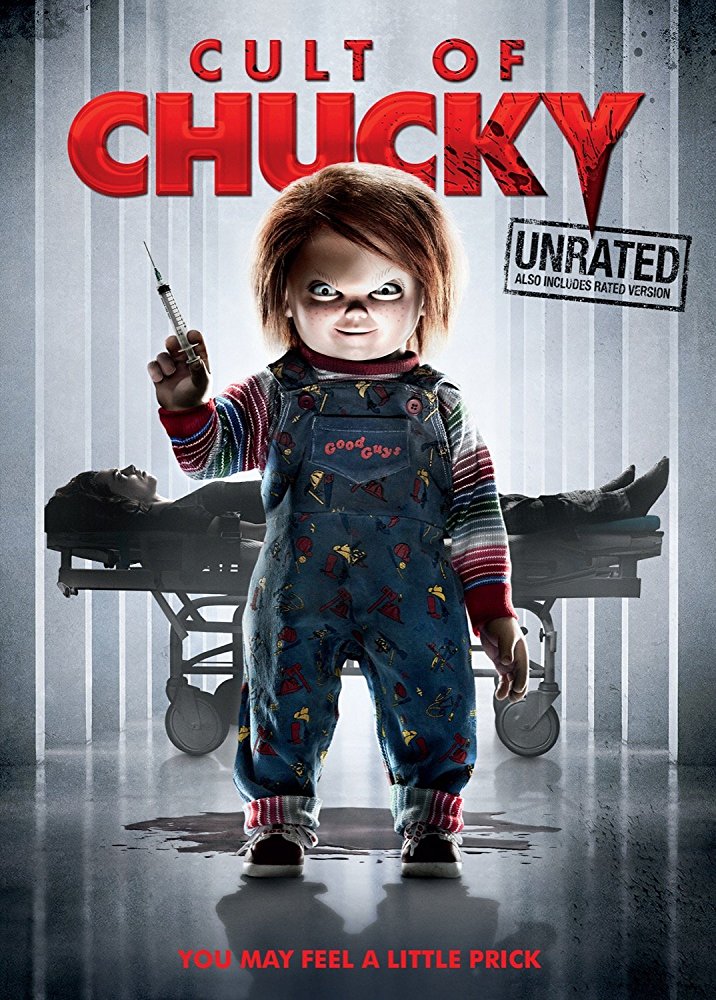
REVIEW: Cult of Chucky


It's sort of an unspoken rule that franchises tend to get worse and worse as they go on (especially when it comes to horror). Of course, this isn't true of all sequels, but the number of follow-ups that actually innovate and improve upon the groundwork laid by the first film is a proverbial drop in the bucket compared to the raging tidal wave of mediocre, derivative retreads pumped out of the Hollywood machine. Typically when a horror franchise makes the jump straight-to-video, it's a sign that the series is all but dead and buried (see Hellraiser, Leprechaun, and countless others). It signals an admission of weakness; the studio does not feel confident enough in their product's money-making potential to justify the cost of a theatrical release, so the best they can manage is to recoup their cost by skipping theaters altogether and going straight to home video. Sometimes, however, a direct-to-video sequel can surprise you. Like I've explained, it's fairly rare that a non-theatrical sequel to a classic horror franchise ends up any good, especially when said franchise dates back well over a decade, and especially when the sequel in question is movie number seven. Which brings us to Cult of Chucky, a follow-up to 2013's Curse of Chucky, which in and of itself was something of a revival of the Child's Play franchise (after its steady descent into comedy schlock during the late 90's/early 2000's).


Right off the bat I've got to commend the filmmakers for not taking the easy way out; this is by no means a soft-reboot. It's a clear benefit of smaller-profile releases such as this; while large-scale blockbusters like The Force Awakens and Jurassic World are forced to retread old ground in order to appeal to younger demographics, movies like Cult of Chucky are free from such boardroom legislature. The movie picks up essentially right where Curse of Chucky left off, and assumes you're familiar with every film in the series thus far (if you're a bit rusty, as I was, a quick trip to Wikipedia is invaluable before viewing; alternatively, just marathon the entire series, it's a fun time). We find our protagonist from Curse, Nica (Fiona Douriff), serving time in a psych ward after the justice system deemed her a more likely murderer than a knock-off Cabbage Patch Kid. After transferring to a new facility to continue her treatment, it isn't long until Chucky (Brad Douriff) comes calling to settle his debts. 

The movie isn't nearly as straightforward as one might expect, subverting the formula beyond the usual "THE DOLL IS ALIVE, I TELLS YA, I SWEAR I'M NOT CRAZY" schtick one might expect from such a premise. In our opening scene, we see Andy Barclay (Alex Vincent, reprising the role he played at the age of six in the first Child's Play) living in a remote cabin in the woods, his only company being Chucky's severed head (whom he routinely tortures when he's got nothing better to do). With Chucky seemingly in two places at once (and our protagonists being a mental patient and a man who experienced severe, Chucky-related trauma at a young age), the viewer is left wondering what is real and what isn't. The movie plays fast and loose with our perceptions, adopting a much more psychological bent than the standard slasher fare one would expect from this franchise. By the third act, I was able to more or less guess what was going on, but there were still enough red herrings and misdirects that I was never 100% certain that I had this movie pinned down. It never gives the viewer the chance to become totally comfortable in their assumptions until the climax, when the film finally tips its hand and clues us in on what exactly has been going on all along; the result is imaginative, original, and thoroughly engaging.


I also need to compliment the film on its sense of tone, toeing the line with expert finesse between horror, mystery, and black comedy. There's never a moment where a joke breaks the tension completely or pulls the viewer out of a moment; it all feels very homogenous and natural, which is so often the downfall of genre-benders such as this. There's bits of humor and levity, but the threat is still very much real; we're able to laugh at Chucky's sarcastic wise-cracks, but we still feel tense when he's in the same room as characters we've come to care about. It's a delicate balance that not every film can pull off, but which Cult really displays a fine mastery of. I feel like a lot of this is thanks specifically to writer/director Don Mancini; he's been heavily involved in the Child's Play franchise since the very beginning, so it's clear he has a deep and intimate understanding of how this particular monster works.

It's also worth noting that this is a very good-looking movie, not only in terms of set design and special effects, but in terms of cinematography as well. The camera really has fun with its environments, implementing PoV shots, dolly zooms, and even some split-screen from time to time. It's a film with style to spare, helped along by the cold, sterile environment the bulk of the story takes place in. The clean, white surfaces of the mental institution are just begging to be hosed down with fake blood, the perpetual snowfall outside lending a sense of eerie calm and isolation. Pair that with the old-fashioned uniforms of the nurses and orderlies and you're left with a place that feels both alien and familiar, like something out of a dream. It's not necessarily the first environment I'd think of to set a smart-mouthed killer doll loose in, but damned if it doesn't work.


Speaking of, Chucky himself is looking better than ever. He's still 100% practical, portrayed by a series of animatronics and puppets; it almost feels like cheating, since a doll is expected to have a sort of artificial, plastic-y look to it, but it's clear that the effects team went above and beyond. Chucky is just so expressive, especially when it comes to his eyes, to the point that he's more believable as a living character than many of the big-budget creatures I've seen in recent years (I'm looking at you, surprisingly fake-looking apatosaurus from Jurassic World). Part of this is helped along by the vocal performance of Brad Douriff, still the only actor to ever portray Chucky on-screen. It's the role he was born to play, yet I still find myself questioning who I think was the strongest part of this cast, Brad Douriff, or his daughter, Fiona. Nica, as a protagonist, is so easy to root for (beyond the sympathy she earns off the bat for being confined to a wheelchair, terrorized by a killer doll, and framed for the murder of her family) and Fiona Douriff really brings so much more to the role beyond the usual "beleaguered horror protagonist whom no one believes" (especially during the final act).


All in all, Cult of Chucky is far better than I think it has any right to be; granted, it offers essentially nothing to those unfamiliar with the series thus far, but it works fervently against all odds to deliver an engaging, interesting, and above all original entry in a decades-old slasher franchise. It's a real testament to the power of love in filmmaking; Child's Play hasn't been a theatrically-viable franchise since the early 2000's. It's clear that everyone who worked on this project, from Douriff to Mancini to Jennifer Tilly, is here because they want to be. This is no quick cash-grab or tax write-off, there's legitimate passion and enjoyment for what they're doing, even though what they're doing is part seven in a slasher series about a serial killer who sealed his soul inside a doll through the use of voodoo magic. There's a self-awareness to it (it wouldn't really feel like Chucky if there wasn't), but there's absolutely zero cynicism, and I feel like that makes all the difference in the world.

October 1, 2017

REVIEW: Get Out


Normally at the end of the month, I try to watch a movie that I know is going to be garbage going in. It's something of a tradition around here, allowing me a chance to really let loose and have fun just tearing something apart; variety is the spice of life, as they say. That said, considering the pure and utter tripe I've put myself through over the past month, I feel as though I've earned myself a little break. With Halloween right around the corner, I'm on something of a horror kick and, coming off of The VVitch, found myself hungry for more quality scares. With that in mind, it seemed obvious to check out the one film even I can't believe I didn't see back in March, director Jordan Peele's Get Out.

The plot feels like something straight out of a classic Twilight Zone or Tales From the Crypt episode; Chris and Rose (Daniel Kaluuya and Allison Williams) are a young, interracial couple who've been seeing each other for a few months. As one might expect, they reach that all important part of a relationship that all young couples dread: meeting the parents. The two depart for Rose's family home, an opulent ranch-house secluded in the woods, where Chris is introduced to Rose's mother and father (Catherine Keener and Bradley Whitford). A hypnotherapist and a neurosurgeon, the two seem to be making almost too much of an effort to make Chris comfortable (leading to more than a few good-natured but still cringe-inducing remarks) and all seems to be going about as well as expected. That is, until Chris begins to notice odd occurrences around the house, leading him to believe that everything is not quite as it seems. Much like with The VVitch, this movie is far better the less you know going in, so I'll end my plot summary here. If you want to know what happens, go watch the movie and find out.


The most important part of a movie like this, one so reliant on its subtext, is that said subtext actually works. So often you'll get a situation where the filmmaker gets too swept up in his or her own metaphor, tamping the message down the viewer's throat, completely sinking the film in the process. Get Out is a film that avoids this pitfall simply by reaching higher than the low-hanging fruit dangling right in front of it. Distilled to the most general terms possible, this is a story about the ills of racism. Now, had Jordan Peele wanted to simply deliver a generic parable about how racism is bad, he could have very easily set this movie in the deep south, instead of what looks like upstate New York or Vermont. He could have littered Rose's family house with confederate flags and jugs of moonshine instead of souvenirs from trips to Africa and bottles of expensive wine. He could have had every white character angrily shout racial slurs instead of smiling politely while mentioning how they know Tiger Woods.

This sense of subtlety, this challenge Peele took upon himself when telling this story, is exactly what makes Get Out work as well as it does. This isn't a movie about your generic, after-school-special kind of racism; the villains aren't boisterous right-wing southerners, they're just seemingly well-meaning liberals who are completely disconnected from Chris' world view. The conflict in this story shows that racism (excuse the pun) isn't entirely black-and-white, highlighting how progressive "ally" culture can be just as harmful as overt bigotry. This is a movie about how a well-intentioned majority can, through their seemingly progressive actions, rob those whom they seek to help of their voice and autonomy. Again, I don't want to delve into spoiler territory, but there's a specific point during the climax where the film lays out exactly what it's really about in spectacular fashion. All in all, it ends up coming off like a reverent throwback to the early films of George Romero and Paul Verhoeven, all while remaining fresh enough so as not to feel in any way cliché or done-before. Everything about the way this movie conveys its message subverts expectations (especially in regards to the ending), ignoring the most trite, obvious symbolism and instead going for something much more clever and, most importantly, real.


That said, all the biting subtext in the world doesn't amount to much if the film itself doesn't function properly. I'm pleased to report that, while some may find the tone somewhat inconsistent, this is a very structurally sound film (especially impressive considering, like The VVitch, this is a first-time director). The performances are all-around excellent, but I have to give some extra credit to Daniel Kaluuya in the lead role of Chris. He's our everyman, the one the audience is clearly supposed to identify and sympathize with as the situation unfolds before him. Kaluuya's performance is solid enough that it wasn't for some time after the film had ended that I realized how little there was to Chris as a character. On paper, he isn't too clearly defined; he is, in every sense, your average, ordinary guy. Kaluuya manages to elevate this, however, purely through his performance. So much is conveyed through simple facial expressions or the use of his eyes; they're even front and center on the poster I chose for this Review. Kaluuya managed to take a protagonist that, in the hands of a lesser performer, could have been totally flat and unengaging and turned him into the perfect lifeline connecting the viewer to the plot.

At the same time, we also have LilRey Howery as Rod, a TSA agent and Chris' best friend. He's our primary comic relief and I'm convinced that in any other movie, this character would have been completely insufferable. Through the combined efforts of Howery, Peele, and the screenwriters, Rod ended up one of my favorite aspects of the entire film, not only providing some legitimately effective levity, but actually contributing to the plot as more than a mere joke machine. Again, we see this movie's commitment to ignoring the low-hanging fruit; it would have been so simple for Rod to have ended up as your basic "goofy best friend" character. He'd spit out a few jokes, maybe act as a vehicle for some product placement, and overall just be an obnoxious, unnecessary addition used to pad out the runtime. Instead, he goes above and beyond in terms of what this kind of character usually ends up being, and the benefits of this effort are plain to see.


Get Out is a movie I simply cannot recommend enough; while it's definitely more of a suspense/mystery (with a hefty dose of satire) than an outright horror movie, it still feels like a loving throwback to a simpler time, when horror films weren't afraid to get inventive in order to get their point across. It takes what could have easily been your classic one-note exploitation premise and turns it into something a  lot more nuanced and inventive than what one might initially expect. One of the things that makes horror so special as a genre is its ability to act as a sort of universal catharsis. When the weight of the world seems that much heavier, some of us ease the burden through sunshine and lollypops, others through ghouls and gore. Whenever there's turmoil and tumult in society, the artists get busy; quality may vary, but Get Out is definitely a prime example of how it should be done.

September 22, 2017

REVIEW: The VVitch


With September almost at a close, I've found myself on something of a horror kick as of late. I tend to prepare for Halloween the way most department stores prepare for Christmas (that is to say, months in advance), and what better way to get myself in the proper mood for the most wonderful time of the year than to take in a new horror film? I recall hearing good things about 2016's The VVitch, but it wasn't until Jay Bauman of RedLetterMedia described it as "a masterpiece" and named it his favorite movie of 2016 that it really showed up on my radar. It's been some time, but I finally found myself in that right proper mood for a slower, more mysterious horror film and boy does this one not disappoint.

As the subtitle implies, the story takes place in 17th century New England. A family is banished from their home on a Puritan plantation over a disputed interpretation of the New Testament and find themselves living in solitude on a small farm, just on the edge of a large and imposing forest. I really hesitate to say any more for spoilers sake, even though I've only covered the very first few minutes of the movie. This is truly one of those films where the less you know going in, the more you're going to take away from it. A strong sense of mystery and fear of the unknown are the bread and butter of the horror genre, and The VVitch is no different. Anything I mention beyond this point is going to delve into some mild spoilers, so if you haven't seen this movie and are wondering what I thought of it, I'll say this; The VVitch would make for an excellent triple-feature alongside The Exorcist and The Shining. It's got a surprisingly brisk pace for something so tense (even though things feel a little rushed near the end of the second act, but only for a moment or so) and there's seldom a dull moment. It's a modern day horror classic that will most definitely stick with you long after the credits roll and, assuming that endorsement is satisfactory, I'd like to go more in-depth as to just why I enjoyed this film so much.

If I wasn't clear enough yet, beware of Spoilers from this point onward.


The most immediately striking thing about this movie is the aesthetic choices at play. It's astounding to think that The VVitch is Robert Eggers' debut as a director, given his clear knack for the medium. The color grading, shot composition, and environments used work in tandem with the hair-raising soundtrack to result in a genuinely chilling experience. The tension somehow never completely fades for the entire 93-minutes; the use of long takes and wide shots left me on the edge of my seat, certain that something horrid lay just around the bend. And the majority of the time, nothing happened. But when something did happen?
Oh-ho.
Oh boy.

I've said in the past that the best horror films know how to manipulate audience expectations; like Pavlov with his dog, the horror filmmaker must train an audience to respond to certain stimuli, be they audio or visual cues (or some combination thereof). The VVitch understands this relationship between filmmaker and filmgoer, to the point where something as simple and innocuous as a shot of a rabbit can fill the viewer with a sense of legitimately disquieting unease. For anyone who's ever wondered how Edgar Allan Poe's The Raven is meant to be scary, watch The VVitch. The film is still fresh in my mind and all I can think about is how easy it would be for someone to scare me out of my wits by simply positioning a billy goat or bunny rabbit where I wouldn't otherwise expect to see one.


Like most good horror movies, there's more going on here beyond some sinister happenings in the woods. From beginning to end, the film shows how systemic distrust and repression can slowly destroy a once-solid family unit. The mother, Katherine (played by everybody's go-to crazy lady, Kate Dickie), lashes out at her children and husband once her baby disappears, flinging accusations and shifting the blame from one family member to another with frantic speed. In hindsight, it's hard to determine what causes the family more harm in the long-run; the actual coven of witches in the woods, or this seed of paranoia and fear that gradually grows and escalates until everyone is at each other's throats. The eldest daughter, Thomasin (Anya Taylor-Joy), gets the worst of it, suffering the accusations of her younger siblings and even coming under scrutiny by her God-fearing but well-meaning father, William (Ralph Ineson). For the better part of this movie, she's treated as an outsider, shouldering the majority of her family's burdens despite her complete and total innocence. As a result, we see her pushed to the edge, eventually forced to kill her own mother in self-defense before embracing the darkness that did her family in. 

And as she makes her pact with the Devil himself and wanders naked into the woods, the true message of this film comes full circle. Repression is a ticking time bomb; once fear enters the equation, it's only a matter of time before outright hostility becomes the status quo. And after that, those made to feel oppressed and marginalized will become radicalized, striking back against those who once put them down, becoming oppressors in their own right. As Thomasin rises into the air and becomes part of the coven, we see the culmination of her siblings' taunting, her mother's accusations, and her father's distrust. All of these negative emotions, brought about through only the most pious and holy intentions, amounted to nothing more than yet another witch being born unto Satan's flock.


Like The Exorcist and The Shining before it, The VVitch is a movie where what you don't see is just as terrifying (if not moreso) than what you do see. And like The Exorcist in particular, this is one of the few horror films I've seen that actually makes The Devil into a legitimately horrifying concept. More often than not, the scariest antagonists are the ones you cannot bargain with; the Xenomorph, Jason Voorhees, and even the Terminator. Creatures who will not hesitate to gut you on-sight, regardless of what you might say or do in an attempt to sway them. But The VVitch finds a way to make Satan so much more terrifying than any of these, simply for the reason that you can reason with him. He's not some mindless beast out for blood, but something much more sinister and intelligent than that. You can just talk to him whenever you want. And that's exactly what he wants. The Devil lives in an unexplored part of each and every human soul, waiting for the right moment to make his influence known. The VVitch poses the idea that Satan exists in all of us, that every human has the potential within them for great evil. And that all it takes for that evil to come bubbling to the surface is the proper incentive.

September 17, 2017

REVIEW: It (2017)


As I've said before, modern horror seems to be in something of a rut. For the past decade (starting noticeably with the release and success of Paranormal Activity), it seems as though the majority of recent horror films tend to focus on delivering nothing more than predictable jump-scares to a PG-13 audience. The market is oversaturated with small-budget event films that offer very little in the way of plot or ingenuity, designed to appeal to middle-schoolers getting dropped off at the local cinema for their first big date-night. I can't exactly fault studios for exploiting this marketing model; the teenage spook-show has been a time-tested venture since the 1950's. Films like Annabelle Creation and Lights Out go on to gross upwards of twenty-times their modest budgets, so it's understandable why the market seems so flooded with these types of horror films; if it ain't broke, don't innovate, after all. 

That said, it's still disappointing that we've entered an age of film without any monsters. Sure, there's generic ghosts and demons, but there's no personality or character to it anymore. This is a generation without a Freddy Kreuger, a Jason Voorhees, or even a Chucky. Sure, occasionally you'll get a nice, low-concept horror film like Get Out, or even something like The Conjuring or Insidious (which manages to tell an interesting story despite being littered with popcorn-flinging jump scares), but for each of these films you have at least a dozen generic, toothless "upper-middle class family moves into suburban house, haunting ensues" projects designed to turn a $4 million budget into a $200 million profit. Which is why I was so excited for a new adaptation of Stephen King's iconic novel, It. As messy as the source material can be at times, the story is anything but generic or simplistic; it explores themes such as maturation and the loss of innocence, involves Lovecraftian cosmic entities from parallel dimensions, and is all tied together by the OG killer clown, Pennywise (once iconically portrayed by the immortal Tim Curry). Not to mention, this was promised to be a hard-R horror movie that stuck closer to the novel than the campy 90's made-for-TV miniseries. I went into the theater with high hopes and, while It most definitely has a host of flaws, I still found myself more or less satisfied with what I had seen.


The original novel tells the story of a gang of misfits who twice encounter a demonic entity known only as It; once as children, and again as adults, 27 years later. This particular adaptation exclusively follows the former part of the story (with the adult section to take place in the planned sequel). It is a notoriously dense book, so whereas dividing a novel into multiple films usually reads like a blatant cash-grab (I'm looking in your direction, The Hobbit), here it feels entirely justified and definitely works in the film's favor. The story takes place in the town of Derry, Maine in the year 1989 (updated from the novel's setting of 1958) as we follow a group of plucky youths known as The Losers Club; over the course of the summer, each child shares a terrifying encounter with the same supernatural being (usually taking the form of a dancing clown named Pennywise, played by Bill Skarsgård). Coming to the conclusion that the entity is responsible for the long history of annual tragedies in their sleepy hometown (most-recently a string of missing and murdered children), the Losers decide to take a stand and confront the darkness which lies at the heart of Derry, facing their deepest fears in the process.

While I don't think this film is by any means perfect or mind-blowing, there's definitely a lot it gets right, namely in terms of tone and character interactions. This is, oddly enough, a very feel-good horror movie; I hesitate to even call it a horror film at all, considering there's so little about it that is genuinely scary. The film moreso excels at establishing a very strong sense of atmosphere and tension which, unfortunately never leads to a payoff as strong as the buildup. There's a very foreboding, oppressive atmosphere that the film really gets down perfectly, yet things never feel overly depressing or outright unpleasant for the sake of unpleasantness or shock value. There is considerable darkness here, yes, but it's all overcome through the power of courage and friendship. We aren't left feeling like the film flipped us a sardonic middle finger as with Alien: Covenant; the Losers are all likeable, endearing characters and we all want to see them overcome the oppressive fear that permeates so much of their day-to-day lives.


It can also be quite tricky when the majority of your cast is composed of child actors, but the talent at play here completely makes this movie. The dialog doesn't shy away from prepubescent vulgarity and it all flows very naturally, thanks both in part to the talented writing staff (Chase Palmer, Cary Fukunaga, and Gary Dauberman) and the talented group of child actors the filmmakers had assembled to portray the Losers (Jaeden Lieberher, Jeremy Ray Taylor, Sophia Lillis, Chosen Jacobs, Jack Dylan Grazer, Wyatt Olef, and Stranger Things' Finn Wolfhard). They really come off like a group of friends hanging out during the summertime, even when forced to band together to destroy a trans-dimensional clown creature. Which brings me to, arguably, the star of the show; Bill Skarsgård as Pennywise, the dancing clown.

When you've got a role as iconic as Pennywise (especially when said character is famously portrayed by an actor as beloved as Tim Curry), it's obvious that arguments are going to spring up as to who's portrayal of the character is the definitive version. I'm going to put that entire debate to bed right now with an unsurprisingly anticlimactic answer; they're both good. First of all, we haven't seen the entirety of SkarsgÃ¥rd's take on the clown, considering this is only the first half of a greater whole. But even ignoring that and simply going off of what we've already got, it's hard to say who truly had the better take on the titular monster. Curry had a certain whimsy to his performance that isn't really present in the more modern take; SkarsgÃ¥rd's Pennywise is overtly threatening, whereas Curry's was silly on the surface with something sinister lurking underneath. Conversely, Curry's take was very much limited by the 1990's television budget they were working with; while Curry's Pennywise shows a greater range of emotion, SkarsgÃ¥rd's is far easier to take seriously as a legitimate threat. Where each interpretation of the character is weaker, the other is stronger; at the end of the day, they're two very different takes on the same character and any question of who is better than who simply boils down to personal taste. For my money, SkarsgÃ¥rd did an excellent job, especially in regards to the physicality and screen presence he brought to the role; while I can't in good faith say he'll eclipse Tim Curry anytime soon in the eyes of the public, his is most definitely a respectable and original interpretation.


I also have to compliment the cinematography; in conjunction with the tone, dialog, and performances, this film creates a number of memorable moments and images that are still seared into my head. There's a lot of detail in terms of set design and dynamic camera angles that really adds a lot to the film as a whole and I simply must praise everyone involved for not going full "80's nostalgia" with this. There's a few out-of-focus movie posters, a handfull of New Kids on the Block jokes, and a reference or two to Street Fighter; other than that, the film deftly avoids that modern pitfall of confusing references to 80's iconography with actual story development (ironically enough, I got a trailer for Ready Player One before the movie began). Overall, the film presents an organic and immersive atmosphere that really ropes the viewer in; it's easy to care about these characters and the mission they undertake, and the visuals are a big part of what make this movie as good as it is. Unfortunately, I can't say as much for the sound design. 

As I mentioned before, despite this being a reboot of the film that gave so many 90's kids a severe case of coulrophobia, this just isn't a very scary film. Tense, yes, but far from terrifying. The scares lack any and all subtlety (take a shot every time you hear that obnoxious "HEHSHENNKH!!!" sound during a jump-scare, double up if it's with that same shot of a befanged Pennywise lunching at the camera) and a little restraint (especially in the audio department) would have gone a long way in terms of complimenting the existing air of dread and suspense. It feels as if everything has to be big, loud, and bombastic, simply because this is a big-budget theatrical release; for example, the scene in which Beverly Marsh's bathroom sink erupts into a comical geyser of blood. While the buildup is solid (and the red-tinted lighting that follows is a nice artistic touch), all of the tension leading up to this moment is entirely done away with (and that's ignoring how this scene is one of the majority of scares which was spoiled through various promotional materials). And that's truly the biggest problem with this movie; the payoff never lives up to the buildup.


Don't misunderstand me; the rising action here is rock-solid. The buildup will have you on the edge of your seat, waiting for something terrifying to happen. However, once that terrifying thing actually does happen, it immediately stops being scary. The most chilling scene involves a character simply flipping through an old history book; there's no jump scare or obnoxious sound sting, just good old fashioned tension and atmosphere. When the film works, it truly works, but the majority of scares feel like a terrifyingly-long climb to the top of a rollercoaster, only for the car to drop about ten feet before slowly returning to the station. Horror demands a certain rhythm; just like comedy, timing is everything. It displays masterful skill when it comes to setup, but the punchline falls flat nearly every time. It's this sense of unbalance that causes the majority of the film's primary hiccups. 

It, as a villain, is tremendously interesting, yet it feels like we hardly get to see him; whenever we do, he's interrupting the vastly more engaging character interactions of the Loser's Club. There's a strong sense of mystery, which is good, but it's also easy to feel a little cheated when we're given so little of what is clearly an imaginative, charismatic, well-acted antagonist. Conversely, all of the Losers are well-acted and likeable, but several of them definitely get the short end of the stick when it comes to character development (Chosen Jacobs' Mike Hanlon disappears for a good twenty minutes during the first act and Wyatt Olef's Stan Uris gets hardly an ounce of the development his peers receive, which is troubling, considering the role his character is presumably going to play in Chapter 2). There's also a severe dip during the second act in terms of pacing; the first and final acts are by far the most engaging parts of the film. Once the film falls into a pattern of "Losers scene, Pennywise scene, Losers scene, Pennywise scene", the movie slows to a crawl despite each of these scenes being more or less enjoyable in their own right.


Don't get me wrong, I very much enjoyed this movie, but there's definitely a lot of room for improvement. It's clear that this is meant to be watched back-to-back with the eventual follow-up, but on its own it feels a little lacking in some regards. My hope is that the filmmakers can learn from the mistakes and missteps present in It, so that Part 2 can become the kind of sequel that retroactively improves its predecessor (such as the case with the first two Insidious films). All that said, I would definitely recommend It; it's definitely got its flaws, but there's certainly a lot to like (heck, there's a lot to love). If you're a fan of Stephen King or the original 1990 miniseries, or if you're like me and just long for the kind of chilling monster movies we'd see before found footage was deemed the most cost-effective option, definitely give It a watch. It's got loads of atmosphere and enough heart to match, which is more than I can say for the vast majority of horror films we see today; there was clearly a lot of love and artistic elbow-grease put into what could have been a sloppy nostalgia-job, and for that much at least I have to give it some kudos.