Showing posts with label surreal. Show all posts

August 27, 2018

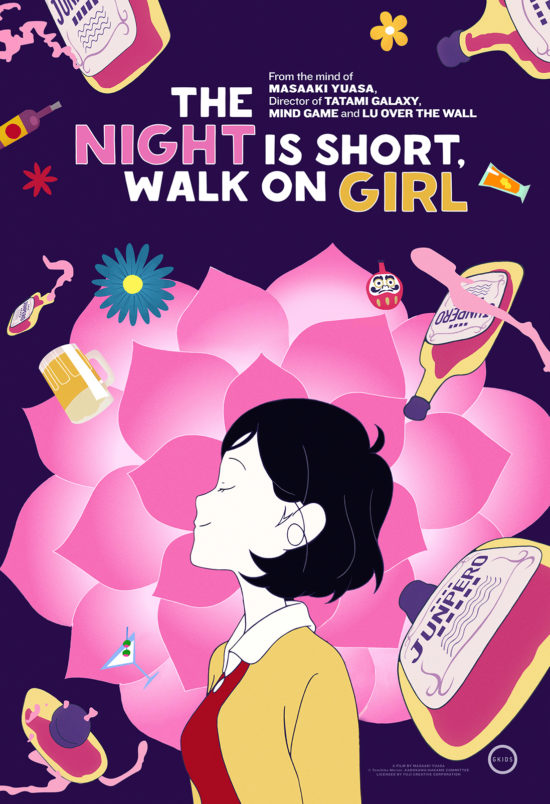
REVIEW: The Night is Short, Walk On Girl


For as much as I like to say I enjoy anime, the irrefutable truth of the matter is that I'm basically just a novice; I've watched Fooli Cooli and Gurren Lagann  a couple of times and I'm currently enjoying My Hero Academia, but it's safe to say that there are vast parts of the medium that I still need to explore. I was, for example, completely unfamiliar with the work of Masaaki Yuasa; that is, until I decided to check out The Night is Short, Walk On Girl (loosely adapted from the Japanese novel of the same name). I saw the trailer on Facebook just by chance (or perhaps it was fate), but the fluid animation, whimsical art design, and catchy music told me that I just had to go check this one out (especially since it would be in US theaters for two nights only). 90 minutes later and I'm not only convinced that I need to seek out the rest of Yuasa's work, but that The Night is Short, Walk On Girl is my personal pick for the best movie of 2018 (even though it was technically released in 2017, though only in the UK and its native Japan).

The plot is, shall we say, difficult to describe. This is one of those situations where I feel as though I'd be walking a fine line between describing the premise and simply recounting every scene; it's very much like Alice in Wonderland or The Wizard of Oz, where our protagonists move from situation to situation, encountering a host of unique characters as they go on their journey. The film follows a nameless girl with black hair (typically just referred to as Otome, the Japanese word for "maiden", and voiced by Kana Hanazawa) on a night of heavy-drinking through Kyoto. Meanwhile, a similarly nameless classmate of Otome's (referred to as Senpai, voiced by Gen Hoshino) is determined to confess his feelings towards her on this fatefull night. As he explains, he's implemented a long-term plan of crossing paths with Otome as often as he can manage, under the guise of their encounters being sheer coincidence. When the time is right, he will reveal his true intentions and it will seem as if the two had always been intertwined by the red string of fate. What follows is a delightfully charming, psychadelic rom-com that utterly annihilated my expectations in the best sort of way. This is just one of those movies that feels like a vivid dream, boasting the kind of atmosphere I'd like to curl up inside of for the rest of my life.


While the movie is, aesthetically-speaking, undeniably gorgeous, the real draw for me was the thematic subtext underneath it all. This is one of those films that focuses in on that sort of "quarter-life crisis" that twenty-something college students tend to go through. We've seen so many coming-of-age stories, but what happens after the protagonists have already grown up before the plot truly began? We're told from high school onward that we're "young adults", but that feeling honestly didn't kick in for me until after I'd completed my undergrad, got a job, and moved into a place of my own. For those who go right from high school into college, the question of what comes after is something that really starts to weigh on you after you get acclimated. We act like the transition from high school senior to college freshman is a massive change, but it's really nothing compared to spending the first 22 years of one's life adhering to a more or less consistent system of schooling and socializing, only to finally cross the finish line into the stage of your life when you have to start thinking about taxes and rent and insurance. You get your degree, then what comes next? Graduate school? A career? Or just another job to pay the bills? Should you get married? Start a family? Buy a house? Do you even have the means to do any of those things? These are all the questions you start to mull over as you begin to fully and finally transition into the adult world, and said questions tend to weigh heavily on the minds of chronic over-thinkers like Senpai (or myself, for that matter).


The character of Senpai manages to transcend the usual "awkward nerd who's hopelessly smitten with the girl of his dreams" trappings by really delving into his mindset. He isn't just another gawky buffoon in pursuit of his manic pixie dreamgirl; he's insecure to the point that he outright questions if he even deserves to have his insane plan work out, or if it would be more fitting that he just shrivel up and die alone. He's become accustomed to failure, putting up walls to protect himself from the terrifying idea of what might happen if he actually gets what he wants for once, the only outcome he's completely unprepared for. Otome, meanwhile, is in the exact opposite situation; she's naturally talented at everything she tries, resolved to simply go with the flow and see where the night takes her. While she hardly has to put in any effort in order for things to go her way, she's left with a life that, compared to Senpai, lacks any semblance of drive, ambition, or purpose. The film establishes that her easy-breezy attitude towards life tends to leave those around her in the dust, leaving her with her own kind of loneliness to deal with. They're two sides of the same coin, yin and yang, but that doesn't mean they don't need to grow and change in their own ways before they're fit to be together.

The film hypothesizes that who we are is but an amalgamation of those we meet in life; whether we know them for the rest of our days or just for one drunken evening, the impact and influence they leave us with is what determines who we are and how we grow as people. The emotions these people inspire and the stories they leave us with are the things that life is made of. Feelings of isolation, loneliness, and disassociation are hardly rare for young people, especially those who find themselves in the midst of a great transitory period in their lives, and The Night is Short, Walk On Girl goes to great lengths to remind us that no man is an island. Whether you believe in fate or not, your existence is immutably intertwined with those around you (and even those you've yet to meet). We're all players in the funny, tragic, oddball play that is the human race; everyone matters, no one is truly alone, and happiness will always inevitably win out over nihilism.


Although it's obvious that the underlying motifs this movie set forth resonated with me on a deep emotional level, I want to make it clear how much I adored everything else in this movie. Like I said before, the animation is absolutely stunning (putting Masaaki Yuasa on my radar in a big way) and I really love the use of color and sound to establish a sensory experience that's at the same time fantastical and immersive. As the night goes on, an entire year seems to pass; we begin on a warm spring evening, transition into summer heat, and by the time the climax rolls around, all of Kyoto is stuck inside with the flu as unforgiving winds and snow rip through the empty city streets. I also found myself surprisingly invested in the stories of the various side-characters Otome and Senpai come across, absurd as they are. My personal favorite would have to be Don Underpants ( Ryƻji Akiyama), a writer and hopeless romantic who has pledged to not change his underwear until he reconnects with a girl he had a fated encounter with some time ago. At first we assume he's just there for a one-off joke about his self-appointed nickname, but then he shows up again much later on, setting up guerrilla plays at the student festival as a means of attracting his mystery love's attention. These side-characters are all bit players compared to our two main leads, but their stories are told in such a way that it truly feels as though the plot thread doesn't end the moment they walk off-screen. We really get the feeling that this isn't just an extraordinary night for Senpai and Otome; everyone has their tale to tell, and that's really the entire message of this movie in a nutshell.


The Night is Short, Walk On Girl is really just a remarkable little movie. It's a surprisingly conventional, feel-good love story that's conveyed in the most unconventional of ways; pair that with sublime animation, supremely comfy atmosphere, a killer soundtrack, and loads of endearing and memorable characters, and you've got a winning recipe for my personal favorite movie of 2018 thus far. Yes, I know, it technically came out in 2017 everywhere but the USA, but I'd be outright lying if I said that, out of everything I've seen in theaters this year, The Night is Short, Walk On Girl wasn't my favorite. If it wasn't clear already, I absolutely adore this lovely, lovely film and would like nothing more than to just immerse myself in all the charm and good vibes it's constantly putting out. If you're a fan of anime or animation in general, you owe it to yourself to give this one a watch.

August 6, 2018

REVIEW: Sorry To Bother You


One of my favorite things about film as a means of artistic expression is the way in which it allows filmmakers to present a sort of funhouse mirror version of our own reality. Where certain aspects of everyday life are tweaked and exaggerated in order to convey some sort of social commentary; it's the kind of style you find in films such as Robocop and Office Space, concealing a bittersweet truth about society behind a veneer of sardonicism and parody. After catching the trailer for Boots Riley's Sorry To Bother You before a showing of Deadpool 2 back in May, I knew it was the kind of slick-looking indie flick I just had to check out. Having finally seen it, I can definitely say that, as far as style goes, I got exactly what I was hoping for and then some. As far as everything else... well, let's just say there's a reason this particular Review took so long to post. This is the kind of movie I had to sleep on for a good long while, and I wouldn't be surprised if my opinion of it continues to change after I've hit publish. It's a very unique beast of a film, and while I'm not entirely sure that's 100% a compliment in this case, it definitely gives me a lot to talk about.

The film is set in an alternate-present version of Oakland; it's more or less the same as our world, just, shall we say, less subtle. Mega-corporations are essentially pushing exportable slave labor (seen as a fairly sweet deal by many members of the lower class), advertising has devolved to the point that brands are simply named after whatever product they're designed to move (such as "Soda Cola"), and America's number one television show is an assault on human dignity aptly titled "I Just Got the Sh*t Kicked Out of Me!"; it's a dystopia in the most mundane, everyday sense, where our collective doom is brought about by sterilized corporate overreach, rather than murderous robots or nuclear armageddon. It's here that we meet our protagonist, Cassius "Cash" Green (Lakeith Stanfield, who is way too good here to have also starred in Death Note). Low on funds and unable to find a job, Cash begins working at a telemarketing firm known as RegalView. Initially, he feels as though the job isn't cut out for him, struggling to close sales and climb the corporate ladder. That is, until one of his coworkers (Danny Glover) suggests that he use his "white voice" (a squeaky-clean overdub provided by David Cross); not so much an imitation of white people, per sey, but rather a means of code-meshing that gives off the impression that Cassius is living a worry-free life where things can only get better. With the power of his white voice, Cash becomes a superstar at RegalView, ascending to the almighty and mysterious position of "Power Caller"; however, this promotion just happens to coincide with his coworkers (along with his girlfriend, Detroit, played by Tessa Thompson) organizing a labor strike in search of better wages and benefits. I don't want to go any further into the plot, as this is definitely the kind of movie you want to go into blind, but suffice to say tensions rise between Cash and those around him after he earns his first taste of what could modestly be called success.


Like I said, I've got a lot to say about this movie, so I'd like to get everything I liked about it out of the way first. As far as visuals go, this is a strong contender for the most inventive film I've seen thus far in 2018; the cinematography gets insanely creative at times, whether it's to convey a subtextual message or to simply help sell a joke. When Cassius is on the phone with a client, he's violently transported to wherever they may be when their phone starts ringing, whether they're eating dinner or having sex on the couch. It's an inventive way to make something as milquetoast as telemarketing engaging and interesting, fully taking advantage of the visual medium they're working in. It's definitely a film with a very distinct look to it, especially when it comes to details like Tessa Thompson's various outfits and earrings (her character is an independent artist, and the film takes full advantage of this opportunity to play dress-up). This is a movie about income inequality and racially-coded language and corporate America, yet it finds a way to be fascinating from a visual standpoint, rather than just from a narrative standpoint, and that's definitely a feather Sorry To Bother You wears proudly in its cap.

I also loved the sense of humor and overall tone/atmosphere; like I said before, it exaggerates key elements of our reality, calling specific attention to details we're more or less used to seeing in our day to day lives. There's a joke later on in the film involving a rap song that made me both laugh and wince until it hurt; really, it's the film's ability to pull off moments like that that make it such an enjoyable watch. For as surface-level as some of the commentary can be, it's very smart in the way it doles it out for the first two acts. Despite how absurd things appeared, I found myself seriously invested in the moral dilemma at the heart of the plot. A lot of this is not only due to the smart dialog and writing, but also to Lakeith Stanfield; he's the perfect everyman for a movie like this, fitting right into this absurd, exaggerated universe while also staying totally down-to-earth and relatable. Just about every character aside from Cash ends up being a little hyperbolic in one way or another, so it was a smart move to cast someone so naturalistic as the focal point of the entire plot. 

SPOILER ALERT: While I don't spoil that twist (the one everyone is going nuts over), I do mention a few minor plot points. If you're looking to go in as blind as possible (which is really the only way to see this movie), be warned!


Now, if you've heard anything about this movie, you've probably heard people raving about the curveball it throws in later on in the plot; I'm going to respect the wishes of the filmmakers and not spoil it here, but I can't just pretend like I can discuss this movie without talking about it (albeit in the vaguest possible terms I can manage). While I can definitely see what Riley was going for with this plot point, I can't help but feel as though it was a punch-line to a joke nobody was telling. When the twist happened in the theater, I literally thought I was being pranked, that the entire conceit of the movie was to get people invested in an oddball but compelling dramedy about the price of success before completely going off the rails into straight-up monkey cheese territory. Now, all that said, I want to make it perfectly clear that, while it didn't really work for me, I still have to give Boots Riley and company some tremendous props for doing something so ballsy and out-there. It's really the kind of thing you have no way of predicting; if you sat 1,000 monkeys at 1,000 typewriters, they would eventually guess the plot twist to Sorry To Bother You. It's definitely a "your mileage may vary" type thing, something that no major studio would ever let a filmmaker get away with. We all act like the end of Infinity War was shocking, but it honestly has nothing on this.


While I greatly respect a filmmaker's decision to throw his audience for a loop, I still can't help but think that taking such a radical turn ended up damaging the overall narrative in the long run. In doing some research after leaving the cinema, I learned that apparently Riley had intended for the film to have a Communist message, which I found a bit concerning (for more reasons than the obvious); namely that, as far as I could tell, the film did a remarkable job of offering solid refutations to that mindset. The moral quandary that the first two acts are entirely based around involves Cash's desire to succeed, even if it means turning his back on his friends and coworkers. It's easy to see his decision as selfish at first, but we also see that he has people in his life (like his uncle, played by Terry Crews) whom he has to provide for. When Cash's friends (who aren't particularly good at their job) shame him for working hard and succeeding on his own merits, they come off as remarkably petty and hypocritical, as if Cash should allow his uncle to lose his house in order to add another body to the picket line. At one point in the movie, we learn that Detroit has a "white voice" of her own that she uses during her art installation (which is really just a more pretentious version of "I Just Got the Sh*t Kicked Out of Me!"), after she's spent the entire movie up to that point talking down to Cash for using his white voice outside of work. Steven Yeun's character (who organizes the strike in the first place) spends all of his time moralizing about unity and brotherhood and the shared struggle of the proletariat, only to act like a duplicitous, incompetent goober when no one important is watching. 

Make no mistake, Cash's hands aren't clean either (he consciously goes along with some pretty deplorable things in pursuit of a white-collar paycheck, after all), but it felt to me like the movie was doing everything in its power to avoid coming off as one-sided; all the players in the central conflict had moments where they were given realistic, human flaws, and that added a lot in terms of making this moral dilemma feel multi-faceted and real. It feels like you could make a reasonable case for either side of the argument, and it's that kind of conflict that makes for compelling drama. But then the twist happened and the film started beating us over the head with its message (which only took the form of playful and flirtatious love-taps before). When there's such a large gap between what I took away from Sorry to Bother You and what the filmmaker intended I take away from it, I seriously have to wonder where things started to get lost in translation. I certainly don't want to place this entirely on the shoulders of the film itself (Boots Riley is the one who wrote and directed it, I just paid for my ticket and interpreted what I saw from my own, lowly perspective), but I can't help but feel that something's amiss in terms of how the story is conveyed when the director's supposed intentions feel so divergent from what actually played out on screen.


For all my personal hang-ups with Sorry To Bother You, I can't really bring myself to not recommend it. There were major elements of it that just didn't land for me, but that still doesn't change the fact that this is one of the most unique films I've seen in a theater in a good long while. This doesn't feel like just another surrealist comedy, this feels like someone's unique, inspired artistic vision, and that's something I can always commend (even if, at the end of the day, it feels like it presents themes and ideas that I've seen done before and done better). The title, Sorry To Bother You, isn't only meant as a reference to the world of telemarketing, but also as something of a warning to the audience; as if to say, "sorry to bother you, but this film is gonna force you to wake up and see things as they are". I can't say for sure that Sorry To Bother You woke me up, but it sure as hell didn't put me to sleep. Avoid all spoilers, go in as blind as possible, and see what you take away from it.

July 22, 2018

REVIEW: Redline


I've been on something of an anime kick as of late (getting up to speed on both Konosuba and My Hero Academia in less than a week), so it felt appropriate to finally tick off a film that's been sitting in my backlog for a good couple of years now; 2009's Redline. I normally tend to avoid summarizing movies as "X crossed with Y", but I simply can't help myself in the case of Redline. This is Speed Racer crossed with Wacky Races in the style of Mad Max: Fury Road, but in space. It's a film every bit as absurd as that description, more than making up for what it lacks in plot with some of the most stunningly engaging animation I've ever seen.

Set in the far reaches of space, the film follows "Sweet" JP (Takuya Kimura), a rockabilly racer with a checkered past whose driving skills are nearly as impressive as his pompadour. When JP finds himself voted in as a participant in the titular Redline race (a highly anticipated annual event using traditional motors only), he can't help but say no, even though the race is set to be held on the aptly-named Roboworld, a planet populated entirely by cyborg zealots. The president of Roboworld (Kōsei Hirota) is staunchly against hosting the Redline on his planet, as he fears the broadcast of the race could reveal a number of illegal military operations (which would undoubtedly violate a great number of treaties); as such, he has pledged to terminate any and all racers he finds on his planet. As if that wasn't enough, JP is oblivious to the treachery of his longtime partner, Frisbee (Tadanobu Asano), a mechanic who's gotten in deep with the mob. Not only does he need to win the Redline, he has to survive, all while pursuing the heart of fellow racer, Sonoshee McLaren (YĆ» Aoi). It's a romance/drama/action/sci-fi extravaganza and I honestly had so so much fun with it.


I tend to use the term "feast for the eyes" regrettably often whenever it comes to discussing animated films, and Redline is definitely no slouch when it comes to visuals. I love everything about the way this movie looks, feels, and moves. The character designs are imaginative and endearing, never getting too silly or outlandish so as to distract from the action. Along with JP and Sonoshee, we have a dirty-cop gorilla man (chasing after the other participants for speeding, naturally), a pair of bounty hunters that definitely aren't parodies of Batman and Robin, and a well-mannered robot who literally is his own car (among others). It feels trite to say something like "this film is bursting at the seams with pure imagination", as if something as abstract and subjective as imagination could be measured, but I really can't think of a better way to express myself here. It's an animated feature that most definitely leaves a big impression. There are obvious influences from existing works (see the initial Speed Racer/Wacky Races/Mad Max comparison), but it's got its own distinct identity as well. The designs of everything from the racers to their vehicles to the various planets themselves are just so vivid and creative; it's one of those films like Wizards or Fantastic Planet, where I just want to completely immerse myself in the art direction and design.

With such fantastic designs, it should go without saying that the animation here is also top-knotch. I don't know if I've ever uttered, "wew, that looked expensive" at an animated film as often as I did with Redline. According to my rudimentary research, the film was in production for some seven years, and took over 100,000 individual drawings to complete; rest assured, the final project looks it. I especially loved the fish-eye effect used to convey mind-blistering speeds (a winning combo when paired with JP's towering hairdo). If you're into psychadelic visuals like those found in FLCL or Yellow Submarine, you'd be doing yourself a disservice not to add Redline to your "must watch" list.


If I have any real criticism, it simply has to do with the plot. Redline is by no means a complex or thematically-heavy movie; there's a race, our main character wants to win said race, said main character drives really really fast. That's about it. It's most definitely more about the visuals here than it is the plot, which I honestly feel is somewhat forgivable, given the circumstances. The entire plot of Redline focuses in on this one race, and damned if it isn't one hell of a race. It doesn't attempt to be anything more than it is by spouting off pseudo-intellectualisms in an attempt to trick the viewer into thinking that there's anything close to a healthy balance between style and substance. This is a film that 110% knows what it is about, and I honestly respect that. The filmmakers knew that they were making a movie about really cool-looking cars that drive really quickly across stunningly-detailed alien planets, and that's exactly what we get. 

Even then, with how simple the plot is, I found myself surprisingly invested in the drama between JP and Frisbee; the film does slow down at points to give us some insight into their history together, allowing us time to breathe between the insanely engaging action beats. For as simplistic as the plot is, the character interactions are given a good amount of attention (at least moreso than one might expect with a project as visually-focused as this). The time we spend with our main cast isn't just a formality before we can get back to the fast cars and hellacious crashes. Rather than having the characters outright state what their motivations are, the audience is left to piece everything together from implicit details after the credits roll; some might call this lazy, I call it efficient. Both the film and the audience are on the same page, the movie's strongest suit is the manner in which it liberally doles out speed and adrenaline. Additional exposition would have just weighed everything down, so I appreciate the film's confidence in its audience to figure out why certain characters act the way that they do without spoon-feeding it to us, getting in the way of the main event in the process.


I don't really have much else to say about Redline. It's an awesome little flick. If you're a fan of animation (or anime specifically), consider this mandatory viewing; the same goes for those of you who are into cars. It's not an overly-complicated movie, it's just an all-around good time. The plot isn't much to write home about, but Redline more than makes up for its lack of subtextual depth with its positively stunning animation and art direction; watch it on a big screen with a good sound system and all the lights turned off, it'll blow you away.

July 8, 2018

REVIEW: Hereditary


This is going to be awkward. Many a time on this blog, I've sung the praises of A24, the company responsible for distributing some of the best films I've seen in recent years (The VVitch, The Lobster, and The Disaster Artist, among others). It's gotten to the point that I get excited whenever I see an A24 logo in a trailer; the films they put out vary in terms of tone and genre, but it's safe to say that I haven't seen anything from them that I haven't completely loved. That is to say, until now. Horror is one of my favorite genres and 2016's The VVitch is one of my all-time favorite horror films; so when I heard that A24 was putting out another low-key horror film helmed by a first-time director that relied heavily on atmosphere and tension, I was all-in from the very beginning. The media push didn't hurt either, with critics calling Hereditary one of the scariest films of all time, comparable to classics like The Exorcist. I was chomping at the bit to see it, hoping for something that would surely haunt my dreams for countless nights to come. What I got instead is a somewhat clunky yet spectacularly well-acted thriller that unfortunately doesn't amount to more than the sum of its parts.

Without giving too much away, the story focuses on Annie Graham (Toni Collette, giving the performance of her career), a mother of two and independent artist working through the loss of her mother. That's honestly just about all I can say, without giving away vital plot details (or just outright lying), but I think the strong points of the film's narrative definitely lie moreso in the themes it attempts to convey rather than the actual story itself. This is a film that is very much about the grieving process, as well as the less concrete things we inherit from our parents. In case the title wasn't clear enough, I'm talking about mental illness; we're told in the opening scene that Annie's mother suffered from dissociative identity disorder and dimentia, and we gradually come to learn as the film goes on that Annie herself (as well as her children) are definitely struggling with their own issues and conditions (as such things are typically, all together now, hereditary). It's a fascinating concept to base a horror film off of; the idea that mental illness is something we're saddled with against our will from the day we're born, almost like it's been decided for us by some sinister, unknown power. The film definitely has fun with the ways in which it weaves these underlying themes into its base plot, but whether the way it does so is effective or not will definitely vary depending on one's personal tastes and expectations.


Before I delve into the elements of this film that left me feeling somewhat let-down, I think it would be a good idea to discuss what this film does right; horror (especially horror built heavily around a thematic metaphor) tends to be a subjective beast, but there are definitely several areas in which Hereditary objectively succeeds. Despite a meager budget of only $10 million, the film looks stunning. Cinematographer Pawel Pogorzelski has his work cut for him on this project, his eerily still, symmetrical framing mirroring the posed precision found within Annie's various miniature models. Combined with Ari Aster's superb direction (much like Robert Eggers with The VVitch, this is a shockingly strong debut that's sure to leave a lasting impression), the film presents a truly distinct visual style. The Graham house looks completely mundane in the best kind of way, making the eerie atmosphere hit all the more closer to home, and the stark day-to-night cuts are used to remarkable effect in the film's final scenes. It's definitely a film that, visually-speaking, knows exactly what it wants to be; it's as beautiful as it is haunting, leaving the audience with a legitimately creepy atmosphere that had me curling into my seat on more than a few occasions. This is, of course, helped along by one of the finest performances in a horror film (or indeed, any film) I've ever seen.

Everyone here more or less gives an excellent performance (in particular young Milly Shapiro, who makes her feature film debut as Annie's creepy daughter, Charlie), but they're all a distant second place to Toni Collette as our lead. I'll be honest and say I'm not 100% sure I've ever seen her in anything before this, but she's most certainly on my radar now and forever more. I can't think of any other way to describe this performance other than simply "real", in both the best and worst kind of ways (and I of course mean "worst" in the best kind of way). As one might expect, there are those moments where we simply get to see life go on as usual (lulling us into a false sense of security before things get ominous), and Collette pulls those off with aplomb. She feels like any average woman we might cross paths with at the store. And sure, once things start to get spooky, she can play scared as well as anyone. But then there are the moments where she has to completely break down, and this is when the movie becomes pure gold. Again, I'm completely avoiding spoilers here, but there's a moment around the end of the first act (those who have seen the movie know exactly what I'm talking about) where we really see her disappear into her role as this grieving, troubled mother of two. And that's not even the only moment where her performance completely blew me away; it's merely the first, where I suddenly understood that there simply had to be some sort of award nomination in her future. I'll be frank; for me, Toni Collette's performance is basically the only thing elevating Hereditary in my mind from being nothing more than a very pretty mess.


While there are undoubtedly some elements at play here that transcend the vast majority of horror films in recent years, there are also those that, as far as I'm concerned, have a much harder time getting off the ground. First and foremost is the runtime; at just over two hours, this is a film that very much feels its length. While a slow pace is often beneficial when it comes to building tension (which, as I mentioned, is something this film admittedly does very well), there has to be some sort of payoff in order for that time to come off feeling like a good investment. You have horror classics like Alien that most definitely fall under the mantle of "slow burn", but the buildup is used efficiently, generating momentum to propel us from scene to scene (and from scare to scare). With Hereditary, there isn't really much payoff to that tension until the last ten or so minutes, when the film becomes a very traditional modern horror film. Those like myself who have spent the whole film waiting for something scary to happen will feel cheated, and those who enjoyed the quiet, tense atmosphere will be disappointed in the film's regression into more conventional "haunted house" style scares. Whether you were enjoying the film or not, everyone will feel in some way dissatisfied by the time the credits roll, which is unfortunate, considering how effective some parts of this film can be.

I also wasn't entirely taken with the overall plot; the long runtime is only exasperated by the film's reluctance to show even a hint of its hand until it's far too late (and, again, rushing out an entire film's worth of exposition during the climax). I don't need my films (especially my horror films) to be predictable or straightforward, but I need a hook in order to stay engaged. The film takes a shocking turn at one point that I truly didn't see coming, and then proceeds to do nothing even remotely as interesting or unexpected until the very end. With other metaphor-driven horror films, it's typically not too difficult to get from point A to point B when dissecting the underlying themes and motifs buried within. This doesn't mean that the film lacks depth, but rather that it's conveyed in such a way that the audience doesn't have to strain themselves in order to connect the dots. For example, take The Babadook, another atmospheric horror film that is essentially one big metaphor for mental illness. The film doesn't need to dumb itself down in order for the viewer to understand what it's really about; the filmmaker makes it look easy. But Hereditary just keeps getting in its own way, bouncing from story beat to story beat without really honing in on anything specific. Instead, it places all its chips on mood and atmosphere, which, while strong, makes the entire thing feel somewhat aimless and needlessly obtuse from a plot perspective. It places story cohesion on the backburner so that, once it's all explained in the last five minutes, the audience can go "ohhhhhh, I get it" and it ends up working out about as well as you'd expect. After the first act, you spend the remainder of the film waiting for the other shoe to drop, only for the film to then spend the next hour and a half pretending like it's about to drop before gently placing it on the ground and immediately cutting to credits.


In spite of everything, I still think I would recommend Hereditary. While it definitely didn't click with me, I definitely can't speak for everyone in this case. Every element of this film that isn't related to the way the story unfolds (the camerawork, the direction, the performances, etc.) is sheer brilliance, absolute 10/10 filmmaking. The issues come in when you try to combine the haunting visuals and stellar cast with the clunky, unintuitive story. It feels like a product composed entirely of gourmet ingredients that was left in the oven for about 20 minutes longer than intended; while you can definitely appreciate the individual components on their own, it's the execution that leaves the whole experience feeling not quite as good as it should have been. But then again, I happened to see this movie with a friend of mine (who utterly loathed it, I might add). After the credits rolled, we spent a good couple of hours discussing the various themes and metaphors at play, so there's definitely something to it (though your mileage may vary). It's simply a matter of whether or not it will click for you better than it did for us. I think The VVitch is a masterpiece, yet didn't care much for this, and I'm sure there are plenty of people out there who would champion the exact opposite. If you're looking for a horror film that definitely favors the road-less-traveled in this age of generic, jump-scare-filled ghost flicks, give Hereditary a shot and see how it leaves you.

April 5, 2018

REVIEW: Strawinsky and the Mysterious House


As I've said before, I like to avoid punching-down on this blog, especially when it comes to children's entertainment. It's not exactly fair to critique something made on a shoestring budget and marketed to toddlers the way I would look at something like Logan or The Lobster; there definitely has to be some sort of sliding grade scale, otherwise this whole operation of mine looks totally pathetic (even moreso than it already does). I'm not here to make fun of a film because it lacks a blockbuster budget, the same way I won't go out of my way to poopoo the efforts of criminally mistreated animators. No, what I hone in on for these end-of-month Reviews is the ill-intent of the filmmaker. I'm a firm believer that, despite abundant amounts of evidence to the contrary, film is still very much an art form. In turn, laziness and greed are two motivators I simply cannot abide. Though I must say, in all my years of seeking out awful, low-budget heaps of trash to watch and the end of each month, I have never once come across something so outwardly malicious and underhanded as today's subject. Ladies and gentlemen, I present for your consideration; Strawinsky and the Mysterious House.

There's a good chance you're already aware of this trainwreck, thanks to the power of the internet meme machine. But to fully grasp what makes this 30-minute children's special such an abhorrent piece of work, I need to provide the necessary context. Fret not, The Globglogabgalab will get his in due time. Strawinsky is directed, produced, animated, edited, recorded, and distributed by a man named David Hutter; much like Tommy Wiseau (who infamously wrote, directed, produced, and starred in The Room), Hutter displays an impressive degree of confidence for someone who has absolutely no idea what the hell he's doing. He describes his brainchild as "a magical adventure inspired by the Chronicles of Narnia, Walt Disney animated musicals and the parables by Jesus Christ". At first I was totally baffled. Clearly this would end up being some sort of dime-store religious thing, but I was altogether unprepared for what Mr. Hutter had in store for me. I pondered what in God's good name the movie that gave us The Globglogabgalab could have to do with the word of the Bible, but I soon learned that my questions would be answered in increasingly uncomfortable ways as the film progressed.


We start out to find our bunch of animal friends awkwardly t-posing through the woods before stumbling upon a mysterious house, at which point the leader, Strawinsky, suggests breaking inside and having a look around. They find themselves in a basement full of books, who all implore the little critters to take a load off and read them; so far, it all seems innocuous enough, right? Anthropomorphic British animals in a magic house full of magic books, clearly they're building to some stock moral about how "reading is the most magical adventure of them all" or whatever, yeah? Well... stay with me here, because things are gonna go downhill very fast. 

It's at this point that the friends run into the house's caretaker(?), a troll who looks and sounds like a stereotypical caricature of a Scotsman. The troll mentions how the Scarlet Queen (more on her later) had commanded him to multiply a bag of gold she'd given him; his failure to increase the number of zeroes at the end of the Scarlet Queen's account balance has left him a little on-edge, as he fears what horrible retribution she would have in store for him, should he continue to fail in his quest to produce yet more money for someone who is apparently already royalty. So right off the bat, you'd assume we have our villain in the form of the Scarlet Queen, correct? A vengeful monarch obsessed with gold and negligent to the needs and concerns of her underlings; again, I ask you to just stick with me here. There's a turn coming, and it'd be a damn shame if you were to miss it.


As the troll meanders off to contemplate what hellish torment surely awaits him at the hands of the Scarlet Queen, Strawinsky decides to leave his friends to their books and explore the remainder of the house. He comes across an anthropomorphic cello who explains how she used to belong to the Scarlet Queen; the cello feels understandably forgotten (dare I say, foresaken?) at having been left to rot in a dusty old house by its previous owner. Strawinsky, ever the empathetic paragon of virtue, decides to leave the cello to its wallowing and return to the basement. It's here that he meets the true star of the show, The Globglogabgalab. Essentially, he's a massive, obese, shape-shifting slug man who feeds on the knowledge of books for sustenance. As he explains in his transcendentally bad pan-flute rap song, he is "the yeast of thoughts and minds".

This is arguably the most important moment in the entire movie, since this is where David Hutter lays all his cards on the table and reveals what this film is really about. It's like sitting in a time-share presentation; you know the sale is coming, but you're not sure when until it's too late. Up to this point, it had just been another incompetently made kids' movie with your standard sweatshop CGI, but it's after Strawinsky meets The Globglogabgalab (I refuse to type that out anymore, so hence forth he shall be referred to as G-Man) that things take a hard, sinister turn into Orwellian propaganda. After his disquieting rap number, Strawinsky floats the idea over to G-Man that maybe, just maybe, he should be careful about the books he consumes; maybe it's not a good idea to read books at all, because they can fill your head with dangerous ideas.


As if this message railing against the perils of free-thought wasn't clear enough, we then find out that all of Strawinsky's friends have turned into zombies because they read too many books. Distraught that his loyal sheep friends have grown self-aware and disappeared from the flock, Strawinsky begins desperately praying to Jesus Christ The Scarlet Queen. She arrives in a great pillar of light, leaving the troll and G-Man looking like they were just caught with their hands on the golden calf. After stroking Strawinsky's comatose buddies back to peak woke-ness (yes, the narrator uses the word "stroking"), the Scarlet Queen explains the origin of G-Man; once a beautiful forest elf, G-Man soon found himself seduced by those nasty, wicked books. He just fell in love with the written word, to the point that he grew fat and ugly. This was apparently a punishment bestowed on G-Man by God the great Elohim, an unseen deity who exerts his almighty whim on the poor pathetic pawns who populate the Earth.

It's also here that we learn about Satan the Ratking, who shows up for exactly one scene to tempt our heroes(?) through song. Faced with Strawinsky's incessant evangelizing, G-Man relents and decides to give up his precious, stupid books in favor of devoting himself to the teachings of Christianity whatever religion followers of Elohim keep up with. Despite G-Man making the correct(?) choice and bending the knee to her Scarlet-ness, the narrator makes it painfully clear that, although he has earned his seat at the table in the afterlife, he will never regain his old, beautiful body. G-Man will remain fat and misshapen for all eternity, as punishment for his heinous transgression of reading. As we all know, if there's one thing Jesus is super big on, it's petty retribution. Traits like forgiveness and "turning the other cheek" are for the other, weaker messiahs. The troll, meanwhile, decides not to follow the way of the Scarlet Queen, only because he is so terrified of the prospect of her retribution. As the Scarlet Queen ascends into the great hereafter with her cello, we're left to assume that the fires of Hell await the troll whenever he kicks the bucket (likely whenever the Scarlet Queen finds out he didn't make all that gold for her). Everyone goes home, Strawinsky vows to dedicate his life to the great Elohim, and I'm left feeling horrendously filthy for what I've just witnessed.


Is there even anything left to say at this point? I want to make myself clear, there is nothing wrong with being religious. So long as you're not harming anyone, feel free to believe in whatever you please. But I draw the line at outright propaganda, especially when it's propaganda that's shamelessly targeted at children. Taking a child to Church on Sunday is one thing, but sitting them down in front of a cartoon that outright says that God won't ever truly forgive you if you decide to read books is something entirely different. Never before have I seen such a self-destructive endorsement of organized religion; it practically comes off like satire made by a militant atheist. The positive side of religion is literally portrayed as blissful ignorance and blind allegiance while any attempt to gain knowledge is shown to be the work of the Devil. Normally, I can brush off media that's simply incompetent, but that's hardly what we're dealing with here. And yes, I recognize the irony of saying "don't watch this media that presents dangerous ideas, it pushes a narrative that we should avoid media with dangerous ideas". I'm not saying not to watch this; just don't subject your kids to this dreck. Consider Strawinsky and the Mysterious House a "must-see" in my book, just make sure you've got some manner of mind-altering substance on hand before you hit play.

March 4, 2018

REVIEW: The Lobster


Dry humor is, generally speaking, a really tricky beast to pin down. I don't like to use the phrase "hit or miss" when describing my preferences, since I usually like to fall back on some kind of gold standard, but dry humor is just one of those things that, for me, can only go one of two ways. Either it works or it doesn't; maybe I'll still be able to appreciate what the creator was going for, but it's definitely far from a sure thing for me. Films that take this approach with their tone often run the risk of feeling as though they're trying too hard, as though everyone involved isn't confident enough to find their own, properly-weird kind of weirdness to make it all come together. It requires the filmmaker to take advantage of every detail that defines film as a medium (from the cinematography, to the performances, to the sound design) to sell humor that's presented in an unconventional way; to make the unnatural feel natural in its own unnatural-ness. While it's definitely a genre with its own conventions, it can still be a challenge to do properly. For anyone seeking an example of this style of comedy done right, look no further than 2015's The Lobster.

Directed by The Killing of a Sacred Deer's Yorgos Lanthimos, The Lobster follows a recently-single man named David (played by Colin Farrell, as one of the few named characters in the film). After his wife leaves him for another man, David checks himself into a hotel in hopes of finding a new partner. As the hotel staff explain, David has 45 days to find someone new to fall in love with; if he fails, he will be turned into an animal of his choosing (he decides on a lobster, which the hotel staff assure him is an excellent choice). If this plot sounds the slightest bit absurd, that's because it is, and the entire movie reflects this in its every detail. There's an underlying surreality to everything that happens here, making it perhaps not the easiest watch for your casual moviegoer. I adored nearly everything about it, but this is definitely not the kind of film I would put on at a party (then again, I suppose that depends entirely on what kind of party we're talking about here). There's a lot to unpack, subtextually-speaking, which is one of the reasons I loved it so much.


The film acts as a biting bit of social satire, offering up an all-too-relevant critique of the way society treats the idea of being in a relationship. If you're an adult who hasn't found that special someone yet, you barely qualify as a human in the eyes of society. You're basically an animal. You might as well be dead. The Lobster confronts these ideas with no-holds-barred absurdity and the effect is as deeply resonant as it is frequently hilarious. Couples in the hotel aren't matched up by virtue of their ability to get along with one another or chemistry or anything that real, true romance is made out of. They're boiled (get it?) down to nothing more than a single, base characteristic; one man has a chronic limp, another woman suffers frequent nosebleeds, and John C. Reilly's character has been cursed with a lisp. The clock is ticking and these characteristics are all anyone really has to go off of; there's no natural love to be found among those within the hotel, it's all cold, emotionless, and born out of a desire to not be alone. To not be an animal.

Society dictates that the default end goal for a human being, the one true path to happiness and fulfillment in life, is to get married, settle down, and start a family. When prospective couples in the hotel are on their trial run to test for compatibility, they may be assigned designated children to help resolve any conflicts that arise. This is the level of absurdist dystopia Lanthimos builds for us, a world where children are accessories and relationships exist purely to fulfill a need for sex and security. It isn't so much about finding someone who truly loves and understands you as it is about having a warm body next to yours when you sleep, or an extra pair of arms to help you out if you happen to choke on a bit of food. It's been said that love and death are the two facts of life which dictate our every desire, and The Lobster takes this idea to its logical, sterile, comical extreme.


We often lie to ourselves and others in order to avoid ending up alone (or to avoid ending up with who we think of as the wrong person). There are times throughout the film where David passes up what might be legitimate shots at happiness and fulfillment, instead choosing to focus on pointless minutiae like hairstyles and accents. It's an uncompromising look at the 21st-century dating scene brought to us by apps like Tinder, where any and all personality and nuance is removed from the experience of finding a mate. We see other characters, motivated by fear of ending up alone and becoming an animal, make harsh compromises to ensure they end up with someone, anyone, it doesn't matter who. A very nice widow (played by Ashley Jensen) feels so insecure about her age, she outright offers her body up to David in the hopes that a series of sexual favors between strangers will somehow lead to a relationship. We also see one of David's few friends at the hotel (Ben Whishaw) begin mutilating himself, smashing his face into hard surfaces in order to induce nosebleeds, all so that he can have something in common with his chosen partner; something that makes them "compatible".

For as bad as things are in the hotel, we're also introduced to a colony of loners; hotel guests who failed to find anyone to pair up with and, rather than accept their fate as an animal, decided to flee and establish a commune in the nearby woods. These characters are hunted like sport by the hotel guests (each loner they tranquilize earns them an extra day to find a mate), so we're initially meant to see them as the sympathetic underdogs when compared to the oppressive, conformist horrors that lurk within the hotel. But we soon come to discover that this order of loners has their own set of rules and mores that must be followed at all times; I don't want to spoil anything, but it ends up being a very Fox and the Grapes type scenario. Truthfully, this element exhibits my only real gripe with this film, as it cleanly divides the narrative into two distinct halves, with the majority of interesting story beats and ideas residing in the first half.


Despite this feeling of unevenness, the film still manages to make you care a great deal about these characters. A true testament to both the actors and the writing, as everyone here is giving an intentionally awkward, emotionless performance. They all act like robotic, repressed individuals; you get the impression that everyone is screaming internally, desperate to express some form of genuine emotion without fear of being shunned by those around them. Like I said before, an intentionally awkward tone such as this requires a filmmaker to take advantage of every facet of film as a medium in order to truly leave a bold impression. The cinematography is flat and static, which would be a problem in just about any other movie, but here it compliments the overall tone and atmosphere. We're given a series of beautiful, but awkward shots that linger for just a little too long, at some points giving off some distinct The Shining vibes (which, despite this not being a horror film in the traditional sense, adds an exquisite kind of flair to the overall look of the film).

The soundtrack (care of Johnnie Burn) also adds to the atmosphere, though I wouldn't be surprised if this aspect was a bit more hit or miss with some viewers. It's droning and repetitive, but it also occasionally escalates to something that's downright cacophonous, both punctuating the more dramatic moments and adding a lovely comedic flair to some of the more awkward bits (such as a positively hilarious fistfight out on the hotel's shooting range). All of the awkward, stilted, inhuman moments merely serve to make the few instances of genuine love, romance, and emotion shine all the brighter. It all comes together, bolstering the underlying social commentary and wrapping everything up in a charming, sorrowful, darkly-hilarious package; many will be tempted to write The Lobster off as "weird" and call it a day, but I promise that you'd be doing yourself a disservice to stop there.


The Lobster is a true work of art, through and through. Though some scenes linger on a bit longer than they might need to and the more interesting story beats take place within the first two acts, it's still a fantastically imaginative look at one of the most frequently taken-for-granted aspects of the human experience. Love plays a part in all of our lives (whether we want to admit it or not), hence why this is a film with something to offer for everyone. If you've ever been uncomfortably single or felt disillusioned by the notion of modern love, you owe it to yourself to give The Lobster a watch. It's a film that upholds the idea that love is blind, despite existing in a cynical, material world. If you haven't found the one, there's nothing wrong with you. Though society says otherwise, you are not an animal; and even if you were, it would still be better than the alternative.

February 19, 2018

REVIEW: Fantastic Planet


As I've gotten older, I've developed a growing fascination with outsider animation. Don't get me wrong, I still greatly enjoy the annual fare from Disney and Pixar, but there's something special about the outlandish, surreal, and decidedly more adult-oriented animated films of the 70's and 80's; something that was definitely lost around the time of the Disney Renaissance. With Disney cornering the market on squeaky-clean family fun, there existed a clear niche for animation that explored themes and ideas that the House of Mouse wouldn't dare touch; a niche that was soundly filled by filmmakers like Ralph Bakshi and Don Bluth. It was imagination unrestricted by the limits of the MPAA, and it pains me to see such fantastic examples of creative expression dragged down by the most braindead form of praise art can possibly recieve; "woah, they must have been on drugs to think of this!" Whenever anyone says this, it essentially means that they have such a limited imagination that the only conceivable way a human could create anything even the slightest bit innovative or out of the ordinary is by way of a hefty dose of psychedelics. Which, to clarify, doesn't mean that drug-use didn't influence some of these films (especially considering the era they were born from). But the fact of the matter is that movies like today's film, Fantastic Planet, have far more to offer than just some trippy visuals. Behind all the surreal imagery and whacked-out animation lies subtext, and it's this vital facet of storytelling that elevates films like Fantastic Planet above simply being the cinematic equivalent of a lava lamp.

An adaptation of the 1957 French novel, Oms en sƩrie, the film takes place in the distant future, on the far-away alien world of Ygam. Long after wiping out their own civilizations on Earth, humans were brought to Ygam by the Draags, an advanced race of blue giants. On Ygam, humans (known as Oms, a play on the French word "homme") are regarded as little more than common vermin; while a good number of Draags have domesticated Oms they keep as pets, there are also roaming colonies of savage Oms who are routinely exterminated (not unlike rats or mice). The film follows one Om in particular, Terr (voiced by Barry Bostwick in the English dub); orphaned as a baby, he finds himself adopted by the daughter of a Draag diplomat, eventually escaping and joining a wild colony of Oms with the intent of ending the oppression of his species once and for all.


The most immediately striking aspect of the entire movie (and the detail which lead me to eventually watch it) is the art design, care of painter/writer Roland Topor. Given the setting and themes of the story, it's immensely important that Topor was able to create a world that looks truly and honestly alien in nature; none of the creatures on Ygam even remotely resemble anything on Earth, and the eerie landscapes help foster an atmosphere of unfamiliarity and foreboding. It all really adds to the situation the Oms find themselves in; you're able to get a powerful sense of how far humanity has fallen and how separated they are from the civilization we know today (even if their base instincts and motivations remain more or less the same, but more on that later). Admittedly, there are moments here and there where the design falters and aspects of the Draag civilization end up looking as though they're simply meant to appear strange for strange's sake; this isn't a film like Treasure Planet where every single aspect of the film's visuals are designed with the idea that it must serve some sort of in-universe purpose. Then again, one must think of the artist's intent when judging aspects like this; world-building isn't exactly meant to be the main takeaway of Fantastic Planet. The subtext is meant to be the primary focus here, and in that area it very much succeeds (but again, more on that later).

My only other gripe with the design of this film is the limited animation. Whereas films like Yellow Submarine give the impression of a watercolor painting brought to life, Fantastic Planet feels much more akin to the work of Terry Gilliam (who, coincidentally, would release his animated short, The Miracle of Flight, just a year later). While Topor's designs are hauntingly beautiful, the animation at play simply doesn't do them justice; everything moves in a very stilted, deliberate manner and character movements tend to lack any and all sense of weight. I also wasn't overly fond of the soundtrack (care of French jazz pianist, Alain Goraguer); while some praise the psychedelic atmosphere the score brings to mind, I found that it just didn't work for me. This is a thoughtful, surreal experience filled with haunting visuals and themes drenched in existential dread. It feels like exactly the sort of concept that would be best complimented by an equally eerie orchestral or prog-rock score, only to be undercut by a dated and altogether unfitting collection of funky beats and wah-wah guitars. This is a score that would have worked perfectly in just about any other film, but just feels wrong here. Then again, it could also be argued that the ill-fitting music and limited animation only serve to enhance the existing atmosphere of unfamiliarity and unease, so these are aesthetic details that (much like the all-important subtext) are free to be left up to the viewer's individual interpretation.


As I mentioned before, inspired visuals can only support so much. While it's very much true that film is a visual medium, it is the way that movies are able to combine all manner of sensory expression that sets film aside from other artistic outlets. When a film ignores any of the tools provided, focusing purely on visuals and ignoring its story (or vise-versa), it is doing itself a disservice. In the case of Fantastic Planet, you come for the tripped-out visuals, but stay for the thought-provoking subtext. The film raises a number of intriguing (and, depending on your perspective, uncomfortable) questions about the nature of life and sentience. What makes the life of one being inherently more valuable than another? By what standard do we judge if a living thing is sentient, or civilized, or even alive? There's obviously a clear "how would you like it?" aspect regarding man's relationship with the natural world, but in truth there's so much more here to unpack and explore. It's very easy to feel inherent sympathy for the Oms, the same way it's very easy to feel a deep resentment towards the Draags. We want to side with the downtrodden and oppressed humans over the beady-eyed, emotionless aliens, despite the fact that the Draags are us. They adhere to their own, odd social rituals and exert callous control over the natural world without a care, simply because they've deemed themselves the most advanced race and that gives them the right to do as they please

There's an obvious environmentalist tilt to the whole thing, but it never feels so cut-and-dry, so narrow in scope. One could also easily view the conflict between the Oms and the Draags (in which one species, deemed inferior by those with more power and technology, is systematically exterminated) as an allegory for genocide and racism. The Draags don't think much of the Oms until the Oms become educated and organized; then the downtrodden and oppressed suddenly become a legitimate threat to their oppressors, and only then is peace and equality considered to be an option. Personally, I took the film as a metaphor for how humanity is often manipulated into destroying itself by any number of higher powers (be it competing governments, religions, or what have you); the Draags often make their domesticated Oms fight for each other's amusement, inspiring internal conflict and squabbling among the oppressed, preventing actual progress from being made towards freedom, enlightenment, and prosperity. Whatever your personal interpretation, they all feel equally valid. Not in a half-baked, lazy kind of way, as though the filmmakers didn't put enough thought into what they actually wanted to say with this film, but rather in a sense that denotes extreme care taken on the part of the filmmakers to ensure that the underlying messages could be conveyed to any number of perspectives. The fact that this film is open to so many interpretations could easily come off as needlessly vague in theory; in practice, however, it feels like anything but, and it's this kind of potential for exploration that represents what I consider to be Fantastic Planet's true worth as a film.


In terms of entertainment, I'm not 100% certain I'd recommend Fantastic Planet to just anyone. While I definitely took a lot away from it, I wouldn't exactly call this an "entertaining" movie; despite being just over an hour long, it's quite slow-paced and very dense from a conceptual standpoint. It's not the kind of thing I see myself ever throwing on to unwind after a long day at the office. That said, as a film, I consider this to be mandatory viewing, especially if you consider yourself a fan of animation. The art direction is worth the investment alone and the underlying themes and messages are sure to stick with you well after the credits finish rolling. This is the kind of movie I can't help but recommend everyone watch at least once (although I'm sure repeat viewings will do nothing but enhance one's overall experience). If you feel as though you're in the proper mindset for something in this wheelhouse, you'd be hard pressed to go wrong with giving Fantastic Planet a watch.