Showing posts with label adult animation. Show all posts

August 27, 2018

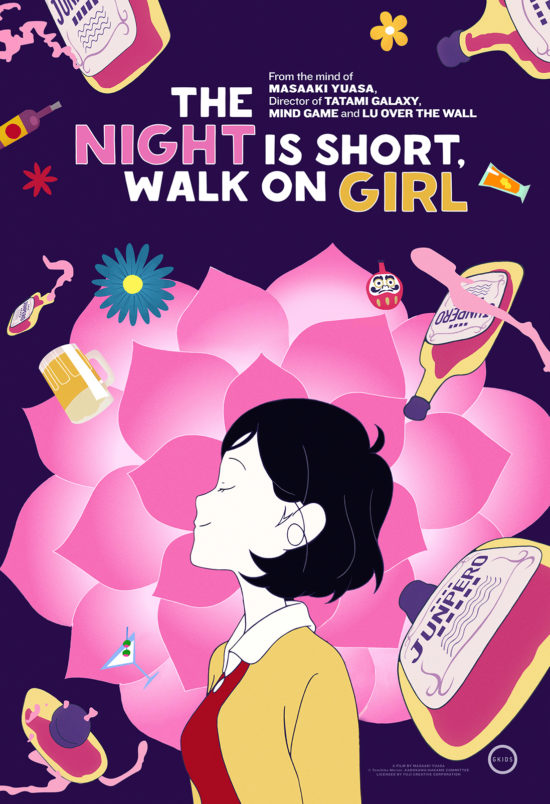
REVIEW: The Night is Short, Walk On Girl


For as much as I like to say I enjoy anime, the irrefutable truth of the matter is that I'm basically just a novice; I've watched Fooli Cooli and Gurren Lagann  a couple of times and I'm currently enjoying My Hero Academia, but it's safe to say that there are vast parts of the medium that I still need to explore. I was, for example, completely unfamiliar with the work of Masaaki Yuasa; that is, until I decided to check out The Night is Short, Walk On Girl (loosely adapted from the Japanese novel of the same name). I saw the trailer on Facebook just by chance (or perhaps it was fate), but the fluid animation, whimsical art design, and catchy music told me that I just had to go check this one out (especially since it would be in US theaters for two nights only). 90 minutes later and I'm not only convinced that I need to seek out the rest of Yuasa's work, but that The Night is Short, Walk On Girl is my personal pick for the best movie of 2018 (even though it was technically released in 2017, though only in the UK and its native Japan).

The plot is, shall we say, difficult to describe. This is one of those situations where I feel as though I'd be walking a fine line between describing the premise and simply recounting every scene; it's very much like Alice in Wonderland or The Wizard of Oz, where our protagonists move from situation to situation, encountering a host of unique characters as they go on their journey. The film follows a nameless girl with black hair (typically just referred to as Otome, the Japanese word for "maiden", and voiced by Kana Hanazawa) on a night of heavy-drinking through Kyoto. Meanwhile, a similarly nameless classmate of Otome's (referred to as Senpai, voiced by Gen Hoshino) is determined to confess his feelings towards her on this fatefull night. As he explains, he's implemented a long-term plan of crossing paths with Otome as often as he can manage, under the guise of their encounters being sheer coincidence. When the time is right, he will reveal his true intentions and it will seem as if the two had always been intertwined by the red string of fate. What follows is a delightfully charming, psychadelic rom-com that utterly annihilated my expectations in the best sort of way. This is just one of those movies that feels like a vivid dream, boasting the kind of atmosphere I'd like to curl up inside of for the rest of my life.


While the movie is, aesthetically-speaking, undeniably gorgeous, the real draw for me was the thematic subtext underneath it all. This is one of those films that focuses in on that sort of "quarter-life crisis" that twenty-something college students tend to go through. We've seen so many coming-of-age stories, but what happens after the protagonists have already grown up before the plot truly began? We're told from high school onward that we're "young adults", but that feeling honestly didn't kick in for me until after I'd completed my undergrad, got a job, and moved into a place of my own. For those who go right from high school into college, the question of what comes after is something that really starts to weigh on you after you get acclimated. We act like the transition from high school senior to college freshman is a massive change, but it's really nothing compared to spending the first 22 years of one's life adhering to a more or less consistent system of schooling and socializing, only to finally cross the finish line into the stage of your life when you have to start thinking about taxes and rent and insurance. You get your degree, then what comes next? Graduate school? A career? Or just another job to pay the bills? Should you get married? Start a family? Buy a house? Do you even have the means to do any of those things? These are all the questions you start to mull over as you begin to fully and finally transition into the adult world, and said questions tend to weigh heavily on the minds of chronic over-thinkers like Senpai (or myself, for that matter).


The character of Senpai manages to transcend the usual "awkward nerd who's hopelessly smitten with the girl of his dreams" trappings by really delving into his mindset. He isn't just another gawky buffoon in pursuit of his manic pixie dreamgirl; he's insecure to the point that he outright questions if he even deserves to have his insane plan work out, or if it would be more fitting that he just shrivel up and die alone. He's become accustomed to failure, putting up walls to protect himself from the terrifying idea of what might happen if he actually gets what he wants for once, the only outcome he's completely unprepared for. Otome, meanwhile, is in the exact opposite situation; she's naturally talented at everything she tries, resolved to simply go with the flow and see where the night takes her. While she hardly has to put in any effort in order for things to go her way, she's left with a life that, compared to Senpai, lacks any semblance of drive, ambition, or purpose. The film establishes that her easy-breezy attitude towards life tends to leave those around her in the dust, leaving her with her own kind of loneliness to deal with. They're two sides of the same coin, yin and yang, but that doesn't mean they don't need to grow and change in their own ways before they're fit to be together.

The film hypothesizes that who we are is but an amalgamation of those we meet in life; whether we know them for the rest of our days or just for one drunken evening, the impact and influence they leave us with is what determines who we are and how we grow as people. The emotions these people inspire and the stories they leave us with are the things that life is made of. Feelings of isolation, loneliness, and disassociation are hardly rare for young people, especially those who find themselves in the midst of a great transitory period in their lives, and The Night is Short, Walk On Girl goes to great lengths to remind us that no man is an island. Whether you believe in fate or not, your existence is immutably intertwined with those around you (and even those you've yet to meet). We're all players in the funny, tragic, oddball play that is the human race; everyone matters, no one is truly alone, and happiness will always inevitably win out over nihilism.


Although it's obvious that the underlying motifs this movie set forth resonated with me on a deep emotional level, I want to make it clear how much I adored everything else in this movie. Like I said before, the animation is absolutely stunning (putting Masaaki Yuasa on my radar in a big way) and I really love the use of color and sound to establish a sensory experience that's at the same time fantastical and immersive. As the night goes on, an entire year seems to pass; we begin on a warm spring evening, transition into summer heat, and by the time the climax rolls around, all of Kyoto is stuck inside with the flu as unforgiving winds and snow rip through the empty city streets. I also found myself surprisingly invested in the stories of the various side-characters Otome and Senpai come across, absurd as they are. My personal favorite would have to be Don Underpants ( Ryûji Akiyama), a writer and hopeless romantic who has pledged to not change his underwear until he reconnects with a girl he had a fated encounter with some time ago. At first we assume he's just there for a one-off joke about his self-appointed nickname, but then he shows up again much later on, setting up guerrilla plays at the student festival as a means of attracting his mystery love's attention. These side-characters are all bit players compared to our two main leads, but their stories are told in such a way that it truly feels as though the plot thread doesn't end the moment they walk off-screen. We really get the feeling that this isn't just an extraordinary night for Senpai and Otome; everyone has their tale to tell, and that's really the entire message of this movie in a nutshell.


The Night is Short, Walk On Girl is really just a remarkable little movie. It's a surprisingly conventional, feel-good love story that's conveyed in the most unconventional of ways; pair that with sublime animation, supremely comfy atmosphere, a killer soundtrack, and loads of endearing and memorable characters, and you've got a winning recipe for my personal favorite movie of 2018 thus far. Yes, I know, it technically came out in 2017 everywhere but the USA, but I'd be outright lying if I said that, out of everything I've seen in theaters this year, The Night is Short, Walk On Girl wasn't my favorite. If it wasn't clear already, I absolutely adore this lovely, lovely film and would like nothing more than to just immerse myself in all the charm and good vibes it's constantly putting out. If you're a fan of anime or animation in general, you owe it to yourself to give this one a watch.

July 22, 2018

REVIEW: Redline


I've been on something of an anime kick as of late (getting up to speed on both Konosuba and My Hero Academia in less than a week), so it felt appropriate to finally tick off a film that's been sitting in my backlog for a good couple of years now; 2009's Redline. I normally tend to avoid summarizing movies as "X crossed with Y", but I simply can't help myself in the case of Redline. This is Speed Racer crossed with Wacky Races in the style of Mad Max: Fury Road, but in space. It's a film every bit as absurd as that description, more than making up for what it lacks in plot with some of the most stunningly engaging animation I've ever seen.

Set in the far reaches of space, the film follows "Sweet" JP (Takuya Kimura), a rockabilly racer with a checkered past whose driving skills are nearly as impressive as his pompadour. When JP finds himself voted in as a participant in the titular Redline race (a highly anticipated annual event using traditional motors only), he can't help but say no, even though the race is set to be held on the aptly-named Roboworld, a planet populated entirely by cyborg zealots. The president of Roboworld (Kōsei Hirota) is staunchly against hosting the Redline on his planet, as he fears the broadcast of the race could reveal a number of illegal military operations (which would undoubtedly violate a great number of treaties); as such, he has pledged to terminate any and all racers he finds on his planet. As if that wasn't enough, JP is oblivious to the treachery of his longtime partner, Frisbee (Tadanobu Asano), a mechanic who's gotten in deep with the mob. Not only does he need to win the Redline, he has to survive, all while pursuing the heart of fellow racer, Sonoshee McLaren (Yû Aoi). It's a romance/drama/action/sci-fi extravaganza and I honestly had so so much fun with it.


I tend to use the term "feast for the eyes" regrettably often whenever it comes to discussing animated films, and Redline is definitely no slouch when it comes to visuals. I love everything about the way this movie looks, feels, and moves. The character designs are imaginative and endearing, never getting too silly or outlandish so as to distract from the action. Along with JP and Sonoshee, we have a dirty-cop gorilla man (chasing after the other participants for speeding, naturally), a pair of bounty hunters that definitely aren't parodies of Batman and Robin, and a well-mannered robot who literally is his own car (among others). It feels trite to say something like "this film is bursting at the seams with pure imagination", as if something as abstract and subjective as imagination could be measured, but I really can't think of a better way to express myself here. It's an animated feature that most definitely leaves a big impression. There are obvious influences from existing works (see the initial Speed Racer/Wacky Races/Mad Max comparison), but it's got its own distinct identity as well. The designs of everything from the racers to their vehicles to the various planets themselves are just so vivid and creative; it's one of those films like Wizards or Fantastic Planet, where I just want to completely immerse myself in the art direction and design.

With such fantastic designs, it should go without saying that the animation here is also top-knotch. I don't know if I've ever uttered, "wew, that looked expensive" at an animated film as often as I did with Redline. According to my rudimentary research, the film was in production for some seven years, and took over 100,000 individual drawings to complete; rest assured, the final project looks it. I especially loved the fish-eye effect used to convey mind-blistering speeds (a winning combo when paired with JP's towering hairdo). If you're into psychadelic visuals like those found in FLCL or Yellow Submarine, you'd be doing yourself a disservice not to add Redline to your "must watch" list.


If I have any real criticism, it simply has to do with the plot. Redline is by no means a complex or thematically-heavy movie; there's a race, our main character wants to win said race, said main character drives really really fast. That's about it. It's most definitely more about the visuals here than it is the plot, which I honestly feel is somewhat forgivable, given the circumstances. The entire plot of Redline focuses in on this one race, and damned if it isn't one hell of a race. It doesn't attempt to be anything more than it is by spouting off pseudo-intellectualisms in an attempt to trick the viewer into thinking that there's anything close to a healthy balance between style and substance. This is a film that 110% knows what it is about, and I honestly respect that. The filmmakers knew that they were making a movie about really cool-looking cars that drive really quickly across stunningly-detailed alien planets, and that's exactly what we get. 

Even then, with how simple the plot is, I found myself surprisingly invested in the drama between JP and Frisbee; the film does slow down at points to give us some insight into their history together, allowing us time to breathe between the insanely engaging action beats. For as simplistic as the plot is, the character interactions are given a good amount of attention (at least moreso than one might expect with a project as visually-focused as this). The time we spend with our main cast isn't just a formality before we can get back to the fast cars and hellacious crashes. Rather than having the characters outright state what their motivations are, the audience is left to piece everything together from implicit details after the credits roll; some might call this lazy, I call it efficient. Both the film and the audience are on the same page, the movie's strongest suit is the manner in which it liberally doles out speed and adrenaline. Additional exposition would have just weighed everything down, so I appreciate the film's confidence in its audience to figure out why certain characters act the way that they do without spoon-feeding it to us, getting in the way of the main event in the process.


I don't really have much else to say about Redline. It's an awesome little flick. If you're a fan of animation (or anime specifically), consider this mandatory viewing; the same goes for those of you who are into cars. It's not an overly-complicated movie, it's just an all-around good time. The plot isn't much to write home about, but Redline more than makes up for its lack of subtextual depth with its positively stunning animation and art direction; watch it on a big screen with a good sound system and all the lights turned off, it'll blow you away.

February 19, 2018

REVIEW: Fantastic Planet


As I've gotten older, I've developed a growing fascination with outsider animation. Don't get me wrong, I still greatly enjoy the annual fare from Disney and Pixar, but there's something special about the outlandish, surreal, and decidedly more adult-oriented animated films of the 70's and 80's; something that was definitely lost around the time of the Disney Renaissance. With Disney cornering the market on squeaky-clean family fun, there existed a clear niche for animation that explored themes and ideas that the House of Mouse wouldn't dare touch; a niche that was soundly filled by filmmakers like Ralph Bakshi and Don Bluth. It was imagination unrestricted by the limits of the MPAA, and it pains me to see such fantastic examples of creative expression dragged down by the most braindead form of praise art can possibly recieve; "woah, they must have been on drugs to think of this!" Whenever anyone says this, it essentially means that they have such a limited imagination that the only conceivable way a human could create anything even the slightest bit innovative or out of the ordinary is by way of a hefty dose of psychedelics. Which, to clarify, doesn't mean that drug-use didn't influence some of these films (especially considering the era they were born from). But the fact of the matter is that movies like today's film, Fantastic Planet, have far more to offer than just some trippy visuals. Behind all the surreal imagery and whacked-out animation lies subtext, and it's this vital facet of storytelling that elevates films like Fantastic Planet above simply being the cinematic equivalent of a lava lamp.

An adaptation of the 1957 French novel, Oms en série, the film takes place in the distant future, on the far-away alien world of Ygam. Long after wiping out their own civilizations on Earth, humans were brought to Ygam by the Draags, an advanced race of blue giants. On Ygam, humans (known as Oms, a play on the French word "homme") are regarded as little more than common vermin; while a good number of Draags have domesticated Oms they keep as pets, there are also roaming colonies of savage Oms who are routinely exterminated (not unlike rats or mice). The film follows one Om in particular, Terr (voiced by Barry Bostwick in the English dub); orphaned as a baby, he finds himself adopted by the daughter of a Draag diplomat, eventually escaping and joining a wild colony of Oms with the intent of ending the oppression of his species once and for all.


The most immediately striking aspect of the entire movie (and the detail which lead me to eventually watch it) is the art design, care of painter/writer Roland Topor. Given the setting and themes of the story, it's immensely important that Topor was able to create a world that looks truly and honestly alien in nature; none of the creatures on Ygam even remotely resemble anything on Earth, and the eerie landscapes help foster an atmosphere of unfamiliarity and foreboding. It all really adds to the situation the Oms find themselves in; you're able to get a powerful sense of how far humanity has fallen and how separated they are from the civilization we know today (even if their base instincts and motivations remain more or less the same, but more on that later). Admittedly, there are moments here and there where the design falters and aspects of the Draag civilization end up looking as though they're simply meant to appear strange for strange's sake; this isn't a film like Treasure Planet where every single aspect of the film's visuals are designed with the idea that it must serve some sort of in-universe purpose. Then again, one must think of the artist's intent when judging aspects like this; world-building isn't exactly meant to be the main takeaway of Fantastic Planet. The subtext is meant to be the primary focus here, and in that area it very much succeeds (but again, more on that later).

My only other gripe with the design of this film is the limited animation. Whereas films like Yellow Submarine give the impression of a watercolor painting brought to life, Fantastic Planet feels much more akin to the work of Terry Gilliam (who, coincidentally, would release his animated short, The Miracle of Flight, just a year later). While Topor's designs are hauntingly beautiful, the animation at play simply doesn't do them justice; everything moves in a very stilted, deliberate manner and character movements tend to lack any and all sense of weight. I also wasn't overly fond of the soundtrack (care of French jazz pianist, Alain Goraguer); while some praise the psychedelic atmosphere the score brings to mind, I found that it just didn't work for me. This is a thoughtful, surreal experience filled with haunting visuals and themes drenched in existential dread. It feels like exactly the sort of concept that would be best complimented by an equally eerie orchestral or prog-rock score, only to be undercut by a dated and altogether unfitting collection of funky beats and wah-wah guitars. This is a score that would have worked perfectly in just about any other film, but just feels wrong here. Then again, it could also be argued that the ill-fitting music and limited animation only serve to enhance the existing atmosphere of unfamiliarity and unease, so these are aesthetic details that (much like the all-important subtext) are free to be left up to the viewer's individual interpretation.


As I mentioned before, inspired visuals can only support so much. While it's very much true that film is a visual medium, it is the way that movies are able to combine all manner of sensory expression that sets film aside from other artistic outlets. When a film ignores any of the tools provided, focusing purely on visuals and ignoring its story (or vise-versa), it is doing itself a disservice. In the case of Fantastic Planet, you come for the tripped-out visuals, but stay for the thought-provoking subtext. The film raises a number of intriguing (and, depending on your perspective, uncomfortable) questions about the nature of life and sentience. What makes the life of one being inherently more valuable than another? By what standard do we judge if a living thing is sentient, or civilized, or even alive? There's obviously a clear "how would you like it?" aspect regarding man's relationship with the natural world, but in truth there's so much more here to unpack and explore. It's very easy to feel inherent sympathy for the Oms, the same way it's very easy to feel a deep resentment towards the Draags. We want to side with the downtrodden and oppressed humans over the beady-eyed, emotionless aliens, despite the fact that the Draags are us. They adhere to their own, odd social rituals and exert callous control over the natural world without a care, simply because they've deemed themselves the most advanced race and that gives them the right to do as they please

There's an obvious environmentalist tilt to the whole thing, but it never feels so cut-and-dry, so narrow in scope. One could also easily view the conflict between the Oms and the Draags (in which one species, deemed inferior by those with more power and technology, is systematically exterminated) as an allegory for genocide and racism. The Draags don't think much of the Oms until the Oms become educated and organized; then the downtrodden and oppressed suddenly become a legitimate threat to their oppressors, and only then is peace and equality considered to be an option. Personally, I took the film as a metaphor for how humanity is often manipulated into destroying itself by any number of higher powers (be it competing governments, religions, or what have you); the Draags often make their domesticated Oms fight for each other's amusement, inspiring internal conflict and squabbling among the oppressed, preventing actual progress from being made towards freedom, enlightenment, and prosperity. Whatever your personal interpretation, they all feel equally valid. Not in a half-baked, lazy kind of way, as though the filmmakers didn't put enough thought into what they actually wanted to say with this film, but rather in a sense that denotes extreme care taken on the part of the filmmakers to ensure that the underlying messages could be conveyed to any number of perspectives. The fact that this film is open to so many interpretations could easily come off as needlessly vague in theory; in practice, however, it feels like anything but, and it's this kind of potential for exploration that represents what I consider to be Fantastic Planet's true worth as a film.


In terms of entertainment, I'm not 100% certain I'd recommend Fantastic Planet to just anyone. While I definitely took a lot away from it, I wouldn't exactly call this an "entertaining" movie; despite being just over an hour long, it's quite slow-paced and very dense from a conceptual standpoint. It's not the kind of thing I see myself ever throwing on to unwind after a long day at the office. That said, as a film, I consider this to be mandatory viewing, especially if you consider yourself a fan of animation. The art direction is worth the investment alone and the underlying themes and messages are sure to stick with you well after the credits finish rolling. This is the kind of movie I can't help but recommend everyone watch at least once (although I'm sure repeat viewings will do nothing but enhance one's overall experience). If you feel as though you're in the proper mindset for something in this wheelhouse, you'd be hard pressed to go wrong with giving Fantastic Planet a watch.

September 7, 2017

REVIEW: Batman & Harley Quinn


I honestly didn't think things could get much worse than The Killing Joke. Sure, that was a tone-deaf (if admittedly well-acted) cash-in on an iconic Batman story, but it had to have been a fluke, right? There are plenty of decent DC animated features out there; some of them (Justice League: The New Frontier, Mask of the Phantasm, Under the Red Hood) are even pretty phenomenal. However, having taken in the latest Warner Animated movie starring the caped crusader, I'm forced to simply come to terms with the fact that, much like Warner Bros' live-action division, they simply have no idea what they're doing when it comes to the beloved and time-honored characters of Detective Comics. It's not often that a movie is so bad it makes me angry. More often than not, I can see the fun in a good, bad movie (like last week's trainwreck, Death Note). But believe me when I say that Batman and Harley Quinn is one of the most insufferable, insulting things I've had to sit through in a good long while.

The story takes place in the continuity of Batman The Animated Series, the classic show that introduced us to the once-novel but now woefully over-played character of Harley Quinn (incidentally, BTAS just turned 25 years old, and lord knows it deserves a better birthday tribute than this tripe). The plot follows Batman (Kevin Conroy, of course) and Nightwing (Loren Lester) as they attempt to put a stop to the sinister plans of Poison Ivy (Paget Brewster) and Jason Woodrue, the Floronic Man (Kevin Michael Richardson). As one might expect from a duo of hippy-dippy plant-based supervillains, their scheme involves mixing up some manner of super-chemical that will transform all animal life into sentient plants, thus returning the Earth to the rightful hands of Mother Nature and yadda yadda yadda. In order to track down the green meanies, the dynamic duo enlist the help of Ivy's longtime gal-pal and associate, the recently-reformed Harley Quinn (The Big Bang Theory's Melissa Rauch). If this sounds like a rehash of the classic BTAS episode, Harliquinade (in which Batman and Robin enlist Harley's help in tracking down the Joker after he acquires a nuclear bomb), that's simply because that's exactly what it is, just minus any inkling of pathos or emotion and with at least 100% more prolonged fart jokes.


The most jarring issue with this film is that it has no idea what it wants to be, tonally-speaking. The original Batman animated series on which this film is based was notable for its dark tone and noir aesthetics. It had its lighter moments, sure, but the main reason it's so fondly remembered is because of how effectively it reinvented the character of Batman for a new generation, casting the classic superhero in a brooding, mature, dynamic light, reminiscent of the Tim Burton films released around the same time. And the character of Harley Quinn, bubbly and comedic as she was, was still very much a product of this sense of tone. Just under the surface was a tragic figure, able to illicit sympathy just as easily as she could illicit laughter. She wasn't, for lack of a better term, a meme character, meant to spout catchphrases ready-made to be printed on a line of t-shirts at your local Hot Topic. She had some actual degree of emotional depth to her character beyond "wacky random clown girl", yet these days it seems like that's all DC is content in giving us. She's got all the "lol so random" appeal of Marvel's Deadpool, but with that oh-so-important addition of easily-marketable sex appeal. What else is there? She moves buttloads of merchandise with little to no creative effort on DC's part, may as well stay the course until this proverbial cow is milked dry.

This movie's take on Harley is just insufferable in every way. Melissa Rauch is a refreshing change, I guess (I've come to terms with the fact that Tara Strong is probably the best replacement for Arleen Sorkin we're gonna get, but I'd be lying if I said it wasn't getting a bit grating hearing the same exact voice every time the character shows up these days), but she still does a sub-par job overall. While I can admit that any substitute voice would sound wrong coming out of the BTAS Harley, Rauch's pseudo-Yiddish accent just sounds painfully forced. It's obvious WB had her on the payroll for The Big Bang Theory and was just looking for some cheap and easy brand synergy. It also hardly helps that Harley is written here like an author-insert in a gaudy fanfic. She's essentially the best, coolest person in the world; she solves all the problems and has all the epic zingers and even has a totally necessary musical number at one point (again, this movie is definitely not a lazy rehash of that one episode of Batman The Animated Series). Meanwhile, Batman doesn't do much of anything and Nightwing serves as nothing more than a pseudo-love interest/rape victim.


Yes, it seems that once again, Dick Grayson, Bruce Wayne's old chum and faithful ward, ends up getting raped for "comedic" effect. You see, it's perfectly fine that Nightwing gets drugged and tied to a bed in an abandoned tenement, only to have a crazed ex-supervillain jump his batarang. It doesn't matter that Harley is a self-described sociopath; she's hot and that's all that matters, am I right fellas? (Insert whooping and fist-pumping here). No but really, all sarcasm aside, this entire sequence is utterly disgusting. Let's not pretend that heads wouldn't roll if the genders were reversed and a vulnerable superheroine was the one knocked out and sexually assaulted by a reformed mental patient (and before you go throwing The Killing Joke at me, at least that didn't try to hand-wave it away by implying Barbara Gordon actually enjoyed it). It's really the most patronizing and insulting message to men who enjoy comics; the idea that the target audience for this is so desperate, that they'd accept, or even embrace, getting drugged and raped by a murderous psychopath (so long as she's a total dime, of course). Over the remainder of its runtime, the film sees fit to make Nightwing the butt of a number of jokes, implying that he's not only responsible for what happened, but that he deserves to be mocked for letting Harley slide down his bat-pole, as if he was a horny schoolboy who got caught with his hand in the cookie jar. I guess it makes sense, all things considered; I mean, just look at what he's wearing! A fit, handsome young man in a form-fitting outfit like that, why he was practically asking for it!


Aside from turning one of the title characters into a full-fledged rapist, the film also confirms a theory I've been mulling over for some time now; without the Joker, Harley Quinn just isn't an interesting character. I'm sorry, but it's true. The Joker is an integral part in her internal conflict; he is the entire reason that Harleen Quinzel became Harley Quinn in the first place. Removing his influence on her story has the same effect as if Batman's parents came back to life; that initial struggle, that core dynamic that defines the entire character, is lost. Instead, we're simply left with a catchphrase-spouting Poochie of a character and it becomes abundantly clear that this was simply made to cash in on Harley's ongoing mainstream popularity, as well as Batman The Animated Series' big 25th anniversary. At one point Batman describes her as "the walking definition of 'loose cannon'", which I can only assume is a direct quote from some Warner Bros executive at whatever pitch meeting spawned this cheap, lazy trash. 

Without the Joker keeping her down, Harley loses all sense of sympathy; if she's willing to throw on the tights, a supposed symbol of a horribly traumatic and abusive period in her life, at the drop of a hat, then she just becomes another supervillain with flexible morality. She ceases to be a truly tragic figure and just becomes another wacky comic book character with an unfortunate past. Everyone has a tragic backstory these days. Kite Man has a tragic backstory these days. The thing that set Harley aside from the rest was that it wasn't just her backstory, but her whole life that was tragic. Mr. Freeze was one of the best villains featured on BTAS, but once you cure his wife, he loses all relevance and has no reason to go cavorting about with Batman and Robin anymore. The same applies to Harley; once she's free of the Joker's influence, any attempt to put a mallet back in her hands just comes off as hackneyed and regressive from a characterization standpoint. Then again, it's fairly obvious that nuanced characterization wasn't exactly at the top of the agenda when putting this together.


If it wasn't clear already, I absolutely positively loathed this movie. I say this as a tremendous fan of not only Batman the Animated Series, but of all the cartoons and comics that Bruce Timm and Paul Dini created together; this movie is pure trash of the highest caliber. The tone comes off like a Hot Topic interpretation of the 60's Adam West show, conveyed through the aesthetic of The Animated Series, only the people behind it managed to capture exactly none of the nuance or charm of either of those shows (which is especially confusing, considering Bruce Timm is one of the two writers responsible for this mess). This movie is so bad it made me wish that DC had retired the character of Harley Quinn alongside Arleen Sorkin. The characters are paper-thin and bafflingly characterized, the animation is sub-standard, everyone appears off-model more often than not, and the frame-rate sinks like a stone any time there's any action onscreen. There's tons of padding for time and the end result ranks alongside BTAS episodes like I've Got Batman in My Basement; it stretches itself so thin to try and justify a full-price home release, yet by the time Floronic Man made Poison Ivy eat a psychedelic yam he plucked off of Swamp Thing's corpse I just didn't care anymore. 

The only bit worth salvaging is the post-credits scene, in which Harley finds herself hosting a television show that's one part Doctor Phil, one part Takeshi's Castle. It's actually legitimately funny and is the only part of this entire ordeal that feels even remotely in-tune with the tone of the series it's banking off of. Unless you feel like wasting an hour of your life you'll never be able to get back, I recommend sparing yourself the headache and giving this mess a miss.

May 13, 2017

REVIEW: Wizards


Cult classics are a tricky lot, especially when it comes to psychedelic cinema. There's always the chance that a film with a large following will simply fail to live up to the hype when viewed without the assistance of a bag of hallucinogens. All the same, there are times when one comes across an entry in this genre that amounts to more than just a trippy collection of pretty colors set to acid rock. 1977's Wizards is definitely responsible for blowing the minds of more than a few burnout college kids, I'm sure, but that's not to say that there isn't something worth exploring beneath the surface. One of the more tame creations of animation legend Ralph Bakshi (who proved that animation could be used for more than just cheery Disney children's films with such X-rated fare as Fritz the Cat and Heavy Traffic), Wizards paints an extraordinarily out-there portrait of a far-off, fantastical future over a subtextual exploration of morality and the power of propaganda.

The plot in this is a bit much to take in, but I'm going to do my best to sum it all up as succinctly as possible. In the future, the Earth is annihilated by nuclear weapons and terrorism, eradicating all life on the planet. However, over the next two million years, human life begins to re-emerge; those who populate the idyllic good lands regress into humanity's true ancestors, fantasy races of elves, dwarves, and fairies. In the heavily irradiated bad lands, humans devolve into hideous mutants, ogres, and goblins. After thousands of years of peace, two wizards are born; the good and kindly Avatar (Bob Holt) and his brother, the sinister mutant, Blackwolf (Steve Gravers). After many years, the two eventually do battle, with Avatar emerging victorious. His brother leaves for the dark lands of Scorch, vowing to return one day and reap his vengeance. If this sounds like the entire plot of the movie, I think it's worth noting that this is all mere backstory, established within the first five minutes. 


The incredibly dense prologue sets the tone for the adventure to follow, letting the viewer know that they're watching something that's about to get very strange very quickly. We then flash a few thousand years further into the future; Blackwolf is still consolidating his power and Avatar has grown old and somewhat cynical. The peaceful kingdom of Montagar has long since outlawed science and technology while Blackwolf  reigns as the ruler of Scorch, excavating ancient relics from a time before the nuclear holocaust. One such relic is an old film projector loaded with Nazi propaganda; using the ancient footage to motivate his dimwitted troops (and to traumatize his enemies), Blackwolf puts his plan into motion and declares war on the peaceful free states. It is up to Avatar, the fairy princess Elinore (Jesse Welles), the reprogrammed robot assassin Peace (David Proval), and the elfin spy Weehawk (Richard Romanus) to seek out and destroy the "dream machine", putting an end to Blackwolf's sinister machinations and preventing the second coming of the Third Reich.


I did say that this film went to some far-out places, didn't I? It would be very easy to simply brush this film off as hyper-stylized stoner fodder, packed to the brim with Tolkien-esque fantasy creatures and rotoscoped footage from World War 2 movies, but there's really a great deal more this has to offer just beneath the surface. To write Wizards off as "something cool to watch while high" (or even worse, with the old-as-time "woah, they must have been on drugs to come up with this!") is a tremendous disservice to the clear amount of deliberate thought and imagination Bakshi and company implemented when making this film. There's a reason the plot creates a false sense of build-up towards an anti-science moral, the same way there's a reason so much Nazi imagery is used throughout; Wizards is a puzzle, and it's up to the viewer to put the pieces together. Just about everything we're given serves some sort of a greater narrative purpose, even if it doesn't appear so at first glance.


At first, it appears as though the film is going for the classic "nature trumps technology" theme we've seen so many times before. The villains all use WW2-era panzers and rifles while the barefoot forest creatures fight with swords and arrows. However, the film gradually subverts the audience's expectations, espousing the merits of pragmatism and compromise. The World War 2 parallels are plain to see; the downtrodden mutants are clearly in dire straits, forced to reside in an unforgiving hellscape where both the air and water are toxic. However, they end up rationalizing their misfortune as justification to adopt the ideals of the Nazi party, lashing out at those they deem as oppressors. Meanwhile, the peaceful fairy-folk have outlawed science and put all their faith in peace and harmony and happy feelings of oneness with nature. This essentially makes for a population of complacent layabouts who fall into disorganized shambles the second their leaders are compromised; when asked why they can't simply fight back and win, a fairy mother tells her child "because, they have weapons and technology. We just have love."


It seems to be a recurring theme in fantasy fiction that there is no greater force in the universe than generic feelings of love, but Wizards is having absolutely none of that. Make no mistake, love matters a great deal, but the film shows the importance of balance in both beliefs and morals. The good creatures place far too much reliance on love, peace, and harmony, and are thus wholly unprepared for the ruthless enemies that seek to do them harm. Meanwhile, the slovenly mutants are completely devoid of such emotions, and thus end up nothing more than dull cowards with no drive or conviction. This is where the power of propaganda comes in. The propaganda used by the villains is so overt, it's easy to miss that the "good" creatures make use of it as well, albeit through subtler means. It's fascinating how quickly one is able to accept something as egregious as outlawing science and technology as no big problem at first glance; perhaps it's because so much media exists warning us of the dangers of valuing technological progress over nature, but Wizards shows flat-out that both sides of the primary conflict are equally indoctrinated in their respective dogma. 

This is, again, where a sense of balance comes into play. The film pokes fun at the superstitions and rituals associated with organized religion, yet also levels with the audience, stating that a silly, complicated moral code is better than no morals at all. We see countless creatures slaughtered by superior firepower, despite their belief in love, magic, and the natural world. In the end, the side that claims victory doesn't win because of their superior morals, but because they are willing to bend and change as is necessary, without losing a sense of who they are. This is a story where the most powerful weapon is literally the use of propaganda; it can be used to inspire both hope and fear, to keep populations complacent or rally them to commit acts of violence. The film inspires the viewer to take a hard look at their own beliefs and ponder whether or not the viewer is just as indoctrinated as those they would call enemies. By painting morality as anything but gray, the nuances of a given conflict are buried and obscured, all in favor of saber-rattling and battle cries, ensuring that a peaceful resolution remains elusive to those who need it most.


While Wizards certainly offers a lot to think about, there are other aspects of the film that don't hold up quite as well. Ralph Bakshi is a legend of animation for a reason, yet while the character designs and backgrounds are sheer works of art, the animation quality tends to wildly fluctuate from good to bad and back again. The voice acting is also relatively hit-or-miss and the plot completely falls apart when viewed as anything other than a surrealist parable on the dangers of indoctrination. It's definitely a cult film for a reason, as I could very easily see someone not picking up what the film is putting down. Personally, I was somewhat lukewarm on it at first, yet I find myself loving and respecting this film more and more the more I think about it. While it's not for everyone, Wizards is most definitely a well-crafted, thoughtful, and thoroughly bizarre work of art that has earned its place of recognition in the annals of animation history.

August 25, 2016

REVIEW: Sausage Party


Why was this movie made? What was the thought, the spark of imagination, that was the creative impetus for this film's creation? Why do they constantly refer to hotdogs exclusively as "sausages"? Even the main character, Frank (Seth Rogan) is sealed in packaging that says "dogs", not sausages. If this movie is meant to be a parody of animated musicals, why is there only one song in the beginning? If humans are still able to see the food move (for instance, baby carrots fleeing in terror are shown to be slowly rolling off a counter), why doesn't anyone notice them dancing and cheering inside a shopping cart? 

Why did we have to watch a talking douche rape a juice box? Why did absorbing the juice make the douche stronger? Why couldn't the writers think of more inspired names than "Kareem Abdul Lavash" and "Sammy Bagel Jr"? I understand that the joke is that the lavash (David Krumholtz) is meant to represent Palestine and the bagel (Edward Norton) is meant to represent Israel, but those aren't even puns. While it's true that Kareem Abdul Jabbar and Sammy Davis Jr eventually converted to Islam and Judaism respectively, they hardly seem to be the prime candidates for food-based puns focused on religion. You might as well have named the character "Mel Bagels" or "Bagel Stewart" and achieved the same result. Not to mention how I imagine the target audience for Sausage Party knows as much about the Rat Pack as they do about retired basketball players.


Why did the filmmakers see fit to swindle so many animators out of their hard-earned credit? Not that the animation on display here is anything particularly groundbreaking, but credit is due where credit is due. Why were the hotdogs displayed on a non-refrigerated stand? I understand that it makes sense to position hotdogs in close proximity to buns, mustard, and other related paraphernalia, but I can't imagine a sleeve of room-temperature weenies would have a very long shelf life. Why would a modern-day supermarket sell a brand of alcohol labeled "Firewater" with a Native American motif? Even if they did, how would such a product not cause massive public outcry and be pulled from store shelves? How is it that the only non-perishable items in an entire store are a bottle of liquor, a package of grits, and a single Twinkie? Why does a film that ends in a cartoon food orgy make the assumption that a single member of its target audience would be familiar with They Call Me Mister Tibbs? Where would a talking bottle of liquor acquire enough weed to become a bonafide stoner? How does a bottle of liquor even smoke weed? Do the food characters have respiratory systems? Do they need to eat and drink? If so, what does food eat? Is there a sub-group of food-food that views our food as monstrous god-beings obsessed with murder and destruction as well?


Why was the Irish potato covered in extra eyes? Why are some products shown as being items inside a package (for instance, Frank and friends) and some shown as being the actual package itself (the aformentioned box of grits, voiced by Craig Robinson)? Considering that the cast includes a talking douche, a roll of toilet paper, and even a condom, the film establishes that not only food is sentient. Where does this end? Are all inanimate objects in some way alive? Why does a druggie (voiced by James Franco) own a large, medieval battleaxe and why is it positioned above his doorway? Why is said battleaxe kept sharp enough to cleanly sever a human head? How did a wad of gum manage to construct an electronic wheelchair and voice box? If a person under the influence of bath salts is able to see the food walking and talking the same as the viewer, then what did the blood-soaked climax look like to a sober person? Was it just a bunch of crazed shoppers and employees suffering cartoonishly fatal coincidences?


Why does the movie end in a store-wide food orgy? Was this entire movie made just because Seth Rogen realized that there's more than one way to interpret the phrase "food porn"? Why does it feel the need to shoehorn in an extremely heavy-handed metaphor about religion? Why does the half-assed message of "I guess you have to respect everyone's beliefs even though they're stupid and not real" come off as somehow more insulting and condescending than if the film had simply said "religion is dumb"? Why does the movie end on a cliff-hanger sequel tease that feels as though it's right out of a Marvel movie? Why did anyone sign on to make this? Why would anyone make this? How am I unable to muster legitimate anger towards this film despite it literally being the stupidest, most pointless thing I have ever seen in my entire life? More importantly, why did I spend actual money to go and see this?
What the hell did I even watch?

July 28, 2016

REVIEW: Batman- The Killing Joke


There was a time a few years ago when Mark Hamill decided to permanently retire from voicing the Joker, claiming that the role put too much stress on his throat after all these years. The only exception he would return for, he said, would be an animated adaptation of Alan Moore's The Killing Joke. An understandable caveat; an actor considered by many to be the definitive Joker, playing the part in an animated adaptation of what many consider to be the definitive Joker story. Years passed, and not only has Mark Hamill returned to voicing the Joker on a regular basis, but his dream of seeing this classic story adapted into an animated feature has come to pass. The question remains, does Batman: The Killing Joke do its source material justice?

The plot is the first thing that will concern comic fans. The original story is not particularly long (before writing this piece, I revisited the comic and finished it in about ten minutes). There's essentially enough material to make for a 30 to 45 minute runtime at best, but then that's hardly feature-length. Warner Bros Animation would be hard-pressed justifying a full-price home release for something so short, let alone a limited theatrical run, so naturally some additions have been made. The original plot of The Killing Joke concerns the Joker once again escaping Arkham Asylum to wreak havoc on the city of Gotham. After crippling Barbara Gordon (Tara Strong), the clown prince of crime kidnaps her father, Commissioner Jim Gordon (Ray Wise) and attempts to drive the old man insane in order to prove that even the most upstanding individual is "one bad day" away from descending into total madness. While the Batman (Kevin Conroy) tries to track the Joker down and put a stop to his scheme, we see flashbacks that shed some light on the Joker's mysterious origins. The source material is an exemplary display of the dynamic between Batman and the Joker; these two are without a doubt, the stars of the show. Which is why it's so confusing to me that the entire first act of this movie is a totally unrelated story about Batgirl.


I'll admit, I can see where writer Brian Azzarello was going with this. The graphic novel on which the film is based was released on comic stands; if someone was reading The Killing Joke, chances are they knew who Barbara Gordon was and understood why she was important. Her incidental role in the original story could be forgiven, considering that the book was part of the greater ongoing Batman canon that comic fans of the time would clearly be familiar with. However, film is much less of a niche medium than comics; whereas an issue of a comic series can act as a smaller chapter in a greater overarching storyline, a movie usually has to end up being more or less self-contained. It follows that, in a story in which a major plot point finds a character getting shot in the spine and crippled for life, it would make sense to endear any uninitiated audience members to that character before delivering such a powerful emotional beat.

While I can understand the logic behind adding in additional scenes of Batgirl in action, it still doesn't change the fact that The Killing Joke was never about Barbara Gordon; it was about Batman and the Joker (with extra emphasis on the latter). A prologue to further characterize Batgirl would have worked just fine, so long as it tied in with the actual meat of the story. Instead, we're given a one-off storyline involving a narcissistic would-be crime lord named Paris Franz (Maury Sterling ) and his creepy obsession with Batgirl. In terms of tone and content, this story and The Killing Joke couldn't possibly be more different. Whereas the parts of the film that are adapted straight from the book are full of somber imagery and the iconic prose of Alan Moore, the primary conflict of the Batgirl prologue involves Barbara feeling jilted after an uncomfortable one-night stand with Batman. The second half of this movie delves into the Joker's tragic backstory and is full of spine-chilling imagery and dialog, while the first half has Babs pouring her heart out to her camp gay best friend, wishing that the dark knight would call her back. Despite Batgirl not being the primary focus of the original story, it would have been very possible to write a prologue that not only characterizes her for a new audience, but also ties into the primary plotline in terms of content and theme. Instead we get this boring, baffling diversion that feels like it would almost make for a good one-off story if it wasn't taking attention away from everything that we all obviously came to see.


I must also call attention to the animation, art style, and general look of the movie. While some shots do an admirable job of mimicking Brian Bolland's iconic artwork, the entire thing just appears too simplified. When I see Bruce Timm's name in the credits of anything, even just as a producer, I immediately hold it to the same high standard of animation seen in Justice League Unlimited and Batman: Mask of the Phantasm. Unfortunately, the film doesn't come close to reaching that standard; I spotted numerous animation errors, as well as shots that simply came off as purely lazy (keep an eye on Gordon's silhouette as he makes his way through the Joker's funhouse). The art of the graphic novel had a true sense of grit to it; the heavy shadows and meticulous details fit the tone perfectly. This is a Batman story that is grimier and dirtier than those you're used to reading. While the designs of the comic are used here, liberties had to be taken in order to keep things easy to animate. The shadows are less complex, the range of motion is for the most part stiff, and minor details have been smoothed out in favor of something cleaner. "Cleaner" is not a style that compliments the content of this story. There's also some genuinely garish CGI at times that stands out like a sore-thumb; while I understand that a carousel must be one of the absolute worst things to animate, the one featured in this film made me physically cringe. I can only dream of what this would have looked like had it been made in the mid-late 90's, when Paul Dini and Bruce Timm's Batman The Animated Series was taking the world by storm. While the art design here is acceptable in terms of a TV/direct-to-video release, it's definitely a poor adaptation of Bolland's original artwork.


For all the issues I had with this movie, there was one facet that justified the entire thing for me; the voice acting. As a movie, it's heavily flawed, but it's a damn good audiobook. Kevin Conroy and Mark Hamill return once again as Batman and the Joker, in my opinion the best interpretations of the characters ever committed to screen. While I rolled my eyes at just about everything in the first act, I got genuine chills hearing Hamill recite iconic lines from the comic. It's only dawned on me just now that this is the most true-to-form Joker to ever be shown on the big screen. He's legitimately terrifying, unpredictable, and despicable, but at the same time relatable and sympathetic. In an era when I was suffering from Joker-fatigue, this movie came along and reminded me why the character has stood the test of time. Every moment from the graphic novel, from Batman's plea for compromise to the ambiguous ending are all adapted flawlessly. I simply cannot praise the main cast of Conroy, Hamill, Strong, and Wise enough; had this movie used a different cast, this all would have been utterly pointless. The vocal performances on display here are what made the movie worthwhile for me. While I obviously can't say this works as a replacement or stand-in for the original comic, I can say that, once the actual plot begins, it's an overall excellent adaptation of one of the greatest Batman stories ever told. If you're a fan of Batman or the Joker or both, I highly recommend you check this out at least once; it's entirely worth it just to hear those iconic lines being read by those iconic voices.

And now I sit back and pray WB Animation does a better job with the inevitable animated adaptation of Neil Gaiman's Whatever Happened to the Caped Crusader?

March 31, 2016

REVIEW: Hell and Back


It always fascinates me to see animated adult comedies that actually make it to theaters. Aside from the works of Trey Parker and Matt Stone, I'd be hard pressed to name a single theatrical release that not only made money, but provided an enjoyable experience. Comedies are usually profitable thanks to recognizable names and low budgets; when the medium is suddenly changed to animation (and especially stop-motion animation), the budget gets ratcheted way up and the cast is required to sell tickets on name and voice recognition alone. Again, apart from movies like South Park: Bigger, Longer, & Uncut and Team America: World Police, it's a genre with few winners. Keeping that trend of almost-consistent mediocrity alive is Hell and Back, a stop-motion animated romp starring Nick Swardson and T.J. Miller.

We begin our story at a crummy carnival-style amusement park run by Brian Posehn (who steps out of his comfort zone on this one to play an aging metalhead who likes to smoke pot); Remy (Swardson), Augie (Miller), and Curt (Rob Riggle) are three childhood pals who spend their time lamenting their crummy jobs running and repairing the rides, wishing for more out of life. After Curt begrudgingly takes a blood oath on an ancient satanic text in order to scam Remy out of a breath mint, he finds himself sucked into the firey hereafter. Remy and Augie give chase, literally delving into the bowels of Hell itself in order to save their friend.


The plot is literally every tired, worn-out "bros on an adventure" cliché in the book. There's three friends; the jerk who's comfortable in his mediocrity, the fat dork who's never been near a woman, and the bland one who talks about maybe wanting to make something of himself one day. They end up going somewhere weird where they meet a lot of colorful characters, including a sexy lady (Mila Kunis) who, shocker, ends up with the fat virgin for some reason. The jerk briefly abandons everyone around the end of the second act, they all reconcile, and everything works out nicely in an ending where everyone simultaneously gets what they want. It's trite and tired and has been done before and done better. Despite the strong comedic talent in the cast (including a slew of cameos from the likes of Dana Snyder, Kumail Nanjiani, Greg Proops, and more), this is no Superbad.

Then again, the plot in a comedy is really like the cherry on top of an ice cream sundae; if it's there, great, but it's not what people are here for. The most important part of any comedy is that it's funny; unfortunately, I found Hell and Back to be the very definition of the phrase "a mixed bag". Anything involving our primary cast amounts to little more than tired frat boy humor, the kind of jokes you see on Comedy Central during the daytime. Yes, scatological humor is the name of the game when it comes to our main protagonists; aside from a delightfully over-the-top monologue from Swardson about what it means to be a bro, I can't remember a single line from any of our protagonists that made me even crack a smile. Early on, Riggle's character suggests they try to solicit oral sex from the bearded lady at the carnival they work at, only for Miller to reply "I'll go get the chloroform!"
Not to toot my own horn, but it takes a lot to make my skin crawl, especially when I don't get the joke. Hell and Back, however, managed to find a way.


That said, salvation came, ironically enough, at the hands of the Devil himself, voiced here by Bob Odenkirk. This character was easily the highlight of the film; portraying Satan as a beleaguered bossman of the underworld (who isn't really quite as bad as the Bible makes him out to be) is hardly an original concept, but Odenkirk is by far the member of the cast trying his hardest here, and it shows. Each one of his scenes felt like a breath of fresh air after dealing with our unlikeable protagonists; even if it wasn't anything laugh-out-loud funny, it would at least be tolerable. Aside from the Devil, there were also a number of comedians making single-scene cameos as his demonic henchmen; simple as it was, there's a recurring gag here involving a demon (voiced by John Farley) constantly subjecting lost souls to his various "punishments" (such as a Taco Bell/Pizza Hut that has run out of pizza) that consistently tickled my funny bone. Had every character been written as strongly as Odenkirk's Devil, my opinion of this movie would definitely be a lot more positive.


To be totally honest, Hell and Back isn't even that bad. There's a few moments here and there that got me, and I really have to admire the animation and art design. While it's not the smoothest stop-motion I've ever seen (this is much more Rankin-Bass than it is Laika), it's still a challenging medium to work in. Animators and artists clearly worked hard building and designing everything that appears on screen, which is why it's a shame that the movie underneath it is just so wholly crummy. While some of the cast provides legitimately funny moments, there's still an entire sequence where Danny McBride sings about being raped by a tree (voiced by H. Jon Benjamin, who naturally does the good work we've come to expect from him). At the end of it all, it's not good enough to watch legitimately and it's not bad enough to watch ironically. It's that middling, bland kind of mediocre that doesn't even warrant a watch. If you've got nothing better to do, I suppose you could definitely do worse, but it's also an objective fact that you could do better.