Showing posts with label body-horror. Show all posts

October 15, 2018

REVIEW: Tusk


There's something to be said in favor of films that seem to revel in their own stupidity. Movies that completely and utterly understand what they're about and make no pretense about being anything more. Tusk, released in 2014, was inspired entirely by a gag hypothetical on director Kevin Smith's podcast, Smodcast. Smith had stumbled upon a bizarre personals ad (later revealed to be the work of poet/prankster Chris Parkinson) which described a room for rent; lodging was free of charge, on the condition that whatever would-be tenant wear a handmade walrus costume for several hours every day. Taken with the idea, Smith then immediately pitched a horror/comedy film built around the same basic concept. Judging from the excerpt of the podcast we hear during Tusk's credits, it was to have its tongue planted firmly in its cheek, presenting something absurd and idiotic in the most over-the-top serious fashion manageable. To some extent, the end result succeeds in what Smith and pals were going for; I love the fact that the line, "Is man indeed a walrus at heart?" made it into the final cut, as moments such as that demonstrate everything a film like Tusk should be. If only it could maintain such an overwrought facade for the entirety of its slightly-excessive 101 minute length. Whereas certain elements of this film capture the tone of a straight-faced genre parody flawlessly, the majority of its runtime left me feeling as though I was watching a comedian who couldn't stop laughing at his own joke before he'd even gotten the punchline out.

The story follows jerkass podcast host, Wallace Bryton (Justin Long), as he travels to the Great White North to interview the beleaguered star of a famous viral video. After the kid in question is revealed to have killed himself out of embarrassment, Wallace is left without a subject for his podcast segment (not to mention, any and all sympathy for the deceased or his family). That is, until he stumbles upon a personals ad hanging in a dive bar bathroom that promises free room and board to anyone willing to listen to the life stories of a former maritime explorer. Intrigued by the amount of mean-spirited web content he could generate from such a meeting, Wallace travels to Bifrost, Manitoba to interview the enigmatic Howard Howe (Michael Parks), who regales an enraptured Wallace with tales of his past adventures. Naturally, things take a turn for the absurd as Howard eventually drugs Wallace's tea and begins surgically transforming him into a walrus. Meanwhile, it's up to Wallace's co-host and girlfriend (Haley Joel Osment and Genesis Rodriguiez) to travel to Canada and, with the help of a painfully unfunny Johnny Depp cameo, rescue their friend before it's too late.


As I said before, the origin and mission statement of this movie are arguably the best things about it. There's something pure and wonderful about the idea of a filmmaker coming up with a hilariously stupid idea, gathering some friends, and saying "this sounds fun, let's make it". Honestly, good for Kevin Smith; he started at the bottom and has long-since shilled his way to the top, finally amassing enough disposable wealth and studio clout that he can make literally whatever he wants. That's every filmmaker's dream, and I don't blame him for utilizing the advantages he's accumulated over the course of his career in order to make that dream a reality. I just wish he'd take it even slightly seriously; Tusk is designed from the ground up to be something nonsensical and absurd, which I get. The only problem is a terminal lack of commitment. It tries to be a horror/comedy and fails on both fronts, deciding to be nothing instead.

There are moments in Tusk in which the horror is legitimately effective (namely when, spoiler-alert, Wallace is completely transformed into a grotesque approximation of a human walrus). There are also moments where the deadpan "I'm not sure if this is supposed to be a joke" style comedy works well (see the aforementioned "Is man indeed a walrus at heart" line). The problem is, these moments are few and far between. Tusk clearly aims to lampoon the Human Centipede school of horror films, in which irritating protagonists suffer comically grotesque consequences at the hands of mad doctors who scream inane platitudes over classical music, acting to the rafters while covered in buckets of fake blood. The foundation is there, but the execution is what kills this experiment in its tracks. You get the impression that Smith and company are just screwing around; while a sense of behind-the-scenes fun can often enhance lesser films and make for a more entertaining, enjoyable experience, here it just feels like a millionaire wasting everyone's time. I'm totally down for a self-aware genre parody about Justin Long getting turned into a walrus, but I found myself wishing that Kevin Smith would just stop dimly giggling into a bag of Funyuns and tell an actual joke for once.


Nowhere else is this feeling of frustration more evident than the scene where Johnny Depp appears as a former inspector who has been hunting Howard down for several years. Imagine a friend of a friend telling a supposedly hilarious story of the last time they were drunk; it drags on forever and ever and is not once even remotely entertaining, only to end with "well I guess you just had to be there". That's Johnny Depp's character in this movie. It's Johnny Depp doing a bad Québécois accent and eating a cheeseburger while he tells a monotonous story. Every time he says someone's name, he says their full name and title. Every. Single. Time. This is the joke, please laugh.

Really, the only notable performance here is Michael Park as Howard, and I get the feeling that he only stood out because he's a dignified-looking older gentleman with a very nice voice saying completely ridiculous things. His part could have been played just as well by any kindly-looking actor, a John Hurt or Jim Broadbent type. He does his job well, but it's not anything mind-blowing. Justin Long pulls off the insufferable fame-hog role a little too well, but I will give him credit for how well he tapped into his inner walrus once he was sewn inside the massive, stitch-covered suit. There are honestly some things I liked about Tusk; they just had nothing to do with the script, performances, or overall execution of the film itself.


Tusk is a movie I sincerely wish I could love. The entire reason it was made in the first place is that some friends came up with something that made them laugh, they said "we should make this into a movie", and then they went and did it. That's a remarkable, beautiful thing that should be celebrated and lifted up as a paragon of artistic expression. The key words being should be. The reality of the situation is that Tusk is nothing more than a self-indulgent waste of time that thinks it's far more clever and hilarious than it really is. The concept is solid in an unapologetically silly kind of way, but that's where the thought process on this project started and ended; Kevin Smith said "wouldn't it be funny if we made a horror movie about a man getting turned into a walrus?", dug three million dollars out of his couch cushions, and the end result is Tusk, a movie that provides nothing especially entertaining to anyone but the people who made it. That said, I've heard that it's still far better than Yoga Hosers, so maybe I shouldn't be so quick to judge.

August 6, 2018

REVIEW: Sorry To Bother You


One of my favorite things about film as a means of artistic expression is the way in which it allows filmmakers to present a sort of funhouse mirror version of our own reality. Where certain aspects of everyday life are tweaked and exaggerated in order to convey some sort of social commentary; it's the kind of style you find in films such as Robocop and Office Space, concealing a bittersweet truth about society behind a veneer of sardonicism and parody. After catching the trailer for Boots Riley's Sorry To Bother You before a showing of Deadpool 2 back in May, I knew it was the kind of slick-looking indie flick I just had to check out. Having finally seen it, I can definitely say that, as far as style goes, I got exactly what I was hoping for and then some. As far as everything else... well, let's just say there's a reason this particular Review took so long to post. This is the kind of movie I had to sleep on for a good long while, and I wouldn't be surprised if my opinion of it continues to change after I've hit publish. It's a very unique beast of a film, and while I'm not entirely sure that's 100% a compliment in this case, it definitely gives me a lot to talk about.

The film is set in an alternate-present version of Oakland; it's more or less the same as our world, just, shall we say, less subtle. Mega-corporations are essentially pushing exportable slave labor (seen as a fairly sweet deal by many members of the lower class), advertising has devolved to the point that brands are simply named after whatever product they're designed to move (such as "Soda Cola"), and America's number one television show is an assault on human dignity aptly titled "I Just Got the Sh*t Kicked Out of Me!"; it's a dystopia in the most mundane, everyday sense, where our collective doom is brought about by sterilized corporate overreach, rather than murderous robots or nuclear armageddon. It's here that we meet our protagonist, Cassius "Cash" Green (Lakeith Stanfield, who is way too good here to have also starred in Death Note). Low on funds and unable to find a job, Cash begins working at a telemarketing firm known as RegalView. Initially, he feels as though the job isn't cut out for him, struggling to close sales and climb the corporate ladder. That is, until one of his coworkers (Danny Glover) suggests that he use his "white voice" (a squeaky-clean overdub provided by David Cross); not so much an imitation of white people, per sey, but rather a means of code-meshing that gives off the impression that Cassius is living a worry-free life where things can only get better. With the power of his white voice, Cash becomes a superstar at RegalView, ascending to the almighty and mysterious position of "Power Caller"; however, this promotion just happens to coincide with his coworkers (along with his girlfriend, Detroit, played by Tessa Thompson) organizing a labor strike in search of better wages and benefits. I don't want to go any further into the plot, as this is definitely the kind of movie you want to go into blind, but suffice to say tensions rise between Cash and those around him after he earns his first taste of what could modestly be called success.


Like I said, I've got a lot to say about this movie, so I'd like to get everything I liked about it out of the way first. As far as visuals go, this is a strong contender for the most inventive film I've seen thus far in 2018; the cinematography gets insanely creative at times, whether it's to convey a subtextual message or to simply help sell a joke. When Cassius is on the phone with a client, he's violently transported to wherever they may be when their phone starts ringing, whether they're eating dinner or having sex on the couch. It's an inventive way to make something as milquetoast as telemarketing engaging and interesting, fully taking advantage of the visual medium they're working in. It's definitely a film with a very distinct look to it, especially when it comes to details like Tessa Thompson's various outfits and earrings (her character is an independent artist, and the film takes full advantage of this opportunity to play dress-up). This is a movie about income inequality and racially-coded language and corporate America, yet it finds a way to be fascinating from a visual standpoint, rather than just from a narrative standpoint, and that's definitely a feather Sorry To Bother You wears proudly in its cap.

I also loved the sense of humor and overall tone/atmosphere; like I said before, it exaggerates key elements of our reality, calling specific attention to details we're more or less used to seeing in our day to day lives. There's a joke later on in the film involving a rap song that made me both laugh and wince until it hurt; really, it's the film's ability to pull off moments like that that make it such an enjoyable watch. For as surface-level as some of the commentary can be, it's very smart in the way it doles it out for the first two acts. Despite how absurd things appeared, I found myself seriously invested in the moral dilemma at the heart of the plot. A lot of this is not only due to the smart dialog and writing, but also to Lakeith Stanfield; he's the perfect everyman for a movie like this, fitting right into this absurd, exaggerated universe while also staying totally down-to-earth and relatable. Just about every character aside from Cash ends up being a little hyperbolic in one way or another, so it was a smart move to cast someone so naturalistic as the focal point of the entire plot. 

SPOILER ALERT: While I don't spoil that twist (the one everyone is going nuts over), I do mention a few minor plot points. If you're looking to go in as blind as possible (which is really the only way to see this movie), be warned!


Now, if you've heard anything about this movie, you've probably heard people raving about the curveball it throws in later on in the plot; I'm going to respect the wishes of the filmmakers and not spoil it here, but I can't just pretend like I can discuss this movie without talking about it (albeit in the vaguest possible terms I can manage). While I can definitely see what Riley was going for with this plot point, I can't help but feel as though it was a punch-line to a joke nobody was telling. When the twist happened in the theater, I literally thought I was being pranked, that the entire conceit of the movie was to get people invested in an oddball but compelling dramedy about the price of success before completely going off the rails into straight-up monkey cheese territory. Now, all that said, I want to make it perfectly clear that, while it didn't really work for me, I still have to give Boots Riley and company some tremendous props for doing something so ballsy and out-there. It's really the kind of thing you have no way of predicting; if you sat 1,000 monkeys at 1,000 typewriters, they would eventually guess the plot twist to Sorry To Bother You. It's definitely a "your mileage may vary" type thing, something that no major studio would ever let a filmmaker get away with. We all act like the end of Infinity War was shocking, but it honestly has nothing on this.


While I greatly respect a filmmaker's decision to throw his audience for a loop, I still can't help but think that taking such a radical turn ended up damaging the overall narrative in the long run. In doing some research after leaving the cinema, I learned that apparently Riley had intended for the film to have a Communist message, which I found a bit concerning (for more reasons than the obvious); namely that, as far as I could tell, the film did a remarkable job of offering solid refutations to that mindset. The moral quandary that the first two acts are entirely based around involves Cash's desire to succeed, even if it means turning his back on his friends and coworkers. It's easy to see his decision as selfish at first, but we also see that he has people in his life (like his uncle, played by Terry Crews) whom he has to provide for. When Cash's friends (who aren't particularly good at their job) shame him for working hard and succeeding on his own merits, they come off as remarkably petty and hypocritical, as if Cash should allow his uncle to lose his house in order to add another body to the picket line. At one point in the movie, we learn that Detroit has a "white voice" of her own that she uses during her art installation (which is really just a more pretentious version of "I Just Got the Sh*t Kicked Out of Me!"), after she's spent the entire movie up to that point talking down to Cash for using his white voice outside of work. Steven Yeun's character (who organizes the strike in the first place) spends all of his time moralizing about unity and brotherhood and the shared struggle of the proletariat, only to act like a duplicitous, incompetent goober when no one important is watching. 

Make no mistake, Cash's hands aren't clean either (he consciously goes along with some pretty deplorable things in pursuit of a white-collar paycheck, after all), but it felt to me like the movie was doing everything in its power to avoid coming off as one-sided; all the players in the central conflict had moments where they were given realistic, human flaws, and that added a lot in terms of making this moral dilemma feel multi-faceted and real. It feels like you could make a reasonable case for either side of the argument, and it's that kind of conflict that makes for compelling drama. But then the twist happened and the film started beating us over the head with its message (which only took the form of playful and flirtatious love-taps before). When there's such a large gap between what I took away from Sorry to Bother You and what the filmmaker intended I take away from it, I seriously have to wonder where things started to get lost in translation. I certainly don't want to place this entirely on the shoulders of the film itself (Boots Riley is the one who wrote and directed it, I just paid for my ticket and interpreted what I saw from my own, lowly perspective), but I can't help but feel that something's amiss in terms of how the story is conveyed when the director's supposed intentions feel so divergent from what actually played out on screen.


For all my personal hang-ups with Sorry To Bother You, I can't really bring myself to not recommend it. There were major elements of it that just didn't land for me, but that still doesn't change the fact that this is one of the most unique films I've seen in a theater in a good long while. This doesn't feel like just another surrealist comedy, this feels like someone's unique, inspired artistic vision, and that's something I can always commend (even if, at the end of the day, it feels like it presents themes and ideas that I've seen done before and done better). The title, Sorry To Bother You, isn't only meant as a reference to the world of telemarketing, but also as something of a warning to the audience; as if to say, "sorry to bother you, but this film is gonna force you to wake up and see things as they are". I can't say for sure that Sorry To Bother You woke me up, but it sure as hell didn't put me to sleep. Avoid all spoilers, go in as blind as possible, and see what you take away from it.

April 14, 2018

REVIEW: The Brothers Grimm


There's something to be said, I think, in defense of well-meaning schlock. Unlike your usual soulless cash-grab, an otherwise lackluster film can be elevated by some degree of creativity on the part of the filmmaker. This is something we saw last year with Kong: Skull Island; in terms of plot and character development, it was about as basic as they come. However, the cinematography, creature design, and overall atmosphere of the film illustrated just how much of a difference a little artistic effort can make. One could make a similar case, I feel, for today's subject, The Brothers Grimm. Before the mid-aughts tsunami of edgy fairy tale adaptations (Snow White and the Huntsman is likely the most infamous, but Hansel and Gretel: Witch Hunters is easily the most ludicrous), Monty Python alum Terry Gilliam gave us his own spin on the mythos behind the classic folk tales (and the men who collected them). It's a movie I could see working well in a double-feature with Sleepy Hollow, but I admittedly enjoyed The Brothers Grimm a good deal more (despite its flaws).

A fictitious tale of the real-life Brothers Grimm, the film paints the siblings as a pair of con-men, travelling from town to town across French-occupied Germany, using smoke and mirrors to perform phony exorcisms. After being arrested by the French military, the siblings (played by Matt Damon and Heath Ledger) are instructed to investigate the disappearance of a number of young girls in the small village of Marbaden. Suspected to be the work of fellow con-artists, the brothers are offered amnesty for their various grifts if they can expose whatever scheme is being cooked up and rescue the missing girls. However, they soon discover that the curses and folklore surrounding the supposedly enchanted forest is far more real than what they're used to dealing with. Alongside Mercurio Cavaldi (an Italian torturer played by Peter Stormare) and a hunter named Angelika (Game of Thrones' Lena Headey), it's up to Wilhelm and Jacob Grimm to solve the mystery of the enchanted forest and save a host of kidnapped children from succumbing to a grisly fate.


The most immediately-striking thing about this entire film (and my favorite detail) is the absurd-yet-macabre atmosphere Gilliam is able to establish. Before being sanitized and mass-produced into a multi-million dollar franchise by the Disney Corporation, the original Grimms' Fairy Tales was chock-full of stories of death, murder, and other assorted horrors. Cinderella's step-sisters were mutilated and blinded for their sins and the evil Queen in Snow White was literally forced to dance herself to death while wearing red-hot shoes. The content and themes of these stories tended to be a tad heavier than the usual "wish upon a star and believe in your dreams" schtick we're used to today, and it's that sense of tone that Gilliam captures magnificently here. While it is an action movie, it's not especially violent or profane, no moreso than any given Pirates of the Caribbean movie. This is a perfectly acceptable film to let children watch (almost like a more adult Over the Garden Wall), that is if you're willing to deal with the series of morbid and surreal night-terrors The Brothers Grimm is sure to inspire. 

Yes, everyone still lives happily ever after in the end, and yes, the majority of these moments employ liberal use of dodgy mid-2000's CGI, but there were a few moments where even I, a grown-ass man, found myself getting a little unsettled by just how morbid some of these sequences were. Maybe it's because so many of these scenes (again, true to their 19th century inspirations) involve horrific things happening to children; then again, it's not much of a stretch to define a scene where a small girl is eaten alive by a horse full of spiders as pure, high-octane nightmare fuel. There's also a sequence later on in which a gingerbread man forms out of a pile of mud and proceeds to steal a child's face, leaving her to stumble around blindly, attempting to scream despite not having a mouth. While some people may find scenes like this offputting, I absolutely loved it; it's all presented without a hint of shame or irony, perfectly capturing that sense of foreboding and dark humor you see all the time in old-world folklore. The film knows what it's about and it has no intention of apologizing (as illustrated in the scene in which an adorable kitten is kicked into a rotor-blade). You get the sense Gilliam wanted to present the side of these classic stories you seldom see anymore in popular culture, and it ends up being arguably the biggest feather in the film's cap.


I also adored the way that Gilliam was able to tie all of the notable Grimm folklore together, without it coming off as trite or unnatural. The idea behind the film is that Jacob (the more studious brother, played by Heath Ledger) is constantly taking down notes in a leather-bound journal, the implication of course being that these notes will eventually serve as the inspiration for the characters and stories collected in Grimms' Fairy Tales. The wicked Mirror Queen (Monica Bellucci), for example, is meant to serve as a sort of amalgam of the Evil Queen from Snow White and the titular princess from Rapunzel. The woodsman (Tomáš Hanák) is also the big, bad wolf. The film doesn't try for the overplayed "well here's what ACTUALLY HAPPENED" gimmick like so many other modern twists on classic stories, instead putting a unique spin on things that, overall, feels like a cohesive and believable backstory for each of these timeless fairy tales. Granted, I mean believable in a world with blood-moon enchantments and living gingerbread men, but the point I'm getting at is that, considering the world the film establishes, we're able to connect the dots between fiction and "reality". There are countless examples of the creative process working like this in real life (the Chain Chomps in Super Mario Bros were inspired by a neighborhood dog that would chase a young Shigeru Miyamoto around, Professor Snape was based off of J.K. Rowling's firm but fair chemistry teacher, etc.), so it's interesting to see a film work embrace its own fictional aspects and work backwards in such a way.

Attention to detail aside, I was most surprised at how taken I was with the relationship between the titular brothers; in the opening scene, we see a destitute family waiting for a doctor to help their sick little girl. Her brother returns home, only to reveal that he sold the family cow for "magic beans" that would supposedly cure his sister. As one might expect, the beans aren't magic at all and the little girl succumbs to her sickness and dies, much to the dismay of her brothers (who grow up to be Jacob and Wilhelm Grimm). It's a surprisingly dramatic origin for the two, illustrating just why they've taken up work as travelling con-artists, as well as providing context for their dynamic (both as brothers and as business partners). Wilhelm (Damon) is the more profit-minded of the two, typically taking charge; whenever anything sparks Jacob's imagination, Wilhelm is quick to drag him back down to Earth by mentioning the magic beans. And it's because of this inciting incident that, when the enchantments in the forest are proven to be real, Jacob is driven to get to the bottom of things while his brother would be content to collect what they can and skip town. If he can prove the existence of magic, then he can absolve himself of guilt for his sister's death; if magic exists, then she died because of a scam artist, rather than because of Jacob's ignorance and naïveté. It's an unexpectedly resonant aspect of an otherwise schlocky, offbeat action film, and one that I greatly appreciated in the end.


For all my praise, the film is far from perfect. The plot tends to meander about in search of something interesting to do, and scenes tend to just happen one after another. At just under two-hours, it definitely feels its length (despite some fun action setpieces scattered throughout). It doesn't exactly follow a traditional plot structure, which isn't necessarily a bad thing, but I have to say that this is one element where I wish Terry Gilliam had played it a tad more traditional. Your typical three-act structure is pretty hard to mess up, and while one can definitely divide the film up into a beginning, middle, and end, it's hardly three clean, even sections. The second act lasts essentially from when the brothers arrive at Marbaden all the way to the climax, and while this is where the majority of memorable scenes are found (such as the aforementioned nightmare horse and gingerbread man sequences), they're all spaced out between long spans of nothing. Our villains, while easy to root against, lack any and all subtlety or nuance and arguably the most interesting character (Angelika, a stoic hunter played by Game of Thrones' Lena Headey) is written out of the main conflict just before the final battle, relegated to nothing more than a typical damsel in distress who, oddly enough, ends up something of a romantic reward for both the brothers. At the same time, however, we also get Peter Stormare acting to the rafters as a morally-questionable Italian man. So at least there's that.


All in all, I enjoyed my time with The Brothers Grimm. It's heavily flawed, but it's also a ton of fun in a really offbeat, darkly humorous sort of way. You get the sense that there was some degree of a creative vision here, rather than just an attempt to make a cheap action movie out of some public domain fairy tales. The sets and costumes and lighting are all spectacular, as is the creature design and overall idea behind the plot. It's the kind of concept that would have crashed and burned in the hands of someone like Brett Ratner or Paul W.S. Anderson, but instead found something special with Terry Gilliam. Sure, it can technically be classified as a "guilty pleasure", but why over-complicate things? It's a fun, schlocky, imaginative bit of work that'll scare the pants off of any child you put in front of it. If you find yourself in the mood for that specific kind of fantasy film that seems to intentionally stray away from that Peter Jackson standard of "epic", you could certainly do a lot worse than this.

February 25, 2018

REVIEW: Fullmetal Alchemist


There's a trick to getting live-action anime adaptations right; you see, the trick is to not even try. There are a scant few exceptions to the rule (though right now, the only one that comes to mind is 2008's Speed Racer, and even then that's definitely an acquired taste), but anime as a medium is just something that seldom ever translates well to live-action. It's a genre packed full of characters with over-exaggerated features and displays of emotion, with manic, physics-defying action sequences; something like Gurren Lagann would never work in live-action, just considering the scope and scale alone. The only way anime can work in live-action is if the filmmakers are prepared to get silly and inventive with their presentation (such as with Speed Racer); as Pan Pizza once suggested, it wouldn't be impossible for someone to pull off a proper live-action take on something like Dragon Ball Z or Fist of the North Star in the style of something like Kung-Fu Hustle. But such an undertaking would require equal amounts of talent and flair, a balance that Fullmetal Alchemist (the latest anime adaptation to get dumped on Netflix) sorely lacks.

Adapted from the manga and anime series of the same name, Fullmetal Alchemist follows the adventures of Edward (Ryôsuke Yamada) and Alphonse Elric (Atom Mizuishi), two brothers who attempt to resurrect their dead mother through the power of alchemy. You see, the story takes place in a fictional European country around the start of the 20th century (despite the fact that the entire cast is Japanese, but whatever) where alchemy has been refined into an advanced science. However, the ritual goes awry; due to the Law of Equivalent Exchange, the attempt at human transmutation costs Ed an arm and a leg (literally) while his brother, Al, loses his entire body. With Alphonse's soul trapped in a massive suit of armor, the two search far and wide for the legendary Philosopher's Stone, a mysterious maguffin that may hold the key to restoring their bodies. This is about all we get in terms of plot as our characters meander about from location to location for upwards of two hours, never truly advancing the narrative until the last 30 or so minutes when the film suddenly remembers that it's telling a story.


For transparency's sake, I suppose it's only fair that I admit I've never watched the anime this film is based off of. And here we come to our first major problem; this isn't an adaptation for anyone but the fans. The vast majority of dialog here is exposition used to set up a messy, confusing plot that attempts to condense however many volumes of a manga series into a single feature-length film. As a newcomer to the franchise, I was just barely able to keep up, but even then I was left feeling like this was made to be nothing more than supplementary material for those already in the know. It's less of a standalone film and more an excuse to see the events of the source material play out in live-action, so one really has to wonder why this film was even made. Considering how well the film did at the Japanese box office, it's hard to see this as anything more than a cash-in meant to make a solid chunk of change off of the curiosity of fans.

I can't imagine this was made with the intention of introducing the world of Fullmetal Alchemist to a new audience; I've heard nothing but wonderful things about the anime and manga (specifically Fullmetal Alchemist: Brotherhood), but this movie takes a world with such a novel concept behind it and conveys it all in the most mind-numbingly boring way imaginable. Roughly the first 40 minutes is nothing but exposition and world-building, there's far too much telling and not nearly enough showing for this to really be worth anyone's time. Longtime fans will already know how everything works, so they likely won't get anything out of the plodding, clinical dialog exchanges about the rules and principles of alchemy. At the same time, it does a really poor job of selling the concept to newcomers like myself; it's an imaginative concept, but it's never really used in an interesting or entertaining way.


These are all symptoms of a greater problem, namely that the film can't decide what it wants to be. It presents this imaginative fantasy world, yet gives us exactly one entertaining action scene before the climax. There's moments of more reserved character drama, but all of it feels forced and manufactured, since our characters don't really have anything to do in terms of development. One of the best scenes in the movie is a haunting look at the darker side of what alchemy can create (fans of the series will immediately know what I'm talking about), but it comes completely out of nowhere. We start out with a boring but overall upbeat fantasy story, then take a hard turn into outright body-horror for a few minutes, and then it's never mentioned again. I'm not saying that every movie has to have the universally safe appeal of a Marvel blockbuster, but some tonal consistency would be nice. 

It's only exasperated by the fact that our protagonists don't really have much in the way of personality. I suppose Alphonse is nice, whereas Edward... well, Edward is really just kind of there. He wants to fix his brother's body, I get that, but he really doesn't have anything resembling a personality. He's just a bland excuse for a protagonist; despite all the dramatic yelling he does, he felt entirely devoid of any and all passion. Maybe something was lost in translation, but I honestly felt like the true star of the show was Colonel Roy Mustang (played by Dean Fujioka). A no-nonsense military official with the power to manipulate flame, Mustang is briefly introduced in the first act before being all but forgotten until he reappears in time for the climax; the climax, I should specify, is the one part of this movie that actually works. The action isn't especially spectacular, but the film had all but completely deprived me of characters with personality and stakes and emotions up until this point. I understood Mustang's motivation, I sympathized with his position, and above all, he actually does stuff, unlike Ed and Al. I wouldn't be surprised if Mustang got more screentime during the last 30 minutes than the titular character does, he just completely steals the movie. This should have been called Flame Alchemist, I'd gladly watch an entire movie about him. Unfortunately, it's all just too little, too late.


To give credit where credit is due, the special effects are quite solid for a film out of Japan; Japanese CGI has never been anything spectacular, but one could be forgiven for assuming Alphonse's suit of armor is a practical effect. The idea of using alchemy like a superpower is pretty inventive; characters make walls and pillars burst out of the ground, using the environment itself as a weapon. While the special effects somewhat limit things, you still get the feeling that the filmmakers were very excited about pulling off this kind of action with a cast of physical actors. However, the half-decent CGI doesn't change the fact that every member of the cast looks like they're wearing the cheapest pre-made cosplay the studio could afford. Edward in particular looks especially ridiculous, Yamada's natural hair poking out underneath one of the worst wigs to hit the big screen since Fant4stic's Invisible Woman. I can only assume this was a big-budget blockbuster, so one really has to wonder why the costumes look worse than the majority of what you'll find at your local anime convention. I know it might sound cheap to knock a film for something as seemingly inconsequential as the quality of the costumes, but it was something that never ceased to pull me out of the movie. 


Like Death Note, this is a project that apparently meant a lot to the people making it; director Fumihiko Sori has been quoted as saying "It is my dearest wish to turn this wonderful story into a film, and it is not an exaggeration to say that I am living for this reason", and that he "wants to create a wonderful film that uses techniques that challenge Hollywood". While this kind of attitude is nothing but admirable, it doesn't change the fact that Fullmetal Alchemist just doesn't have much to offer anyone other than hardcore fans of the original series. The tone and pacing are all over the place, our protagonists have next to nothing interesting to do, and worst of all, the entire thing was just so boring. This isn't even a spectacularly bad movie; it's semi-competent, and that almost makes it worse. I actually had a better time watching Death Note, since that was at least so bad it was hilarious. Meanwhile, Fulllmetal Alchemist ends up feeling like nothing more than a chore to get through. The last thirty minutes is pretty solid, but that's about the highest praise I can offer it. Judging from the movie's box office returns in its native Japan (and the supremely confusing post-credits stinger), I can only assume there's going to be a sequel, so maybe they'll get it right next time. In the meanwhile, if you're a Fullmetal Alchemist novice like myself, save yourself the trouble and just watch Brotherhood.

February 10, 2018

REVIEW: The Cloverfield Paradox


I've said it before and I'll say it again; Netflix really will greenlight just about anything. True as that is, they can almost be forgiven for pulling the trigger on The Cloverfield Paradox, the latest entry in J.J. Abrams' Cloververse. After 10 Cloverfield Lane (my personal favorite film of 2016), a sci-fi horror anthology series seemed like a sure thing. With J.J. Abrams' considerable funds and studio clout being used to thrust smaller directors with new and original ideas into the spotlight, I found myself incredibly excited to see what would come out of this fresh take on the rapidly-aging "cinematic universe" gimmick. I remember being so excited during the Superbowl last Sunday; the next Cloverfield movie is already finished, and I can watch it right after the game. Even if you're not particularly a fan of these movies, it's impossible to deny how well J.J. Abrams and company understand the ins and outs of stunt marketing. Unfortunately, I'd later discover that stunt marketing is about all that The Cloverfield Paradox gets right as I took in what might be the first major disappointment of 2018.

The setting of The Cloverfield Paradox is something of a paradox in and of itself. It takes place in the year 2028; the world is caught in the grip of an energy crisis and war looms over the horizon. Orbiting around Earth is the aptly-named Cloverfield Space Station, manned by a team of scientists tasked with successfully activating a particle accelerator that could provide free, unlimited energy for the entire planet. And herein lies the first problem; we aren't certain if this is the same universe as the original Cloverfield or if it's a totally separate timeline (as was the case with 10 Cloverfield Lane). If this is the same timeline as the original Cloverfield, then the canon narrative is left with more retcons, plot holes, and timeline disparities than the Star Wars prequels and OT Special Editions combined. However, if this is it's own original universe, then the film is exposed for being a shallow cash-grab, incorporating existing elements from the first Cloverfield movie for marketability's sake and nothing more. As I said, it's a paradox (where neither outcome particularly works in the film's favor). I don't want to say much more regarding the plot, as the story is easily the most interesting and engaging aspect of this entire mess. 


This is a movie where the plot is driven moreso by the novel concept rather than the characters. The situation that the crew of the Cloverfield Station have been placed in is a frightening and fascinating one; imagine floating through the emptiness of space, only to look out the window to discover that planet Earth has disappeared. It reminds me a lot of Event Horizon in this regard, but done in a much more interesting, coherent way. The station  doesn't just turn into a haunted mansion, there's a steady rhythm of mystery and gradual payoff that keeps the viewer invested until the final act. However, the film also suffers from many of the same pitfalls that befell Event Horizon, namely paper-thin characters and tonal inconsistency.

The only actor really pulling their weight is Gugu Mbatha-Raw as our main character, Ava Hamilton. She gets all of the characterization and backstory, while everyone else gets basically nothing. There was one point in the story where I was certain her arc was going to take a sudden dark turn, only for things to play out in a much more conventional way. In fairness, I can't really hold that against the film; Gugu Mbatha-Raw gives a really solid performance whereas everyone else is passable at best, and while her character arc is nothing revolutionary, at least it's something. She's the only person we see with some kind of backstory and emotional stake in the events of the plot (aside from Elizabeth Debicki's character, but she hardly gets enough screentime to make it worthwhile).


The Cloverfield Paradox also commits the cardinal sin of utterly wasting Daniel Brühl. He's proven in films like Inglorious Basterds and Captain America: Civil War that he's capable of giving an intense, impactful performance (even when confined to a mere supporting role), but here he's given absolutely nothing to do. His character is the German guy, and that's it. There's a moment early on where the Russian crew member (played by Askel Hennie) accuses Brühl's character of sabotaging the particle accelerator; they've been trying to get it working for the past two years, and Germany is on the verge of taking military action against Russia. The implication here being that Brühl's character may be a German operative planted in the Cloverfield Station in order to ensure Germany has justification to invade Russia. It's a really fascinating idea with a lot of potential for engaging character drama, only to be dropped within minutes and never referenced again (except for a brief fake-out scene during the second act, which is similarly brushed aside without any fuss or muss).

That said, the hands-down weakest element in this entire cast is Chris O'Dowd as Mundy, the comic-relief Irish engineer. Look, I love The IT Crowd as much as the average person (considering the continent I'm on, likely more than the average person). And I totally get where they were coming from with this character; in films like this, it can help to introduce a little levity so the audience doesn't get burned out on tension. Even films like Alien (which Paradox takes obvious influence from in a number of areas) had moments of comedic banter to help endear the doomed crew to the audience. I get it. But O'Dowd just feels completely out-of-place in this movie, cracking jokes and one-liners at the most horrendously inappropriate of times. Again, I understand levity, but one doesn't typically pull out a wacky quip immediately after watching one of their friends and co-workers convulse to death, vomiting up blood and earthworms as they go. The rest of the characters weren't fleshed out in the slightest, but they at least generally acted like human beings might act when met a horrific or distressing circumstance. The material given to O'Dowd actively drags the rest of the movie down and completely kills what could have been a really solid sense of atmosphere.


The paper-thin characters are nothing, however, to this film's true fatal flaw. Like with 10 Cloverfield Lane, this was not originally a Cloverfield movie. Rather, it was to be a standalone film titled God Particle; it wasn't until part-way through production that J.J. Abrams decided it should be a sequel to the original Cloverfield, adding additional scenes during filming to tie the two stories closer together. Which brings us to our B-story, where we follow Hamilton's husband, Michael (Roger Davies) on Earth where (presumably, it's never 100% confirmed) the events of the first Cloverfield film are taking place. This side-plot is the death-knell for this movie; whenever it shows up, it distracts from the main plot, adding nothing substantial beyond a series of potential plot holes. The only purpose it serves is to justify billing this half-decent sci-fi film as a Cloverfield movie. 

It's worth noting that a similar thing happened with 10 Cloverfield Lane (originally a spec-script known as Cellar), but it's also worth noting that 10 Cloverfield Lane wasn't a direct continuation of the Cloverfield story. It took place in a totally different universe, and while some were naturally disappointed not to get any further context on the mysteries established in the first movie, it managed to stand on its own as a well-made film. The Cloverfield name was slapped on for marquee value, but the overall plot and script were more or less unchanged. Compare this to The Cloverfield Paradox where (prepare for the most obvious spoiler of all time) the iconic Cloverfield monster does make an on-screen appearance. Now normally I might write this off as a creative choice; the filmmakers laying the groundwork for more films to come. But we know explicitly why this thing was put in the movie. We know that J.J. Abrams and director Julius Onah didn't plan for this to be a Cloverfield movie when they started filming. Which brings me to a major problem I've noticed with a lot of Abram's recent work.


Looking at Star Wars: The Force Awakens and now this, it's clear that J.J. Abrams doesn't think long-term when it comes to plotting out his stories. The Force Awakens seemed ripe with set-up for future films, but after The Last Jedi came out, we learned that that wasn't the case at all. Abrams simply wrote a bunch of unanswered questions and passed the buck to Rian Johnson, assuming it would all work out. It's a storytelling technique Abrams refers to as "the mystery box"; while I can appreciate the intentions behind wanting to preserve a sense of wonder and mystery to surprise the audience, there's a fine line between creating engaging mysteries and simply making things up as you go. And that's not to say that filmmakers can't create something great by accident; we only remember Jaws as a masterpiece of suspense because Steven Spielberg couldn't get the mechanical shark to work. He didn't intend to shoot the film the way he did, the end product is simply the result of a filmmaker having to creatively work around a technical problem on-set. 

With The Cloverfield Paradox, I'm reminded of the Halloween franchise; originally intended to be an anthology of horror films (each telling a different story set on Halloween), the series turned back to relying on the established characters and story of the first two films after Halloween 3 had people wondering where Michael Meyers was. It's the same exact situation here, but with the Cloverfield monster. As the film ended, I was left thinking less about the actual plot and characters and more about how this could possibly fit into the existing canon of the first film (if it even does at all). Shoehorning in all these elements from Cloverfield comes off as nothing more than a cheap and transparent marketing gimmick; I know I likely wouldn't have given this a chance, had it not been called The Cloverfield Paradox. I don't like to admit it, but it's true. They got me, hook, line, and sinker. The film pretends like it's going to explain the origins of the Cloverfield monster in order to distract from the weaker elements of the main plot, but in doing so only serves to introduce the most flagrant flaws of the entire film. They soundly shot themselves in the foot on this one and the end result is downright embarrassing.


The Cloverfield Paradox is not a good film. Granted, it's not terrible, but it's certainly not good. The only reason I'm not angrier about it is that I didn't pay money to see this in a theater; Abrams and company made the right decision in unloading this on Netflix. I feel like most people lower their expectations for anything labeled a "Netflix Original", and while the reviews for The Cloverfield Paradox are hardly glowing as is, I guarantee the response would have been downright brutal had it actually gone to cinemas. This works out great for J.J. and pals, covering up their lazy storytelling with a soundly lowered-bar, but the real victim here is Netflix. They've worked so hard in recent years to establish themselves as the next big entertainment outlet, only to constantly put their energy behind projects like this. Granted, there are gems on there if you're willing to look, but constantly giving top billing to its more mediocre fare like The Cloverfield Paradox is what keeps people from taking Netflix seriously as a legitimate media empire. It's why "Netflix original movie" has all the punch and legitimacy of "made-for-TV movie". There was a time when everyone assumed Netflix was ahead of the curve, taking risks with their content and thinking outside the box. But now, much like with J.J. Abrams, it's clear that they're just throwing everything at the wall to see what sticks. Which is fine, until things just stop sticking. If you're a fan of the Cloverfield series thus far, there's a good chance you've already watched The Cloverfield Paradox. If you're just tuning in, this is without a doubt the weakest entry in the series. As far as horror/sci-fi films go, you could certainly do worse, but you could also objectively do better. My advice? Just watch 10 Cloverfield Lane. If you've already seen it, watch it again. You'll get more out of it than I did with this.

October 18, 2017

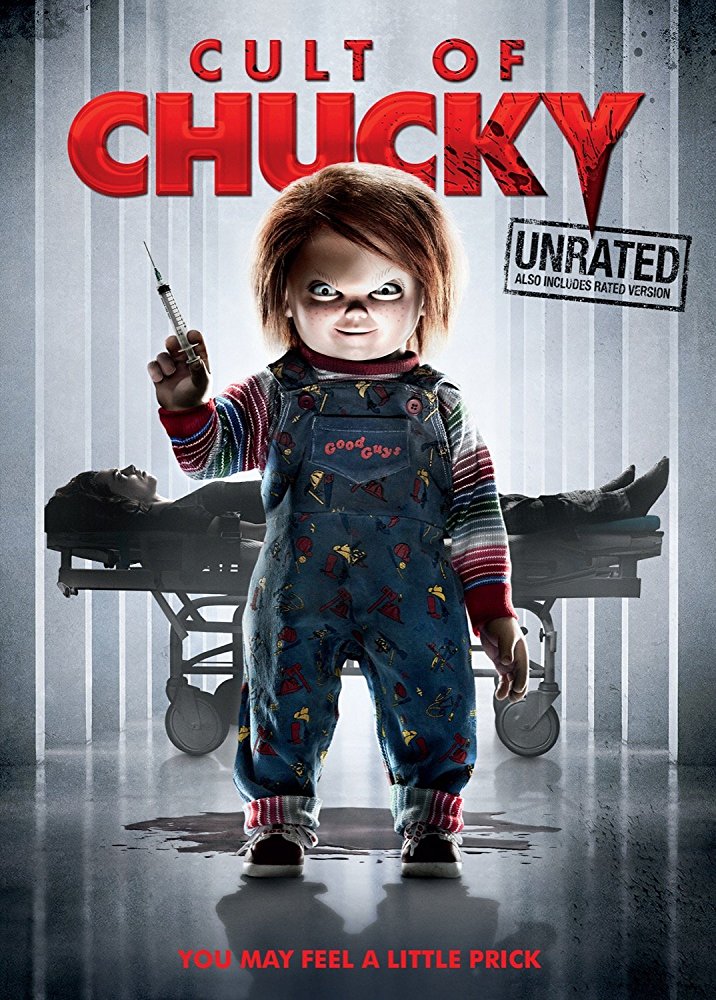
REVIEW: Cult of Chucky


It's sort of an unspoken rule that franchises tend to get worse and worse as they go on (especially when it comes to horror). Of course, this isn't true of all sequels, but the number of follow-ups that actually innovate and improve upon the groundwork laid by the first film is a proverbial drop in the bucket compared to the raging tidal wave of mediocre, derivative retreads pumped out of the Hollywood machine. Typically when a horror franchise makes the jump straight-to-video, it's a sign that the series is all but dead and buried (see Hellraiser, Leprechaun, and countless others). It signals an admission of weakness; the studio does not feel confident enough in their product's money-making potential to justify the cost of a theatrical release, so the best they can manage is to recoup their cost by skipping theaters altogether and going straight to home video. Sometimes, however, a direct-to-video sequel can surprise you. Like I've explained, it's fairly rare that a non-theatrical sequel to a classic horror franchise ends up any good, especially when said franchise dates back well over a decade, and especially when the sequel in question is movie number seven. Which brings us to Cult of Chucky, a follow-up to 2013's Curse of Chucky, which in and of itself was something of a revival of the Child's Play franchise (after its steady descent into comedy schlock during the late 90's/early 2000's).


Right off the bat I've got to commend the filmmakers for not taking the easy way out; this is by no means a soft-reboot. It's a clear benefit of smaller-profile releases such as this; while large-scale blockbusters like The Force Awakens and Jurassic World are forced to retread old ground in order to appeal to younger demographics, movies like Cult of Chucky are free from such boardroom legislature. The movie picks up essentially right where Curse of Chucky left off, and assumes you're familiar with every film in the series thus far (if you're a bit rusty, as I was, a quick trip to Wikipedia is invaluable before viewing; alternatively, just marathon the entire series, it's a fun time). We find our protagonist from Curse, Nica (Fiona Douriff), serving time in a psych ward after the justice system deemed her a more likely murderer than a knock-off Cabbage Patch Kid. After transferring to a new facility to continue her treatment, it isn't long until Chucky (Brad Douriff) comes calling to settle his debts. 

The movie isn't nearly as straightforward as one might expect, subverting the formula beyond the usual "THE DOLL IS ALIVE, I TELLS YA, I SWEAR I'M NOT CRAZY" schtick one might expect from such a premise. In our opening scene, we see Andy Barclay (Alex Vincent, reprising the role he played at the age of six in the first Child's Play) living in a remote cabin in the woods, his only company being Chucky's severed head (whom he routinely tortures when he's got nothing better to do). With Chucky seemingly in two places at once (and our protagonists being a mental patient and a man who experienced severe, Chucky-related trauma at a young age), the viewer is left wondering what is real and what isn't. The movie plays fast and loose with our perceptions, adopting a much more psychological bent than the standard slasher fare one would expect from this franchise. By the third act, I was able to more or less guess what was going on, but there were still enough red herrings and misdirects that I was never 100% certain that I had this movie pinned down. It never gives the viewer the chance to become totally comfortable in their assumptions until the climax, when the film finally tips its hand and clues us in on what exactly has been going on all along; the result is imaginative, original, and thoroughly engaging.


I also need to compliment the film on its sense of tone, toeing the line with expert finesse between horror, mystery, and black comedy. There's never a moment where a joke breaks the tension completely or pulls the viewer out of a moment; it all feels very homogenous and natural, which is so often the downfall of genre-benders such as this. There's bits of humor and levity, but the threat is still very much real; we're able to laugh at Chucky's sarcastic wise-cracks, but we still feel tense when he's in the same room as characters we've come to care about. It's a delicate balance that not every film can pull off, but which Cult really displays a fine mastery of. I feel like a lot of this is thanks specifically to writer/director Don Mancini; he's been heavily involved in the Child's Play franchise since the very beginning, so it's clear he has a deep and intimate understanding of how this particular monster works.

It's also worth noting that this is a very good-looking movie, not only in terms of set design and special effects, but in terms of cinematography as well. The camera really has fun with its environments, implementing PoV shots, dolly zooms, and even some split-screen from time to time. It's a film with style to spare, helped along by the cold, sterile environment the bulk of the story takes place in. The clean, white surfaces of the mental institution are just begging to be hosed down with fake blood, the perpetual snowfall outside lending a sense of eerie calm and isolation. Pair that with the old-fashioned uniforms of the nurses and orderlies and you're left with a place that feels both alien and familiar, like something out of a dream. It's not necessarily the first environment I'd think of to set a smart-mouthed killer doll loose in, but damned if it doesn't work.


Speaking of, Chucky himself is looking better than ever. He's still 100% practical, portrayed by a series of animatronics and puppets; it almost feels like cheating, since a doll is expected to have a sort of artificial, plastic-y look to it, but it's clear that the effects team went above and beyond. Chucky is just so expressive, especially when it comes to his eyes, to the point that he's more believable as a living character than many of the big-budget creatures I've seen in recent years (I'm looking at you, surprisingly fake-looking apatosaurus from Jurassic World). Part of this is helped along by the vocal performance of Brad Douriff, still the only actor to ever portray Chucky on-screen. It's the role he was born to play, yet I still find myself questioning who I think was the strongest part of this cast, Brad Douriff, or his daughter, Fiona. Nica, as a protagonist, is so easy to root for (beyond the sympathy she earns off the bat for being confined to a wheelchair, terrorized by a killer doll, and framed for the murder of her family) and Fiona Douriff really brings so much more to the role beyond the usual "beleaguered horror protagonist whom no one believes" (especially during the final act).


All in all, Cult of Chucky is far better than I think it has any right to be; granted, it offers essentially nothing to those unfamiliar with the series thus far, but it works fervently against all odds to deliver an engaging, interesting, and above all original entry in a decades-old slasher franchise. It's a real testament to the power of love in filmmaking; Child's Play hasn't been a theatrically-viable franchise since the early 2000's. It's clear that everyone who worked on this project, from Douriff to Mancini to Jennifer Tilly, is here because they want to be. This is no quick cash-grab or tax write-off, there's legitimate passion and enjoyment for what they're doing, even though what they're doing is part seven in a slasher series about a serial killer who sealed his soul inside a doll through the use of voodoo magic. There's a self-awareness to it (it wouldn't really feel like Chucky if there wasn't), but there's absolutely zero cynicism, and I feel like that makes all the difference in the world.

August 26, 2017

REVIEW: Help! I'm a Fish! (A Fish Tale)


Let's talk low-profile animation. Movies that are decidedly B-listers (at best) when compared to your usual Disney/Dreamworks moneymakers, assuming they even make it to theaters in the first place. The kind of movies you always see taking up space in the kids section of the bargain DVD rack, collecting dust until some nearsighted-but-well-meaning relative picks it up as a last minute birthday gift. These kinds of movies are such a fascinating mixed-bag in terms of both quality and content, especially when you factor in foreign films. Little cultural differences and regional influences in art direction can inform the overall look and feel of a film, running the gamut from something like The Little Prince to something like Ivan the Incredible. And speaking of Ivan the Incredible, today's obscure animated feature comes to us from the country of Denmark; regardless of what some of the marketing may imply, Help! I'm a Fish proves that Danish animation doesn't necessarily have to be a nightmarishly incoherent CGI fever-dream.

The story follows a rambunctious boy named Fly (Jeff Pace), his little sister, Stella (Michelle Westerson), and their brilliant-but-stuffy cousin, Chuck (Aaron Paul). After sneaking out to go fishing, the kids stumble upon the lair of an eccentric marine biologist (Terry Jones) who has developed a formula that turns humans into sea creatures. After Stella is accidentally transformed into a starfish and lost beneath the waves, it's up to Fly and Chuck to drink the potion and rescue her themselves. Fortunately for them, the professor also developed an antidote, which falls into the fins of a common pilot fish. After imbibing some of the potion, the fish (voiced by the late Alan Rickman) develops a humanlike intellect. Now calling himself Joe, he seeks to establish an deep-sea society of intelligent, talking fish (of which he is the unquestioned ruler). With only 48 hours until their change becomes permanent, it's up to the kids to rescue Stella, get the antidote away from Joe, and return to their human selves before it's too late.


On the surface, Help! I'm a Fish is fine enough. The voice acting is quite solid for an English dub and the delightfully-dated soundtrack of bouncy Scandanavian-style pop is loads of fun. It's got a pleasing visual style and a host of memorable character designs, in addition to being legitimately very well-animated for what it is. For a kids' movie about a magical science potion that turns people into fish, the script is surprisingly tight, setting up and foreshadowing important plot elements ahead of time so that everything flows in a sensible, coherent way. Functionally-speaking, it's a well-made movie, but that's not what made Help! I'm a Fish stand out to me. The thing that really struck me as interesting was just how dark and dramatic this film was willing to get.

The first thing worth mentioning is the villain, Joe. The film establishes a surprisingly mature metaphor for dictatorships; he who controls knowledge controls the populace. Joe is the keeper of the "magic potion", in addition to being the smartest thing under the sea. He controls who is worthy of the gift of sentience, as well as how smart they're allowed to get. He grants his followers enough mental capacity to speak and follow orders, but purposely keeps them duller than himself so they have no other option but to implicitly believe everything he says. While the metaphor is a little on-the-nose in this case, it's still a wildly original angle for a movie like this to pursue, given how the rest of the plot unfolds.


It's also worth noting how little the film shies away from the dramatic reality of our protagonists' situation. The ticking clock element is in full effect here, and the result is surprisingly heavy. The prospect of being forced to live out ones remaining years as a jellyfish is a worrying prospect, and the level of optimism our protagonists show deteriorates more and more as the film goes on. It may sound as though I'm hyperbolizing a bit here, but the film really does get downright dreary as it approaches the final act. There's also a surprising amount of death; there's no "fish are friends, not food" sentiment to be found here, as the shark Joe recruits as his enforcer (David Bateson) casually eats a number of characters without remorse. Usually these "tough but dopey henchman" type characters end up joining forces with the heroes in the end (typically after being mistreated time and time again by the primary antagonist), but that isn't the case here. The shark is, by all accounts, unapologetically malevolent and aggressive, taking extreme pleasure in chowing down on whatever unfortunate Joe allows him to. This is a movie about three children trapped in a fledgling dictatorship where everyone in charge wants to murder them. And it's called Help! I'm a Fish. Grim as that is, I haven't even touched on the climax yet.


Without spoiling anything, let me say this; the climax to this film is pure nightmare fuel. The rest of the movie was a tad more dramatic than I expected, but it still felt like a kids' movie. A little heavier than something like Frozen, sure, but still a kids' movie. The climax is typically where all the dramatic tension in a film comes to a head, but this movie has a tonal curve like a brick wall, veering into Cronenberg-esque body-horror at one point. If the final confrontation with Joe doesn't leave little ones wetting their underoos, we're treated to a scene that commits so soundly to selling the tragedy that occurs that it almost comes off as hilarious in a really mean-spirited kind of way. Again, I don't want to spoil anything, but this ending really needs to be seen to be believed. I'm all for children's entertainment that dabbles in the more macabre side of things, but the climax of Help! I'm a Fish is the stuff that "Top 10 Most Disturbing Childhood Movie Moments" clickbait articles are made of.


Suffice to say, I don't think this is a movie I'll be forgetting anytime soon. It's well put-together, well animated, and goes to some surprisingly dour places given that it's a movie about kids turning into cutesy cartoon fish. While I wouldn't necessarily go as far as to call it a hidden gem, Help! I'm a Fish is certainly a curiosity that I would recommend to anyone who enjoys outsider animation. By all means, grab some friends, dim the lights, and crack some jokes about Jesse Pinkman playing an obese kid who turns into a jellyfish. It's all just build-up to the insane punchline that is the hilariously bleak and traumatic climax that's sure to satisfy anyone who's ever asked "how did they get away with that?"

Credit and thanks go to Sparky from the "Help! I'm a Fan" fansite for the majority of screengrabs used in this Review.