Showing posts with label slasher. Show all posts

November 21, 2018

REVIEW: Halloween (2018)


This isn't the first time I've spoken about the modern phenomenon known as soft-reboots on this blog and lord knows it won't be the last (at least not until general audiences and fanboy consumers get wise to the studio game and force Hollywood to come up with a new means of selling us the same product twice). Despite the negative connotation the concept of a soft-reboot carries, it's not always an inherently negative thing. Sure, it can be hard to shake the feeling that a movie was only put into production to cash in on those valuable nostalgia bucks, but there are ways for a soft-reboot to rise above being a mere cash-grab and stand on its own as a solid film and sequel. There's a reason why movies like The Predator don't work, while movies like The Force Awakens (more or less) do; each is spawned from a film that has stood the test of time and continues to stay relevant within the public consciousness, but it is only the soft-reboots that understand why that is that go on to any modicum of critical success. In a best-case scenario, a soft-reboot will not only faithfully recreate the spirit and atmosphere of a well-known property, but bring something new and original to the table, acting as a genuine continuation of the story (rather than merely shifting everyone's characters around and following the same exact plot we already know). When a soft-reboot brings something new to the table, it is able to transcend the cynical, corporate circumstances of its birth and become something truly special, such is the case with the (infuriatingly titled) sequel to John Carpenter's 1978 classic, Halloween, Halloween.

Set 40 years after the original, we once again find Michael Meyers (portrayed by both newcomer James Jude Courtney and original actor Nick Castle) escaping from captivity to wreak havoc on the small town of Haddonfield, Illinois on Halloween night. As one might expect, bodies begin to pile up, justifying the paranoid fears of a damaged, gun-toting Laurie Strode (played once again by the OG scream queen, Jamie Lee Curtis). In the years since her first encounter with The Shape all those years ago, Laurie has become a twitchy recluse, estranged from her daughter (Judy Greer), twice-divorced, and still recovering from both her severe emotional trauma and alcoholism. Convinced that someday Michael would escape to finish what he started, Laurie sets out to confront him one last time, before he can bring any more death to her little town.


The thing I'm most thankful for about director David Gordon Green's vision for this film (which he wrote alongside Jeff Fradley and, surprisingly enough, Danny McBride) is the way in which it vehemently opposes reinventing the wheel. It's made abundantly clear that this film ignores all other entries in the Halloween franchise aside from the 1978 original, cutting out all the fat and nonsense that have diluted and bogged down this perfectly simple concept since. Gone are the hokey attempts at raising the stakes; Michael Meyers and Laurie Strode are no longer secret siblings, and he's no longer under the magical control of a sinister cult. We're back to basics on this one, where Michael is just a hulking mute who feels no remorse towards his abominable actions. Really, he feels no emotions; he's a blank slate, like a shark, he just moves forward and kills without a second thought  (although he still shows a slight affinity for boiler suits and butcher's knives). It's for this reason that Michael Meyers is actually a terrifying antagonist for the first time in years. There's no attempt to explain why he does what he does. He's just pure evil given form with no rhyme or reason assigned to his actions. This unpredictability adds to the tension; the original film worked because of that sense of unease, that you were constantly being watched, and Halloween understands how to generate those same feelings. Michael Meyers could be anywhere. He could even be outside your window right now, watching you read this.


While I can't ignore the silent intensity Courtney and Castle imbue The Shape with this time around, it's no surprise that the performance everyone is talking about is Jamie Lee Curtis as Laurie Strode. In a less inspired film, Laurie would simply slip into the Doctor Loomis role, the same way Han Solo became the new Ben Kenobi, while her granddaughter (Andi Matichak) serves as the main character. Instead, we're given a Halloween movie where Laurie is once again our primary protagonist. That's not to say that her family falls by the wayside, but this is very clearly Laurie's story; we see how low she's fallen after that fateful Halloween night and watch her reclaim her agency. It's a move that, in less competent hands, would feel corny and tonally inappropriate (though likely less so than a kung-fu fight with Busta Rhymes), but is pulled off with both style and substance here. Both Curtis and the screenwriters make Laurie into a tragic, flawed character who alienates and neglects those around her. Sure, she's eventually proven right when Michael inevitably escapes from the asylum and starts carving up teenagers like so many jack-o-lanterns, but that doesn't exactly justify her toeing the line of becoming a monster herself. The other performances here are serviceable, but Jamie Lee Curtis grants this movie the legitimacy it really needs to stand on its own, and I think that's why I liked it as much as I did.

I'd definitely recommend watching this back-to-back with the original (as I did); there are a number of callbacks and references, none of which are intrusive or obnoxious, that really make this feel like a genuine continuation of the story. Michael Simmonds' cinematography manages to recreate the feeling of John Carpenter's low-key, stripped down original without feeling cheap or derivative. Paired with a haunting score (care of Carpenter himself), it really does convey the feeling that this is a true and honest follow-up to the original film. At the same time, the new blood behind the cameras bring a few of their own tricks to the table, all in service of making this stand out from its progenitor; there's an impressive tracking shot that follows Michael around the neighborhood on Halloween night that might qualify as my favorite thing in the entire movie.


That said, this is by no means a film without flaw. The plot, while engaging, starts to lose steam midway through the second act, introducing a series of plot points (such as Laurie's granddaughter Allyson's relationship with her boyfriend, played by Dylan Arnold) that never see any kind of resolution. While the climax is most definitely worth it, our means of getting there feels half-baked and sloppy (compared to the airtight first act). There's a really unnecessary twist at one point that, while surprising, makes little sense and even comes dangerously close to stripping Michael of his all-important mystique. It literally only serves to transport a character from point A to point B so that the climax can happen and it's not the only example of questionable writing to be found in this script.

There's also a lot of misplaced humor here as well. I really wish that modern films would ditch the idea that everything needs to at least partially be a comedy; just because it works for Marvel movies doesn't mean I need something to chuckle at every time I go to the cinema. With the exception of a genuinely hilarious performance by young Jibrail Nantambu, almost all of the jokes here fell flat. This is a movie that thrives on suspense and tension, instilling a paranoid fear in the audience, so lighthearted humor should be used sparingly, if at all. That's not to say the original was devoid of any attempt at comedy, but I think we can all agree that moments like P.J. Soles' monologue about textbooks didn't exactly work to the benefit of the atmosphere or tension or any of the other elements that made the original film work as well as it did. For a movie that seems to understand the beast that is the original Halloween so well, creative decisions like this caused me to raise an eyebrow, to say the least.


Criticisms aside, it's very clear that this film was a labor of love, made by fans of the original Halloween, for fans of the original Halloween. They seem to have more or less cleared that all important pitfall that so many soft-reboots fall into, striking a fair balance between reverence and innovation that make for an experience that, despite its flaws, is very hard to dislike. Had the plot and script been a tad cleaner, this would have been a home run, but as is, it's still an excellent slasher flick and a worthy follow-up to the original. A sequel has already been greenlit, so here's hoping the filmmakers continue to innovate and develop their ideas further, rather than getting high off fanboy fumes and crashing the hype train entirely in favor of "subverting expectations".

September 21, 2018

REVIEW: The Predator


There are a few notable trends that I keep noticing in modern movies that I'd like to talk about for just a bit. The first (and most irritating) is Hollywood's obnoxious over-reliance on 80's nostalgia. G.I. Joe, Transformers, Ninja TurtlesRobocop, Terminator, Thundercats, Ghostbusters; if it existed in the 1980's, you're probably gonna see its fetid corpse unearthed and propped up by a hack studio to make a quick buck. We've also witnessed the rise of the soft-reboot; a film that is, for all intents and purposes, a remake/reboot of a classic film franchise, except it's stated to take place in the main series continuity, making it a sequel, and thus okay. I feel like the most notable of these is The Force Awakens, but it's hardly a rarity nowadays, especially for big-budget franchises with a lot of brand recognition. We've also been seeing a lot of movies get utterly destroyed through reshoots. Normally, reshoots are a relatively innocuous practice, but it feels like as of late, more and more big-budget projects are suffering the slings of studio interference, producing an end result that turns out worse than anyone could have possibly predicted. The reason I choose to mention all of these phenomena is that Shane Black's The Predator manages to be a sterling example of all three with shockingly little effort.

The film opens as one would expect a Predator film to, with a spaceship hurtling towards Earth. After crash-landing in the South American jungle, everyone's favorite human-hunting space monster has a run-in with an Army Ranger by the name of Quinn McKenna (Boyd Holbrook). Battered from the crash, the Predator (Brian A. Prince) is actually incapacitated by the hard-boiled sniper, who makes off with the creature's mask and wrist gauntlet. Sensing that he's seen something he wasn't meant to have seen, Quinn mails the alien tech back home before he's taken into custody by government agents. Naturally, the government has captured the Predator as well, who inevitably escapes and sets out in search of his stolen gear (which has since ended up in the hands of McKenna's autistic son, Rory, played by Jacob Tremblay). With the help of a renegade biologist (Olivia Munn) and a ragtag gang of disabled veterans, it's up to Quinn to keep his son out of the way of an interplanetary blood war, all while avoiding the shadowy government agents who want him disappeared. Despite how exciting that may sound, I assure you large chunks of this movie are dull as all get-out.


When this movie was first announced, I was understandably optimistic. Shane Black is a solid director (who also starred in/wrote parts of the original Predator), and a natural choice to helm the next entry in the franchise (redundant title notwithstanding). Predator is one of those rare films like Robocop that works both ironically and unironically well; it's the movie that made Arnold Schwarzenegger an action superstar, and it's chock-full of all the hilariously dated tropes and clichés one would expect from such a film. At the same time, it executes its deceptively simple premise startlingly well, balancing both action and suspense until things reach a head at the surprisingly small-scale climax. It's got all the excess that 80's action movies are lauded for to this day, but it also understands and appreciates the effect some quieter, more intimate moments can have when establishing atmosphere and tone. If they wanted to have a soft reboot of Predator that took itself seriously for the most part, they could certainly do so and have it work out nicely; 2010's Predators is living proof of this.

Alternatively, if Shane Black wanted to turn the whole thing into an utter farce, lampooning the various action tropes that the original Predator helped establish, I could see that working out as well; plenty of relatively serious films have successfully made the transition to more comedic fare as time's gone on (the most notable example that comes to mind being the Evil Dead trilogy). Black has a penchant for snappy dialog, and his role as Hawkins in the original film provided much of the early comedic relief. This appears to be the approach that The Predator is going for, but unfortunately the whole thing runs into a critical error; it's not particularly funny. There's a few one-liners that got a sensible chuckle out of me, and the gore has the tendency to reach Monty Python and the Holy Grail levels of cheap, slapstick-y excess, but I doubt anyone would describe The Predator as a rollicking good time (unless a character saying "get to da choppa" before escaping on a bunch of stolen motorcycles is your idea of clever writing). Really, the script here is so bad that it gives Jurassic World: Fallen Kingdom a run for its money, with such winners as "Motherf-cker hacked our vehicles" and "F-ck me in the face with an aardvark".


In the film's defense, the first act is more or less exactly what I wanted it to be; it's by no means groundbreaking, but it's a reasonably fun monster movie with some solid action (in particular, the sequence in which the Predator escapes from a government lab). But everything goes downhill quickly soon after that scene, up until the point that our bigger, badder, entirely CGI rival Predator shows up. After this new monster is introduced, the entire film breaks and goes down the drain, devoid of any intellect or charm it may have possessed beforehand. Before that point, the lackluster performances, groan-worthy one-liners, and bland, forgettable characters were just sort of there, but it was around this time that it all compounded and started actively making the movie worse, dragging it down into the realm of pure trash. From what we've learned, apparently the entire third-act of the movie was rebuilt from the ground up at the behest of 20th Century Fox, so it seems as though this is another film that may have had the potential to actually be something not terrible before a bunch of studio suits decided to stick their slimy paws all over it. Honestly, I'd have happily accepted a Predator movie that was "just okay", but instead got something that appears to put active effort into being terrible. And that's not even touching the way The Predator attempts to tackle such weighty topics as mental illness and climate change.

There was a clear attempt at having some subtext, pitting a team of mentally-disturbed veterans and a young child with Asperger's up against an alien menace who has modified his own DNA to become a genetically-perfect being. Truth be told, giving the main group of heroes in an action/slasher flick a host of neuroses and disorders to deal with in addition to the impending extraterrestrial threat is a pretty fascinating idea that could really result in something spectacular if handled properly by a talented filmmaker (like, say, Shane Black). Instead what we get is a series of jokes where the punchline is "the guy with Tourette's said something profane" and a kid who can use the power of autism to operate alien technology as if he were R2-D2. The disorders in this movie are treated as either a punchline or a plot convenience; I'm not even going to harangue The Predator for how potentially offensive such a portrayal is, that's just lazy writing. I'm still struggling to wrap my head around how this even turned out so bad; this is a movie written by Shane Black and Fred Dekker. These are the guys who gave us The Monster Squad for crying out loud, what the hell happened? Was this a Producers-esque scam? Or did the studio seriously interfere that much? No amount of explanation is really going to save this trainwreck, but I'll admit that I'm the least bit curious.


I'll admit, for all of its problems, The Predator would actually make for a pretty good bad movie. I can easily see this working well in a room full of intoxicated friends, or with a rowdy audience at the local theater; but at the same time, it's important that everyone understand that statements such as these aren't exactly points in the film's favor. If the kindest thing you can say about a movie is "it's not offensively bad, it's just stupid and forgettable", there's clearly a problem, especially when talented people are involved. It could be fun with the right audience, but then again so is the first Predator. Predator didn't need to be "ironically good", it was just "good". Every idea we see here (Predator hounds, genetic modification, a crazed government alien-hunter, a ragtag gang of ex-military guys throwing out vulgar banter, etc.) was already done far better in other Predator movies (yes, even Predator 2). Is it the worst thing ever? No. But is there a solid reason to run out and watch it? Also no.

October 18, 2017

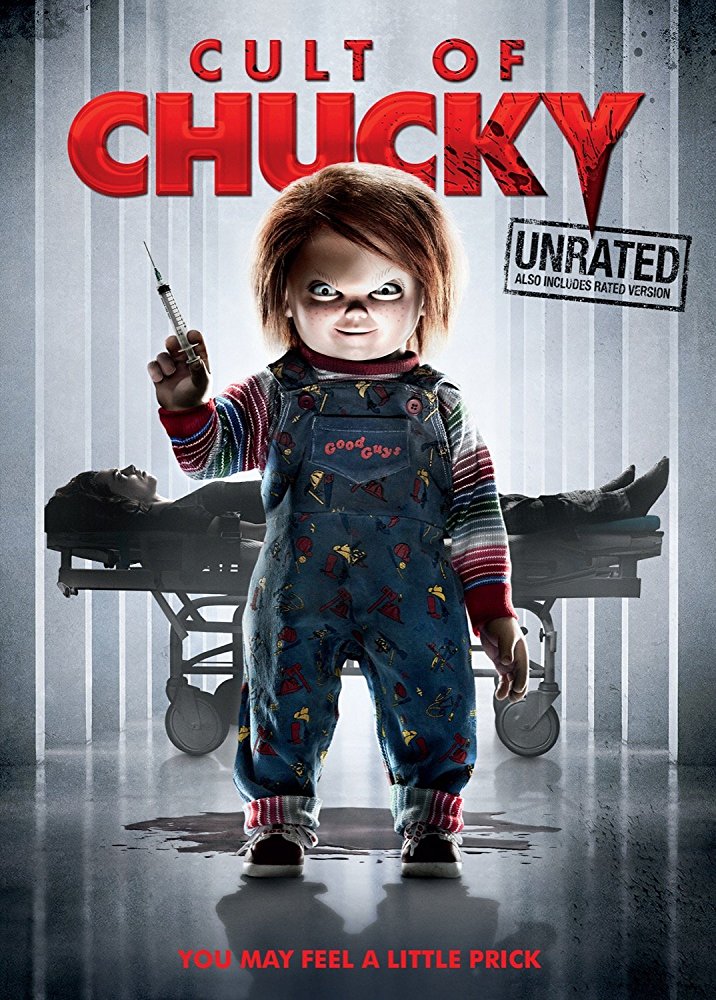
REVIEW: Cult of Chucky


It's sort of an unspoken rule that franchises tend to get worse and worse as they go on (especially when it comes to horror). Of course, this isn't true of all sequels, but the number of follow-ups that actually innovate and improve upon the groundwork laid by the first film is a proverbial drop in the bucket compared to the raging tidal wave of mediocre, derivative retreads pumped out of the Hollywood machine. Typically when a horror franchise makes the jump straight-to-video, it's a sign that the series is all but dead and buried (see Hellraiser, Leprechaun, and countless others). It signals an admission of weakness; the studio does not feel confident enough in their product's money-making potential to justify the cost of a theatrical release, so the best they can manage is to recoup their cost by skipping theaters altogether and going straight to home video. Sometimes, however, a direct-to-video sequel can surprise you. Like I've explained, it's fairly rare that a non-theatrical sequel to a classic horror franchise ends up any good, especially when said franchise dates back well over a decade, and especially when the sequel in question is movie number seven. Which brings us to Cult of Chucky, a follow-up to 2013's Curse of Chucky, which in and of itself was something of a revival of the Child's Play franchise (after its steady descent into comedy schlock during the late 90's/early 2000's).


Right off the bat I've got to commend the filmmakers for not taking the easy way out; this is by no means a soft-reboot. It's a clear benefit of smaller-profile releases such as this; while large-scale blockbusters like The Force Awakens and Jurassic World are forced to retread old ground in order to appeal to younger demographics, movies like Cult of Chucky are free from such boardroom legislature. The movie picks up essentially right where Curse of Chucky left off, and assumes you're familiar with every film in the series thus far (if you're a bit rusty, as I was, a quick trip to Wikipedia is invaluable before viewing; alternatively, just marathon the entire series, it's a fun time). We find our protagonist from Curse, Nica (Fiona Douriff), serving time in a psych ward after the justice system deemed her a more likely murderer than a knock-off Cabbage Patch Kid. After transferring to a new facility to continue her treatment, it isn't long until Chucky (Brad Douriff) comes calling to settle his debts. 

The movie isn't nearly as straightforward as one might expect, subverting the formula beyond the usual "THE DOLL IS ALIVE, I TELLS YA, I SWEAR I'M NOT CRAZY" schtick one might expect from such a premise. In our opening scene, we see Andy Barclay (Alex Vincent, reprising the role he played at the age of six in the first Child's Play) living in a remote cabin in the woods, his only company being Chucky's severed head (whom he routinely tortures when he's got nothing better to do). With Chucky seemingly in two places at once (and our protagonists being a mental patient and a man who experienced severe, Chucky-related trauma at a young age), the viewer is left wondering what is real and what isn't. The movie plays fast and loose with our perceptions, adopting a much more psychological bent than the standard slasher fare one would expect from this franchise. By the third act, I was able to more or less guess what was going on, but there were still enough red herrings and misdirects that I was never 100% certain that I had this movie pinned down. It never gives the viewer the chance to become totally comfortable in their assumptions until the climax, when the film finally tips its hand and clues us in on what exactly has been going on all along; the result is imaginative, original, and thoroughly engaging.


I also need to compliment the film on its sense of tone, toeing the line with expert finesse between horror, mystery, and black comedy. There's never a moment where a joke breaks the tension completely or pulls the viewer out of a moment; it all feels very homogenous and natural, which is so often the downfall of genre-benders such as this. There's bits of humor and levity, but the threat is still very much real; we're able to laugh at Chucky's sarcastic wise-cracks, but we still feel tense when he's in the same room as characters we've come to care about. It's a delicate balance that not every film can pull off, but which Cult really displays a fine mastery of. I feel like a lot of this is thanks specifically to writer/director Don Mancini; he's been heavily involved in the Child's Play franchise since the very beginning, so it's clear he has a deep and intimate understanding of how this particular monster works.

It's also worth noting that this is a very good-looking movie, not only in terms of set design and special effects, but in terms of cinematography as well. The camera really has fun with its environments, implementing PoV shots, dolly zooms, and even some split-screen from time to time. It's a film with style to spare, helped along by the cold, sterile environment the bulk of the story takes place in. The clean, white surfaces of the mental institution are just begging to be hosed down with fake blood, the perpetual snowfall outside lending a sense of eerie calm and isolation. Pair that with the old-fashioned uniforms of the nurses and orderlies and you're left with a place that feels both alien and familiar, like something out of a dream. It's not necessarily the first environment I'd think of to set a smart-mouthed killer doll loose in, but damned if it doesn't work.


Speaking of, Chucky himself is looking better than ever. He's still 100% practical, portrayed by a series of animatronics and puppets; it almost feels like cheating, since a doll is expected to have a sort of artificial, plastic-y look to it, but it's clear that the effects team went above and beyond. Chucky is just so expressive, especially when it comes to his eyes, to the point that he's more believable as a living character than many of the big-budget creatures I've seen in recent years (I'm looking at you, surprisingly fake-looking apatosaurus from Jurassic World). Part of this is helped along by the vocal performance of Brad Douriff, still the only actor to ever portray Chucky on-screen. It's the role he was born to play, yet I still find myself questioning who I think was the strongest part of this cast, Brad Douriff, or his daughter, Fiona. Nica, as a protagonist, is so easy to root for (beyond the sympathy she earns off the bat for being confined to a wheelchair, terrorized by a killer doll, and framed for the murder of her family) and Fiona Douriff really brings so much more to the role beyond the usual "beleaguered horror protagonist whom no one believes" (especially during the final act).


All in all, Cult of Chucky is far better than I think it has any right to be; granted, it offers essentially nothing to those unfamiliar with the series thus far, but it works fervently against all odds to deliver an engaging, interesting, and above all original entry in a decades-old slasher franchise. It's a real testament to the power of love in filmmaking; Child's Play hasn't been a theatrically-viable franchise since the early 2000's. It's clear that everyone who worked on this project, from Douriff to Mancini to Jennifer Tilly, is here because they want to be. This is no quick cash-grab or tax write-off, there's legitimate passion and enjoyment for what they're doing, even though what they're doing is part seven in a slasher series about a serial killer who sealed his soul inside a doll through the use of voodoo magic. There's a self-awareness to it (it wouldn't really feel like Chucky if there wasn't), but there's absolutely zero cynicism, and I feel like that makes all the difference in the world.

March 2, 2017

REVIEW: The Texas Chainsaw Massacre (1974)


As time goes on, movies are going to end up looking better and better. It's an inevitable side-effect of technological progress and, while such progress may sound like an objectively positive thing, I can't help but feel that some things may be lost as our films become cleaner, brighter, and all-around better looking. Take for example one of the granddaddies of the slasher genre, Tobe Hooper's The Texas Chainsaw Massacre.

Inspired loosely by the real-life story of serial killer Ed Gein, the story follows a van full of twenty-somethings as they drive across Texas to visit a family grave. There have been mysterious reports of vandalism and grave-robbing, so Sally Hardesty (Marilyn Burns), her crippled brother, Franklin (Paul A. Partain), and three of their friends (Allen Danzinger, William Vail, and Teri McMinn) decide to take the ride to investigate the scene and make sure their grandfather is still in the family plot. After a tense encounter with a disturbed hitchhiker, the group decides to visit the old Hardesty family homestead; they poke around and trespass like the meddling kids they are, attracting the attention of a disturbed family of cannibals. As one might expect from a classic slasher flick, the kids are picked off one by one until the lone survivor is left to make a tense and daring escape.


The first thing that struck me about this movie is the overall look of it. Visual style is a tremendous aspect of what makes this movie work so well; it was made on a budget of only $300,000 (just under $1.5 million by today's standards), utilizing relatively unknown actors who were local to the area in which it was shot. There's not a lot of spectacular special effects or gore, the music is mostly ambient, and everything from the props to the film itself has this grainy, gritty feel to it. It's a very low-key kind of horror movie (compared to more bombastic fare that would follow, your Nightmare on Elm Street or your Friday the 13th), and that really helps to establish a strong sense of tone and atmosphere. Much like Alien, this is a horror film that succeeds mostly because of how it is able to immerse the viewer in the events that are playing out on screen. However, unlike Alien, The Texas Chainsaw Massacre is so scary because it feels like a story you could very well see on the news tonight. This movie is for roadtrips what Jaws was to summertime trips to the beach.


This is also due (in no small part) to the wonderful performances of Gunnar Hansen, Jim Siedow, and Edwin Neal as Leatherface, Old Man, and Hitchhiker. These aren't your usual scenery-chewing loonies you often see in the psycho-hillbilly genre; they come off like actual disturbed individuals, taking sadistic glee in the atrocities they commit. They manage to display the requisite amount of crazed energy you might expect, but they stay just reserved enough to come off as starkly believable. It's this delicate bit of nuance and reservation that makes the whole thing that much more real; they remain a lot more coherent and "in control" than the usual on-screen psychopath, and that extra touch makes their actions all the more disquieting. 

By the same token, the film comes off very much like a cautionary tale about the dangers of unchecked industrial growth. As Hitchhiker explains, new advances in technology led to large-scale layoffs at the local slaughterhouse. As a result, the lower, working class is forced to (literally and figuratively) eat each other to survive; industry has abandoned them and now they are forced to survive by doing the only thing they know how to do. Once our gang of youthful yuppies trespass on the family's property, their fate is sealed. The oppressed become oppressors in their own right, reducing those whom they deem more fortunate to nothing more than meat in a similar (albeit more visceral) way that they themselves were taken advantage of by big business. Horror films have a wonderful way of discussing serious issues of manmade society and human nature by way of copious bloodshed and horrendous acts of violence, and that is specifically why I adore this genre the way I do.


Despite the grainy look of the film and the thoroughly 70's wardrobe of the cast, The Texas Chainsaw Massacre is very much a timeless classic of the horror genre. It's a shining example of how restrictions and reservations can help elevate a film to unseen heights. A slasher film in which the main killer uses a chainsaw doesn't exactly come off like the most low-key concept, but it's this subversion of audience expectations that helps sell the unsettling realism that makes this movie work. Even the brilliant, climactic chase doesn't play out as you'd expect; everyone's limping along, it's framed in a long shot, and yet you're able to cut the tension in the air with a steak knife. It's a horror film that isn't afraid to slow down and linger on itself, rather than attempting to create a synthetically scary situation. It simply lays its cards on the table and invites you to be terrified, and that works surprisingly well.

June 17, 2016

REVIEW: Sleepaway Camp


Sleepaway Camp is one of those movies that, despite being considered by many to be required viewing for the horror genre, I had never gotten around to actually seeing. While I'm far from a horror expert, I've seen most of the classics; from iconic masterpieces like Jaws and Alien to indie darlings like Trick R Treat to bona-fide pieces of history like The Cabinet of Dr. Caligari. And yet Sleepaway Camp, a supposed classic that had slipped under my radar for all this time.

It's a simple enough premise, so quaint it almost borders on parody when viewed through a modern lens. The film focuses on Angela (Felissa Rose), a young girl, traumatized as a child following a horrible boating accident that left her orphaned. Now living under the care of her eccentric aunt, she and her cousin, Ricky (Johnathan Tiersten), are sent away to Camp Arawak for a summer of fun and excitement; unfortunately for the campers, there happens to be a killer in their midst. As the summer goes on, the bodies continue to pile up while everyone (including the viewer) tries to decipher who could possibly be behind it all.


With a plot like that, one might wonder just why Sleepaway Camp is considered such an essential cult classic; "80's summer camp" isn't exactly a standout backdrop for a slasher flick, especially when compared to the Friday the 13th series. What is it about Sleepaway Camp that makes it stand the test of time? There's an objective answer to this question; the ending. But I'll get to that later, in a timely (and spoiler-free) fashion. Aside from the obvious reason, it's honestly just a really fun watch. As would be expected from something in this particular wheelhouse, there's loads of unintentionally hilarious moments. From the jock who dies via bee attack while on the toilet, to the camp director who just wants to keep everything hush-hush, to the gaggle of guys who are maybe a little too enthusiastic to go skinny-dipping, there's a lot to laugh at in this movie. That said, these moments rarely feel jarring in tone; this is a horror movie that knows how to have fun with itself when appropriate. However, for all the cheesy gags and delightful 80's throwbacks, the climax of this film ratchets the tension up to eleven, delivering one of the most shocking, haunting endings to any film I've ever seen.


Again, no spoilers, but the ending of Sleepaway Camp is what makes this movie. The entire film proposes a mystery to both the characters and the audience; who is committing these murders? I went into this film knowing there was some sort of twist at the end, and as such I kept my eyes peeled for any clues that might be found. Truthfully, watching this movie knowing that there's a big reveal at the end enhances the entire thing. Every stray object becomes a potential murder weapon, every flare of adolescent aggression becomes a potential motive, every single character becomes a potential suspect. Before watching Sleepaway Camp, I had heard how apparently the ending was one of the most shocking in all of horror cinema, how it was truly disturbing, resonating with viewers to this day. Really though, how bad could it be? What could this quaint, goofy little low-budget slasher flick from the 80's possibly show me, a jaded child of the 90's, that could qualify as "disturbing"? What could this movie possibly do to "shock" me, in an age where The Human Centipede is a household name? Ladies and gentlemen, I under-estimated this movie and paid the price for it. I make no exaggeration when I say the ending of Sleepaway Camp is the most haunting piece of film I have ever seen. I don't want to over-sell it, and honestly the less I say, the better. But I know for sure that on repeat viewings, I'll be watching through my fingers.


For all my praise, I must implore you to go into Sleepaway Camp with modest expectations. There's a few strong performances and some nice camerawork and composition here and there, but it's for the most part a pretty generic film. It's a slasher movie about a killer at a summer camp, so there's only so much you can expect of it, but that doesn't change that half the scenes in this feel like lost footage from Wet Hot American Summer. It's goofy and corny, but it's built around a pretty compelling mystery which leads to one hell of a payoff. It's important to keep things in perspective while watching this one; don't expect too much, don't overthink it. If you set the bar too high, the entire thing will fall flat. But if you adjust your expectations appropriately, sit back, and let the movie do its work, it'll blow you away as it did me.

July 9, 2015

REVIEW: American Psycho


After having just watched American Psycho, it's only now dawned on me how few films I've seen Christian Bale in. Of course, I saw Christopher Nolan's Dark Knight trilogy and I'm fairly certain I watched Pocahontas at least once as a child. But other than that, I really don't think I've seen him in much. This is something I'm going to have to remedy posthaste, considering that Christian Bale is positively brilliant here.

The plot involves 80's businessman, Patrick Bateman (Bale, channeling Nic Cage circa Vampire's Kiss); when he's not climbing corporate ladders on Wall Street, Bateman spends his time butchering call girls and homeless people in an attempt to sate his latent, psychotic bloodlust. Truthfully, that's about the extent of the plot. We follow Bateman for the entirety of the film, watching him commit various horrifying deeds while he narrates his thoughts and feelings on the proceedings. There isn't much of an arc or central conflict; the whole thing feels more like a look at a period in time rather than a definite story with a beginning, middle, and end. It's a little unorthodox, but the plot is hardly the main selling point here. In this case, it's all about the performances and the meaning behind the actions of the characters.


Bale is absolutely phenomenal as Patrick Bateman; despite him being such a psychotic, evil human being, he still manages to be oddly charming and endearing. He does horrible, disgusting things, but he's just so charismatic, you can't completely hate him. He doesn't come off as an antagonist so much as a protagonist who is utterly deplorable in every imaginable way. Bale's sense of energy and comedic timing are cranked up to eleven here; within a single scene, he's able to build a wall of tension, then make you laugh out loud without that tension breaking even slightly. It's a masterful blend of horror and pitch-black comedy that works spectacularly well together. For the first two acts, Patrick Bateman comes off as someone who is legitimately psychotic; not "horror movie" psychotic, but rather genuinely dangerous and unpredictable. Despite his eccentricities, they all come off as genuine and he avoids feeling like a silly slasher villain and more like a legitimate serial killer. That is, until around the third act; as the film goes on, I noticed several touches that had Bateman's character descend somewhat into the realm of hilarious cheese. Everywhere else in the movie, the contrast in tone manages to work perfectly here, but there's one scene in particular near the end that comes off as really quite jarring, even though it begins and ends in an appropriately chilling fashion. To put it in perspective, the first two acts can be taken completely seriously; you can define them as straight-up psychological horror. Any traces of comedy only serve to make the situation that much more uncomfortable. The third act, however, should be given a little more leeway when it comes to tone. This is interesting, seeing as how the third act is easily the most in-depth in terms of subtext and meaning.


In supporting roles, we have Chloë Sevigny, Cara Seymour, and Willem Dafoe. Sevigny plays Jean, Bateman's secretary. I enjoyed this performance in particular, considering the very interesting relationship the two have with each other. Bateman is chauvanistic and patronizing, but never really straight-up mean to her. Considering this is a man who "likes to dissect girls", one could consider a few backhanded remarks to be getting off easy. Conversely, Jean takes it all in stride; she calls Patrick by his first name and feels much less like his subordinate than his behavior would imply. Cara Seymour portrays a prostitute who ends up involved with Bateman; we never learn her real name, as he simply decides to refer to her as "Christie". She plays the part well and comes off as appropriately tragic and sympathetic, but I can't help but wish we saw more of her. Bateman himself is an interesting character, but it's also interesting to see some things from the point of view of his victims. All that said, I can't really complain; the mystery surrounding this character helps sell the idea that she could be anybody. Patrick literally finds her on the side of the road, so what happens to her could literally happen to anyone, making Bateman's actions all the more effective. In the role of Detective Donald Kimball, we have Willem Defoe. Defoe is a favorite actor of mine, but I feel he's under-utilized here. All he really does is question Christian Bale in a few scenes, but nothing really comes of it. He does a good job, but there's not enough of him to make it especially noteworthy.


American Psycho is an excellent film; it's brilliantly shot, smartly written, and simply oozes personality. The majority of the movie's high points come care of Christian Bale, giving the best performance I've seen out of him yet, but it's clear he wouldn't shine as brightly as he does if the writing and direction weren't as strong as they are. If you're looking for a wholly unique psychological thriller, put down a few tarps, pop in some Huey Lewis, and give American Psycho a watch.


May 7, 2015

REVIEW: Knights of Badassdom


Knights of Badassdom is a flick that I've been curious about for some time now. On one hand, the title is utter garbage, making this sound like a low-budget package of "nerd humor" for the Big Bang Theory crowd. On the other hand, Peter Dinklage. I spent this past winter watching the entirety of Game of Thrones, so I figured that anything with Peter Dinklage in it must surely be worth my time. I was wrong, but good lord does he try.

The plot involves a group of pals (Ryan Kwanten, Steve Zahn, and Peter Dinklage) who embark on a LARP (Live-Action Role Play) after our protagonist, Joe (Kwanten) is dumped by his girlfriend (Margarita Levieva). Once they're in the woods amongst their fellow adventurers, Eric the mage (Zahn) accidentally summons a succubus who promptly takes the form of Joe's ex (and begins killing off the assembled geeks). It sounds like a fun premise that can be easily accomplished with a small budget; for the most part, it is. The greatest problem with the film lies in the fact that it's simply too short for its own good; at 85 minutes (counting the credits), this is not a long picture by any means. As such, plot points are glossed over left and right and the film deteriorates in quality as it goes along. The first half is honestly quite enjoyable; once it turns into a slasher flick is where things really begin to go wrong. For example, we're told offhand that Joe lives with one of his friends who is "an accidental millionaire". We assume it's either Dinklage or Zahn, but we never really find out who it is or how they accidentally stumbled onto such a fortune. The succubus is summoned through the use of an ancient magical tome (as explained through the great opening, in a loving homage to Army of Darkness), but we never find out how Zahn's character even came into possession of the book in the first place. Once the protagonists encounter the succubus (who still looks like Joe's former girlfriend), they immediately know something supernatural is afoot and have no qualms with running her through with a longsword. Afterwards, another character explains to them everything that we already know about the book (from the aformentioned opening sequence). The movie feels like it's way too excited to move on to a payoff that isn't nearly as great as it thinks it is; as a result, our characters aren't nearly as fleshed out as they need to be and the pacing suffers tremendously. I'm thinking back to what I just watched and it honestly all feels like a blur after the first fifteen minutes.


Rounding out the cast is Danny Pudi as Lando (the cleric), Jimmi Simpson as Ronnie (the game master), and Brett Gibson as Gunther (the hulking brute who never breaks character). They're all wholly underdeveloped (like the rest of the cast), but Simpson at least provides a good deal of laughs in the later half of the film. Filling the role of the love interest is Summer Glau's character, Gwen. She's the token "girl who does something a sheltered person would assume only nerdy guys would do" character, and as such she is super cool and tough and hot and awesome and amazing. It's the most basic "GRRL POWER" cliche in the book and she's completely devoid of any amount of depth or character growth (even moreso than the rest of the cast). Glau can hardly be blamed for this though, since I'm sure this character would have been terrible no matter who donned the leather studded miniskirt.


For the most part, I enjoyed Ryan Kwanten in the lead role, though I find the best way to describe his performance is "not quite Chris Pratt". He's not quite as handsome or funny or likeable as Chris Pratt, but he's pretty good. As one would expect, Peter Dinklage is the highlight here. You really get the feeling that he had a good time making this, which is never a bad thing (especially in a movie with this kind of tone). The only problem is that he's clearly the biggest actor in the cast; therefore, it's reasonable to say that he's the most expensive actor in the cast. As such, he doesn't have nearly as much screentime as I would have liked; the same goes for Danny Pudi. I feel as though the budget really limited this picture, but for all the wrong reasons; like the filmmakers spent too much money on things that didn't matter in lieu of things that did. For instance, the special effects. Minimalist practical effects would work perfectly for a film like this; when the film employs such effects, they look great (there's a gag involving a decapitated head that I found to be one of the highlights). However, the other half of the time, it uses incredibly dodgy CGI worthy of the SyFy channel. One would think that, had the filmmakers spent less money on nonessential details (like the main characters' lavish castle home), there would have been more room in the budget for additional scenes featuring more plot, character development, and Peter Dinklage.


The one positive quality I can attribute to this film is that it portrays role-playing nerds in a semi-realistic way; while there are still a few throwaway jokes about noobs and level 27 sorcerers, these characters are far more accurate portrayals of the modern melvin than one would find on The Big Bang Theory. There's gratuitous swearing and drug use and a healthy love of the various subgenres of metal; this isn't a movie that looks down on nerd culture for the sake of a punchline, which is appreciated. It's just a shame that the rest of the movie didn't have as much care put into it. It's not offensively bad or anything (as I said, the beginning is quite fun for anyone who's ever rolled a D20), but I feel as though this is a film I'll never end up watching again. Take that as you will.