Showing posts with label Disney. Show all posts

July 14, 2018

REVIEW: Ant-Man and the Wasp


Speaking as someone who liked the first Ant-Man, I feel like even I have to agree with everyone else in saying "who even cares about Ant-Man and The Wasp after THAT?" I mean, can you blame us? I figured I'd change my mind and come around after the hype from Infinity War died down, but it's two months later and I still can't fathom why Marvel decided to release their biggest and most-awaited film to date before their sequel to Ant-Man. I was reasonably excited for this movie, yet I still found myself saying "oh yeah, that did just came out, didn't it?" last weekend. I went to the theater, grabbed my ticket, and settled in with low expectations for an offbeat, inoffensive sci-fi/comedy romp. Unfortunately, I feel like the filmmakers approached this project with those same expectations in mind, and therein lies the problem.

Set two years after the first film, we find Scott Lang under house arrest after the airport incident in Captain America: Civil War. He hasn't worn the Ant-Man suit since, spending his sentence making up for lost time with his daughter, Cassie (Abby Ryder Fortson); this all changes when he's contacted once again by Hope Van Dyne (Evangeline Lilly) and her father, Hank (Michael Douglas). After the events of the first Ant-Man film, the two have been working on a device capable of accessing the Quantum Realm, the mysterious, sub-atomic dimension where Hope's mother (and Hank's wife), Janet (Michelle Pfeifer), is thought to be lost. Seeing as how Scott successfully navigated the Quantum Realm in the first movie, Hank and Hope believe him to be the key to locating and rescuing Janet. Naturally, it's not quite that easy; things are complicated, not only by Scott's incarceration, but by the Ghost (Hannah John-Kamen), a sinister operative with the ability to phase through solid matter and a keen interest in Hank's research on Quantum energy. With Janet's life hanging in the balance, it's up to Ant-Man and The Wasp to save the day without violating the terms of Scott's plea arrangement.


If this movie has a strong-suit, it's most definitely the character interactions. Scott Lang continues to be one of the most likeable protagonists in the MCU, and his dynamic with Hope reaches new heights this time around. It would have been so simple to go with the old cliché of "inept but loveable man/capable but angry woman", but instead we're allowed moments to see that Hope genuinely cares about Scott. This isn't a one-sided attraction, meant to act as wish-fulfillment for any divorced dads in the audience; they work well together, both as superheroes and human beings, and this is all thanks to Rudd and Lilly's charming "workplace romance"-style chemistry. I also really liked Scott's family dynamic this time around; his relationship with Cassie continues to be tooth-achingly adorable, and it's really nice to see a divorced couple interact in a realistic yet positive manner. There's no glimmer of hope that Scott and his ex-wife (played by Judy Greer) are going to get back together, but they're both totally invested in putting their daughter first, despite the circumstances of their family situation. There isn't any of that "my ex-wife is a shrew and her new man is a tool, they're gonna get some gratifying comuppance" nonsense to be found here; it's a genuinely sweet (if a tad idyllic) portrayal of how parents and step-parents can overcome personal drama and past disputes to make a positive impact in their child's life.

Really, this movie does a lot of interesting things regarding morality and the way people overcome personal conflicts with one another. Ghost is another excellent antagonist in the modern MCU, doing questionable things for perfectly understandable reasons. Her life is at risk, the same as Janet's, so our heroes are placed in a tricky spot; if they do as Ghost asks, they're throwing away their chance at saving Hope's mother. But if they "beat" Ghost the way a superhero usually might, they're essentially condemning her to a painful death, as her condition worsens to the point that it literally causes her to phase out of existence. It's a curious predicament that leads to an admittedly inventive outcome, albeit by way of a conflict resolution that completely dismisses any and all intrigue generated by this catch-22 of a situation (not unlike the way things were resolved in Black Panther). It gives us a host of charming character interactions and a villain who plays with the story and cast in ways you wouldn't necessarily expect, only to handicap itself with a complete and utter lack of any and all ambition in every other respect.


It's a film that, compared to its predecessor, feels much more confident and self-assured of its own identity. Typically, this would be a positive thing, except that the identity in question is painfully unremarkable in nearly every way. The first Ant-Man felt like a truly daring experiment for Marvel Studios; it's the film that made everyone say "okay, I liked The Avengers and Guardians of the Galaxy, but really? Ant-Man?" It had an uphill battle to fight in winning over mainstream audiences, and it more than succeeded. Ant-Man and The Wasp, however, feels like exactly what you'd expect if you asked someone to make a generic Marvel movie. It feels like it lacks an identity of its own, especially in a visual sense, which leads me to believe that everything I found so impressive and imaginative about the first Ant-Man was just left-over details from the original Edgar Wright draft. Unlike its predecessor, Ant-Man and The Wasp has no groundwork to build off of, so everything feels noticably flatter as a result.

The action in particular suffers the worst here; outside of a fun and engaging chase sequence through the streets of San Francisco, the fight scenes here are nothing to write home about. We rarely see things from Ant-Man or Wasp's tiny perspective (which, visually speaking, was the best thing about the first movie); instead, get ready to watch that "shrink, dodge, grow, kick, shrink, dodge, grow, kick" maneuver over and over and over again. I understand that it can be challenging to showcase shrinking powers when the main villain is a normal-sized human 100% of the time, but then that's sort of the challenge, isn't it? There's also next to no ant-based action, which was a huge disappointment for me, seeing as how that's easily Ant-Man's most unique ability. Remember that insane sequence in the first movie where Scott learned about all the different types of ants he'd be using during the heist? Here, the ants are purely set dressing and transportation, nothing more (in a movie called Ant-Man and The Wasp, no less). It's a nitpick, sure, but again, why do it at all if you're not even going to try? Ant-Man is a challenging character to bring to life on the big screen, but that's supposed to be the appeal; a movie about Ant-Man isn't going to be as straightforward in terms of its action, direction, or visuals as a movie about Captain America or The Hulk. Instead of rising to the occasion like the first movie did, Ant-Man and The Wasp puts all of its chips on its (admittedly endearing) cast and ends up feeling lesser overall because of it.


All of those flaws, however, more or less fell within my expectations. I came in expecting a lighthearted, low-stakes sci-fi adventure, nothing anywhere near on the same level as Infinity War, and that's basically what I got. I can excuse some preference-based hang-ups and nitpicks for a situation like this, where the film in question isn't really aspiring to be anything more than an enjoyable, down-to-earth romp. What I can't excuse, however, is the numerous plot holes, conveniences, and outright examples of laziness found within this film's storyline. I love Michelle Pfeifer and think she's a perfect choice for the role of Janet Van Dyne, but it's not hyperbole to say that her chunk of the story is held together with chewing gum and dental floss. Everyone's talking about the amount of technobabble in this film, which, to be fair, is to be expected from a character as deeply-rooted in the world of fantastical super-science as Ant-Man. Normally, a character like Scott Lang would act as the everyman, giving Hank and Hope an excuse to put everything in layman's terms for the audience. It's a well-worn trope, but it's more or less forgivable, seeing as how it plays a practical purpose in conveying plot details to the audience (i.e. the scene in Event Horizon in which Sam Niell sticks a pencil through a folded sheet of paper to explain warp-travel). 

The only problem is that we never really get that explanation. The constant repetition of the word "quantum" is just filler, to the point that the film itself makes it the punchline of a joke. You could make the argument that this is meant to be a clever subversion of a classic sci-fi trope (since, in reality, Hank Pym probably wouldn't waste his time explaining the ins and outs of quantum science to a schmo like Scott, especially while on the clock), but I feel that it's much more likely that the filmmakers realized that if they attempted to explain the technobabble, the entire plot would fall apart. The whole point of sci-fi is that it's fiction rooted in science; it's fascinating because, even though concepts like laser guns and robot suits are fantastical, we can more or less rationalize how they might work. Here, the Quantum Realm is essentially magic; if you were to remove every instance of the word "quantum" from the script, you'd end up with a story that answers every pertinent question with "because". How did Janet survive in the Quantum Realm for 30 years without starving or going insane? Because. Why do our heroes only have a set amount of time to rescue her? Because. I'd be fine if the Ant-Man series started to become more fantasy than sci-fi (hey, the opposite worked out alright for Thor), but this just feels indefensibly lazy. Any time a plot point has to happen, the film forces it through by way of some made-up science-y sounding words. It's the same issue I had with the black goo in Prometheus, and I honestly wouldn't care if all of these conveniences didn't occur in places that are integral to the plot we're supposed to care about. You can have harmless conveniences in your movie; it's convenient that Scott happened to be robbing a house with a shrink suit in the basement in the first Ant-Man, but the film isn't lesser for it. You can use coincidence to get your characters into a predicament, but you should never use it to get them out of it, which is something Ant-Man and The Wasp does at all the worst moments. A movie can be off-beat and endearing without insulting the viewer's intelligence, but then that's a balance that this film struggles to grasp (despite a few clever moments here and there).


Despite some really enjoyable performances and some occasionally fun action, Ant-Man and The Wasp only manages to feel painfully average at best. It's inoffensive, but altogether unremarkable, which is a shame, seeing as how this is the 20th film in the MCU. If you're just looking for an excuse to go to the cinema this summer, you could most definitely do worse, and I know kids are gonna love this just as much as they loved the first one (if you have small children, it's sure to inspire less awkward conversations about the nature of mortality than Infinity War did). That said, I'm not sure I need another Ant-Man adventure after this, if this is all they're going to aspire to be. There's nothing wrong with having more low-key entries in something as massive as the MCU; movies like Ant-Man can provide some much needed levity and breathing room in-between the larger blockbusters. But just because a movie aims to be fun and laid-back doesn't mean it has to feel this unambitious and lazy. It's just a victory lap after Infinity War, and I really hope Marvel Studios avoids this kind of attitude in the future. With how much time, effort, and money they've poured into crafting the MCU into an interwoven narrative of annual blockbusters, the one thing they should never aspire to be is "fun enough, but nonessential viewing", which is exactly what Ant-Man and The Wasp turned out to be.

June 21, 2018

REVIEW: Incredibles 2


It's about damn time. After fourteen long years of waiting, The Incredibles finally has a sequel. Really, I should talk briefly about the first film before we get into the nitty-gritty on Incredibles 2. Released in 2004 and directed by animation legend Brad Bird, The Incredibles turned the superhero genre on its head well before the MCU came to town. Stylish yet down-to-earth, the film was arguably Pixar's most mature film to date, earning the studio its first PG rating. I personally consider the first Incredibles to be Pixar's best film, as well as one of the greatest superhero films ever made. Suffice to say, this sequel has some big shoes to fill; Brad Bird had always said that he would never return to make a sequel unless he had a story he felt he needed to tell, a respectable display of restraint in this day and age (especially considering that Disney is involved). So after all this time, is Incredibles 2 a good movie? Yes. Was it worth waiting nearly two decades for? Ehhh...

In a move no one could have predicted, the plot picks up immediately after the end of the first film, in which we see the city of Metroville menaced by the fiendish Underminer (Pixar's good luck charm, John Ratzenberger). Naturally, the Parr family springs into action, only to find themselves arrested after their heroism causes its fair share of very expensive collateral damage. While parents Bob and Helen (Craig T. Nelson and Holly Hunter) discuss their concerns over raising three super-powered kids in a world where superheroes are illegal, they are approached with a business proposition by an eccentric magnate by the name of Winston Deavor (Bob Odenkirk). A longtime fan of superheros, Deavor would like nothing more than to see the laws keeping them underground overturned. Determined to show the supers' side of the story, he and his sister, Evelyn (Catherine Keener), outfit their suits with body cameras; the supers would go out and do what they do best, with the Deavors' considerable PR connections and insurance plans keeping their images clean. In order to get the project off the ground, Winston proposes that they lead with Elastigirl, as she's routinely caused the least collateral damage out of the bunch (which makes sense, compared to her human wrecking ball of a husband). This leaves Mr. Incredible, typically comfortable with being the breadwinner for the Parr clan, out of his element, staying at home to raise the kids while Elastigirl tracks down a new supervillain threat known as the Screenslaver (Bill Wise).


I'd like to apologize in advance, since a good deal of this Review is going to involve me comparing Incredibles 2 with its predecessor, but I feel like that's somewhat unavoidable when discussing sequels (especially sequels with such a large gap of time in between them). The first Incredibles featured some remarkably mature themes for an animated superhero film targeted at children; it's not difficult to see Mr. Incredible's complaints about society "celebrating mediocrity" as a critique of No Child Left Behind, and the stakes presented had a very real-world weight to them. Before finding out that her husband is sneaking away to play superhero, Helen has a legitimate fear that he's having an affair. Later on, she has a heart-to-heart talk with her children, in which she explains that the people they're going up against won't hesitate to kill them, if given the chance. Hot off the heels of Finding Nemo, The Incredibles was a surprisingly heavy film for Pixar (but then again, it was brought to us by the man who made The Iron Giant). It's because of this that I found myself disappointed in some respects with Incredibles 2; it's a fun time, but it feels very much conceptually watered-down. Whereas the first film just oozes atmosphere ripped straight from pulp spy stories and Golden Age comics, Incredibles 2 feels much moreso influenced by Saturday morning cartoons. It deftly avoids simply being a rehash of things we've already seen, but there isn't a single moment in Incredibles 2 that even approaches the tension, atmosphere, or emotional weight of the iconic "Missile Lock" scene from the first movie.

It doesn't help matters that the Screenslaver, despite an intriguing origin story, amounts to little more than the most recent in Disney's growing line of predictable Scooby-Doo twist villains. I won't spoil the Screenslaver's true identity, but I'll say this; I had figured it out before I even walked into the theater, simply by virtue of looking at the names of the main characters. It's a twist so painfully obvious and overly-telegraphed that I honestly thought the film was trying to pull one over on me, but alas, it really is just that simplistic. Granted, we're talking about an animated family film primarily marketed to children, but I still have a hard time believing that anyone above the age of 9 would have any difficulty in putting the pieces together before the other shoe drops. The surprise villain reveal worked well in Wreck-It Ralph and Zootopia, but it feels like this is a trope that appears in nearly every single animated Disney film released nowadays. When you go into the theater expecting a twist... well, it's not much of a twist anymore, is it? Granted, the first Incredibles had a twist villain in the form of Syndrome (formerly Mr. Incredible's number one fan, turned to a life of villainy after being rejected by his idol), but Screenslaver doesn't even come close to matching Syndrome's level of complexity and ambition. For those who need a refresher, Syndrome's evil scheme essentially involved murdering countless superheroes (both to gain revenge and to field-test his gadgets and equipment), then asserting himself as a new superhero, saving the day from threats that he himself engineered. After he grows old and retires, he plans to market his tech to the general populace, effectively making superheroes an obsolete concept; "when everyone's super, no one will be."

Screenslaver, on the other hand, basically just wants to hypnotize people into ruining the legislation that will make superheroes legal again, ensuring that they stay illegal. And that's about it.


I also have to say that I wasn't a fan of the new group of heroes introduced as part of Winston's endeavors to legalize hero work. While I usually adore the character design and art direction found in both Incredibles films, these new supers just totally missed the mark with me, clashing painfully against the already-established retro art-deco look. It also doesn't really help that, like other aspects of the film, they feel more than a little conceptually shallow. One of the strongest subtextual aspects of The Incredibles is the relationship between the main characters' personalities, roles, and powersets. Fathers are meant to be strong, so Bob can bench-press a locomotive without breaking a sweat. Mothers have a habit of stretching themselves thin to keep everyone together, hence Helen's innate flexibility. Violet (Sarah Vowell) is an insecure teenager, who wants nothing more than to disappear; her powers include invisibility and the ability to put up psychic barriers. Dash (now voiced by Huck Milner) is a hyperactive ten-year-old with super speed and baby Jack-Jack (Eli Fucile) is a polymorph with a whole host of powers, representing the unrealized potential an infant possesses. Even Frozone's powerset feels subtextually appropriate, considering he's something of a "cool" uncle to the Parr children. Meanwhile, among this new group of heroes, we have characters like Screech, who is just an owl-man. I have nothing against owls, owls are cool, but it feels like the design session for this character started and ended with the phrase "what if one of them was an owl?"

The only member of this group of second-stringers who has anything close to a personality is Voyd (Sophia Bush), an awkward and insecure fangirl who can create portals. Even though she's the only one of these new superheroes to get more than one or two actual lines, she still doesn't really have much in the way of a character arc (or even a character, really). She's just sort of there, her only purpose being to participate in one of the better fight scenes later on in the third act. If anything, I'd have much preferred to see some of the older superheroes who were forced into hiding step back into the public eye; there was a fantastic bonus feature on the DVD of the original Incredibles that I highly recommend anyone with even a passing interest in these movies check out. It really gives some insight into the level of effort Brad Bird and company put into the worldbuilding of the first movie, constructing backstories and personalities for every single superhero we only see briefly mentioned in the first film. One super is implied to have been a closeted homosexual, leaving his five adopted children in the custody of his "roommate" after dying due to a cape malfunction. Another views superheroes as a superior race and uses his good looks and charisma to seduce female supervillains before killing them on behalf of the government. Another is stated to be a recovering alcoholic. Each of these background characters are given more personality and characterization within the span of a 24 minute DVD special feature than any of these new superheroes are throughout the entirety of Incredibles 2.


With all the negatives out of the way, let's move onto the things I loved about Incredibles 2, namely literally everything else. Sure, I have my gripes, but this is still an Incredibles sequel written and directed by Brad Bird; even though this is definitely a movie with flaws, I feel like Brad Bird is the kind of person who would have to actively try to make a bad animated film. First off, the animation is absolutely stunning, really highlighting just how far the medium has come in the years since the first Incredibles. I'm not exaggerating in the slightest when I say that Incredibles 2 has some of the best superhero action ever put to screen. I wish I was joking when I say that the scene in which Jack-Jack harasses a wild raccoon is leagues better than any fight scene in the DCEU, but I'm so glad that I'm not. I praised Infinity War for getting creative with its fight scenes, but Incredibles 2 is on a whole other level when it comes to making superpowers look both cool and fun. It's so obvious that the people behind this had a ball just mashing all these different powers together and seeing how far they could push the creative envelope, all in the name of making the most visually-engaging action setpieces they could manage; there is no weak link when it comes to the action here, it's all brilliant. Even though the new superheroes are bland and half-baked when it comes to their characterization, their powersets make for some truly memorable action in the latter half of the film. Not to mention, a surprising amount of the action (especially during the Underminer sequence in the beginning of the film) is dedicated to actually saving people. You know, that thing that superheroes used to do? Right there, the film gets tremendous brownie points from me just for that; it's easy to make a superhero look cool when all you have them do is punch a bad guy, it's far more impressive when they manage to make assisting a little old lady look both dynamic and heroic.

We also get to spend more time with the Parr family, which is really the main draw here. Brad Bird's strategy of blending the fantastical with the mundane has resulted in some of the most down-to-earth and realistic portrayals of human beings I've ever seen in an animated film, naturally helped along by the stellar voicework. Even if Dash and Frozone get the short end of the stick in terms of character growth, it's still great seeing this family dynamic back in play. Craig T. Nelson and Holly Hunter knock it out of the park, bringing forth a chemistry that perfectly sells the idea that, while their marriage isn't always ideal, it's most certainly perfect in its own special way. Sarah Vowell is indistinguishable from her first turn as Violet 14 years ago, which is no small feat; if I'm being honest, she ended up being one of my favorite characters this time around. Maybe it's just that, in the time since the first Incredibles film came out (in which I could only really relate to Dash), I've been able to experience life as both a teenager and an adult, but Violet's interactions with Bob made for some of the funniest (not to mention, most heartwarming) moments in the entire film.


I remember hearing the initial plot synopsis for Incredibles 2 some time ago; how Elastigirl would be off doing hero work while Mr. Incredible stayed at home with the kids, and being terrified that it was going to fall back on the same tired old clichéd scenario we've seen a million times before. Where the dad is reduced to a simpering buffoon, horrified and baffled by things such as diapers and cooking dinner. Thankfully, the situation presented in Incredibles 2 couldn't be farther from that played-out stereotype; despite all the focus on Elastigirl tracking down the Screenslaver, I have to say that I honestly preferred the B-story about Bob bonding with the kids more than anything else. Mainly because, despite a bit of a learning curve, it turns out that he's a legitimately good parent.

 This doesn't play out like a hack sitcom, where dad is too pigheaded to admit that he needs his wife to "deal" with the children; he's Mr. Incredible, and that means he rises to the challenge, even if that challenge happens to involve learning New Math. Sure, not all of his approaches towards being a stay-at-home-parent work out (a scene in which Bob takes the kids out to dinner at a family restaurant where Violet's would-be boyfriend happens to work is pure perfection; hilarious, heartwarming, and cringe-inducing in all the right ways). And granted, he eventually has to admit that he needs a bit of help here and there (understandable when you're dealing with a baby who can phase through dimensions and shoot lasers from his eyes). But it's the sheer enthusiasm and effort he puts into being a dad that sells this storyline. Make no mistake, this is a very Elastigirl-centric movie in regards to the majority of the action and adventure, but Bob bonding with his kids is where the true heart of the story lies. It's no coincidence that this was released on Father's Day weekend, and it's great to see a cartoon dad who isn't an incompetent moron who feels "stuck" with his children. Sure, he's a little disappointed he doesn't get to go be Mr. Incredible right away, but it's made abundantly clear that he doesn't view raising his kids as a chore or an inconvenience; it takes a lot out of him, but he pushes through because he legitimately loves his family. I feel like this kind of unironic emotion is (unfortunately) a rare thing to see from father-figures in works of fiction nowadays, but if Incredibles 2 has a strong suit (or would that be super suit?), this is definitely it. 


At the end of the day, I can still safely say that I prefer The Incredibles over Incredibles 2 any day. But there's also no way I'd call Incredibles 2 disappointing or lackluster; sure, I wish it had gone for something a little more conceptually ambitious (considering how groundbreaking the first film was), but the simple truth is that I am absolutely in love with this world that Brad Bird and company have managed to create. The characters are as endearing as they are relatable, the action is fantastic, and did I mention how legitimately funny this movie is? Put simply, it's a continuing adventure in the world of The Incredibles, and that's never a bad thing, even if parts of it can feel a little watered-down. It's really a testament to how talented Brad Bird and pals are, considering something that feels like their B material easily ranks head and shoulders above most everything else we've got on the market. If it wasn't for Infinity War, I could safely say that Incredibles 2 would be an easy lock for my favorite superhero film of 2018; as it stands, the two are just about neck-and-neck, so take that as you will. No, it doesn't reach the mythic heights of its predecessor, but the same can be said of many quality films (and many quality Pixar films, at that). It's funny, it's action packed, and it's full of that patented, down-to-Earth Brad Bird charm that leaves me hoping it won't take another 14 years to get Incredibles 3 off the ground.

May 3, 2018

REVIEW: Avengers Infinity War


Well, it's finally here. 10 years after Iron Man kicked off the modern superhero craze, 6 years after the first Avengers teased this particular storyline in its post-credits stinger, and just over two months since Black Panther set all those impressive box office records that this is inevitably going to demolish; Avengers: Infinity War is finally upon us. There are many who view this as the grand finale of the Marvel Cinematic Universe, the designated jumping-off point for anyone (like myself) beginning to feel the strain of superhero fatigue. It's taken 18 movies over the past decade to get to this point, so it's understandable if it's all starting to feel like a bit much nowadays. Having at long last seen Infinity War, I can safely say that Joe and Anthony Russo have accomplished the impossible; not only have they crafted a blockbuster with over 30 main characters that doesn't feel like an incoherent mess, they have reignited my excitement for the latent potential of the MCU, leaving me to eagerly await whatever comes next.

The film begins directly after the post-credits scene of Thor Ragnarok, as we find the mad titan Thanos (Josh Brolin) making his way across the galaxy collecting the ubiquitous Infinity Stones, six glowy ingots that each control some basic element of existence. With all six stones, Thanos would possess the power of a literal god, a power he intends to use to wipe out half of all living things in the universe (all for the supposedly-altruistic goal of restoring cosmic balance, naturally). As one might expect, his plans put him in conflict not only with the recently broken-up Avengers, but with the Guardians of the Galaxy as well. What follows is a two and a half hour long event, taking us from the streets of Manhattan to the far reaches of space, and right about now is probably a good time to mention that there will be mild, implicit spoilers from this point onward. I'm not going to be outright stating what happens to whom, but this isn't the kind of thing you'll want to read if you intend to go in totally blind. So once more, for the people in the back:

SPOILER ALERT: the remainder of this Review reveals certain plot elements of Avengers: Infinity War!


The most immediately striking thing about this movie, for me, was how smartly put-together it was. When describing this movie, it's understandable to assume it would sail about as smoothly as the Titanic; it's got over 30 superheroes in it and acts as a sequel/finale to 17 other movies (I'm not counting Ant-Man since Scott Lang isn't present here), all while acting as a part one to it's own finale. Balancing a stage full of spinning plates isn't even an apt metaphor, it's more like the Russos are balancing live tigers on top of lit sticks of dynamite while riding a tilt-a-whirl. There's no shortage of things that could go wrong with a situation like this, but it's obvious that everyone involved in the production of Infinity War was perfectly cognizant of these possibilities and did everything in their power to avoid making any fatal mistakes (not unlike a certain Sorcerer Supreme).

I've seen a fair share of critics accuse this film of being an exercise in excess, and I can only assume said critics are completely new to the superhero genre. Infinity War shows a frankly miraculous level of restraint in how it doles out its eye-candy; there's no headache-inducing, nigh-incomprehensible action bukkake here like you'd find in Age of Ultron or X-Men: Apocalypse. We aren't given an extended sequence where all 30+ characters attack Thanos at the same time, reducing the screen to an eye-melting visual cacophony of CGI laser beams; instead, everyone is divvied up into teams and given something important to do. Everyone has a plot line to contribute to and, as such, everyone feels as though they matter to some degree. Naturally some characters are more prominent than others (Doctor Strange and Thor play much bigger roles than Okoye and the Winter Soldier, for instance), but no one really feels completely tertiary or useless. It doesn't revel in its own scale this early on, not while there's still half a story left to be told in next year's Avengers: Untitled (a daring, but unique naming convention, if I do say so myself).


The filmmakers knew that, going in, all of our most pressing questions would involve Thanos. All he's done for the past decade is sit in a chair, so they waste no time at all in establishing him as a credible threat. How do they do this? By showing him beating the incredible Hulk (Mark Ruffalo) into submission with nothing but his bare hands in the first five minutes of the movie. The character that has been a trump card for essentially every film he's appeared in is dispatched in the very first scene and doesn't appear again for the rest of the movie (fake trailer shots like the one above are a trend I wholeheartedly endorse, incidentally). The inevitable rematch is something we're denied until the next Avengers film comes out; while some may find this unsatisfying, all it does is make me even more excited for next May.

I also appreciated how Infinity War refuses to waste its audience's time. We've waited this long to get here, so there's no justifiable excuse for any filler. There's a scene near the end of the first act where a broken and battered Thor (Chris Hemsworth) comes across the Guardians of the Galaxy. After an offhand mention that Gamora (Zoe Saldana) is Thanos' daughter, Thor begins to dramatically advance on her while the other Guardians try to fast-talk their way out of a godly beating. Things grow tense for just a moment, only for Thor to pat Gamora on the shoulder and remark "family can be tough". In a lesser film, we'd surely be subjected to a 5-10 minute action sequence where Thor fights the Guardians of the Galaxy over a misunderstanding. It would accomplish nothing beyond padding the runtime with more unnecessary action and feel like a trite waste of our time which, in a movie that's already well over two hours long, is something we cannot abide. Instead, Infinity War makes the mature choice to forego mindless action in favor of a small character moment. It knows exactly what it wants to accomplish and adjusts its priorities accordingly; we've already had entire movies about Black Panther (Chadwick Boseman) and Spider-Man (Tom Holland). This one is all about Thanos.


With the recent addition of characters like Killmonger, Ego the Living Planet, and the Vulture to the MCU pantheon, there've been rumblings that Marvel's supposed "villain problem" is finally over. Nowhere is this better illustrated than in Infinity War's handling of Thanos; Josh Brolin is far and above the breakout star here, delivering a performance that more than lives up to nearly ten years of hints and teases. I haven't been this taken with a villain performance since Heath Ledger's turn as the Joker in The Dark Knight, screenwriters Christopher Markus and Stephen McFeely have somehow found a way to take a giant purple cartoon character who has done nothing but sit in a chair for the past decade and turn him into the most nuanced Marvel antagonist this side of Loki (Tom Hiddleston). I've seen a lot of people praising Thanos' motives as being relatable, which I honestly don't understand; his motivation for enacting a universe-wide culling is essentially to preserve resources and vastly improve the quality of life for those who survive (rather than an obsessive infatuation with Lady Death, as seen in the comics). His logic is inherently flawed (considering he could just make more resources appear with a snap of his fingers), but then that's sort of the point; he is the mad titan, and the film makes it perfectly clear that Thanos is insane. He truly believes in his heart of hearts that he's doing the right thing, that he's the iron-willed savior of life as we know it, and that's what makes him such a tangible threat. He isn't simply evil because (as the misleading trailers put it) murdering billions of people puts a smile on his face. He's the hero of his own story; if you watch Infinity War as a film where Thanos is the protagonist, the seemingly odd structure and pacing suddenly make perfect sense. This is a movie where the main character is the villain. It's got a horrifying, depressing, downer of an ending, unless you're watching from Thanos' perspective, in which case everything worked out exactly the way it was supposed to.

The film also takes an opportunity to put other, less prominent Avengers in the spotlight; after Infinity War, I think my favorite character in the entirety of the MCU may be Thor, which is an insane testament to how far we've come. Between Thor: The Dark World and Infinity War, the God of Thunder has been re-worked from a complete jobber with exactly one joke ("I say mortals, what is this "Twitter" you all speak of? Is it anything like the Casket of Ancient Winters???") into a true king who's lost everything. By the time he meets the Guardians in Infinity War, he's lost his family, his friends, his kingdom, his home, his hammer, and his eye, and we finally get a feel for how all of this senseless loss has affected him deep down. My favorite scene in the entire movie is a quiet moment between Thor and Rocket Raccoon (Bradley Cooper), in which his typical bravado is slowly chipped away as we see him truly begin to process his grief. Chris Hemsworth has truly come into his own with this character and I'm praying to Odin and Frigga and all the powers that be that he's not among the deceased in the next Avengers outing. I also came out really enjoying Benedict Cumberbatch's Doctor Strange, who (much like in Thor: Ragnarok) seems to shine best when he's got some other parts of the MCU to bounce off of. Special kudos must also be awarded to Tom Holland, who feels more like Spider-Man here than in any other MCU film (including his own).


With a budget falling somewhere between $300 and $400 million, Infinity War is easily one of the most expensive films ever made; and boy does it look it (can you imagine how embarrassing it would be if the visuals here were complete and utter trash?). It's safe to say that most Marvel movies don't look bad when it comes to their use of CGI, but this is the first time in a very long while where I've actually been impressed by the visual effects in a blockbuster like this. We've reached a sort of singularity where the visuals all mesh together perfectly, and we start to forget that characters like Thanos are made entirely inside a computer. Spider-Man has lost that offputting, overly-animated action figure look he had in Civil War and Homecoming, and I don't even bat an eye when I see Rocket Raccoon and Groot (Vin Diesel) interacting with a room full of real humans. This is also the first film to be shot entirely with IMAX cameras, so perhaps that distinction added something to the visual fidelity we're left to enjoy. When you're dealing with something of this scale, it's important that the action never feels overly-cluttered, and that's something the visual effects artists completely nailed.

The cinematography (care of longtime Russo collaborator, Trent Opaloch) is also quite good, maintaining the Russos' standard up-close-and-personal approach while (for the most part) ditching the requisite shaky-cam we find in The Winter Soldier and Civil War (I suppose shaking an IMAX camera would be both very difficult and potentially very expensive). One sequence in particular that I absolutely adore happens very early on, when two members of Thanos' Black Order (The Ebony Maw, played by Tom Vaughan-Lawlor, and Cull Obsidian, played by Terry Notary) do battle on the streets of New York with Iron Man (Robert Downy Jr), Doctor Strange, Spider-Man, and Wong (Benedict Wong). The beginning of the sequence, where we see the Black Order's ship descending on Bleeker Street, is shot entirely from street-level; we see the ship for the first time the same time Stark and Strange do, and it's this choice of camera angle (along with the seat-rattling sound design) that makes this sequence so immersive. Imagine being a civilian in a post-Avengers NYC; there's a big donut-shaped spacecraft ominously humming above a residential neighborhood and Tony Stark is running towards it alongside two wizards. Things are about to get real. It's a feeling I haven't gotten from one of these movies since I saw the first Avengers film back in 2012, and I think it's Infinity War's ability to not only recapture that same feeling, but to improve upon it that has me so taken with it.


Really, that sums up my entire takeaway here; Avengers was an unforgettable experience the first time I saw it, but it mostly coasts by on spectacle alone. Once you've seen it, it's never quite as good on repeat viewings (especially when you're at home and not in a theater). Infinity War, on the other hand, has so much more to offer right off the bat; already, I'm able to appreciate it on a level beyond the sheer scale of it all. Despite all my praise, it's not quite a perfect film. There are definitely some who will find the length and pacing exhausting, while others will be disappointed in how much screentime is given to certain characters (you can definitely tell this was made before Black Panther went on to make over a billion dollars, and I'm pretty sure Captain America has less than ten lines in the entire thing), but these minor speedbumps can't change the fact that this is an expertly-crafted event of a film that more than lives up to the hype Marvel Studios has spent so much time building. Anyone dismissing this for not feeling like a standard Marvel movie or requiring viewers to do their due-diligence in keeping up with the MCU canon is completely missing the point of this movie; this is not your traditional Marvel movie. At the same time, those who are quick to write off the numerous character deaths as "inconsequential" fail to realize that, in this situation, it's very much about the journey rather than the destination (mainly because we haven't reached the destination just yet). It should be obvious to anyone over the age of 10 that a number of the characters killed off in Infinity War will return for the next Avengers outing, but that doesn't invalidate this film's contributions to the overarching, multi-film narrative that is the MCU.

Avengers: Infinity War is a dark, daring blockbuster that soundly breaks the modern superhero movie mold while upholding and celebrating all the elements that made the genre the box office behemoth it is today. It's a modern-day Empire Strikes Back; in 20-30 years, when we ask the new generation of filmmakers what movie inspired them to pursue such a career, I would be shocked if at least one of them didn't cite Infinity War as the film that changed their life forever. It's a new high for the Marvel Cinematic Universe, and it made a True Believer out of me all over again. Go check it out.

March 25, 2018

REVIEW: Black Panther


Black Panther is the 18th movie in the Marvel Cinematic Universe. It is completely adequate. 

I could honestly end this Review there, that sums it all up; I know I'm more than a little late on this one and people are probably looking forward to what I have to say, but really now, am I seriously expected to say this is "one of the year's best films, and one that transcends the superhero genre to emerge as an epic of operatic proportions"? The zeitgeist surrounding this movie has been insane to say the least (not unlike the buildup to last year's Wonder Woman), and I can't say I don't blame the hype surrounding this film for building up my expectations to the point that I left the theater feeling somewhat underwhelmed. It seems as though a lot of this overwhelming praise has been awarded due to the film's primarily African setting and characters; representation is, naturally, important, but I just can't understand the mindset of people who only look at these films in terms of what color the actors are. I remember talking to a coworker about Black Panther before I had the chance to see it, and literally the only detail they bothered to discuss were how many women of color were in it. 

Don't get me wrong, that's great; variety is the spice of life, and I'm glad to see different kinds of characters getting to spend some time in the spotlight, especially in the increasingly-homogenous MCU (take a drink every time the protagonist is a snarky, inoffensively-likable white guy). But it still struck me as odd that that was the one positive takeaway they had after seeing it; not the plot, or the writing, or the cinematography, or any of the other aspects of the film that make it a film. I've just had to come to the conclusion that, when it comes to modern blockbusters like this, your average moviegoer is less concerned with the actual craft on display, compared to the messy, sensationalistic politics surrounding it. And despite all my griping, I had my fun with Black Panther; I'm really more disappointed in the fans than I am with the movie. They overhyped this totally passable superhero blockbuster for all the wrong reasons. To the film's credit, it actually does try (and for the most part, succeed) to break the tried and true Marvel movie mold where it can afford to, and those moments make all the difference in the world.


Following the events of Civil War, we see Prince T'Challa (Chadwick Boseman) taking on his late father's role of king and protector of Wakanda, a hyper-advanced nation hidden in the heart of Africa. Shortly after ascending to the throne, T'Challa finds himself pitted against Ulysses Klau (Andy Serkis, acting to the rafters), an arms dealer hellbent on stealing Wakanda's most precious natural resource, vibranium (the same miracle metal which makes up Captain America's shield). With Klau is a vicious mercenary by the name of Erik "Killmonger" Stevens (Michael B. Jordan), who hopes to usurp the throne and utilize Wakanda's vast advances in military technology to bend the world to his will. It's up to T'Challa to rise to the challenge and protect his family, his home, and the rest of the world at large as the stalwart defender of Wakanda, the Black Panther.

Right off the bat, we're given some clear and relevant social commentary regarding the conflict between the safety of isolationism and the moral responsibility that comes with wielding great power on the global stage. I hesitate to call this superhero popcorn flick a "political movie", but there is a fair amount of contemporary subtext, all of which it handles tactfully. The only issue is that the film seldom does anything truly interesting with it. Thanks to the technological advances granted by the nation's vast deposits of vibranium, Wakanda possesses technology far beyond that of other world superpowers; while they could easily use these advantages to help the less fortunate of the world, they choose to remain hidden, opting to not get involved. "You let refugees in, you let in all their problems", remarks Daniel Kaluuya's W'Kabi; a little on the nose, but it lets you know exactly what the conflict in this film is about. It's a situation where both sides of the argument are shown to have objectively valid points and there are no easy answers, yet the film gives us one anyway. The entire movie we're told that these opposing concerns matter (as it's this conflict which drives the entire plot), only for the film to abruptly tell us that none of those things actually matter and everything just works itself out. It's a shame, because I was actually invested in the political intrigue of this movie (moreso than I expected to, at least), only for it to be sold short like so many of the other positive aspects here.


That said, I actually quite enjoyed the performances here. While I'm not overly-familiar with his work, I've heard that Ryan Coogler is an actor's director, and Black Panther gives me no reason to doubt that. Everyone gives a strong performance, even if they're criminally under-utilized (Serkis and Kaluuya are the big two that come to mind) and even if I didn't particularly care for the character themself (such is the case with T'Challa's little sister, Shuri (played by Letitia Wright), who honest-to-god makes a "what are thooooose" joke in this, the year of our lord 2018). Chadwick Boseman continues to play the part of T'Challa with a reserved, dignified sense of cool; he's got an air of importance and unironic seriousness about him that you don't quite get with your Tony Stark or your Star Lord or your Mister Doctor Strange. He's both a superhero and a king, and the film treats him as such; the few comedic moments he gets typically involve him playing the straight man to another character, rather than spitting out sarcastic quips and pop culture references. Some have called his performance boring, I call it exactly the kind of hero the MCU needs more of to balance the tonal scales.


The highlight here, by far, is Michael B. Jordan as Erik Killmonger; in an ironic twist for the MCU, the villain this time around is fleshed-out and interesting, while the protagonists are all comparatively flat and underdeveloped. An American black-ops mercenary looking to give Wakanda a brutal premiere on the world stage, Killmonger is an ethno-nationalist who believes in subjugating (if not outright mudering) those he deems "privileged"; a topical villain if ever there was one. I don't want to spoil his backstory (although, given his aspirations, one could probably make a solid guess), but we'll say that he's completely and totally justified in his outrage; we understand why he feels the way he does and sympathize with his anger. At the same time, it's the way he expresses this outrage (typically through mass, unapologetic bloodshed) that makes him a villain; being able to understand where a character is coming from while being morally opposed to their actions is the stuff great antagonists are made of. I'll admit, when I saw the trailers and realized Black Panther would have to fight "evil Black Panther", I all but wrote the character off, only to be surprised by just how engaging he was. When we see what Killmonger has planned for Wakanda's resources, we understand the kind of responsibility that rests on T'Challa's shoulders; I'm fairly sick of Marvel villains who are "a dark reflection of the hero" (see Iron Man, Ant-Man, Doctor Strange, and most other MCU films), but this is an instance where the symmetry is more than just skin-deep. My only issue is that he unquestionably steals the show from the titular character, who ends up with the short end of the stick in terms of characterization and development.


Despite the strong direction and performances, I still can't help but feel as though Black Panther is a woefully inefficient movie. It's as though every positive aspect of the film has to have an ominous "but" attached to it; the performances are great, but the majority of the characters are under-developed. The cast is talented, but very few of them were utilized to their fullest potential. The subtext is engaging, but it lacks a satisfying payoff. This is a film that clocks in at just over two hours long, yet its main character is denied any kind of impactful, drastic arc. By the time the credits roll, T'Challa is basically the same person he was at the end of Civil War; a proud, young king who just wants to live up to his title, only now he views the past without the aid of rose-tinted glasses. There's a good twenty-minute stretch where the movie unironically pretends as though T'Challa is dead, despite Chadwick Boseman appearing in literally every piece of promotional material for next month's Infinity War. It's clear that, from the story concept to the art design, a lot of thought and care went into making this movie, but details such as this just make the whole thing feel lazy. 

The action is passible (I particularly enjoyed a close-quarters brawl that spilled out into a car chase on the streets of South Korea), but at the same time manages to feel utterly toothless to the point that I found myself growing bored during the film's climax. Early on, Shuri develops a new suit for T'Challa that allows him to harmlessly absorb the kinetic energy of any impact he's hit with; while it's definitely a cool power, it completely and utterly kills the tension in every following action sequence. The only fight scenes with any kind of dramatic weight to them are the moments where T'Challa is challenged for the crown and has his powers and costume ritualistically stripped away. We're given a character like Black Panther (whose powerset is built around acrobatic movement and close-combat martial arts) directed by the man who gave us Creed, yet the majority of the action is bloodless, tensionless, and pointless. It's not helped by the shockingly cheap-looking CGI; Wakanda is a fantastically imaginative concept, but it ends up feeling like nothing more than three or four sets and a green screen. The filmmakers were working with a budget of over $200 million, yet we're subjected to a scene with a CGI rhino that looks like something fresh out of Attack of the Clones. You can't honestly tell me that it was cheaper, quicker, and easier to synthesize a hilariously fake rhinoceros inside a computer than it would have been to take a day-trip to a nature preserve or sanctuary and just get some footage with a real rhino. They were working with one of the few superheros whose powers can be portrayed with nothing more than some martial arts training and tight choreography, yet the action looks like something out of a Playstation 2 cutscene. It's creative decisions like these that give the film an air of cheapness, which is a shame, since it's an utter joy from a conceptual standpoint. For as much as I'm ragging on this movie, I need to make clear that there were a lot of fantastic ideas here, it's just that very few of them were represented to their fullest potential.


Black Panther isn't a bad movie, nor is it a great one. It's fine. I don't regret paying for my ticket, but I can't help but cock a skeptical eyebrow in the direction of everyone who's spent the past month raving about it. That said, I guess you could say that I'm happy that people are happy with it; it's great to see a movie as large as this with a black protagonist that doesn't completely revolve around the pain and horrors of racism. This isn't 12 Years a Slave or Detroit; kids who watch this movie will think it's awesome to be like Black Panther, and that's an objectively positive thing to take away, regardless of what your personal take on the film itself is. While it's definitely not a bad movie, I just don't think it's one of Marvel's best. Like a lot of what the MCU has to offer, it's fairly likable and inoffensive, despite its faults; I only hope that Kevin Feige and company can aspire to something more substantial for King T'Challa and pals next time around.

January 12, 2018

REVIEW: Coco


I know, this is over a month late, but Coco honestly couldn't have come out at a worse time for me; it released right around Thor, Justice League, The Disaster Artist, and Star Wars, and since then I've experienced multiple holidays, a bout of wintertime sickness, and a bomb cyclone (whatever that is). With everything I had on my plate, I just couldn't find time to get out and see Pixar's latest film until just this week (in what I'm fairly certain was the absolute last showing in my hometown). On the bright side, I'm overjoyed I got to catch this one before it left theaters (unlike some other animated films); I've been a Pixar fan from the day I was born, and it always feels weird whenever I miss the theatrical run of anything that isn't Cars. However, I'm also left with the bittersweet realization that last week's 2017 Retrospective is already outdated. I wish I had seen Coco when it released back in November, or at least before I started compiling my rankings of everything I watched last year. Had I not put it off for so long, I can guarantee that it would have landed right next to Logan as one of my favorite films of 2017; trust me, it's just that good.

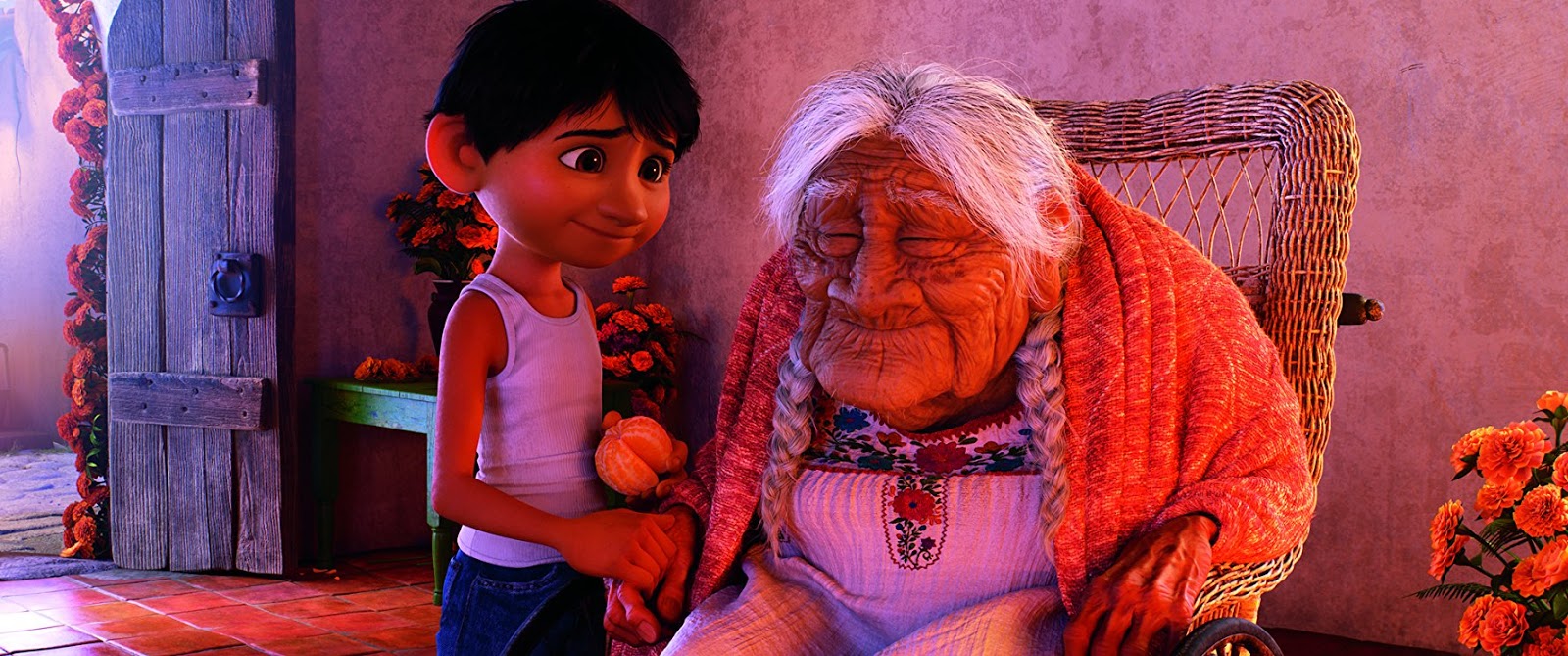
Set in the Mexican town of Santa Cecilia, the story follows a young boy by the name of Miguel Rivera (Anthony Gonzales). An aspiring musician in a family of shoe-makers, Miguel dreams of following in the footsteps of his idol, Ernesto de la Cruz (Benjamin Bratt); unfortunately for him, music has been banned in the Rivera household ever since his great-great-grandfather left his wife and child to pursue a career in the music industry. After a family spat on Dia de Muertos (The Day of the Dead, a Mexican holiday where offerings are made to the spirits of departed family members), Miguel finds himself trapped in the Land of the Dead amongst his ancestors; if he doesn't receive a blessing that allows him to return to the Land of the Living before sunrise, he'll be stuck knee-deep in the dead for all eternity. What follows is a colorful, emotional adventure that explores the messy, complicated relationship between familial responsibility and duty to one's own dreams and passions.


I'll admit, I wasn't exactly excited for Coco in the months leading up to its release. The character design didn't thrill me (particularly the choice to add eyeballs to the skeleton characters) and the plot seemed extraordinarily basic for something from Pixar. In hindsight, I wasn't being entirely fair to Coco; it works much better from a visual standpoint now that I've actually seen it in practice (to the point that it might just be the most visually-impressive Pixar film to date) and the story (as I should have expected) had much more to it than your standard "child gets lost in fantastical place, has to race against the clock and learn a lesson" plot. 

It feels like so many movies of 2017 (even ones I've enjoyed) run into the same problem of either falling into a painful slump during the second act or outright losing all steam by the time the climax rolls around; Coco, it seems, has the opposite problem. This is a film that takes quite a bit to properly get going; until Miguel enters the Land of the Dead, I was honestly getting a bit worried. The film opens with an upbeat first-person narration that doesn't return at any other point in the story, so it ends up feeling like it's specifically addressing the kids in the audience who don't know anything about Mexico. It comes off as so cheery and overly-earnest that it comes dangerously close to crossing the line into "anyone over the age of 12 is going to feel embarrassed to be watching this" territory, but that luckily all changes once Miguel is flung into the afterlife. From that point on, the film only gets stronger as it goes, culminating in one of the most emotionally-resonant third acts I've seen all year. Again, I'm referring to the same year that gave us Logan, so keep that in mind.


Despite its almost overly-kid-friendly opening, the atomosphere of the movie matures alongside its protagonist. Miguel starts off as a rambunctious, impudent kid; at 12 years old, he's right on the verge of casting off childish flights of fancy in favor of more adult responsibilities, hardly a smooth transition for most young people. The idea that, sometimes, you can't be whatever you want to be is a bitter pill to swallow, especially when it feels as though your own family is standing in the way. The conflict between Miguel wanting to become a musician and his elders wanting him to take up the family trade isn't exactly the most original, but it's how it's handled here that makes it stand out. Unlike The Last Jedi, this is a movie where characters actually sit down and talk with one another; both sides make valid and flawed arguments, and sometimes they don't reach a consensus that makes everyone happy. It's not an ideal situation, but the emotions at play make it a relatable one; whether or not we agree with these characters' stances, we can 100% understand and sympathize with how they came to these conclusions, and that attention to detail makes all the difference in the world.

As the plot continues and the tone grows more somber, we see the shift in Miguel's priorities (as well as those of his ancestors, who want nothing more than for him to give up his dream of being a musician and return safely to the Land of the Living). Every character has a lesson to learn, so the message of the story never feels one-sided. We don't get a moral that reads like a lecture ("Always listen to your elders, they know what's best for you"), but we also don't get a moral that feels like a cynical appeal to a sense of prepubescent rebellion ("Up yours, old man! What the world really needs is to learn how to dance!"). Instead, we get something more in the middle; you should always be willing to do anything for your family, but your family should never be willing to let you give up on your dreams. Instead of feeling wishy-washy, it strikes just the right chord, presenting two flawed-yet-understandable arguments and reconciling them in classic Pixar fashion.


I suppose I should talk about what inspired me to give Coco a watch after over a month of procrastination. While I was off seeing Justice League like a sucker, my compatriots at The Long Run Podcast went to see Coco (side note, fellas, what gives? Y'all had a month-long head-start on me and I put out my Coco Review first? Get it together). Their reactions floored me; here I was, looking at a movie I expected to measure up alongside Pixar's more lukewarm entries like Brave and The Good Dinosaur, only to be told that this was the most emotionally-impactful Pixar film since Toy Story 3. That this movie contains scenes as tear-jerking and sob-inducing as the first 5 minutes of Up. That, not only was this one of the best films Pixar has ever put out, but that it was one of the best films of the year. So yeah, high praise.

I entered the theater, expecting some of those good ol' Pixar feels. I left not-quite two hours later, whistling mariachi music and trying to hide how hopelessly bleary my eyes has become. I need to reiterate, this is not your stock plot about an average kid who no one understands. This is a tale about life, death, family, tradition, and legacy. It's a story about how what we amount to, at the end, is the memories we leave behind with those we've loved in life. Coco pulls no punches and goes right for the jugular; when you're sitting there during the third act, quietly weeping into your popcorn, you can rest easy knowing that Lee Unkrich and company have earned every single teardrop.


I won't mince words; Coco is my second-favorite film to come out in 2017 and I hate that I procrastinated so long in seeing it. It's a true masterpiece, one of Pixar's best (which, despite a few less-than-stellar entries, still remains high praise for any animated feature). The music is incredibly well-crafted, even by Disney standards (and then there's Remember Me, which is so thematically brilliant it's on a whole other level). And that's to say nothing of the art direction and animation, which is just spellbinding to look at, bursting with vibrant colors and liveliness. I'm not sure if this is standard for all screenings, but there was a lovely little bumper before the film began in which several of the filmmakers showcased how much work it took to animate certain shots and sequences, before thanking all of us for coming out to see Coco in an actual movie theater. It really offered some insight into the process of modern animation and helped remind me that, even though Disney is a company with essentially bottomless resources, movies like Coco are still the cumulative result of mountains of individual care, effort, and imagination. 

If you haven't seen it by this point, I'm afraid you might be out of luck for a theatrical screening (like I said, I just happened to luck out and catch the final show in my neck of the woods), but in hindsight, I'd say that Coco is worth the effort. If you can find a theater that's still showing it, take the journey and settle in for a lovely time. I came away from it feeling like I did after seeing Inside Out; in that it gave me a good cry that I didn't know I needed to have until I'd had it, and I feel like that's the true magic of Pixar movies. To clarify, this isn't a good movie because it made me cry; the same result can be achieved with a swift kick to the groin or a hefty ball of wasabi. No, Coco is a good movie because it earns its emotional response without feeling cheap. You can get cheap tears as easily as you can get cheap laughs; it's sad when an animal dies in the same way it's funny when Melissa McCarthy falls down some stairs. But when we have a genuine, emotional reaction to the experiences of the characters on screen; when we form a connection to what we're seeing and these fake, imaginary people cease to be cartoon characters and become real, that is when you can rest assured that true artistry is taking place.