Showing posts with label soundtrack. Show all posts

February 1, 2019

REVIEW: Spider-Man: Into the Spider-Verse


2018 has certainly been a big year for Spider-Man, hasn't it? He's had a hit video game come out, his comics aren't bad for the first time in a good long while, and he DIED. Spider-Man (or rather, the entire concept of the character) is also the primary subject of Spider-Man: Into the Spider-Verse, brought to us by the fine folks at Sony Animation and produced by Clone High progenitors, Phil Lord and Chris Miller. Naturally, anything with Lord and Miller involved is sure to get my attention (their involvement with Solo being the only reason I ever had even a passing interest in that movie), so I couldn't wait to see what they did with a character like Miles Morales, who has always felt like a wealth of untapped potential. While the end result didn't utterly blow me away, I think it's safe to say that Into the Spider-Verse is a strong contender for the best animated film of 2018 (or at the very least, the best animated superhero film of 2018).

The primary focus of the story, as mentioned before, is young Miles Morales (Shameik Moore); after acquiring spider-powers of his own and witnessing the untimely demise of his universe's Spider-Man (Chris Pine) at the hands of the villainous Kingpin (Liev Schreiber), Miles is left feeling woefully under-prepared in the face of the great responsibility that's been bestowed upon him. Fortunately for Miles, he's not the only Spider-person crawling around New York. As a result of Kingpin's experiments, alternate Spider-Men from alternate realities have been plucked from their home dimensions and deposited in Miles' version of NYC, including an older, washed-up Peter Parker (Jake Johnson). With the help of his reluctant new mentor, Miles must live up to Peter Parker's legacy, defeat the Kingpin, and find a way to save his new friends and, indeed, the world.

SPOILER ALERT: The remainder of this Review spoils key plot elements of Spider-Man: Into the Spider-Verse!


Really, the plot is my only major issue with this movie, in that it feels as though it can't decide whether it wants to be a Miles Morales origin story or an experimental dimension-blending crossover event. It tries to go for both, but in the process ends up spreading itself too thin in some regards, neglecting elements from both sides of the story. A good example is Miles' relationship with his Uncle Aaron (Mahershala Ali); the film establishes a promising dynamic between the two, with Aaron acting as a sort of outlet for all the aspects of Miles' personality that his father, Jefferson (Brian Tyree Henry), has trouble relating to. The only problem is that Miles and Aaron really only share two scenes together. Miles hangs out with him when he gets his spider-powers (honestly one of the best sequences in the movie), then Aaron is the Prowler for the rest of the film, and then he dies and that's that. It just feels like a missed opportunity for something grander that lives up to the intrigue established early on, and perhaps less focus on the alternate universe Spider-people would have freed up more time to devote to their relationship.

On the other side of the story, we have other characters who don't get near their due in the form of Spider-Man Noir (Nic Cage), Peni Parker (Kimiko Glen), and Spider-Ham (John Mulaney). All three are brought to life through some stunningly imaginative animation and perfectly cast voice acting, yet at the same time feel wholly under-utilized. These characters dominated the trailers, yet they altogether have very little impact on the plot, entering in at about the midway point in the story and sharing what felt like a collective thirty lines between the three of them. Visually-speaking, they bring a lot to the table, but contextually they felt more like a mere aesthetic device; really, that sums up my main issue with the movie as a whole. Part of me wonders if this wouldn't be a stronger overall product if the amount of Spider-Men was capped at just Miles, Peter, and Gwen (Hailee Steinfeld), or even just Miles and Peter for that matter. Gwen, despite a cool costume and elegant fighting style, has very little to do here, and it felt like the movie didn't explore the older, dumpier Peter Parker nearly as much as it should have. 


Peter Parker, as a fictional character, is almost always trapped in a state of arrested development; writers tend to hesitate letting Pete advance beyond the stage where he's still going to school or working part-time for the Daily Bugle. The average consumer knows Spider-Man as a teenager (or vaguely 20-something at the oldest), so that's what tends to sell, meaning we rarely see portrayals of Spider-Man advance past that point (and even when they manage to, a retcon sending him back to that tried and true "aw jeez I've gotta get to class on time but now THE RHINO is attacking!" formula is never far away). Spider-Verse's take on an older, jaded Peter Parker who's simply fought too long and lost too much is a truly unique take on the character, and the film's way of twisting this archetype we all know so well presents a lot of potential for emotional depth; he's buried his Aunt May, Mary Jane divorced him, his metabolism is catching up with him, and he's just left to be a sad, lonely man in a spider onesie whose best years are long behind him. He makes the conscious decision to sacrifice himself for the greater good, even after Miles shows up during the climax to save the day. This is a Peter Parker who is actively ready and willing to die in action, yet his emotional struggle is more or less glossed over despite it having a significant impact on the plot. It's an issue we get with the Kingpin as well; the film wastes no time in establishing Wilson Fisk as a physical threat (his massive, angular design inspired by Bill Sienkiewicz's Daredevil: Love and War) and Liev Schreiber does a great job channeling his inner mafioso, but all we really get in the way of motivation is a 30-second flashback in the middle of an action sequence. The tragic reveal of why Kingpin is messing around with inter-dimensional portals makes narrative sense and sets the stage for an emotional climax, but the film doesn't really do anything with this new information. When it finally comes time for Miles to face Kingpin on his own, it's a pretty straightforward superhero fight; good guy punches bad guy, bad guy almost beats good guy, good guy triumphs, courtesy your friendly neighborhood Spider-Man.

The real strength of this movie (aside from the stunning animation, more on that later), is when it outright revels in the new and original. One of my absolute favorite characters was Kathryn Hahn's surprise turn as a female Doctor Octopus; while it's not exactly a brand-new concept, it's little differences like these that help cement the idea that Miles' universe is a world of new and exciting spider-possibilities. This version of Doc Ock truly feels like a fresh addition to the pantheon of superhero movie antagonists, and especially to the limited pool of female bad guys (a group where, as far as Marvel is concerned, Hela and Ayesha are the only antagonists who aren't redeemed or relegated to the role of your average henchwoman). She isn't secretly insecure about her appearance and she doesn't get off easy with a heroic turn because she's more sensitive than her male cohorts in crime. She's just a mad scientist who's really into the idea of brutally murdering Spider-Man, and I'd love to see more female antagonists show this much unabashed enthusiasm in their work.


It's through details like this that Into the Spider-Verse truly shines. While I found the overall plot to be a little unbalanced, it's when the movie goes all-in on presenting us with something that we haven't seen before that it ascends to heights worth raving about. My primary criticism of the MCU's take on the wall-crawler is that, for as enthusiastic as Tom Holland's performance is, the way in which his stories are told belies a deep-seated misunderstanding of not only the character of Peter Parker, but the very concept of Spider-Man as a whole. There's no such issue present with Spider-Verse; this is a movie with a reverent love and understanding of what makes Spider-Man tick (regardless of who's under the mask) and why his stories and struggles and assorted adventures resonate so deeply with such a wide audience again and again, and it often takes risks in how it presents itself in order to convey that sense of understanding to the viewer.

The character of Miles isn't simply "inoffensively brown Peter Parker" here. They're two radically different people in radically different circumstances, the only connecting thread between them having been weaved by a radioactive spider. Spider-Man, as a concept, is all about a person (typically a younger person) being thrust against their will into extraordinary circumstances. The weight of the world is placed upon Spidey's shoulders and it's his responsibility to carry that weight so that the world may spin on. It's Young Protagonist 101, and the film doesn't harbor the delusion that a legacy character need be a 1:1 copy of the more iconic hero who preceded them in order to fill the same shoes. Miles' relationship with Jefferson and Aaron is very different from Peter's relationship with Uncle Ben, and while I felt it could have been fleshed out more in a few areas, it still managed to hit me right where I live in the same kind of way that "with great power, there must also come great responsibility" does. Brian Tyree Henry gives an amazing performance as Jeff and his dynamic with Miles is honestly strong enough to have carried an origin story all on its own. It speaks volumes about the quality of a story when the only major complaint I have is "I liked everything it gave me so much, I wish it was either longer or less jam-packed so it could give me even more".


Also, hey, not sure if you're aware of this, but the movie is absolutely downright stunning to look at. We truly are living in the renaissance of computer-generated animation, as Into the Spider-Verse looks so fantastic that Sony have attempted the ultimate scumbag move of trying to patent the animation style used in this movie. It's the kind of film I can't wait to watch on Blu-Ray, just to pick apart all of the background details (a billboard in Times Square advertising Clone College made me equal parts excited and sad). There's just loads of visual information packed into every frame. Parts of the background that, in a live-action film, would be out of focus are rendered to resemble the dye blur found in older comic books. Ben Day dots are all over the place and sound-effects are typically accompanied by animated onomatopoeia floating across the screen. After Miles gets bitten and his Spidey-Sense starts to tingle, his interior monologues begin appearing in yellow boxes near the top of the screen, complete with little wavy effect lines emanating from his head. I hesitate to use the phrase "a feast for the eyes" here, first and foremost because it's terribly cliché, but also because it honestly doesn't do the visuals here justice. The animation and shot composition are not only used as a means of giving this movie its own unique identity, but also to further the story; when Miles jumps off the side of a skyscraper during the "What's Up Danger" sequence, the camera is inverted. Because Miles isn't falling, he's rising. What Spider-Verse occasionally lacks in narrative cohesion, it more than makes up for in visual flair. It's a movie with so much evident care and thoughtful design oozing out of every pore that I simply can't not recommend it to everyone, dedicated Spider-fan or no.


While I'd still hesitate to call Into the Spider-Verse the greatest Spider-Man movie ever made, it's an easy lock for one of the top 3, and I absolutely wouldn't fault someone who put it at the very top of their personal list. It's not without its flaws (personally, the soundtrack felt very hit-or-miss at times), but as a piece of Spider-Man media, it's not hard at all to place this near the top of the stack. Now that the origin-story bloat is over and dealt with, I can't wait to see what the creative team behind this has in-store for the sequel; if the post-credits scene is any indication of where the plot is heading (which I hope it is, seeing as how it was easily my favorite post-credits stinger of 2018, possibly of all time), I'm beyond excited to see what the future will bring. Congratulations, Sony. You actually did good. Now don't screw this up. I mean... good luck.

January 19, 2019

REVIEW: The Favourite


It may be jumping the gun to say something like "Yorgos Lanthimos is one of my all-time favorite filmmakers" after only seeing two of his films, but... here we are. While I still have yet to see The Killing of a Sacred Deer or Dogtooth (they're on the list, alongside the rest of his filmography, I promise), The Lobster put him on my radar in a big way. When I heard that he would be directing The Favourite, I leapt at the opportunity to see one of his films in theaters. Again, it may be premature to say that he is one of my favorite filmmakers of all time (and indeed, one of the finest filmmakers working today), but saying the man is two for two in my books would be an understatement. I was excited to see what he had to offer with The Favourite and left the theater not only satisfied, but fairly confident that I had just seen the best film of 2018.

Set during the War of Spanish Succession right around the start of the 18th century, the film focuses on the tumultuous relationship between Queen Anne (Olivia Coleman) and her close adviser/secret lover, Sarah Churchill, the Duchess of Marlboro (Rachel Weisz). Ill and eccentric after a life of tragedy, Anne cares little for governing or warfare, delegating the majority of her decision-making to Sarah (much to the dismay of Earl Robert Harley (Nicolas Hoult) and his fellow Tories in Parliament). This all changes with the arrival of Abigail Hill (Emma Stone), a former lady of status and Sarah's younger cousin. Hoping that her connection to Sarah will allow her to gradually re-build her social standing, Abigail eventually begins to usurp her cousin's role as the Queen's favourite. What follows is a brutal, hilarious ballet of deception, blackmail, and wit as the two women vie for the affections of the ailing Queen (and all the privileges that come with it).


The most immediately striking thing about this film has got to be the performances. Everyone in the supporting cast does a fine job (shout-out to Horatio, the fastest duck in the city), but the main trio of women absolutely make this film. Olivia Coleman gives one of the best performances of the year as Queen Anne, playing the sickly monarch in a way that's as hilarious as it is multifaceted. She's damaged and crazy and unpredictable, but you never get the impression that she's nothing more than a punchline. She's very much an active player in the conflict between Abigail and Sarah, even if it doesn't appear as such at first glance. She's a character who could have been little more than a plot device, a living maguffin for Stone and Weisz to quarrel over and manipulate, but Coleman imbues her with a true sense of pathos; we get occasional glimpses into her world, revealing her to be a flawed, pitiable person who's suffered repeated and tremendous loss in her time as Queen. There's a strong undercurrent of mockery directed at aristocracy and the ruling class, but Anne is still primarily painted as a truly sympathetic character. "The Queen is crazy" isn't the fullest extent of the joke, as The Favourite goes for something a little more conceptually ambitious in how it deals with conflict and drama.

Nowhere is this more evident than in the relationship between Abigail and Sarah. I'm a big fan of movies that subvert audience expectations, when done properly. It's a tricky business to get right, and I always see people defending poor examples of subversion by insisting naysayers only want movies to break the mold in ways that they were already expecting (and therefore comfortable with). In reality, it's far from being so simple. Anyone can do something unexpected; I could write the rest of this Review in Mandarin, because surely you wouldn't normally expect that to happen, but doing so wouldn't give my work an inherent value for that reason alone. Well-crafted subversions of audience expectations serve to enhance the story, taking things in a new and exciting direction that adds a new dimension to the events playing out on-screen. This is something screenwriters Deborah Davis and Tony McNamara understood when crafting the characters that Stone and Weisz brought to life.


When we're introduced to Emma Stone's Abigail, she's a polite and filthy young girl, having just been shoved out of a moving carriage into the mud. It's a sharp contrast to Weisz's Lady Sarah; cold, manipulative, and at times downright cruel in her indifference towards the Queen's problems. It establishes a clear protagonist/antagonist situation with Queen Anne stuck in the middle. Abigail has been used and abused her entire life, robbed of her birthright and reduced to working as a scullery maid. She's a humble yet ambitious young lady who's found herself in a particularly low place in life through no fault of her own, so she's easy to root for at first. Meanwhile, Sarah enacts her will on the country by whispering in the Queen's ear and slipping into her bedchamber behind her husband's back, seemingly looking out for none but her own interests. At first glance, it all appears very cut and dry, but that's where the truly gripping elements of the plot come into play.

As the story progresses, we notice a gradual shift in character dynamics as more and more comes to light. We learn that, although she exploits her position as the Queen's favourite for personal gain, Sarah truly does care for Anne, both as a friend and lover. What on the surface appears to be a simple lust for power is eventually revealed to be a legitimate sense of duty; the Queen is far more concerned with playing with her rabbits than she is with waging war on the French, leaving Sarah with the responsibility of maintaining a nation. It's Sarah's dedication to the war effort that leaves her momentarily unavailable to stay by Anne's side, allowing Abigail the chance she needs to hook her claws into the sad and lonely Queen. What first appeared to be the story of an underdog hoping to improve her station in life soon becomes the tale of a malicious schemer, drunk on power and status, eventually resorting to truly abominable actions to ensure her position is secured. We really get to see a 360 view of this seemingly straightforward conflict, with first impressions dissolving before our very eyes as we learn more and more about who these characters actually are.


Of course, the actors aren't the only element of this film worth praising. As with The Lobster, Lanthimos exhibits his truly distinctive directorial eye, creating a style that compliments both the dry, comedic elements and the more serious, dramatic elements of this story. From a stylistic standpoint, the film is very unique without feeling as though it's trying too hard to stand out from the crowd. There's a real sense of creative confidence at play here; nothing is presented the way it is for a purely superficial reason, and you never lose the feeling that Lanthimos (along with cinematographer, Robbie Ryan) knew exactly what he was doing with every scene and shot.

The whole thing is shot on-location at Hatfield House in Hertfordshire, England, so nothing feels like a set. The spaces these characters inhabit feel appropriately lived-in, lending the whole thing a real air of authenticity (even though the actual historical accuracy of the plot is questionable at best). I admittedly found myself getting a lay of the land as the film went on, becoming very familiar with spaces such as the Queen's bedroom and the lush, well-kept grounds. The strong reliance on naturalistic lighting and use of classical music only adds to the authenticity, and that atmosphere of historical realism contrasts wonderfully with the dry, absurdist humor at play. It's a relationship summed up in a visual sense through the film's occasional use of a fish-eye lens, moving away from the many spacious wide-shots the film is littered with and portraying things from a warped, exaggerated perspective. It's like a metaphor for the presentation of the film as a whole; aesthetically, this is but one or two degrees away from your standard period drama, yet the dry sense of humor and use of visual comedy keep things skewed just enough to stand out from the herd, at least on a subconscious level.


Overall, I don't really have anything remotely negative to say about The Favourite. It's a hilarious comedy, a compelling drama, and a gorgeously-shot period piece all in one. Brought to life by a remarkably talented cast of actors all giving award-worthy performances and helmed by one of the most unique and talented directors working today, I can't very well think of a reason not to recommend this to just about anyone. I suppose, as with The Lobster, the unorthodox presentation may at times seem intimidating to those in search of something more by-the-numbers, but like The Lobster, I feel this is absolutely a film worth engaging with, even if it's outside of your typical comfort zone. I'd go as far to say it's a modern classic and absolutely can't recommend it enough, go check it out.

November 21, 2018

REVIEW: Halloween (2018)


This isn't the first time I've spoken about the modern phenomenon known as soft-reboots on this blog and lord knows it won't be the last (at least not until general audiences and fanboy consumers get wise to the studio game and force Hollywood to come up with a new means of selling us the same product twice). Despite the negative connotation the concept of a soft-reboot carries, it's not always an inherently negative thing. Sure, it can be hard to shake the feeling that a movie was only put into production to cash in on those valuable nostalgia bucks, but there are ways for a soft-reboot to rise above being a mere cash-grab and stand on its own as a solid film and sequel. There's a reason why movies like The Predator don't work, while movies like The Force Awakens (more or less) do; each is spawned from a film that has stood the test of time and continues to stay relevant within the public consciousness, but it is only the soft-reboots that understand why that is that go on to any modicum of critical success. In a best-case scenario, a soft-reboot will not only faithfully recreate the spirit and atmosphere of a well-known property, but bring something new and original to the table, acting as a genuine continuation of the story (rather than merely shifting everyone's characters around and following the same exact plot we already know). When a soft-reboot brings something new to the table, it is able to transcend the cynical, corporate circumstances of its birth and become something truly special, such is the case with the (infuriatingly titled) sequel to John Carpenter's 1978 classic, Halloween, Halloween.

Set 40 years after the original, we once again find Michael Meyers (portrayed by both newcomer James Jude Courtney and original actor Nick Castle) escaping from captivity to wreak havoc on the small town of Haddonfield, Illinois on Halloween night. As one might expect, bodies begin to pile up, justifying the paranoid fears of a damaged, gun-toting Laurie Strode (played once again by the OG scream queen, Jamie Lee Curtis). In the years since her first encounter with The Shape all those years ago, Laurie has become a twitchy recluse, estranged from her daughter (Judy Greer), twice-divorced, and still recovering from both her severe emotional trauma and alcoholism. Convinced that someday Michael would escape to finish what he started, Laurie sets out to confront him one last time, before he can bring any more death to her little town.


The thing I'm most thankful for about director David Gordon Green's vision for this film (which he wrote alongside Jeff Fradley and, surprisingly enough, Danny McBride) is the way in which it vehemently opposes reinventing the wheel. It's made abundantly clear that this film ignores all other entries in the Halloween franchise aside from the 1978 original, cutting out all the fat and nonsense that have diluted and bogged down this perfectly simple concept since. Gone are the hokey attempts at raising the stakes; Michael Meyers and Laurie Strode are no longer secret siblings, and he's no longer under the magical control of a sinister cult. We're back to basics on this one, where Michael is just a hulking mute who feels no remorse towards his abominable actions. Really, he feels no emotions; he's a blank slate, like a shark, he just moves forward and kills without a second thought  (although he still shows a slight affinity for boiler suits and butcher's knives). It's for this reason that Michael Meyers is actually a terrifying antagonist for the first time in years. There's no attempt to explain why he does what he does. He's just pure evil given form with no rhyme or reason assigned to his actions. This unpredictability adds to the tension; the original film worked because of that sense of unease, that you were constantly being watched, and Halloween understands how to generate those same feelings. Michael Meyers could be anywhere. He could even be outside your window right now, watching you read this.


While I can't ignore the silent intensity Courtney and Castle imbue The Shape with this time around, it's no surprise that the performance everyone is talking about is Jamie Lee Curtis as Laurie Strode. In a less inspired film, Laurie would simply slip into the Doctor Loomis role, the same way Han Solo became the new Ben Kenobi, while her granddaughter (Andi Matichak) serves as the main character. Instead, we're given a Halloween movie where Laurie is once again our primary protagonist. That's not to say that her family falls by the wayside, but this is very clearly Laurie's story; we see how low she's fallen after that fateful Halloween night and watch her reclaim her agency. It's a move that, in less competent hands, would feel corny and tonally inappropriate (though likely less so than a kung-fu fight with Busta Rhymes), but is pulled off with both style and substance here. Both Curtis and the screenwriters make Laurie into a tragic, flawed character who alienates and neglects those around her. Sure, she's eventually proven right when Michael inevitably escapes from the asylum and starts carving up teenagers like so many jack-o-lanterns, but that doesn't exactly justify her toeing the line of becoming a monster herself. The other performances here are serviceable, but Jamie Lee Curtis grants this movie the legitimacy it really needs to stand on its own, and I think that's why I liked it as much as I did.

I'd definitely recommend watching this back-to-back with the original (as I did); there are a number of callbacks and references, none of which are intrusive or obnoxious, that really make this feel like a genuine continuation of the story. Michael Simmonds' cinematography manages to recreate the feeling of John Carpenter's low-key, stripped down original without feeling cheap or derivative. Paired with a haunting score (care of Carpenter himself), it really does convey the feeling that this is a true and honest follow-up to the original film. At the same time, the new blood behind the cameras bring a few of their own tricks to the table, all in service of making this stand out from its progenitor; there's an impressive tracking shot that follows Michael around the neighborhood on Halloween night that might qualify as my favorite thing in the entire movie.


That said, this is by no means a film without flaw. The plot, while engaging, starts to lose steam midway through the second act, introducing a series of plot points (such as Laurie's granddaughter Allyson's relationship with her boyfriend, played by Dylan Arnold) that never see any kind of resolution. While the climax is most definitely worth it, our means of getting there feels half-baked and sloppy (compared to the airtight first act). There's a really unnecessary twist at one point that, while surprising, makes little sense and even comes dangerously close to stripping Michael of his all-important mystique. It literally only serves to transport a character from point A to point B so that the climax can happen and it's not the only example of questionable writing to be found in this script.

There's also a lot of misplaced humor here as well. I really wish that modern films would ditch the idea that everything needs to at least partially be a comedy; just because it works for Marvel movies doesn't mean I need something to chuckle at every time I go to the cinema. With the exception of a genuinely hilarious performance by young Jibrail Nantambu, almost all of the jokes here fell flat. This is a movie that thrives on suspense and tension, instilling a paranoid fear in the audience, so lighthearted humor should be used sparingly, if at all. That's not to say the original was devoid of any attempt at comedy, but I think we can all agree that moments like P.J. Soles' monologue about textbooks didn't exactly work to the benefit of the atmosphere or tension or any of the other elements that made the original film work as well as it did. For a movie that seems to understand the beast that is the original Halloween so well, creative decisions like this caused me to raise an eyebrow, to say the least.


Criticisms aside, it's very clear that this film was a labor of love, made by fans of the original Halloween, for fans of the original Halloween. They seem to have more or less cleared that all important pitfall that so many soft-reboots fall into, striking a fair balance between reverence and innovation that make for an experience that, despite its flaws, is very hard to dislike. Had the plot and script been a tad cleaner, this would have been a home run, but as is, it's still an excellent slasher flick and a worthy follow-up to the original. A sequel has already been greenlit, so here's hoping the filmmakers continue to innovate and develop their ideas further, rather than getting high off fanboy fumes and crashing the hype train entirely in favor of "subverting expectations".

August 27, 2018

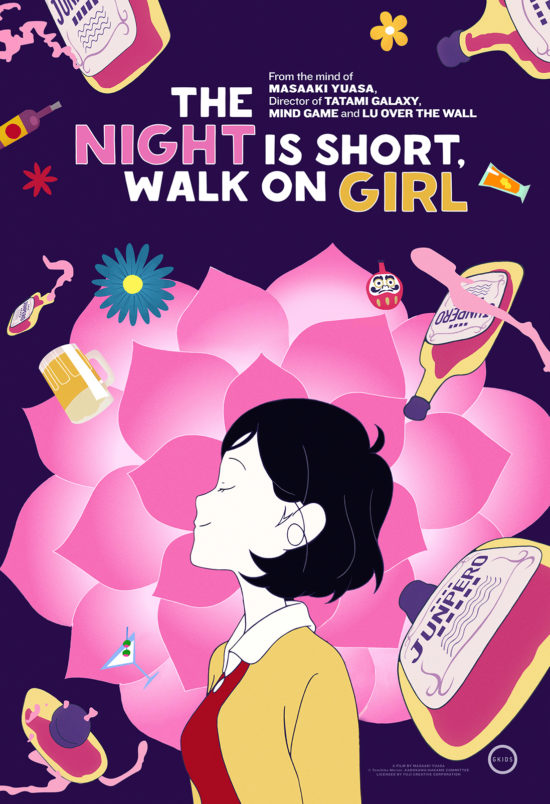
REVIEW: The Night is Short, Walk On Girl


For as much as I like to say I enjoy anime, the irrefutable truth of the matter is that I'm basically just a novice; I've watched Fooli Cooli and Gurren Lagann  a couple of times and I'm currently enjoying My Hero Academia, but it's safe to say that there are vast parts of the medium that I still need to explore. I was, for example, completely unfamiliar with the work of Masaaki Yuasa; that is, until I decided to check out The Night is Short, Walk On Girl (loosely adapted from the Japanese novel of the same name). I saw the trailer on Facebook just by chance (or perhaps it was fate), but the fluid animation, whimsical art design, and catchy music told me that I just had to go check this one out (especially since it would be in US theaters for two nights only). 90 minutes later and I'm not only convinced that I need to seek out the rest of Yuasa's work, but that The Night is Short, Walk On Girl is my personal pick for the best movie of 2018 (even though it was technically released in 2017, though only in the UK and its native Japan).

The plot is, shall we say, difficult to describe. This is one of those situations where I feel as though I'd be walking a fine line between describing the premise and simply recounting every scene; it's very much like Alice in Wonderland or The Wizard of Oz, where our protagonists move from situation to situation, encountering a host of unique characters as they go on their journey. The film follows a nameless girl with black hair (typically just referred to as Otome, the Japanese word for "maiden", and voiced by Kana Hanazawa) on a night of heavy-drinking through Kyoto. Meanwhile, a similarly nameless classmate of Otome's (referred to as Senpai, voiced by Gen Hoshino) is determined to confess his feelings towards her on this fatefull night. As he explains, he's implemented a long-term plan of crossing paths with Otome as often as he can manage, under the guise of their encounters being sheer coincidence. When the time is right, he will reveal his true intentions and it will seem as if the two had always been intertwined by the red string of fate. What follows is a delightfully charming, psychadelic rom-com that utterly annihilated my expectations in the best sort of way. This is just one of those movies that feels like a vivid dream, boasting the kind of atmosphere I'd like to curl up inside of for the rest of my life.


While the movie is, aesthetically-speaking, undeniably gorgeous, the real draw for me was the thematic subtext underneath it all. This is one of those films that focuses in on that sort of "quarter-life crisis" that twenty-something college students tend to go through. We've seen so many coming-of-age stories, but what happens after the protagonists have already grown up before the plot truly began? We're told from high school onward that we're "young adults", but that feeling honestly didn't kick in for me until after I'd completed my undergrad, got a job, and moved into a place of my own. For those who go right from high school into college, the question of what comes after is something that really starts to weigh on you after you get acclimated. We act like the transition from high school senior to college freshman is a massive change, but it's really nothing compared to spending the first 22 years of one's life adhering to a more or less consistent system of schooling and socializing, only to finally cross the finish line into the stage of your life when you have to start thinking about taxes and rent and insurance. You get your degree, then what comes next? Graduate school? A career? Or just another job to pay the bills? Should you get married? Start a family? Buy a house? Do you even have the means to do any of those things? These are all the questions you start to mull over as you begin to fully and finally transition into the adult world, and said questions tend to weigh heavily on the minds of chronic over-thinkers like Senpai (or myself, for that matter).


The character of Senpai manages to transcend the usual "awkward nerd who's hopelessly smitten with the girl of his dreams" trappings by really delving into his mindset. He isn't just another gawky buffoon in pursuit of his manic pixie dreamgirl; he's insecure to the point that he outright questions if he even deserves to have his insane plan work out, or if it would be more fitting that he just shrivel up and die alone. He's become accustomed to failure, putting up walls to protect himself from the terrifying idea of what might happen if he actually gets what he wants for once, the only outcome he's completely unprepared for. Otome, meanwhile, is in the exact opposite situation; she's naturally talented at everything she tries, resolved to simply go with the flow and see where the night takes her. While she hardly has to put in any effort in order for things to go her way, she's left with a life that, compared to Senpai, lacks any semblance of drive, ambition, or purpose. The film establishes that her easy-breezy attitude towards life tends to leave those around her in the dust, leaving her with her own kind of loneliness to deal with. They're two sides of the same coin, yin and yang, but that doesn't mean they don't need to grow and change in their own ways before they're fit to be together.

The film hypothesizes that who we are is but an amalgamation of those we meet in life; whether we know them for the rest of our days or just for one drunken evening, the impact and influence they leave us with is what determines who we are and how we grow as people. The emotions these people inspire and the stories they leave us with are the things that life is made of. Feelings of isolation, loneliness, and disassociation are hardly rare for young people, especially those who find themselves in the midst of a great transitory period in their lives, and The Night is Short, Walk On Girl goes to great lengths to remind us that no man is an island. Whether you believe in fate or not, your existence is immutably intertwined with those around you (and even those you've yet to meet). We're all players in the funny, tragic, oddball play that is the human race; everyone matters, no one is truly alone, and happiness will always inevitably win out over nihilism.


Although it's obvious that the underlying motifs this movie set forth resonated with me on a deep emotional level, I want to make it clear how much I adored everything else in this movie. Like I said before, the animation is absolutely stunning (putting Masaaki Yuasa on my radar in a big way) and I really love the use of color and sound to establish a sensory experience that's at the same time fantastical and immersive. As the night goes on, an entire year seems to pass; we begin on a warm spring evening, transition into summer heat, and by the time the climax rolls around, all of Kyoto is stuck inside with the flu as unforgiving winds and snow rip through the empty city streets. I also found myself surprisingly invested in the stories of the various side-characters Otome and Senpai come across, absurd as they are. My personal favorite would have to be Don Underpants ( Ryûji Akiyama), a writer and hopeless romantic who has pledged to not change his underwear until he reconnects with a girl he had a fated encounter with some time ago. At first we assume he's just there for a one-off joke about his self-appointed nickname, but then he shows up again much later on, setting up guerrilla plays at the student festival as a means of attracting his mystery love's attention. These side-characters are all bit players compared to our two main leads, but their stories are told in such a way that it truly feels as though the plot thread doesn't end the moment they walk off-screen. We really get the feeling that this isn't just an extraordinary night for Senpai and Otome; everyone has their tale to tell, and that's really the entire message of this movie in a nutshell.


The Night is Short, Walk On Girl is really just a remarkable little movie. It's a surprisingly conventional, feel-good love story that's conveyed in the most unconventional of ways; pair that with sublime animation, supremely comfy atmosphere, a killer soundtrack, and loads of endearing and memorable characters, and you've got a winning recipe for my personal favorite movie of 2018 thus far. Yes, I know, it technically came out in 2017 everywhere but the USA, but I'd be outright lying if I said that, out of everything I've seen in theaters this year, The Night is Short, Walk On Girl wasn't my favorite. If it wasn't clear already, I absolutely adore this lovely, lovely film and would like nothing more than to just immerse myself in all the charm and good vibes it's constantly putting out. If you're a fan of anime or animation in general, you owe it to yourself to give this one a watch.

August 14, 2018

REVIEW: Eighth Grade


I'm honestly surprised it's taken this long for Bo Burnham to venture into feature films. He's a remarkably talented guy, so you can understand how excited I was for Eighth Grade, his first foray into the world of writing/directing for the big screen. Comparing the trailers for Eighth Grade to Burnham's stand-up specials, it struck me as not the sort of thing one would necessarily expect from his typical musical-comedy wheelhouse. Really, that only made me more excited to see it; I love watching comedians step outside of their comfort zones to make something that's not necessarily meant to be laugh-out-loud funny, first and foremost. The most successful comedians tend to have a knack for tapping into other base emotions aside from just laughter, and I'm happy to report that Eighth Grade does nothing to dispel that hypothesis.

The film follows eighth-grader Kayla Day (Elsie Fisher) through her final week of middle school, just before summer vacation (and the move to high school after that). It's worth noting that this isn't your typical "teen" movie; there's no big dance or talent show that Kayla needs to prepare for, and the popular girls don't go out of their way to make Kayla's life a living hell (rather, they hardly even acknowledge her existence). The plot foregoes every adolescent trope by being as purposefully mundane as possible, casting aside theatrical dramatization in favor of just being real. And not in the "omg that's literally me" kind of way, either; there are moments where Eighth Grade almost feels like a nature documentary on the middle school ecosystem, rather than an attempt to forcibly relate to a younger audience. I'm well beyond my middle school years, but this film still felt like a time-capsule based on its atmosphere alone. It takes us back to a time in our lives when pool parties and trips to the mall weren't just run-of-the-mill, everyday occurrences, but events where everything (especially image) mattered. There are small details that are sure to strike a chord with everyone for different reasons; for me, it was an unseen class clown shouting "are you my mom?" after the principal handed the mic off to a teacher during a school assembly. The film doesn't need to go out of its way to make these little moments feel important or theatrical, because they already are for Kayla; she's the focal point of the entire story. We care about her, and by extension everything she cares about (even if we're old enough to know better).


The film displays a remarkable knack for inspiring its audience to empathize with Kayla's adolescent struggles, thanks in part to the incredibly naturalistic writing and dialog. However, the factor that carries this entire film is the performances, Elsie Fisher's shining above all else. The character of Kayla is the rock on which the entire film is built; if she doesn't work, the entire thing falls apart. It's a tricky balance, given the premise of the movie, to write a protagonist who is both endearing and believably flawed. If Kayla was portrayed as overly self-aware and wise beyond her years, she'd cease to feel like an everygirl on the brink of young adulthood and start to feel more like every other stock "insecure tween" character in existence. On the flip-side, if she acted too childishly, older audiences would be alienated from her struggles with the pressures of social media and prepubescent peer interaction. It's thanks to Fisher's performance that this balance is kept intact; we'll shake our heads when Kayla makes a mistake, but we never stop rooting for her to succeed.

I honestly saw a surprising amount of myself in her, both now and looking back to my middle school years. I can remember being in middle school, making YouTube videos in my spare time (which I've naturally long since deleted, seeing as how you can watch my voice change a little bit with each upload). Middle school was a time of insecurity and immaturity, where we simultaneously don't care about anything but also care about literally everything. I remember the moments in my childhood, attending parties I wasn't sure I was wanted at, stressing out over nothing, and wanting to be treated like both an adult and a kid at the same time. The film hits a lot of easily-relatable beats without coming off as generic or clichéd, which isn't exactly an easy thing to do. I'm really looking forward to revisiting this as time goes on, maybe even after I've had kids of my own, to see how I respond to it then.


It's worth noting that the supporting cast is excellent as well; suffice to say, there are no bad performances in this entire film (a credit not only to the cast, but to Bo Burnham's skills as a first-time director, working primarily with relative unknowns and children). Jake Ryan is a delight as Gabe, the gawky cousin of one of Kayla's more popular classmates. I like to think I wasn't this much of a dweeb back in middle school, but the way I both smiled and cringed at his Rick and Morty impressions imply otherwise; his performance was yet another of the things in this movie that hit very close to home in a fun, endearing kind of way without feeling as thought it was trying too hard to make me relate. I also utterly adored Josh Hamilton as Kayla's dad; his chemistry with Elsie Fisher is fantastic, and I find that he carries a deceptively large amount of the emotional weight in this film; you get the sense that he's got his own story going on behind the scenes, as though he's the star of his own, unseen movie. I'll always cheer on the death of the idea that father figures in movies must be incompetent, pigheaded idiots, and Hamilton's performance is yet another nail in that proverbial coffin. Not to say that he's an ineffectual pushover either; he's just a man who desperately wants his daughter to be the happy person she was a few scant years ago. Arguably my favorite scene in the entire movie is what could loosely be called the climax (in a film as low-key and down-to-earth as this), and Hamilton's performance solidified it as one of the most heartfelt things I've ever seen.


Eighth Grade is the kind of movie I wish I had back in middle school (kudos to any theater that organizes all-age screenings of this film, incidentally). Heck, it's the kind of movie I wish I had in high school. Regardless, I'm glad I have it now; despite some odd pacing and unambitious cinematography, the film really has a talent for hitting you with moments that makes you realize just how emotionally invested you are in Kayla's journey into adolescence. One scene in particular had me clenching my fist so hard I'm surprised I didn't draw blood (incidentally, I'm also a little disappointed we didn't get any kind of closure regarding what happens therein, but I digress). It's definitely going to hit hard for people in my generation and younger, who found (or find) themselves growing up in an age of social media, where the forced social interaction doesn't necessarily end when school lets out. We've reached a point as a society where we're constantly bombarded with the absolute prettiest moments of everyone else's lives, and that kind of 24/7 connectivity has a unique way of making one feel completely and utterly alone. Eighth Grade is the kind of movie I intend to show my kids (if I ever have any) when they're old enough, and that's just about the highest praise I can give it. It'll make you laugh, it'll make you cry, and it'll make you look back on some of the worst years of your life with a twisted, nostalgic sort of fondness. If there's one movie this summer that deserves your hard-earned money, Eighth Grade is it. Go check it out.

July 22, 2018

REVIEW: Redline


I've been on something of an anime kick as of late (getting up to speed on both Konosuba and My Hero Academia in less than a week), so it felt appropriate to finally tick off a film that's been sitting in my backlog for a good couple of years now; 2009's Redline. I normally tend to avoid summarizing movies as "X crossed with Y", but I simply can't help myself in the case of Redline. This is Speed Racer crossed with Wacky Races in the style of Mad Max: Fury Road, but in space. It's a film every bit as absurd as that description, more than making up for what it lacks in plot with some of the most stunningly engaging animation I've ever seen.

Set in the far reaches of space, the film follows "Sweet" JP (Takuya Kimura), a rockabilly racer with a checkered past whose driving skills are nearly as impressive as his pompadour. When JP finds himself voted in as a participant in the titular Redline race (a highly anticipated annual event using traditional motors only), he can't help but say no, even though the race is set to be held on the aptly-named Roboworld, a planet populated entirely by cyborg zealots. The president of Roboworld (Kōsei Hirota) is staunchly against hosting the Redline on his planet, as he fears the broadcast of the race could reveal a number of illegal military operations (which would undoubtedly violate a great number of treaties); as such, he has pledged to terminate any and all racers he finds on his planet. As if that wasn't enough, JP is oblivious to the treachery of his longtime partner, Frisbee (Tadanobu Asano), a mechanic who's gotten in deep with the mob. Not only does he need to win the Redline, he has to survive, all while pursuing the heart of fellow racer, Sonoshee McLaren (Yû Aoi). It's a romance/drama/action/sci-fi extravaganza and I honestly had so so much fun with it.


I tend to use the term "feast for the eyes" regrettably often whenever it comes to discussing animated films, and Redline is definitely no slouch when it comes to visuals. I love everything about the way this movie looks, feels, and moves. The character designs are imaginative and endearing, never getting too silly or outlandish so as to distract from the action. Along with JP and Sonoshee, we have a dirty-cop gorilla man (chasing after the other participants for speeding, naturally), a pair of bounty hunters that definitely aren't parodies of Batman and Robin, and a well-mannered robot who literally is his own car (among others). It feels trite to say something like "this film is bursting at the seams with pure imagination", as if something as abstract and subjective as imagination could be measured, but I really can't think of a better way to express myself here. It's an animated feature that most definitely leaves a big impression. There are obvious influences from existing works (see the initial Speed Racer/Wacky Races/Mad Max comparison), but it's got its own distinct identity as well. The designs of everything from the racers to their vehicles to the various planets themselves are just so vivid and creative; it's one of those films like Wizards or Fantastic Planet, where I just want to completely immerse myself in the art direction and design.

With such fantastic designs, it should go without saying that the animation here is also top-knotch. I don't know if I've ever uttered, "wew, that looked expensive" at an animated film as often as I did with Redline. According to my rudimentary research, the film was in production for some seven years, and took over 100,000 individual drawings to complete; rest assured, the final project looks it. I especially loved the fish-eye effect used to convey mind-blistering speeds (a winning combo when paired with JP's towering hairdo). If you're into psychadelic visuals like those found in FLCL or Yellow Submarine, you'd be doing yourself a disservice not to add Redline to your "must watch" list.


If I have any real criticism, it simply has to do with the plot. Redline is by no means a complex or thematically-heavy movie; there's a race, our main character wants to win said race, said main character drives really really fast. That's about it. It's most definitely more about the visuals here than it is the plot, which I honestly feel is somewhat forgivable, given the circumstances. The entire plot of Redline focuses in on this one race, and damned if it isn't one hell of a race. It doesn't attempt to be anything more than it is by spouting off pseudo-intellectualisms in an attempt to trick the viewer into thinking that there's anything close to a healthy balance between style and substance. This is a film that 110% knows what it is about, and I honestly respect that. The filmmakers knew that they were making a movie about really cool-looking cars that drive really quickly across stunningly-detailed alien planets, and that's exactly what we get. 

Even then, with how simple the plot is, I found myself surprisingly invested in the drama between JP and Frisbee; the film does slow down at points to give us some insight into their history together, allowing us time to breathe between the insanely engaging action beats. For as simplistic as the plot is, the character interactions are given a good amount of attention (at least moreso than one might expect with a project as visually-focused as this). The time we spend with our main cast isn't just a formality before we can get back to the fast cars and hellacious crashes. Rather than having the characters outright state what their motivations are, the audience is left to piece everything together from implicit details after the credits roll; some might call this lazy, I call it efficient. Both the film and the audience are on the same page, the movie's strongest suit is the manner in which it liberally doles out speed and adrenaline. Additional exposition would have just weighed everything down, so I appreciate the film's confidence in its audience to figure out why certain characters act the way that they do without spoon-feeding it to us, getting in the way of the main event in the process.


I don't really have much else to say about Redline. It's an awesome little flick. If you're a fan of animation (or anime specifically), consider this mandatory viewing; the same goes for those of you who are into cars. It's not an overly-complicated movie, it's just an all-around good time. The plot isn't much to write home about, but Redline more than makes up for its lack of subtextual depth with its positively stunning animation and art direction; watch it on a big screen with a good sound system and all the lights turned off, it'll blow you away.

June 21, 2018

REVIEW: Incredibles 2


It's about damn time. After fourteen long years of waiting, The Incredibles finally has a sequel. Really, I should talk briefly about the first film before we get into the nitty-gritty on Incredibles 2. Released in 2004 and directed by animation legend Brad Bird, The Incredibles turned the superhero genre on its head well before the MCU came to town. Stylish yet down-to-earth, the film was arguably Pixar's most mature film to date, earning the studio its first PG rating. I personally consider the first Incredibles to be Pixar's best film, as well as one of the greatest superhero films ever made. Suffice to say, this sequel has some big shoes to fill; Brad Bird had always said that he would never return to make a sequel unless he had a story he felt he needed to tell, a respectable display of restraint in this day and age (especially considering that Disney is involved). So after all this time, is Incredibles 2 a good movie? Yes. Was it worth waiting nearly two decades for? Ehhh...

In a move no one could have predicted, the plot picks up immediately after the end of the first film, in which we see the city of Metroville menaced by the fiendish Underminer (Pixar's good luck charm, John Ratzenberger). Naturally, the Parr family springs into action, only to find themselves arrested after their heroism causes its fair share of very expensive collateral damage. While parents Bob and Helen (Craig T. Nelson and Holly Hunter) discuss their concerns over raising three super-powered kids in a world where superheroes are illegal, they are approached with a business proposition by an eccentric magnate by the name of Winston Deavor (Bob Odenkirk). A longtime fan of superheros, Deavor would like nothing more than to see the laws keeping them underground overturned. Determined to show the supers' side of the story, he and his sister, Evelyn (Catherine Keener), outfit their suits with body cameras; the supers would go out and do what they do best, with the Deavors' considerable PR connections and insurance plans keeping their images clean. In order to get the project off the ground, Winston proposes that they lead with Elastigirl, as she's routinely caused the least collateral damage out of the bunch (which makes sense, compared to her human wrecking ball of a husband). This leaves Mr. Incredible, typically comfortable with being the breadwinner for the Parr clan, out of his element, staying at home to raise the kids while Elastigirl tracks down a new supervillain threat known as the Screenslaver (Bill Wise).


I'd like to apologize in advance, since a good deal of this Review is going to involve me comparing Incredibles 2 with its predecessor, but I feel like that's somewhat unavoidable when discussing sequels (especially sequels with such a large gap of time in between them). The first Incredibles featured some remarkably mature themes for an animated superhero film targeted at children; it's not difficult to see Mr. Incredible's complaints about society "celebrating mediocrity" as a critique of No Child Left Behind, and the stakes presented had a very real-world weight to them. Before finding out that her husband is sneaking away to play superhero, Helen has a legitimate fear that he's having an affair. Later on, she has a heart-to-heart talk with her children, in which she explains that the people they're going up against won't hesitate to kill them, if given the chance. Hot off the heels of Finding Nemo, The Incredibles was a surprisingly heavy film for Pixar (but then again, it was brought to us by the man who made The Iron Giant). It's because of this that I found myself disappointed in some respects with Incredibles 2; it's a fun time, but it feels very much conceptually watered-down. Whereas the first film just oozes atmosphere ripped straight from pulp spy stories and Golden Age comics, Incredibles 2 feels much moreso influenced by Saturday morning cartoons. It deftly avoids simply being a rehash of things we've already seen, but there isn't a single moment in Incredibles 2 that even approaches the tension, atmosphere, or emotional weight of the iconic "Missile Lock" scene from the first movie.

It doesn't help matters that the Screenslaver, despite an intriguing origin story, amounts to little more than the most recent in Disney's growing line of predictable Scooby-Doo twist villains. I won't spoil the Screenslaver's true identity, but I'll say this; I had figured it out before I even walked into the theater, simply by virtue of looking at the names of the main characters. It's a twist so painfully obvious and overly-telegraphed that I honestly thought the film was trying to pull one over on me, but alas, it really is just that simplistic. Granted, we're talking about an animated family film primarily marketed to children, but I still have a hard time believing that anyone above the age of 9 would have any difficulty in putting the pieces together before the other shoe drops. The surprise villain reveal worked well in Wreck-It Ralph and Zootopia, but it feels like this is a trope that appears in nearly every single animated Disney film released nowadays. When you go into the theater expecting a twist... well, it's not much of a twist anymore, is it? Granted, the first Incredibles had a twist villain in the form of Syndrome (formerly Mr. Incredible's number one fan, turned to a life of villainy after being rejected by his idol), but Screenslaver doesn't even come close to matching Syndrome's level of complexity and ambition. For those who need a refresher, Syndrome's evil scheme essentially involved murdering countless superheroes (both to gain revenge and to field-test his gadgets and equipment), then asserting himself as a new superhero, saving the day from threats that he himself engineered. After he grows old and retires, he plans to market his tech to the general populace, effectively making superheroes an obsolete concept; "when everyone's super, no one will be."

Screenslaver, on the other hand, basically just wants to hypnotize people into ruining the legislation that will make superheroes legal again, ensuring that they stay illegal. And that's about it.


I also have to say that I wasn't a fan of the new group of heroes introduced as part of Winston's endeavors to legalize hero work. While I usually adore the character design and art direction found in both Incredibles films, these new supers just totally missed the mark with me, clashing painfully against the already-established retro art-deco look. It also doesn't really help that, like other aspects of the film, they feel more than a little conceptually shallow. One of the strongest subtextual aspects of The Incredibles is the relationship between the main characters' personalities, roles, and powersets. Fathers are meant to be strong, so Bob can bench-press a locomotive without breaking a sweat. Mothers have a habit of stretching themselves thin to keep everyone together, hence Helen's innate flexibility. Violet (Sarah Vowell) is an insecure teenager, who wants nothing more than to disappear; her powers include invisibility and the ability to put up psychic barriers. Dash (now voiced by Huck Milner) is a hyperactive ten-year-old with super speed and baby Jack-Jack (Eli Fucile) is a polymorph with a whole host of powers, representing the unrealized potential an infant possesses. Even Frozone's powerset feels subtextually appropriate, considering he's something of a "cool" uncle to the Parr children. Meanwhile, among this new group of heroes, we have characters like Screech, who is just an owl-man. I have nothing against owls, owls are cool, but it feels like the design session for this character started and ended with the phrase "what if one of them was an owl?"

The only member of this group of second-stringers who has anything close to a personality is Voyd (Sophia Bush), an awkward and insecure fangirl who can create portals. Even though she's the only one of these new superheroes to get more than one or two actual lines, she still doesn't really have much in the way of a character arc (or even a character, really). She's just sort of there, her only purpose being to participate in one of the better fight scenes later on in the third act. If anything, I'd have much preferred to see some of the older superheroes who were forced into hiding step back into the public eye; there was a fantastic bonus feature on the DVD of the original Incredibles that I highly recommend anyone with even a passing interest in these movies check out. It really gives some insight into the level of effort Brad Bird and company put into the worldbuilding of the first movie, constructing backstories and personalities for every single superhero we only see briefly mentioned in the first film. One super is implied to have been a closeted homosexual, leaving his five adopted children in the custody of his "roommate" after dying due to a cape malfunction. Another views superheroes as a superior race and uses his good looks and charisma to seduce female supervillains before killing them on behalf of the government. Another is stated to be a recovering alcoholic. Each of these background characters are given more personality and characterization within the span of a 24 minute DVD special feature than any of these new superheroes are throughout the entirety of Incredibles 2.


With all the negatives out of the way, let's move onto the things I loved about Incredibles 2, namely literally everything else. Sure, I have my gripes, but this is still an Incredibles sequel written and directed by Brad Bird; even though this is definitely a movie with flaws, I feel like Brad Bird is the kind of person who would have to actively try to make a bad animated film. First off, the animation is absolutely stunning, really highlighting just how far the medium has come in the years since the first Incredibles. I'm not exaggerating in the slightest when I say that Incredibles 2 has some of the best superhero action ever put to screen. I wish I was joking when I say that the scene in which Jack-Jack harasses a wild raccoon is leagues better than any fight scene in the DCEU, but I'm so glad that I'm not. I praised Infinity War for getting creative with its fight scenes, but Incredibles 2 is on a whole other level when it comes to making superpowers look both cool and fun. It's so obvious that the people behind this had a ball just mashing all these different powers together and seeing how far they could push the creative envelope, all in the name of making the most visually-engaging action setpieces they could manage; there is no weak link when it comes to the action here, it's all brilliant. Even though the new superheroes are bland and half-baked when it comes to their characterization, their powersets make for some truly memorable action in the latter half of the film. Not to mention, a surprising amount of the action (especially during the Underminer sequence in the beginning of the film) is dedicated to actually saving people. You know, that thing that superheroes used to do? Right there, the film gets tremendous brownie points from me just for that; it's easy to make a superhero look cool when all you have them do is punch a bad guy, it's far more impressive when they manage to make assisting a little old lady look both dynamic and heroic.

We also get to spend more time with the Parr family, which is really the main draw here. Brad Bird's strategy of blending the fantastical with the mundane has resulted in some of the most down-to-earth and realistic portrayals of human beings I've ever seen in an animated film, naturally helped along by the stellar voicework. Even if Dash and Frozone get the short end of the stick in terms of character growth, it's still great seeing this family dynamic back in play. Craig T. Nelson and Holly Hunter knock it out of the park, bringing forth a chemistry that perfectly sells the idea that, while their marriage isn't always ideal, it's most certainly perfect in its own special way. Sarah Vowell is indistinguishable from her first turn as Violet 14 years ago, which is no small feat; if I'm being honest, she ended up being one of my favorite characters this time around. Maybe it's just that, in the time since the first Incredibles film came out (in which I could only really relate to Dash), I've been able to experience life as both a teenager and an adult, but Violet's interactions with Bob made for some of the funniest (not to mention, most heartwarming) moments in the entire film.


I remember hearing the initial plot synopsis for Incredibles 2 some time ago; how Elastigirl would be off doing hero work while Mr. Incredible stayed at home with the kids, and being terrified that it was going to fall back on the same tired old clichéd scenario we've seen a million times before. Where the dad is reduced to a simpering buffoon, horrified and baffled by things such as diapers and cooking dinner. Thankfully, the situation presented in Incredibles 2 couldn't be farther from that played-out stereotype; despite all the focus on Elastigirl tracking down the Screenslaver, I have to say that I honestly preferred the B-story about Bob bonding with the kids more than anything else. Mainly because, despite a bit of a learning curve, it turns out that he's a legitimately good parent.

 This doesn't play out like a hack sitcom, where dad is too pigheaded to admit that he needs his wife to "deal" with the children; he's Mr. Incredible, and that means he rises to the challenge, even if that challenge happens to involve learning New Math. Sure, not all of his approaches towards being a stay-at-home-parent work out (a scene in which Bob takes the kids out to dinner at a family restaurant where Violet's would-be boyfriend happens to work is pure perfection; hilarious, heartwarming, and cringe-inducing in all the right ways). And granted, he eventually has to admit that he needs a bit of help here and there (understandable when you're dealing with a baby who can phase through dimensions and shoot lasers from his eyes). But it's the sheer enthusiasm and effort he puts into being a dad that sells this storyline. Make no mistake, this is a very Elastigirl-centric movie in regards to the majority of the action and adventure, but Bob bonding with his kids is where the true heart of the story lies. It's no coincidence that this was released on Father's Day weekend, and it's great to see a cartoon dad who isn't an incompetent moron who feels "stuck" with his children. Sure, he's a little disappointed he doesn't get to go be Mr. Incredible right away, but it's made abundantly clear that he doesn't view raising his kids as a chore or an inconvenience; it takes a lot out of him, but he pushes through because he legitimately loves his family. I feel like this kind of unironic emotion is (unfortunately) a rare thing to see from father-figures in works of fiction nowadays, but if Incredibles 2 has a strong suit (or would that be super suit?), this is definitely it. 


At the end of the day, I can still safely say that I prefer The Incredibles over Incredibles 2 any day. But there's also no way I'd call Incredibles 2 disappointing or lackluster; sure, I wish it had gone for something a little more conceptually ambitious (considering how groundbreaking the first film was), but the simple truth is that I am absolutely in love with this world that Brad Bird and company have managed to create. The characters are as endearing as they are relatable, the action is fantastic, and did I mention how legitimately funny this movie is? Put simply, it's a continuing adventure in the world of The Incredibles, and that's never a bad thing, even if parts of it can feel a little watered-down. It's really a testament to how talented Brad Bird and pals are, considering something that feels like their B material easily ranks head and shoulders above most everything else we've got on the market. If it wasn't for Infinity War, I could safely say that Incredibles 2 would be an easy lock for my favorite superhero film of 2018; as it stands, the two are just about neck-and-neck, so take that as you will. No, it doesn't reach the mythic heights of its predecessor, but the same can be said of many quality films (and many quality Pixar films, at that). It's funny, it's action packed, and it's full of that patented, down-to-Earth Brad Bird charm that leaves me hoping it won't take another 14 years to get Incredibles 3 off the ground.