Showing posts with label Halloween. Show all posts

November 21, 2018

REVIEW: Halloween (2018)


This isn't the first time I've spoken about the modern phenomenon known as soft-reboots on this blog and lord knows it won't be the last (at least not until general audiences and fanboy consumers get wise to the studio game and force Hollywood to come up with a new means of selling us the same product twice). Despite the negative connotation the concept of a soft-reboot carries, it's not always an inherently negative thing. Sure, it can be hard to shake the feeling that a movie was only put into production to cash in on those valuable nostalgia bucks, but there are ways for a soft-reboot to rise above being a mere cash-grab and stand on its own as a solid film and sequel. There's a reason why movies like The Predator don't work, while movies like The Force Awakens (more or less) do; each is spawned from a film that has stood the test of time and continues to stay relevant within the public consciousness, but it is only the soft-reboots that understand why that is that go on to any modicum of critical success. In a best-case scenario, a soft-reboot will not only faithfully recreate the spirit and atmosphere of a well-known property, but bring something new and original to the table, acting as a genuine continuation of the story (rather than merely shifting everyone's characters around and following the same exact plot we already know). When a soft-reboot brings something new to the table, it is able to transcend the cynical, corporate circumstances of its birth and become something truly special, such is the case with the (infuriatingly titled) sequel to John Carpenter's 1978 classic, Halloween, Halloween.

Set 40 years after the original, we once again find Michael Meyers (portrayed by both newcomer James Jude Courtney and original actor Nick Castle) escaping from captivity to wreak havoc on the small town of Haddonfield, Illinois on Halloween night. As one might expect, bodies begin to pile up, justifying the paranoid fears of a damaged, gun-toting Laurie Strode (played once again by the OG scream queen, Jamie Lee Curtis). In the years since her first encounter with The Shape all those years ago, Laurie has become a twitchy recluse, estranged from her daughter (Judy Greer), twice-divorced, and still recovering from both her severe emotional trauma and alcoholism. Convinced that someday Michael would escape to finish what he started, Laurie sets out to confront him one last time, before he can bring any more death to her little town.


The thing I'm most thankful for about director David Gordon Green's vision for this film (which he wrote alongside Jeff Fradley and, surprisingly enough, Danny McBride) is the way in which it vehemently opposes reinventing the wheel. It's made abundantly clear that this film ignores all other entries in the Halloween franchise aside from the 1978 original, cutting out all the fat and nonsense that have diluted and bogged down this perfectly simple concept since. Gone are the hokey attempts at raising the stakes; Michael Meyers and Laurie Strode are no longer secret siblings, and he's no longer under the magical control of a sinister cult. We're back to basics on this one, where Michael is just a hulking mute who feels no remorse towards his abominable actions. Really, he feels no emotions; he's a blank slate, like a shark, he just moves forward and kills without a second thought  (although he still shows a slight affinity for boiler suits and butcher's knives). It's for this reason that Michael Meyers is actually a terrifying antagonist for the first time in years. There's no attempt to explain why he does what he does. He's just pure evil given form with no rhyme or reason assigned to his actions. This unpredictability adds to the tension; the original film worked because of that sense of unease, that you were constantly being watched, and Halloween understands how to generate those same feelings. Michael Meyers could be anywhere. He could even be outside your window right now, watching you read this.


While I can't ignore the silent intensity Courtney and Castle imbue The Shape with this time around, it's no surprise that the performance everyone is talking about is Jamie Lee Curtis as Laurie Strode. In a less inspired film, Laurie would simply slip into the Doctor Loomis role, the same way Han Solo became the new Ben Kenobi, while her granddaughter (Andi Matichak) serves as the main character. Instead, we're given a Halloween movie where Laurie is once again our primary protagonist. That's not to say that her family falls by the wayside, but this is very clearly Laurie's story; we see how low she's fallen after that fateful Halloween night and watch her reclaim her agency. It's a move that, in less competent hands, would feel corny and tonally inappropriate (though likely less so than a kung-fu fight with Busta Rhymes), but is pulled off with both style and substance here. Both Curtis and the screenwriters make Laurie into a tragic, flawed character who alienates and neglects those around her. Sure, she's eventually proven right when Michael inevitably escapes from the asylum and starts carving up teenagers like so many jack-o-lanterns, but that doesn't exactly justify her toeing the line of becoming a monster herself. The other performances here are serviceable, but Jamie Lee Curtis grants this movie the legitimacy it really needs to stand on its own, and I think that's why I liked it as much as I did.

I'd definitely recommend watching this back-to-back with the original (as I did); there are a number of callbacks and references, none of which are intrusive or obnoxious, that really make this feel like a genuine continuation of the story. Michael Simmonds' cinematography manages to recreate the feeling of John Carpenter's low-key, stripped down original without feeling cheap or derivative. Paired with a haunting score (care of Carpenter himself), it really does convey the feeling that this is a true and honest follow-up to the original film. At the same time, the new blood behind the cameras bring a few of their own tricks to the table, all in service of making this stand out from its progenitor; there's an impressive tracking shot that follows Michael around the neighborhood on Halloween night that might qualify as my favorite thing in the entire movie.


That said, this is by no means a film without flaw. The plot, while engaging, starts to lose steam midway through the second act, introducing a series of plot points (such as Laurie's granddaughter Allyson's relationship with her boyfriend, played by Dylan Arnold) that never see any kind of resolution. While the climax is most definitely worth it, our means of getting there feels half-baked and sloppy (compared to the airtight first act). There's a really unnecessary twist at one point that, while surprising, makes little sense and even comes dangerously close to stripping Michael of his all-important mystique. It literally only serves to transport a character from point A to point B so that the climax can happen and it's not the only example of questionable writing to be found in this script.

There's also a lot of misplaced humor here as well. I really wish that modern films would ditch the idea that everything needs to at least partially be a comedy; just because it works for Marvel movies doesn't mean I need something to chuckle at every time I go to the cinema. With the exception of a genuinely hilarious performance by young Jibrail Nantambu, almost all of the jokes here fell flat. This is a movie that thrives on suspense and tension, instilling a paranoid fear in the audience, so lighthearted humor should be used sparingly, if at all. That's not to say the original was devoid of any attempt at comedy, but I think we can all agree that moments like P.J. Soles' monologue about textbooks didn't exactly work to the benefit of the atmosphere or tension or any of the other elements that made the original film work as well as it did. For a movie that seems to understand the beast that is the original Halloween so well, creative decisions like this caused me to raise an eyebrow, to say the least.


Criticisms aside, it's very clear that this film was a labor of love, made by fans of the original Halloween, for fans of the original Halloween. They seem to have more or less cleared that all important pitfall that so many soft-reboots fall into, striking a fair balance between reverence and innovation that make for an experience that, despite its flaws, is very hard to dislike. Had the plot and script been a tad cleaner, this would have been a home run, but as is, it's still an excellent slasher flick and a worthy follow-up to the original. A sequel has already been greenlit, so here's hoping the filmmakers continue to innovate and develop their ideas further, rather than getting high off fanboy fumes and crashing the hype train entirely in favor of "subverting expectations".

January 12, 2018

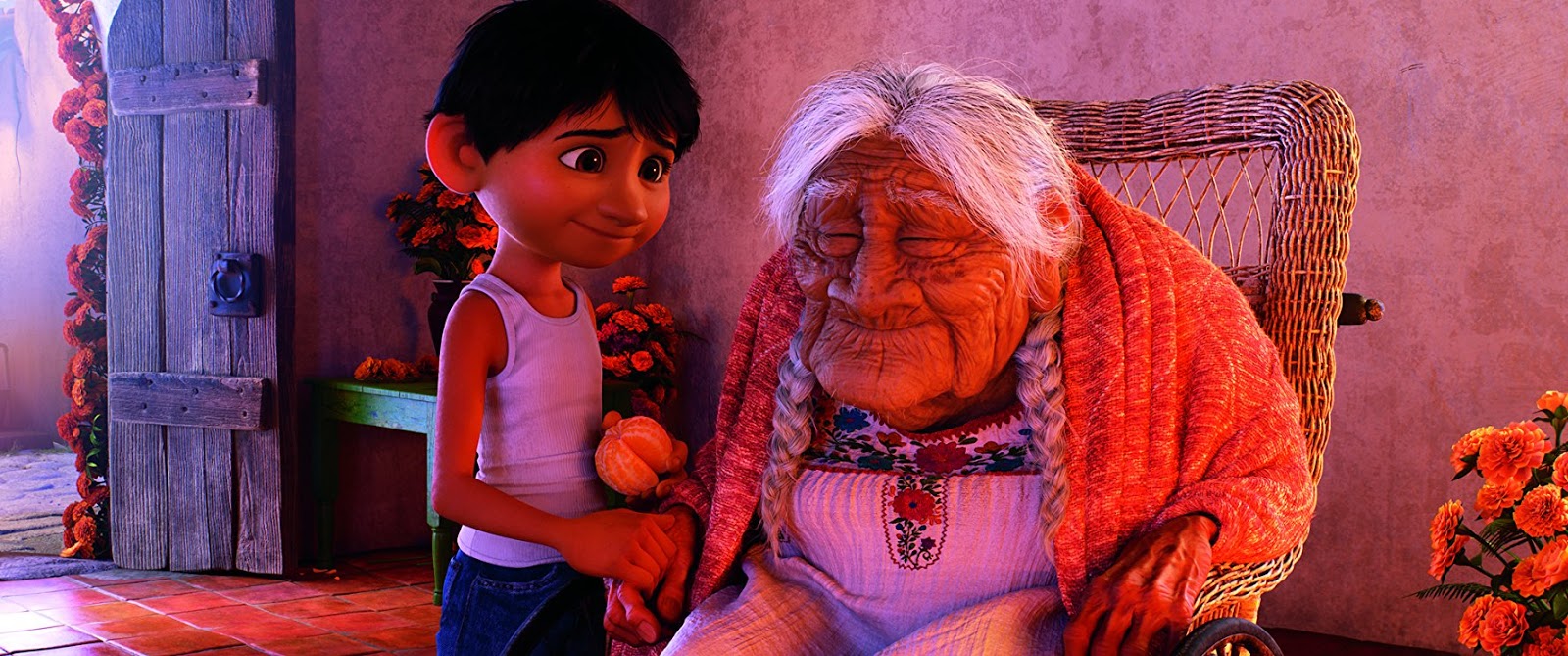
REVIEW: Coco


I know, this is over a month late, but Coco honestly couldn't have come out at a worse time for me; it released right around Thor, Justice League, The Disaster Artist, and Star Wars, and since then I've experienced multiple holidays, a bout of wintertime sickness, and a bomb cyclone (whatever that is). With everything I had on my plate, I just couldn't find time to get out and see Pixar's latest film until just this week (in what I'm fairly certain was the absolute last showing in my hometown). On the bright side, I'm overjoyed I got to catch this one before it left theaters (unlike some other animated films); I've been a Pixar fan from the day I was born, and it always feels weird whenever I miss the theatrical run of anything that isn't Cars. However, I'm also left with the bittersweet realization that last week's 2017 Retrospective is already outdated. I wish I had seen Coco when it released back in November, or at least before I started compiling my rankings of everything I watched last year. Had I not put it off for so long, I can guarantee that it would have landed right next to Logan as one of my favorite films of 2017; trust me, it's just that good.

Set in the Mexican town of Santa Cecilia, the story follows a young boy by the name of Miguel Rivera (Anthony Gonzales). An aspiring musician in a family of shoe-makers, Miguel dreams of following in the footsteps of his idol, Ernesto de la Cruz (Benjamin Bratt); unfortunately for him, music has been banned in the Rivera household ever since his great-great-grandfather left his wife and child to pursue a career in the music industry. After a family spat on Dia de Muertos (The Day of the Dead, a Mexican holiday where offerings are made to the spirits of departed family members), Miguel finds himself trapped in the Land of the Dead amongst his ancestors; if he doesn't receive a blessing that allows him to return to the Land of the Living before sunrise, he'll be stuck knee-deep in the dead for all eternity. What follows is a colorful, emotional adventure that explores the messy, complicated relationship between familial responsibility and duty to one's own dreams and passions.


I'll admit, I wasn't exactly excited for Coco in the months leading up to its release. The character design didn't thrill me (particularly the choice to add eyeballs to the skeleton characters) and the plot seemed extraordinarily basic for something from Pixar. In hindsight, I wasn't being entirely fair to Coco; it works much better from a visual standpoint now that I've actually seen it in practice (to the point that it might just be the most visually-impressive Pixar film to date) and the story (as I should have expected) had much more to it than your standard "child gets lost in fantastical place, has to race against the clock and learn a lesson" plot. 

It feels like so many movies of 2017 (even ones I've enjoyed) run into the same problem of either falling into a painful slump during the second act or outright losing all steam by the time the climax rolls around; Coco, it seems, has the opposite problem. This is a film that takes quite a bit to properly get going; until Miguel enters the Land of the Dead, I was honestly getting a bit worried. The film opens with an upbeat first-person narration that doesn't return at any other point in the story, so it ends up feeling like it's specifically addressing the kids in the audience who don't know anything about Mexico. It comes off as so cheery and overly-earnest that it comes dangerously close to crossing the line into "anyone over the age of 12 is going to feel embarrassed to be watching this" territory, but that luckily all changes once Miguel is flung into the afterlife. From that point on, the film only gets stronger as it goes, culminating in one of the most emotionally-resonant third acts I've seen all year. Again, I'm referring to the same year that gave us Logan, so keep that in mind.


Despite its almost overly-kid-friendly opening, the atomosphere of the movie matures alongside its protagonist. Miguel starts off as a rambunctious, impudent kid; at 12 years old, he's right on the verge of casting off childish flights of fancy in favor of more adult responsibilities, hardly a smooth transition for most young people. The idea that, sometimes, you can't be whatever you want to be is a bitter pill to swallow, especially when it feels as though your own family is standing in the way. The conflict between Miguel wanting to become a musician and his elders wanting him to take up the family trade isn't exactly the most original, but it's how it's handled here that makes it stand out. Unlike The Last Jedi, this is a movie where characters actually sit down and talk with one another; both sides make valid and flawed arguments, and sometimes they don't reach a consensus that makes everyone happy. It's not an ideal situation, but the emotions at play make it a relatable one; whether or not we agree with these characters' stances, we can 100% understand and sympathize with how they came to these conclusions, and that attention to detail makes all the difference in the world.

As the plot continues and the tone grows more somber, we see the shift in Miguel's priorities (as well as those of his ancestors, who want nothing more than for him to give up his dream of being a musician and return safely to the Land of the Living). Every character has a lesson to learn, so the message of the story never feels one-sided. We don't get a moral that reads like a lecture ("Always listen to your elders, they know what's best for you"), but we also don't get a moral that feels like a cynical appeal to a sense of prepubescent rebellion ("Up yours, old man! What the world really needs is to learn how to dance!"). Instead, we get something more in the middle; you should always be willing to do anything for your family, but your family should never be willing to let you give up on your dreams. Instead of feeling wishy-washy, it strikes just the right chord, presenting two flawed-yet-understandable arguments and reconciling them in classic Pixar fashion.


I suppose I should talk about what inspired me to give Coco a watch after over a month of procrastination. While I was off seeing Justice League like a sucker, my compatriots at The Long Run Podcast went to see Coco (side note, fellas, what gives? Y'all had a month-long head-start on me and I put out my Coco Review first? Get it together). Their reactions floored me; here I was, looking at a movie I expected to measure up alongside Pixar's more lukewarm entries like Brave and The Good Dinosaur, only to be told that this was the most emotionally-impactful Pixar film since Toy Story 3. That this movie contains scenes as tear-jerking and sob-inducing as the first 5 minutes of Up. That, not only was this one of the best films Pixar has ever put out, but that it was one of the best films of the year. So yeah, high praise.

I entered the theater, expecting some of those good ol' Pixar feels. I left not-quite two hours later, whistling mariachi music and trying to hide how hopelessly bleary my eyes has become. I need to reiterate, this is not your stock plot about an average kid who no one understands. This is a tale about life, death, family, tradition, and legacy. It's a story about how what we amount to, at the end, is the memories we leave behind with those we've loved in life. Coco pulls no punches and goes right for the jugular; when you're sitting there during the third act, quietly weeping into your popcorn, you can rest easy knowing that Lee Unkrich and company have earned every single teardrop.


I won't mince words; Coco is my second-favorite film to come out in 2017 and I hate that I procrastinated so long in seeing it. It's a true masterpiece, one of Pixar's best (which, despite a few less-than-stellar entries, still remains high praise for any animated feature). The music is incredibly well-crafted, even by Disney standards (and then there's Remember Me, which is so thematically brilliant it's on a whole other level). And that's to say nothing of the art direction and animation, which is just spellbinding to look at, bursting with vibrant colors and liveliness. I'm not sure if this is standard for all screenings, but there was a lovely little bumper before the film began in which several of the filmmakers showcased how much work it took to animate certain shots and sequences, before thanking all of us for coming out to see Coco in an actual movie theater. It really offered some insight into the process of modern animation and helped remind me that, even though Disney is a company with essentially bottomless resources, movies like Coco are still the cumulative result of mountains of individual care, effort, and imagination. 

If you haven't seen it by this point, I'm afraid you might be out of luck for a theatrical screening (like I said, I just happened to luck out and catch the final show in my neck of the woods), but in hindsight, I'd say that Coco is worth the effort. If you can find a theater that's still showing it, take the journey and settle in for a lovely time. I came away from it feeling like I did after seeing Inside Out; in that it gave me a good cry that I didn't know I needed to have until I'd had it, and I feel like that's the true magic of Pixar movies. To clarify, this isn't a good movie because it made me cry; the same result can be achieved with a swift kick to the groin or a hefty ball of wasabi. No, Coco is a good movie because it earns its emotional response without feeling cheap. You can get cheap tears as easily as you can get cheap laughs; it's sad when an animal dies in the same way it's funny when Melissa McCarthy falls down some stairs. But when we have a genuine, emotional reaction to the experiences of the characters on screen; when we form a connection to what we're seeing and these fake, imaginary people cease to be cartoon characters and become real, that is when you can rest assured that true artistry is taking place.

November 1, 2016

REVIEW: The Worst Witch


I wasn't entirely sure how I was going to spend this Halloween. It's easily my favorite holiday, so there's really no telling what manner of merriment I could find myself wrapped up in like so many toilet paper mummies. I can, however, tell you the one way I didn't expect to be spending my Halloween, and that's sitting at home watching the 1986 made-for-TV movie, The Worst Witch. I really don't know what to classify this as, exactly. Don't get me wrong, it's awful, but that doesn't mean that I'm not going to break this out every Halloween from now on. It's so terrible it may have just become a tradition.

The plot follows Mildred Hubble (Fairuza Balk, in what I like to pretend is a prequel to The Craft), a student at the prestigious Miss Cackle's Academy for Witches. A thoroughly mediocre student to begin with (some might even call her the WORST witch), her life is anything but charmed (no pun intended). To make matters worse, she's constantly antagonized by a particularly nasty teacher, as well as a snobbish blonde rival. Students at this school for witchcraft and wizardry partake in potions class, as well as flying lessons taught by an instructor who wears goggles while riding her enchanted broom. The only people who seem to give Mildred a break are her dim, goofy best friend and the eccentric old headmistress of the school, and it was right around this point that I started to wonder if J.K. Rowling is actually a humongous thief who pilfered all of her ideas from a comically bad children's special that aired on HBO in the mid-80's.


While there's bound to be some overlap when it comes to the concept of "magic boarding school", it's honestly uncanny how many similarities there are between The Worst Witch and the Harry Potter series. The scenes that take place during the flying lessons are especially flagrant, since they look like they take place in practically the same castle courtyard we saw in Sorcerer's Stone. Now I'm not saying that one series stole ideas from the other (if anything, I'm vaguely implying it at best), but it's amazing when one considers the similarities, not just in terms of aesthetic, but in terms of story structure.

Both series feature a scene where a character goes surfing on a broomstick. Both series have scenes where the mean blonde kid is turned into an animal as a form of comeuppance. Both series have a magical villain (with a crazy, over-the-top underling) who is defeated by a seemingly innocuous spell. Both Mildred Hubble and Harry Potter are given honors by the headmaster in the Great Hall. I can't get enough of it. One would think that it would be easiest to draw parallels between Harry Potter and all of the Potter contemporaries; your Spiderwick Cronicles or Twilight or Series of Unfortunate Events. But no, the thing that it all bears an uncanny resemblance to is an 80's kids' movie where Tim Curry plays a tambourine in a technicolor wingsuit.


Yes, Tim "Frank-N-Furter" Curry is in this, playing the unfortunately named "Grand Wizard". He claims he has a lot of gigs to get to on Halloween and we can only hope none of them involve cross burnings in the deep south. We also have Dianna Rigg (The Avengers' Emma Peel/Game of Thrones' Olenna Tyrell, depending on your generation) as the slightly-less-unfortunately-named Miss Hardbroom; as one might surmise from her name, she's the Dean Wormer to Fairuza Balk's Delta House. She's normally so darn endearing everywhere she goes, it's genuinely fascinating to watch her play the part of a frigid old ice queen. You end up hating her, naturally, even though a part of you just doesn't want to. We also have Charlotte Rae of Diff'rent Strokes/Facts of Life fame, pulling double duty as Miss Cackle and her evil twin sister, Agatha. One is a perpetually flustered old woman with little to do, the other is a neon nightmare that sounds halfway between Wynonna Judd and Bruce Springsteen. I can't say everyone was good, nor can I say everyone was bad. I honestly don't know what kind of performances these actors gave. All I know is I was transfixed from start to finish.


The Worst Witch is an amazing piece of innocent schlock. The production value is laughable, the story is practically nonexistent, and the songs are the equivalent of a clown getting launched into a vat of acid; you don't really want to laugh, but you just can't think of any other way to process what you're feeling. I feel confident in saying that this is to Halloween as The Star Wars Holiday Special is to Christmas. The only core difference is The Worst Witch is about a half hour shorter, making it intrinsically better by default. Remember, anything can happen on Halloween. Even a couple of particularly stiff cocktails and a viewing of The Worst Witch. It's by no means ideal, but there's definitely worse ways to celebrate.

May 19, 2016

REVIEW: Goosebumps


Having been born in the 90's, of course Goosebumps was a staple of my personal library all throughout childhood. The books were more cheesy than scary, sure, but the series still served its purpose well as a more macabre alternative to The Mouse and the Motorcycle or Super Fudge. Though the covers were often misleading, the black humor and twist endings filled the same niche as Tales from the Crypt or The Twilight Zone; a niche that I feel is woefully underpopulated these days. It's the reason why I champion films like Trick-R-Treat and Krampus so vehemently, as they harken back to a time when horror could be almost joyful in how absurd and inventive it was. Children's horror in particular is a subgenre that is all but devoid of modern entries; it's the reason why 2015's Goosebumps movie brings me such unironic joy.

The plot plays out like a classic Goosebumps novel, as we find our average teenage protagonist (Zach, played by Dylan Minnette) and his recently-widowed mother (Amy Ryan) moving from New York City to the quiet suburb of Madison, Delaware. As is par for the course in these stories, Zach ends up meeting his mysterious new neighbors, a young girl named Hannah (Odeya Rush) and her aggressively reculsive father, "Mr. Shivers" (Jack Black). Surprise surprise, it turns out that Shivers is actually Goosebumps author R.L. Stine, who possesses the ability to create monsters so lifelike, they literally jump right off the page. After his creepy creations are released from their manuscripts by Slappy (the talking ventriloquist doll from the classic Night of the Living Dummy), it's up to Stine and the kids to set things right and put the monsters back on the shelf where they belong.


When one imagines a Goosebumps movie, the plot is obviously going to be the first (and likely biggest) hurdle. There are countless books in the series, and none of them are particularly long or dense enough to fill in for a feature-length movie. Rather than go for the anthology approach à la Twilight Zone: The Movie, the writers instead decided to combine all of Goosebumps into one universe. It's a stroke of genius, making the film into a complete celebration of the series as a whole. If I have one criticism of this approach, it's that the selection of classic Goosebumps monsters on display feels a tad handicapped by the budget. While Slappy is the main antagonist of the film (which makes sense, considering he's arguably the most iconic character from all the books), a number of the more recognizable creatures (such as Carly Beth from The Haunted Mask or the Pumpkin Heads from Attack of the Jack-O-Lanterns) are relegated to blink-and-you'll-miss-it cameos. These cameos are appreciated nonetheless, but considering how many inventive ghouls the Goosebumps books featured over the years, it's a bit of a downer that the most screentime goes to comparatively standard beasts like the Werewolf of Fever Swamp and the generic zombies from Attack of the Graveyard Ghouls.


Everyone gives solid performances here, but it's Jack Black who truly steals the show (playing not only R.L. Stine, but also providing the voice work for Slappy and the Invisible Boy). It's the most over-the-top caricature of a horror author ever; if this whole movie is one big cheesy Goosebumps book, then Black captures the part of the creepy neighbor to a T. Everything he says is delivered by way of rapid, intense, room-volume whispers, and his acting to the rafters provided the most consistent crack-ups the film had to offer. His turn as Slappy also has me convinced that he'd make an excellent Joker; while his Slappy voice veers a tad too close to his Stine voice at times, the man has an excellent laugh and gives a performance that is anything but wooden (I'm sorry).

I really have to applaud the tone of this film as well; I completely expected something more from the Jem and the Holograms or Inspector Gadget school of adaptation. Essentially, something that was made because a studio had access to a license that could be cheaply attached to a mediocre kids' movie. Instead, I got something with way more effort than I was expecting. Sure, not every joke hits (you've gotta have a fart or reference to YouTube in there, lest the kiddies get bored), but it's for the most part very self-aware. I can safely say I didn't expect this movie to make me laugh as much as it did (nor did I expect that many Stephen King jokes). The ending in particular is excellently cheesy, cementing my belief that this movie is nothing more than a big, new Goosebumps book written for the screen, rather than the page.


If you grew up with Goosebumps as so many did, you'd be doing yourself a disservice not to check this out. It's by no means perfect, but it feels like a welcome throwback to a simpler time. Had this been released back in the 90's when the books were at their peak of popularity, I have no doubt that Goosebumps would be remembered fondly alongside such films as Gremlins, The Goonies, and The Monster Squad. While it doesn't quite have the bite of the childrens' horror of the past, the fact that this film is as good as it is feels like a step in the right direction. It's a modern entry in an endangered genre, a unique and imaginative use of a nostalgic license. The people who made this clearly cared about what they were doing, and that's definitely something to be encouraged and applauded.

October 29, 2015

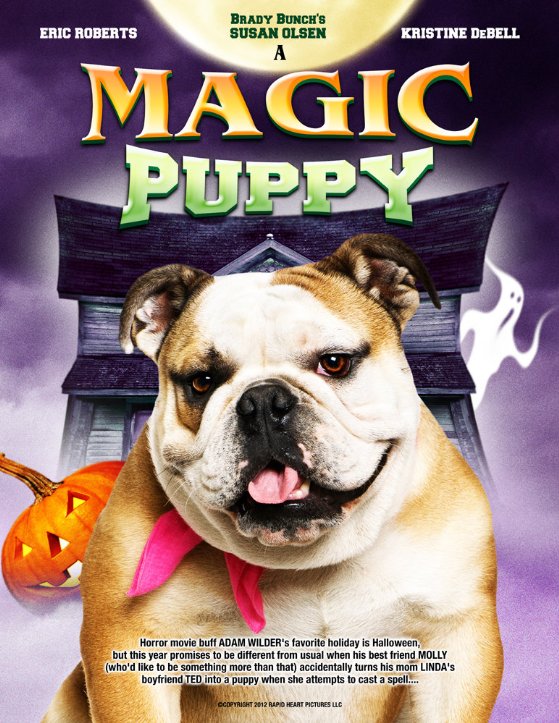
REVIEW: A Magic Puppy


I honestly don't know where to begin with this. If you had just experienced what I did, you wouldn't either. I'm one of those people that can appreciate a really bad movie. Even something like The Room has its purpose within the annals of cinematic history, even if it's just as a massive joke. But every once in a while, a film comes along that shakes this belief of mine to the core. A film that makes me question my outlook on the medium, as well as my own sanity. A film that makes The Room look like Taxi Driver. When I dove to the bottom of the Halloween Favorites category on Netflix and decided to watch A Magic Puppy, I didn't realize that I was about to watch one such film.

I hesitate to use the word "plot". The word "plot" suggests some form of structure; a story born from a writer's mind after a kind of creative spark fired through their synapses and inspired them to put pen to paper. A tale that, once imagined, simply begged to be told, to be born unto this world by way of the art of cinema. No, what A Magic Puppy has, in lieu of a plot, is an idea. Not even a good idea, but an idea nonetheless. That idea is, "Eric Roberts turns into a dog". Yes, that Eric Roberts. "Mongul from Justice League, Sal Maroni from The Dark Knight" Eric Roberts. When he's not a dog, he's wishing he was in a different movie. When he is a dog, he provides a voice-over that makes me want to buy him a hot meal. This movie serves to do nothing but make me depressed.


Every single thing here is wrong. This entire movie is an exercise in unpleasantness. I'm honestly finding it difficult to verbalize my displeasure here, this is just the worst thing I've ever watched. I wish I could just end this review at that, but I feel like it would be something of a cop-out. That raises the question, is A Magic Puppy worth the time I would spend writing a legitimate review? Is it worth your time to read whatever I write? These are the kinds of questions a person begins to ask themselves after they survive a near-death experience or watch A Magic Puppy.

I'm a firm believer in the idea that the worst thing a film can be is boring; A Magic Puppy is most definitely boring, but the filmmakers went out of their way to make sure it covers all the other worst things a film can be while they're at it. This entire movie appears to have been shot on a handheld; the frame wobbles about, the microphone picking up footsteps and ambient noise. It makes you wonder what poor fool managed the bad luck of not only being involved with this production, but also being cheaper than a tripod and an external microphone. Everyone here gives an awful performance, even the dog. The opening sequence is five solid minutes of stock Halloween music over animated clip-art and stock dog photos; several of the images are clearly just pictures of Bela Lugosi with his eyes and mouth edited out. This is the level of artistry A Magic Puppy establishes right from the get-go.


If you're wondering where Halloween comes into all of this (considering it's so prominently featured on the poster and opening credits), the movie takes place roughly around Halloween. The main kid who looks and acts just like Justin Bieber (ie. totally unappealing in every way) enjoys Halloween to the point that he's still planning to go trick-or-treating despite appearing to be in his early 20's. His girlfriend also dabbles in Paganism as a "hobby". I was going to say that the best thing I could say about this movie is that it wasn't offensive in any way, but I'd be lying. This is a picture that is constantly at war with whomever dares watch it, doing its absolute best to make the audience regret their decision to press play. The writing is clunky, redundant, and nonsensical; the only remotely strong piece of dialog is lifted wholesale out of Army of Darkness. Apparently the writer loved Army of Darkness enough to blatantly steal the "Klaatu, Verata, Necktie" bit, but not enough to properly pronounce "Necronomicon" (here referred to as "neh-crow-muh-con").


A Magic Puppy is a hateful film. Take the amateur camerawork, inane script, and lifeless performances from a mediocre porn flick, remove the sex, and add a puppy. I despise this film with everything that I am and I can't help but feel that the film feels the same way about me. Only something with a malevolent consciousness could have wrought such a film upon the world. If you're looking to hurt yourself this Halloween, skip the razor-bladed candy apples and just watch A Magic Puppy.

October 15, 2015

REVIEW: Sleepy Hollow


It's a shame that these days I find myself almost wanting to refer to Tim Burton as a "guilty pleasure" of mine, considering his work used to be so genuinely good. Looking at his filmography from the 80's and 90's, it's clear that the man was an artist who, like George Lucas, should never have been allowed access to a computer. Because his catalog of work is so black and white (both literally and figuratively, in some cases), I really didn't know what I was going to get when I decided to watch 1999's Sleepy Hollow.

Taking place at the end of the 1700's, the film follows Constable Ichabod Crane (Johnny Depp) as he attempts to solve the mystery of a series of grisly beheadings plaguing the quiet village of Sleepy Hollow. Upon arriving and familiarizing himself with the town's influential citizens (all played by fabulous British actors and Jeffrey Jones), he is told that the culprit behind the killings is none other than the Headless Horseman (Christopher Walken), the vengeful spirit of a ruthless Hessian mercenary who was killed during the American Revolution. With more and more townspeople turning up headless, it is up to Crane and a young orphan named Masbeth (Marc Pickering) to get to the bottom of things and restore order in the Hollow.


Right off the bat, the movie looks fantastic; if there's one thing Tim Burton knows, it's visual design. Aside from a few instances of poorly-aged CGI, the film is by and large a tremendous treat to look at. Burton's use of washed-out backgrounds with contrasting elements of color make for a great Gothic aesthetic, perfectly establishing the tone and time period. It's not fantastical enough to feel like a fairy tale, yet not grounded enough to look like an account of history; it's the ideal balance for the look of an American folk tale taking place in the late Autumn. Danny Elfman's score works in perfect harmony with Burton's visuals (as always) to immerse the viewer in the story being told.

That said, it's worth noting that Burton had nothing to do with the screenplay; visuals can only go so far, and while the story is both interesting and engaging, the script tends to be a little muddled here and there. Names and titles are dumped out with such fervor that we hardly have time to match them to a face. Aside from Crane and Katrina (Christina Ricci), the entire cast is totally static and given no amount of characterization. Despite the artful visuals, this is, at its heart, a simple slasher film. Outside of the protagonist, everyone else is merely a prop for the Horseman to potentially behead while Ichabod scrambles to solve the mystery. Speaking of, I do wish that the mystery of the Horseman was kept unsolved for longer than it was; at first, no one is certain whether or not the killings are in fact supernatural in nature or not. It's established that it is possible for an average man to dress up as the Headless Horseman and chase people down, so it may or may not be a genuine haunting. However, the question is explicitly answered less than halfway through the runtime; granted, another mystery is raised in its place, but I really enjoyed the mystique that followed the Horseman legend.


The Horseman himself is a cool, if not particularly deep, villain. He's got a threatening presence about him when he hasn't got a head, though I find Christopher Walken to be an odd casting choice. He still looks like Christopher Walken, so it gets to be distracting when he shows his face. Furthermore, he doesn't do much acting aside from baring his teeth and going "AAAARRHHH"; the Headless Horseman does not have a single non-yelling line in this entire movie, which is a shame considering he's easily the most fascinating element of this entire movie.

On the other hand, Johnny Depp is by far the highlight here. While the other members of the cast all do well (particularly the cabal of town leaders played by Michael Gambon, Richard Griffiths, Ian McDiarmid, Michael Gough, and Jeffrey Jones), none of them hold a candle to Depp. He completely disappears into the role of Crane, coming off as inquisitive and hilariously cowardly while thrust into the role of protagonist. It's a credit to Depp's talent as an actor when one compares his role as Ichabod Crane to a character like Jack Sparrow. While his attempts at comedy all work (mainly because they're for the most part subtle), the rest of the film doesn't fare as well; there's several moments where the excellent tone is completely shattered by some odd attempt at humor. For example, there's an otherwise great scene where Ichabod witnesses the Horseman murder someone right in front of him. As the Horseman's sword connects with his victim's neck, the head spins around comically before rolling down a hill and landing mouth-first over Johnny Depp's crotch. It's kind of baffling that a scene with such a strongly-established tone would be interrupted by a bizarre attempt at comedic relief in a film that doesn't really require it at all.


Despite a few cracks in the otherwise stellar tone and a somewhat bland script, Sleepy Hollow is still an entertaining time. It's an interesting mystery showcased within a masterfully crafted Burton aesthetic; while it's not particularly deep, it's manages to be an enjoyable slasher flick with a really fun Johnny Depp performance. If you're looking for something to watch that compliments the fallen leaves on the ground outside, you could definitely do a lot worse than Sleepy Hollow.

October 1, 2015

REVIEW: The Monster Squad


I absolutely love October. Thanks to Halloween, we get an entire month of candy and costumes and horror movies, all before Christmas begins to loom over us like the holly jolly monolith it is. To celebrate, I've decided to review something appropriately spooky each week of the month, starting with a cult gem from the 80's, The Monster Squad.


The plot plays out like a Goonies Halloween Special; a group of kids obsessed with classic monster movies come into the possession of the diary of Dr. Abraham Van Helsing. The book describes a magical amulet with the power to cast the forces of evil into Limbo; naturally, the aformentioned forces of evil want to get their hands on it. Count Dracula (Duncan Regehr) assembles a crack team of creatures, summoning Frankenstein's Monster (Tom Noonan), the Wolfman (Carl Thibault), the Mummy (Michael MacKay), and the Gillman (Tom Woodruff Jr) to help him retrieve and destroy the amulet. Truthfully, the technical aspects of the story don't hold up in the slightest. Was the Wolfman just a normal guy before Dracula appeared, or did he always know he was a dormant werewolf? Why doesn't Dracula have an accent of any kind? Was the Gillman just hanging out in that lake for the past however many years until Dracula summoned him? He gives Frankenstein's Monster life and threatens the Wolfman with a silver cane, but why do Mummy and Gillman obey him? There's a lot to nitpick with this one, but if you're nitpicking The Monster Squad, then I'm afraid you've missed the point entirely.


This is by no means a profound or groundbreaking film; one of the protagonists is literally referred to as "fat kid" half the time and the magical amulet is about as oddly specific as a plot device can get. However, the picture more than makes up for it in sheer amounts of fun. Every little thing about this movie is totally endearing, from the surprisingly competent child actors to the classic look of the monsters. The special effects range from fantastic creatures made by Stan Winston to charmingly classic bats on strings. The set design takes us everywhere from suburban streets to Gothic haunted houses and castles. It's like if someone made a movie based entirely off of the Halloween decorations found in an elementary school classroom, it's just classic spooky fun. It manages to be a complete and utter 80's time capsule while feeling somehow timeless altogether.


The Monster Squad is just a delightful movie from beginning to end. While it doesn't have much to offer in terms of depth, I feel it's definitely worth its weight in fun. An often overlooked throwback from a time when childrens' movies were full of blood and swearing, The Monster Squad is an all-around good time; if you're looking for something more kooky than spooky this Halloween season, I highly recommend you give this one a watch.