Showing posts with label romance. Show all posts

August 27, 2018

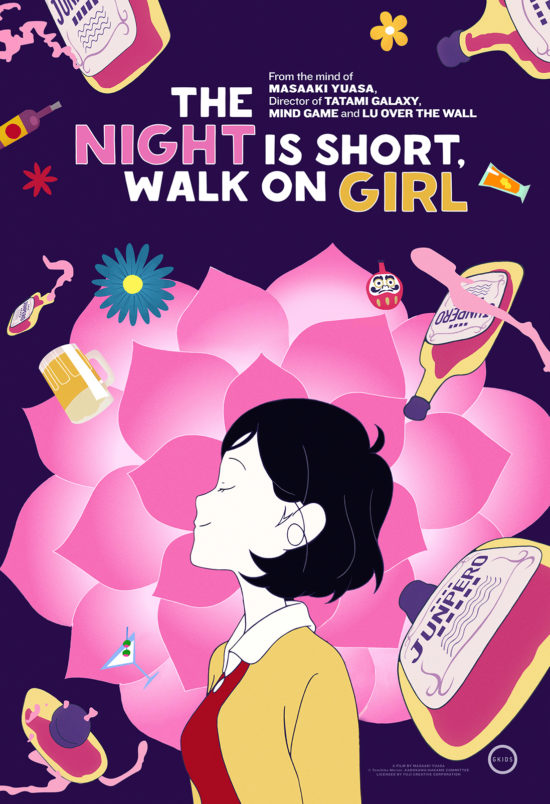
REVIEW: The Night is Short, Walk On Girl


For as much as I like to say I enjoy anime, the irrefutable truth of the matter is that I'm basically just a novice; I've watched Fooli Cooli and Gurren Lagann  a couple of times and I'm currently enjoying My Hero Academia, but it's safe to say that there are vast parts of the medium that I still need to explore. I was, for example, completely unfamiliar with the work of Masaaki Yuasa; that is, until I decided to check out The Night is Short, Walk On Girl (loosely adapted from the Japanese novel of the same name). I saw the trailer on Facebook just by chance (or perhaps it was fate), but the fluid animation, whimsical art design, and catchy music told me that I just had to go check this one out (especially since it would be in US theaters for two nights only). 90 minutes later and I'm not only convinced that I need to seek out the rest of Yuasa's work, but that The Night is Short, Walk On Girl is my personal pick for the best movie of 2018 (even though it was technically released in 2017, though only in the UK and its native Japan).

The plot is, shall we say, difficult to describe. This is one of those situations where I feel as though I'd be walking a fine line between describing the premise and simply recounting every scene; it's very much like Alice in Wonderland or The Wizard of Oz, where our protagonists move from situation to situation, encountering a host of unique characters as they go on their journey. The film follows a nameless girl with black hair (typically just referred to as Otome, the Japanese word for "maiden", and voiced by Kana Hanazawa) on a night of heavy-drinking through Kyoto. Meanwhile, a similarly nameless classmate of Otome's (referred to as Senpai, voiced by Gen Hoshino) is determined to confess his feelings towards her on this fatefull night. As he explains, he's implemented a long-term plan of crossing paths with Otome as often as he can manage, under the guise of their encounters being sheer coincidence. When the time is right, he will reveal his true intentions and it will seem as if the two had always been intertwined by the red string of fate. What follows is a delightfully charming, psychadelic rom-com that utterly annihilated my expectations in the best sort of way. This is just one of those movies that feels like a vivid dream, boasting the kind of atmosphere I'd like to curl up inside of for the rest of my life.


While the movie is, aesthetically-speaking, undeniably gorgeous, the real draw for me was the thematic subtext underneath it all. This is one of those films that focuses in on that sort of "quarter-life crisis" that twenty-something college students tend to go through. We've seen so many coming-of-age stories, but what happens after the protagonists have already grown up before the plot truly began? We're told from high school onward that we're "young adults", but that feeling honestly didn't kick in for me until after I'd completed my undergrad, got a job, and moved into a place of my own. For those who go right from high school into college, the question of what comes after is something that really starts to weigh on you after you get acclimated. We act like the transition from high school senior to college freshman is a massive change, but it's really nothing compared to spending the first 22 years of one's life adhering to a more or less consistent system of schooling and socializing, only to finally cross the finish line into the stage of your life when you have to start thinking about taxes and rent and insurance. You get your degree, then what comes next? Graduate school? A career? Or just another job to pay the bills? Should you get married? Start a family? Buy a house? Do you even have the means to do any of those things? These are all the questions you start to mull over as you begin to fully and finally transition into the adult world, and said questions tend to weigh heavily on the minds of chronic over-thinkers like Senpai (or myself, for that matter).


The character of Senpai manages to transcend the usual "awkward nerd who's hopelessly smitten with the girl of his dreams" trappings by really delving into his mindset. He isn't just another gawky buffoon in pursuit of his manic pixie dreamgirl; he's insecure to the point that he outright questions if he even deserves to have his insane plan work out, or if it would be more fitting that he just shrivel up and die alone. He's become accustomed to failure, putting up walls to protect himself from the terrifying idea of what might happen if he actually gets what he wants for once, the only outcome he's completely unprepared for. Otome, meanwhile, is in the exact opposite situation; she's naturally talented at everything she tries, resolved to simply go with the flow and see where the night takes her. While she hardly has to put in any effort in order for things to go her way, she's left with a life that, compared to Senpai, lacks any semblance of drive, ambition, or purpose. The film establishes that her easy-breezy attitude towards life tends to leave those around her in the dust, leaving her with her own kind of loneliness to deal with. They're two sides of the same coin, yin and yang, but that doesn't mean they don't need to grow and change in their own ways before they're fit to be together.

The film hypothesizes that who we are is but an amalgamation of those we meet in life; whether we know them for the rest of our days or just for one drunken evening, the impact and influence they leave us with is what determines who we are and how we grow as people. The emotions these people inspire and the stories they leave us with are the things that life is made of. Feelings of isolation, loneliness, and disassociation are hardly rare for young people, especially those who find themselves in the midst of a great transitory period in their lives, and The Night is Short, Walk On Girl goes to great lengths to remind us that no man is an island. Whether you believe in fate or not, your existence is immutably intertwined with those around you (and even those you've yet to meet). We're all players in the funny, tragic, oddball play that is the human race; everyone matters, no one is truly alone, and happiness will always inevitably win out over nihilism.


Although it's obvious that the underlying motifs this movie set forth resonated with me on a deep emotional level, I want to make it clear how much I adored everything else in this movie. Like I said before, the animation is absolutely stunning (putting Masaaki Yuasa on my radar in a big way) and I really love the use of color and sound to establish a sensory experience that's at the same time fantastical and immersive. As the night goes on, an entire year seems to pass; we begin on a warm spring evening, transition into summer heat, and by the time the climax rolls around, all of Kyoto is stuck inside with the flu as unforgiving winds and snow rip through the empty city streets. I also found myself surprisingly invested in the stories of the various side-characters Otome and Senpai come across, absurd as they are. My personal favorite would have to be Don Underpants ( Ryƻji Akiyama), a writer and hopeless romantic who has pledged to not change his underwear until he reconnects with a girl he had a fated encounter with some time ago. At first we assume he's just there for a one-off joke about his self-appointed nickname, but then he shows up again much later on, setting up guerrilla plays at the student festival as a means of attracting his mystery love's attention. These side-characters are all bit players compared to our two main leads, but their stories are told in such a way that it truly feels as though the plot thread doesn't end the moment they walk off-screen. We really get the feeling that this isn't just an extraordinary night for Senpai and Otome; everyone has their tale to tell, and that's really the entire message of this movie in a nutshell.


The Night is Short, Walk On Girl is really just a remarkable little movie. It's a surprisingly conventional, feel-good love story that's conveyed in the most unconventional of ways; pair that with sublime animation, supremely comfy atmosphere, a killer soundtrack, and loads of endearing and memorable characters, and you've got a winning recipe for my personal favorite movie of 2018 thus far. Yes, I know, it technically came out in 2017 everywhere but the USA, but I'd be outright lying if I said that, out of everything I've seen in theaters this year, The Night is Short, Walk On Girl wasn't my favorite. If it wasn't clear already, I absolutely adore this lovely, lovely film and would like nothing more than to just immerse myself in all the charm and good vibes it's constantly putting out. If you're a fan of anime or animation in general, you owe it to yourself to give this one a watch.

March 4, 2018

REVIEW: The Lobster


Dry humor is, generally speaking, a really tricky beast to pin down. I don't like to use the phrase "hit or miss" when describing my preferences, since I usually like to fall back on some kind of gold standard, but dry humor is just one of those things that, for me, can only go one of two ways. Either it works or it doesn't; maybe I'll still be able to appreciate what the creator was going for, but it's definitely far from a sure thing for me. Films that take this approach with their tone often run the risk of feeling as though they're trying too hard, as though everyone involved isn't confident enough to find their own, properly-weird kind of weirdness to make it all come together. It requires the filmmaker to take advantage of every detail that defines film as a medium (from the cinematography, to the performances, to the sound design) to sell humor that's presented in an unconventional way; to make the unnatural feel natural in its own unnatural-ness. While it's definitely a genre with its own conventions, it can still be a challenge to do properly. For anyone seeking an example of this style of comedy done right, look no further than 2015's The Lobster.

Directed by The Killing of a Sacred Deer's Yorgos Lanthimos, The Lobster follows a recently-single man named David (played by Colin Farrell, as one of the few named characters in the film). After his wife leaves him for another man, David checks himself into a hotel in hopes of finding a new partner. As the hotel staff explain, David has 45 days to find someone new to fall in love with; if he fails, he will be turned into an animal of his choosing (he decides on a lobster, which the hotel staff assure him is an excellent choice). If this plot sounds the slightest bit absurd, that's because it is, and the entire movie reflects this in its every detail. There's an underlying surreality to everything that happens here, making it perhaps not the easiest watch for your casual moviegoer. I adored nearly everything about it, but this is definitely not the kind of film I would put on at a party (then again, I suppose that depends entirely on what kind of party we're talking about here). There's a lot to unpack, subtextually-speaking, which is one of the reasons I loved it so much.


The film acts as a biting bit of social satire, offering up an all-too-relevant critique of the way society treats the idea of being in a relationship. If you're an adult who hasn't found that special someone yet, you barely qualify as a human in the eyes of society. You're basically an animal. You might as well be dead. The Lobster confronts these ideas with no-holds-barred absurdity and the effect is as deeply resonant as it is frequently hilarious. Couples in the hotel aren't matched up by virtue of their ability to get along with one another or chemistry or anything that real, true romance is made out of. They're boiled (get it?) down to nothing more than a single, base characteristic; one man has a chronic limp, another woman suffers frequent nosebleeds, and John C. Reilly's character has been cursed with a lisp. The clock is ticking and these characteristics are all anyone really has to go off of; there's no natural love to be found among those within the hotel, it's all cold, emotionless, and born out of a desire to not be alone. To not be an animal.

Society dictates that the default end goal for a human being, the one true path to happiness and fulfillment in life, is to get married, settle down, and start a family. When prospective couples in the hotel are on their trial run to test for compatibility, they may be assigned designated children to help resolve any conflicts that arise. This is the level of absurdist dystopia Lanthimos builds for us, a world where children are accessories and relationships exist purely to fulfill a need for sex and security. It isn't so much about finding someone who truly loves and understands you as it is about having a warm body next to yours when you sleep, or an extra pair of arms to help you out if you happen to choke on a bit of food. It's been said that love and death are the two facts of life which dictate our every desire, and The Lobster takes this idea to its logical, sterile, comical extreme.


We often lie to ourselves and others in order to avoid ending up alone (or to avoid ending up with who we think of as the wrong person). There are times throughout the film where David passes up what might be legitimate shots at happiness and fulfillment, instead choosing to focus on pointless minutiae like hairstyles and accents. It's an uncompromising look at the 21st-century dating scene brought to us by apps like Tinder, where any and all personality and nuance is removed from the experience of finding a mate. We see other characters, motivated by fear of ending up alone and becoming an animal, make harsh compromises to ensure they end up with someone, anyone, it doesn't matter who. A very nice widow (played by Ashley Jensen) feels so insecure about her age, she outright offers her body up to David in the hopes that a series of sexual favors between strangers will somehow lead to a relationship. We also see one of David's few friends at the hotel (Ben Whishaw) begin mutilating himself, smashing his face into hard surfaces in order to induce nosebleeds, all so that he can have something in common with his chosen partner; something that makes them "compatible".

For as bad as things are in the hotel, we're also introduced to a colony of loners; hotel guests who failed to find anyone to pair up with and, rather than accept their fate as an animal, decided to flee and establish a commune in the nearby woods. These characters are hunted like sport by the hotel guests (each loner they tranquilize earns them an extra day to find a mate), so we're initially meant to see them as the sympathetic underdogs when compared to the oppressive, conformist horrors that lurk within the hotel. But we soon come to discover that this order of loners has their own set of rules and mores that must be followed at all times; I don't want to spoil anything, but it ends up being a very Fox and the Grapes type scenario. Truthfully, this element exhibits my only real gripe with this film, as it cleanly divides the narrative into two distinct halves, with the majority of interesting story beats and ideas residing in the first half.


Despite this feeling of unevenness, the film still manages to make you care a great deal about these characters. A true testament to both the actors and the writing, as everyone here is giving an intentionally awkward, emotionless performance. They all act like robotic, repressed individuals; you get the impression that everyone is screaming internally, desperate to express some form of genuine emotion without fear of being shunned by those around them. Like I said before, an intentionally awkward tone such as this requires a filmmaker to take advantage of every facet of film as a medium in order to truly leave a bold impression. The cinematography is flat and static, which would be a problem in just about any other movie, but here it compliments the overall tone and atmosphere. We're given a series of beautiful, but awkward shots that linger for just a little too long, at some points giving off some distinct The Shining vibes (which, despite this not being a horror film in the traditional sense, adds an exquisite kind of flair to the overall look of the film).

The soundtrack (care of Johnnie Burn) also adds to the atmosphere, though I wouldn't be surprised if this aspect was a bit more hit or miss with some viewers. It's droning and repetitive, but it also occasionally escalates to something that's downright cacophonous, both punctuating the more dramatic moments and adding a lovely comedic flair to some of the more awkward bits (such as a positively hilarious fistfight out on the hotel's shooting range). All of the awkward, stilted, inhuman moments merely serve to make the few instances of genuine love, romance, and emotion shine all the brighter. It all comes together, bolstering the underlying social commentary and wrapping everything up in a charming, sorrowful, darkly-hilarious package; many will be tempted to write The Lobster off as "weird" and call it a day, but I promise that you'd be doing yourself a disservice to stop there.


The Lobster is a true work of art, through and through. Though some scenes linger on a bit longer than they might need to and the more interesting story beats take place within the first two acts, it's still a fantastically imaginative look at one of the most frequently taken-for-granted aspects of the human experience. Love plays a part in all of our lives (whether we want to admit it or not), hence why this is a film with something to offer for everyone. If you've ever been uncomfortably single or felt disillusioned by the notion of modern love, you owe it to yourself to give The Lobster a watch. It's a film that upholds the idea that love is blind, despite existing in a cynical, material world. If you haven't found the one, there's nothing wrong with you. Though society says otherwise, you are not an animal; and even if you were, it would still be better than the alternative.

August 31, 2017

REVIEW: Death Note (2017)


Death Note might just be the best comedy of 2017. It might sound like I'm joking or just being smarmy, but I simply refuse to believe that the impeccable sense of comedic timing in director Adam Wingard's direct-to-Netflix adaptation of the classic anime/manga series was nothing more than a happy accident. If you want to laugh, and I mean really laugh, then I can't recommend this movie enough. Stop reading, get a nice buzz going, and go watch it right now. If you're looking for a more true-to-the-source adaptation, however, well... I haven't seen or read the original Death Note, but something tells me it's less laugh-out-loud hilarious than what I just watched.

The plot follows the insufferably-named Light Turner (Nat Wolff), a bumbling moron who comes into the possession of a mysterious book known as the Death Note. As the book's keeper, the mysterious death god known as Ryuk (portrayed by Jason Lyles and voiced by the magnificent Willem Dafoe), explains, whosoever has their name written within the Note will die in whatever manner the writer chooses. Things start simply enough, with Light testing the book's capabilities on a school bully (and later the man who killed his mother), but soon escalate, as Light (along with his girlfriend, Mia, played by Margaret Qualley) begin enacting large-scale vigilante justice on terrorists, drug traffickers, and child molesters. Drunk off of their own power, the two hide behind the pseudonym "Kira", painting their school-shooter-esque antics as the work of a mysterious demigod. This attracts the attention of an enigmatic detective known only as L (Lakeith Stanfield), and thus begins a convoluted game of cat and mouse run by some of the most boldly idiotic characters ever written.


The most immediately striking thing about this film is probably the cast, for obvious reasons. In the original Death Note series, Light "Turner" was originally Light Yagami and his father "James" was originally named Soichiro. Really, the only thing that carried over from the original story was Ryuk, and surprise, he's by far the best thing here (though that's moreso due to how wonderful Willem Dafoe is than the obvious ties to the property's Eastern roots). There's been a lot of controversy and criticism surrounding this film, as it's been accused of "whitewashing" a foreign property. This film has a lot of problems, but changing the backdrop from Japan to Seattle is the least of them. It's essentially a non-issue here, especially since Japan does this sort of thing to Western properties literally all the time and no one seems to care. Death Note isn't hilariously bad because Light is played by a white guy or because L is portrayed by a black guy; no, Death Note is bad because the characters are cartoonishly incompetent, the tone is all over the place, and the plot (while a legitimately intriguing concept) thinks it's way smarter and more nuanced than it really is.


Let's start with the cast; Nat Wolff is simultaneously the best and worst thing about this movie. Light is an awful character, a hopeless idiot with a God complex who is way too eager to toy around with the Death Note, a plot device that may as well be made of red flags (seriously, the only way this object could be more of a bad omen is if it appeared to the tune of a Rod Serling monologue). At the same time, he's a major part of why the comedy (both intentional and unintentional) works as well as it does here. Wolff has a knack for over-exaggeration; everything he does, he does to the rafters. When he's meant to be scared, he shrieks like a little girl. When he's feeling edgy, he glares like Anthony Perkins at the end of Psycho. This is a movie that is meant to explore ideas like the frailty of human life and the moral quandry of using death to make the world a better place, yet Wolff treats the whole thing like a mid-90's Jim Carrey vehicle. Subtlety escapes him and the film is better off for it.

Then we have L, played by Lakeith Stanfield. He tries very hard to fill the role of "snarky oddball who is by far the smartest man in the room", yet just comes off like the only non-white kid at a high school anime club meeting. He provides an entirely different comedic angle than Light, rattling off pseudo-intellectual zingers like a preteen who just discovered internet memes and nihilism. He wears a hoodie and face mask that marketing execs might describe as "urban hacker chic" and, for reasons that escape me, perches on every chair he comes across like he's about to frog-splash the Fabulous Moolah at Summerslam. Every aspect of this character, from his appearance to his mannerisms, is meant to make us think "what a mysterious nonconformist", yet he just comes off like the kind of kid that would wear a trilby and cape to class. The kind of kid who claims to be "part of Anonymous" and buys all of his clothes at Hot Topic and Spencer's Gifts. You know exactly the kind of kid I'm talking about. L is that kid.


There's also Mia, a character who, as far as I can tell, is so different from her manga counterpart that she may as well be an original creation altogether. Margaret Qualley actually does a fairly decent job with what she's given, nicely selling that gradual shift from edgy high school girl to total psychopath. This character's issues all lie less within the performance and much moreso within the story; it's made very clear from early on that she's totally unhinged and should never be let anywhere near something as potentially dangerous as the Death Note, yet Light just keeps on trusting her again and again and again. Adolescent lust aside, to any young men reading this, take note; if a girl suggests you use a magical tome to murder your own father, she's probably bad news. You should dump her and cut off all communication, and you should definitely not let her continue using said evil book (that is, need I remind you all, capable of killing literally anyone the user desires).

The only legitimately good part of the cast is, you guessed it, Willem Dafoe as Ryuk. Aside from the base concept, this is the only part of this movie that works as intended; Dafoe is both menacing and mysterious and the film suffers for not giving him a bigger focus. He's not only the best actor performance-wise, he's the most interesting character. You could cut out Mia and L and have the majority of the character interactions be Light dealing with an invisible death god breathing down his neck, tempting him with great and terrible power, and I honestly believe the movie would be stronger for it. The special effects are also quite good for a low-spectacle Netflix release; Ryuk looks perfectly accurate to the source material and the gore is (as far as I can tell) more or less entirely practical. That's one genuine point I can give this movie, it uses its resources well. Ryuk is a great creature design, but he's also kept in shadow and/or out of focus, helping to sell the special effect while creating a sense of atmosphere. The movie stays within its means and understands what it has, so no part of it looks in any way cheap or unprofessional. The Dawson's Creek level cast and cinematography put a damper on things, sure, but for the most part this is a fine-looking mess of a movie.


At the end of the day, would I recommend Death Note? It's stupid, it's silly, and it's altogether an unnecessary cash-grab that really didn't need to be made. It's full of lofty ambitions and bloated subtext, all conveyed through some truly awful performances working off of a truly awful script. Would I recommend Death Note? Yes, absolutely. I know this movie is bad, I know I just tore it apart, and I know the phrase "so bad it's good" gets tossed around a lot these days; so many SyFy Originals aspire to that title, confusing ironic quality with a total lack of effort, but Death Note is one of those few bad movies that truly gets it. A movie doesn't get to be "so bad it's good" simply by being terrible. The viewer needs to feel a genuine sense of effort, that an attempt was made to make something good. The idea that a group of people legitimately tried their best, and this was the result. You have bad movies like Dragonball Evolution, that are bad because not a single person involved cared in any way, shape, or form. They're not "so bad they're good", they're so bad they're bad and the whole thing ends up being a painful experience for everyone involved. But when you get a movie like Death Note, a movie that is a complete and utter (and above all, genuine) mess, you can't help but laugh along at the magnificent failure taking place before you. Death Note is one of the funniest movies I've seen in recent memory and I foresee it becoming an enthusiastic go-to on many a bad movie night to come. By all means, go check it out.

July 15, 2017

REVIEW: The Spectacular Spider-Man


Everyone has experienced the kind of pain I'm about to share with you all. That hopeless longing for the one that got away; that one perfect show that was mercilessly struck down in its prime. Plotlines left unresolved, questions left unanswered, so much potential gone right down the drain. And even though it hurts to remember that such a great story is left without an ending, you keep coming back, again and again, because even though it's unfinished, it's just that good. Everyone has that one show; so what was her name? For me, it was a little cartoon by the name of The Spectacular Spider-Man. It premiered back in March of 2008, on the CW's Kids' WB block before moving to Disney XD after the Marvel acquisition of 2009 (more on that later).

It had been five years since the last animated Spider-Man show (MTV's more teen-oriented take, starring Neil Patrick Harris) and nearly a decade since the classic "spider blood, spider blood, radioactive spider blood" Spider-Man of the late 90's; the webhead was due for a return. Enter Greg Weisman, of Disney's Gargoyles fame. Together with his crew, they set out to make the definitive Spider-Man cartoon, blending elements from classic Lee/Romita/Ditko storylines with the contemporary works of the Ultimate universe. The end result is exactly what they were going for; this is, unquestionably, the best Spider-Man adaptation of all time. If you'll allow me to gush further, I'll be happy to explain why.


Internally, the series was referred to as "the education of Peter Parker", with episodes taking the name of subjects from highschool classes (the first arc, comprised of the episodes Survival of the Fittest, Interactions, and Natural Selection all fall under Biology 101, for example). This approach had a dual meaning, however, as the series not only follows Peter trying to learn and grow as a human being, but as a superhero as well. This is a Spider-Man who, despite his inherent cleverness and upstanding nature, still makes mistakes from time to time, some as simple as missing curfew, others as severe as indirectly giving rise to villains such as Electro and Venom. He's flawed, but he's not hopeless, we sympathize with Peter because he has more on his plate than anyone his age should be expected to handle. It's a classic element of the Spider-Man character and the show goes out of its way to throw us one emotional curveball after another, to the point that the more reserved character drama of Peter's highschool life can at times become more engaging than the slickly-animated action sequences.


The show manages to strike the perfect balance between fresh and innovative and the kind of classic storytelling one might expect from a Spider-Man show. There's a clear reverence for the source material, namely the old-school Amazing Spider-Man comics of the 60's and 70's, yet certain elements (such as the roles, personalities, and ethnicities of the supporting cast) are updated for the modern era, all while keeping the spirit of those classic comics very much alive. As the show's producers put it, "we tried to follow what we came to call "The Five Cs": Contemporary, Cohesive, Coherent, Classic and iConic." Through the benefit of hindsight, the showrunners were able to look back on the decades of Spider-Man stories and determine what was truly essential, boiling down the myriad interpretations of each and every character into their base essence. The result is a concentrated bomb of spider-goodness; despite the modern approach to these classic characters and scenarios, everything feels exactly as it should be. Seldom does an adaptation truly "get" its source material as well as with Spectacular; it's a show that prioritized understanding the tone and characterization of what it was working with, and the result is, well, spectacular.

That said, the show's strengths don't exclusively lie in the realm of engaging characters and plotlines. The art direction (care of Sean "Cheeks" Galloway) lends the show a very smooth, stylized art style that animates superbly well. Spider-Man feels far more lithe and flexible than he ever has before, so the moments where the action ramps up truly feel (as clichĆ©d as this comparison is) like the panels of a comic book brought to life, full of energy and excitement. This is helped along by a superb vocal cast, namely Josh Keaton as Peter Parker. I may alienate some people when I say that Keaton is, without a doubt, the superior Spider-Man. As Kevin Conroy is to Batman, so is Josh Keaton to the webhead. His is a voice that will invade your head whenever you read a Spider-Man comic (or at the very least, one set during Peter's high school years). The rest of the cast is a veritable who's-who of voice acting talent; Clancy Brown, John DiMaggio, Lacey Chabert, Kevin Michael Richardson, Daran Norris, Ben Diskin, Steve Blum, and even the likes of Peter MacNicol, Robert Englund, Keith David, and Ed Asner. Each voice is utterly perfect, further cementing that original vision of making the definitive Spider-Man show. There's also the show's habit of constantly tossing hints and teasers at more comic-savvy viewers; frequently, villains will appear ahead of time in their civilian guise, doing whatever it is they do before the horrible accident that condemns them to a life of villainy. It's touches like these that really make the show feel alive, as though episodes don't necessarily start and end with the supremely catchy theme song. Even aside from being an amazing Spider-Man show, Spectacular ends up being an amazing show, period.

So what happened?


In December of 2009, the Walt Disney Company purchased Marvel Entertainment for the whopping sum of $4.24 billion. Given Marvel's (still to this day) tricky web of broadcasting and distribution rights among its myriad properties, the film and television rights for Spider-Man remained in the hands of Sony. Although Spectacular Spider-Man was critically-acclaimed and saw financial success through the sale of toys and home video releases, Sony relinquished the television rights to Spidey back to Marvel, in exchange for a hefty cash settlement. However, the specific rights to Spectacular remained with Sony, leaving either company unable to continue the series in any way, shape, or form. Disney would eventually go on to create their own Spider-Man cartoon in the form of Disney's Marvel's Ultimate Spider-Man, a disgustingly low-effort 20-minute toy commercial that served to do nothing but remind us what we had lost with Spectacular


As it stands, it seems as though the show will never again see any kind of continuation. Despite a strong cult following and the support of an enthusiastic crew, it's unlikely we'll see the likes of Spectacular Spider-Man ever again. Then again, Samurai Jack just wrapped up its fifth season after a twelve-year hiatus, and Young Justice (also from Weisman) is poised to return in 2018 on a new DC streaming platform; anything is possible. In the meantime, I highly recommend picking up the Blu-Ray box set of the complete series; unless a revival is seen as profitable, there's no reason for anyone, whether it be Sony or Disney, to go through the trouble of giving us a continuation. At the end of the day, we got less than half of what we were supposed to with Spectacular Spider-Man; the only upside of having so little time with this series is that 100% of it is pure quality. Some have compared this to Batman The Animated Series, saying it's nearly as good; I'd go as far to say it's even better, seeing as how Spectacular doesn't have a single episode like I've Got Batman in My Basement. The show starts out solid, but truly picks up once the Green Goblin is introduced in episode 7. From that point on, it's nothing but pure, unadulterated nirvana for Spider-Man fanatics like myself. Take it from me, if you consider yourself a fan of the wall-crawler in any capacity, there's exactly zero reasons not to seek this show out immediately. 'Nuff said!

July 12, 2017

REVIEW: Baby Driver


It's no secret that I'm a tremendous fan of the works of Edgar Wright. I'm rarely ever not in the mood to watch Shaun of the Dead and I consider Hot Fuzz to be one of the finest comedy films ever made. Even films of his that I'm comparatively lukewarm on like Scott Pilgrim and The World's End are still pretty spectacularly well-constructed films. The man is a true auteur, with a distinct visual style and a real knack for details. I hadn't heard much of Baby Driver leading up to its release, but once I heard that Edgar Wright was at the helm, I knew it was something I would have to check out.

The plot focuses on the titular Baby (Ansel Elgort), a teenage getaway driver who's something of a prodigy behind the wheel. Hoping to get out of the world of organized crime after repaying his debt to an enigmatic kingpin played by Kevin Spacey, Baby finds himself dragged back in for one last big score. While trying to bury his criminal past, he ends up romantically involved with a young waitress named Deborah (Lily James); this complicates matters, as Baby tries to balance both sides of his life while making sure no one he cares about gets caught in the crossfire.


In many ways, this is a by-the-numbers heist story; we've all heard "one last job, and then I'm out" before, but it's that unique Edgar Wright flair that makes this movie stand out among the rest. We learn at one point that Baby was in a deadly car accident as a child; not only did this accident kill his parents, it also cursed him with a chronic case of tinnitus. In order to drown out the ringing, Baby is never without one of several iPods, all jam-packed with classic songs from every genre imaginable. Much like Guardians of the Galaxy, Baby Driver features several sequences choreographed to popular music. That said, it's worth remembering that this is Edgar Wright in the director's chair, so this goes a bit farther than simply playing a pop song during an action scene.

I'm tempted to outright call this a musical, as everything, literally everything, from gunshots to graffiti to the editing itself, is synced in tune to the music. This is the kind of movie you can watch again and again, noticing some new bit of visual artistry each and every time. There's tons of blink-and-you'll-miss-it details and long, unbroken shots, to say nothing of the pulse-pounding car chases. This movie has some of the best car chase sequences I've ever seen, and I say this having watched The Blues Brothers. There's an abundance of practical special effects at work here, lots of tricky camera angles and real stunt drivers working on large, impressive sets. Combined with the sublime cinematography of DoP Bill Pope, Edgar Wright manages to give us something that is the very definition of the phrase "a feast for the eyes". Baby Driver is, technically speaking, a work of art. Which is a shame that the other, more narrative-based elements of the film pale in comparison.


For as good as the film looks, elements such as story and characterization feel a little half-baked; there's nothing out and out bad here, per say, but at some points it can distract from the rest of the film. The romance comes off as very under-written for how much focus it receives; we're supposed to care most of all about Baby and Deborah's relationship, yet they don't really have any reason to be interested in each other. They have fairly good chemistry and they both enjoy music, but that's more or less where their similarities end. They aren't given a chance to grow and develop as a couple before they're both ready to drop everything and drive into the sunset towards mystery and adventure. Deborah in particular is far too forgiving in regards to what she has to endure in the latter half of the film, killing any and all tension as to how their relationship will end up; she's with Baby till the end of the line, even though it's not really explained why. 

The story also dips considerably in the middle, struggling to maintain the sheer energy and excitement brought on by the first and final acts. There are also some plot elements that feel more than a little rushed for convenience's sake; this is a movie that keeps a fairly brisk pace, but every now and again something will change just a tad too quickly, to the point that the emotion the filmmakers seem to be going for doesn't feel entirely earned. There's one moment in particular during the climax involving Kevin Spacey's character, Doc, that left me scratching my head. I won't go into it for sake of spoilers, but his sudden shift in character development felt completely out of left field and really took a lot of focus away from what was otherwise an exciting and thoroughly engaging finale.


I think that one definitely has to be in the proper mindset to fully appreciate this movie. Despite its trendy, modern flair, this is a very old-school story in terms of the way the narrative and characters work. The romance is simple, the plot moves quickly, and if you stop to ask questions you're going to miss all the beautiful scenery. Things like half-baked subplots and under-developed characters are problems, yes, but the rest of the movie works so well that it's very easy to overlook these problems, so long as you watch from the proper point of view. True, I didn't really feel anything for the romance between Baby and Deborah. But at the same time, literally everything else about their story and the way it was told commanded my attention. This is a movie that understands that film is very much a visual medium; it favors style over substance, but that doesn't mean there's no substance to be found. By the end of it, I was very much rooting for Baby to make it out okay and I really wanted to see the villains get what was coming to them. This is thanks, not only to the engrossing visual style, but to the stellar performances of everyone headlining the cast, ESPECIALLY Jon Hamm and Jamie Foxx. These two completely stole every scene they were in, especially if they happened to be on-screen together. 


Baby Driver is not a perfect film, but like most of Edgar Wright's work, it's close enough. There wasn't a moment during this movie that I wasn't enjoying myself and this is definitely the kind of thing you want to see in a movie theater. Not just because it's very visually engaging, not just because it's a blast with a good sound system, but because, at this point in 2017, Baby Driver is literally the only movie I've seen in theaters that wasn't a superhero film, sequel, reboot, or remake. It's an entirely original, standalone R-rated film with more love and care than the vast majority of summertime releases, and that's definitely something worth supporting.

October 17, 2015

REVIEW: Crimson Peak


Of all the films to be released in 2015, there were few I was as excited for as Guillermo del Toro's Crimson Peak; from the fantastic Hellboy series to the loads-of-fun Pacific Rim, del Toro has become one of my favorite directors, displaying a sheer knack for paying tribute to the films and aesthetics of bygone eras presented in his own unique style. Still the question remains, did Crimson Peak match the standards set by my excitement? The answer is yes, though most definitely not in the way I had expected.

The film concerns young Edith Cushing (Mia Wasikowska), an aspiring author and daughter of a well-off industrialist (Jim Beaver). After falling in love with the mysterious Baronet Thomas Sharpe (Tom Hiddleston), Edith finds herself married and whisked away to England, living in the Sharpe family home of Allerdale Hall with Thomas and his shrewd sister, Lucille (Jessica Chastain). Once Edith arrives, however, a number of mysterious happenings suggest that all is not what it seems, uncovering the grisly secrets which lie within the walls of the decrepit estate. 


It is very important to note, I feel, that this is by no means a ghost movie. This is a movie which happens to contain ghosts; it is not a Conjuring or a Poultergeist, where the characters are terrorized by supernatural forces. If anything, I would say that the film is most clearly influenced by The Shining moreso than anything else (an influence that I felt became increasingly evident during the stellar final act). The spirits found in this movie look and act appropriately terrifying (thankfully appearing as grisly practical effects, subtly touched-up and enhanced through the use of CGI), but they are not the primary focus of the film. Anyone entering the theater expecting a fast-paced horror film that will make them jump and shriek will surely be disappointed; the director himself has referred to the movie as a "Gothic romance" rather than a horror film. It's a classification I find to be wholly accurate; it's got excellent tension, atmosphere, and scenery, but a creepy, jumpy ghost flick it is most certainly not.


The cast here is all-around excellent, though I would be lying if I didn't say that Jessica Chastain's Lucille Sharpe didn't completely steal the show. The character is played with such an intense air of mystery; she's a complete blank slate, impossible to read or predict. For the majority of the runtime, she remains the lone wild card in the cast, her motivations, history, and actions constantly in question. That's not to say that the rest of the cast is composed of open books; this is a very mysterious film after all, but Chastain plays the part perfectly. To say much more would delve into blatant spoiler territory, so I will simply say that Chastain provided one of my absolute favorite performances out of all of 2015.

As much as I enjoyed Lucille, however, my favorite character in the film by far was the setting of Allerdale Hall itself. With its cavernous hallways and ancient service elevator, it's a strong contender for "most evil-looking house ever committed to film". This is a movie that is positively dripping with character; the set design is worth the price of admission alone. If anyone was ever not convinced that del Toro possessed a distinct talent for visual design and aesthetic (which would be somewhat baffling, considering he made Pan's Labyrinth), this is the film that will convince them. It's simply a gorgeous movie, a picture with a distinct and iconic look to it that will surely be remembered for decades to come. The set design, contrasting colors, and gorgeous score all work in tandem to create a magnificent tone; it is this tone that makes this movie work. Strip away the atmosphere and you've got a handful of strong performances at play within an intriguing mystery, but the aesthetic that this film possesses is what makes Crimson Peak into the movie that it is.


While I wouldn't exactly call it a horrifying thrill-ride, Crimson Peak most definitely won me over with its stellar cast, engaging plot, and superb atmosphere. It's a respectable throwback to the Gothic horror films of the past, drawing the audience into its world of macabre and mystery without ever once resorting to a single jump-scare. If you're looking for something a little more chilling than thrilling this Halloween season, I highly recommend you head to the theater and take a visit to Crimson Peak.

September 17, 2015

REVIEW: Seeking A Friend For The End Of The World


It's a rare thing for a movie to illicit a physical emotional response out of me. I'm by no means made of stone, but there's a difference between something that's funny and something that makes me laugh, the same way there's a difference between something that's tragic or touching and something that actually makes me cry. Seeking A Friend For The End Of The World is a film that managed to do both before the credits rolled.

The film opens with a news report informing us of a massive meteor that is set to collide with Earth in a mere three weeks. The impact will end all life on the planet and people are reacting to the prospect of imminent doom better than one would imagine. This is the first little detail that I truly enjoyed about this movie; it's easily the most down-to-earth portrayal of the apocalypse that I've ever seen. Things don't go from "fine and dandy" to "Mad Max but somehow worse" within the span of a day; in the early stages, people even still attend their boring desk jobs, as evidenced with our protagonist, Dodge (Steve Carell). After his wife leaves him, he's left without purpose. The realization slowly sinks in that he is going to die alone and totally unfulfilled once the meteor hits. His outlook begins to change after he meets Penny (Keira Knightley), a neighbor from upstairs. She reveals that the mailman had been delivering Dodge's mail to her apartment for the past few months by mistake (she just hadn't gotten around to returning it yet). After finding a letter from Dodge's old high school sweetheart proclaiming that she still loves him, the two set out on a journey to reunite Dodge with the one that got away while at the same time attempting to reunite Penny with her family in England.


At its core, this is a simple roadtrip movie. A lonely sadsack and his optimistic friend race against time to get to an emotionally significant location, encountering all sorts of strange characters along the way. The thing that really makes this movie unique is the backdrop; it really plays around a lot with how different people react to the end of the world (the most pedestrian example being the riots that cause our protagonists to leave New York in the first place). Instead of killing each other and declaring martial law, mankind remains in some semblance of order (at least in the part of the world we see during the film). As the meteor approaches, people are let off of work, the police are more lax, the news stays on to give people updates. It's a very mellow kind of end that you really don't see that often in apocalypse movies. This is the kind of movie where doomed people do comical amounts of drugs and engage in casual sex rather than eat each other alive; it's both funny, refreshing, and interesting at the same time. It makes you wonder, what would you really be doing in a situation such as this? This is less armageddon and more Friday night; characters are either out engaging in shallow, overindulgent fun, or they're sitting at home, contemplating what remains of their life. The aspect of the ticking clock in this movie is unique, in that it's not some shallow plot device. If they arrive too late, the love of Dodge's life isn't going to marry some stuck-up rich guy or move to Europe; human existence will simply cease to be. They are given a time limit; once it expires, literally everything ends. As an audience, it's very easy to connect our own mortality with those of the characters on screen. It's a movie about people making the absolute best out of the absolute worst scenario possible.


The reason it works as well as it does is mostly in part to the performances of Steve Carell and Keira Knightley. I can't think of two actors who would be better suited to take on these roles; not that the characters are particularly unique in concept, but the chemistry on display between the two is what makes this film work as well as it does. The focus here isn't on the apocalypse; as interesting as that aspect is, it's merely the staging for these characters to work around. It's not a movie about the world ending so much as it is about the people who will be there when it does. The apocalypse is always shown in film as something in the far-off future, something we would never have to deal with. And even if there is something afterwards, there will definitely be survivors fit to go on all kinds of badass adventures. In this case, the end is here NOW, and as far as we know, there isn't anything afterwards. This is a film that says "here is the amount of time you and literally every other human on the planet has left, do what you will with it". The result of such a scenario manages to be a stellar mix between hilarious, touching, and heartbreaking.


Seeking A Friend For The End Of The World is a fantastic film that raises the question, "if it was all going to end tomorrow, would you be happy with your life?", before pointing out that, if the answer is "no", there's no time like the present to go out and fix it. It puts into perspective just how little time we have on this planet; as far as I'm concerned, the time I spent watching this movie was time well spent.

July 23, 2015

REVIEW: (500) Days of Summer


Director Marc Webb's (500) Days of Summer has become one of my absolute favorite movies of all time. I remember the first time I ever watched it, having been assigned the first fifteen minutes to watch as part of a course on media aesthetics. Ten minutes in, I decided I was seeing this through until the end, because never before had a movie grabbed my attention in such a way. This is a film that, for me, says all the right things at all the right moments. 

Told through a nonlinear narrative, we see Tom Hansen (Joseph Gordon-Levitt) fall head-over-heels for his coworker, Summer Finn (Zooey Deschanel); Tom is convinced he will never truly be happy until he finds "the one" while Summer, on the other hand, dislikes labels and doesn't believe in the concept of love. Naturally, they're headed for disaster; in the very beginning of the movie, we jump right to the moment in their relationship where Summer suggests the two of them stop seeing each other. From that point on, we get to see bit by bit how their relationship grew and changed to the point that it simply stopped existing all together. It's a brilliant way to tell a story such as this, since it manages to present the time-tested story of "boy meets girl" in a really unorthodox, cynical way, while at the same time managing to present an uplifting message. Had this been conveyed in chronological order, we'd get a depressing story about a happy relationship that falls apart, only for a hamfisted ray of false hope to attempt to lift the mood before it ends. When things are scattered around some, we know where everything is going right from the start, so the value lies more in finding out how things get to the point we know they end up at. It's a creative way to tell a basic story, allowing the fleshed-out, well-written characters to do all the heavy lifting.


In the starring roles we have Joseph Gordon-Levitt and Zooey Deschanel; they both work superbly together. Gordon-Levitt is able to fluctuate seamlessly between wide-eyed optimist and disheveled sad sack, depending on the point in time that the scene is focusing on. He's a wholly relatable guy whom we want to see succeed, even if all of his woe was brought on by his own poor judgement. Deschanel manages to be both down-to-earth and completely unattainable at the same time, a combination that works out perfectly for the character of Summer. I feel as though everyone has had a Summer in their life at some point, which really highlights what makes this movie work so well; it's extremely easy to align our own failed romantic experiences with those of the characters on screen. When you think about it, bad relationships are far more common than someone finding "the one". Because it's so relatable, it's that much easier to become invested on an emotional level.


In supporting roles, we have Clark Gregg as Vance (Tom's boss), Geoffery Arend as McKenzie (Tom's coworker), Matthew Gray Gubler as Paul (Tom's friend), and ChloĆ« Grace Moretz as Rachel (Tom's little sister). While the main focus is clearly on Gordon-Levitt and Deschanel, all of these actors give stellar performances nonetheless. I especially enjoyed Clark Gregg's cheery, soft-spoken CEO of the greeting card company Tom works at; while all of these characters are funny, none of them are comic caricatures of real people. When Tom is hanging out with Paul and McKenzie, it sounds like a couple of twenty-something friends hanging out. When he discusses his relationship troubles with his sister, it sounds like two siblings trying to level with each other. This is thanks in part to the talented actors and also to the incredibly tight script. This movie is a well-oiled machine, in that all the components mesh seamlessly together to churn out a really impressive product.

I particularly enjoyed the message behind the movie as well. It's not entirely cynical, but it doesn't leave us with the same old fairy tale nonsense that so many romantic comedies rely on. It doesn't completely shut down the notion of believing in a one true love, but enforces the importance of having some backbone; Tom is clearly not entirely comfortable with his relationship with Summer, constantly wanting more despite her having told him that she's not interested in anything serious. In his eyes, once they reach a certain point, the wall will come down and they'll live happily ever after. He assumes everything will work out for the best because he projects everything he wants to see onto Summer; he clings to a few minor things they have in common, using that as justification for overlooking the fact that she is looking for something completely different than he is. They both enjoy The Smiths, so of course it's fate that they end up together. The two are flawed people who gravitate towards opposite, unhealthy extremes when it comes to relationships; in the end, they both discover that they were wrong. Summer is, for the most part, oblivious and selfish while Tom is far too eager to bend over backwards when faced with the slightest chance of finding "the one". It stresses how vital it is to look at things with some objective when dealing with matters of the heart; while it may hurt, it's sometimes necessary to admit that a situation isn't working out the way it was intended to. No life is free of pain or heartbreak, but that doesn't mean that it's not worth it to keep on trying.


(500) Days of Summer is a wonderful film and, in my opinion, one of the greatest stories about love ever told (since, as the opening narration points out, this is not a love story). It's shot with a great attention to detail, the nonlinear timeline keeps things interesting, and the performances are top-notch all around the board. It manages to be hilarious, heartfelt, and smart, making for an all-around fantastic time. If you haven't seen it yet, definitely give it a watch; this one is most assuredly an underrated classic that shouldn't be missed.