Showing posts with label mystery. Show all posts

October 18, 2017

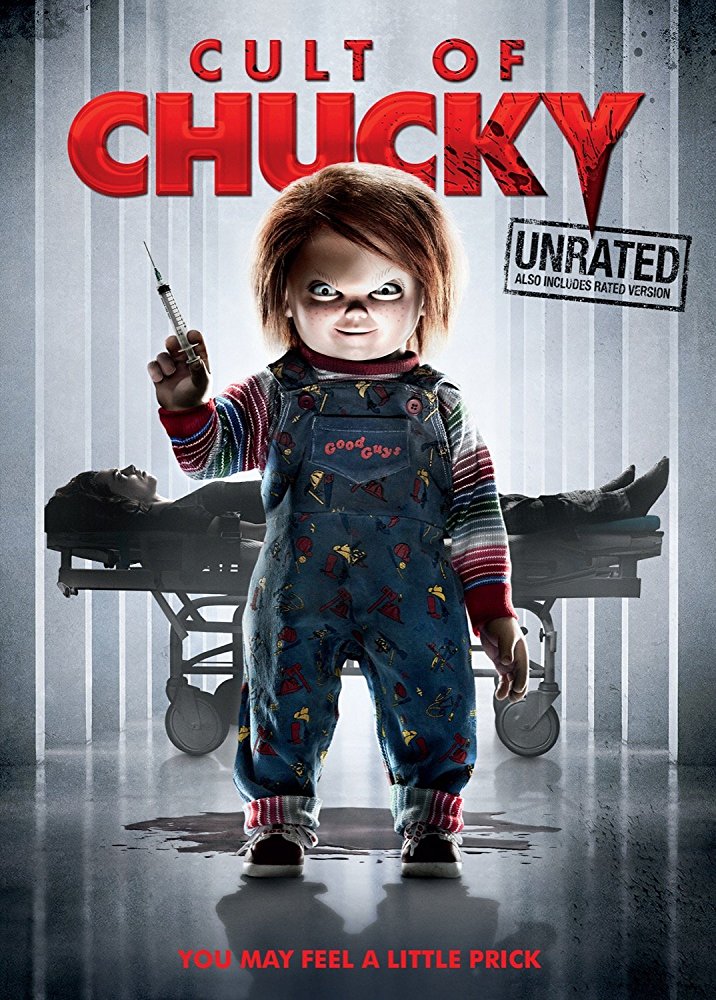
REVIEW: Cult of Chucky


It's sort of an unspoken rule that franchises tend to get worse and worse as they go on (especially when it comes to horror). Of course, this isn't true of all sequels, but the number of follow-ups that actually innovate and improve upon the groundwork laid by the first film is a proverbial drop in the bucket compared to the raging tidal wave of mediocre, derivative retreads pumped out of the Hollywood machine. Typically when a horror franchise makes the jump straight-to-video, it's a sign that the series is all but dead and buried (see Hellraiser, Leprechaun, and countless others). It signals an admission of weakness; the studio does not feel confident enough in their product's money-making potential to justify the cost of a theatrical release, so the best they can manage is to recoup their cost by skipping theaters altogether and going straight to home video. Sometimes, however, a direct-to-video sequel can surprise you. Like I've explained, it's fairly rare that a non-theatrical sequel to a classic horror franchise ends up any good, especially when said franchise dates back well over a decade, and especially when the sequel in question is movie number seven. Which brings us to Cult of Chucky, a follow-up to 2013's Curse of Chucky, which in and of itself was something of a revival of the Child's Play franchise (after its steady descent into comedy schlock during the late 90's/early 2000's).


Right off the bat I've got to commend the filmmakers for not taking the easy way out; this is by no means a soft-reboot. It's a clear benefit of smaller-profile releases such as this; while large-scale blockbusters like The Force Awakens and Jurassic World are forced to retread old ground in order to appeal to younger demographics, movies like Cult of Chucky are free from such boardroom legislature. The movie picks up essentially right where Curse of Chucky left off, and assumes you're familiar with every film in the series thus far (if you're a bit rusty, as I was, a quick trip to Wikipedia is invaluable before viewing; alternatively, just marathon the entire series, it's a fun time). We find our protagonist from Curse, Nica (Fiona Douriff), serving time in a psych ward after the justice system deemed her a more likely murderer than a knock-off Cabbage Patch Kid. After transferring to a new facility to continue her treatment, it isn't long until Chucky (Brad Douriff) comes calling to settle his debts. 

The movie isn't nearly as straightforward as one might expect, subverting the formula beyond the usual "THE DOLL IS ALIVE, I TELLS YA, I SWEAR I'M NOT CRAZY" schtick one might expect from such a premise. In our opening scene, we see Andy Barclay (Alex Vincent, reprising the role he played at the age of six in the first Child's Play) living in a remote cabin in the woods, his only company being Chucky's severed head (whom he routinely tortures when he's got nothing better to do). With Chucky seemingly in two places at once (and our protagonists being a mental patient and a man who experienced severe, Chucky-related trauma at a young age), the viewer is left wondering what is real and what isn't. The movie plays fast and loose with our perceptions, adopting a much more psychological bent than the standard slasher fare one would expect from this franchise. By the third act, I was able to more or less guess what was going on, but there were still enough red herrings and misdirects that I was never 100% certain that I had this movie pinned down. It never gives the viewer the chance to become totally comfortable in their assumptions until the climax, when the film finally tips its hand and clues us in on what exactly has been going on all along; the result is imaginative, original, and thoroughly engaging.


I also need to compliment the film on its sense of tone, toeing the line with expert finesse between horror, mystery, and black comedy. There's never a moment where a joke breaks the tension completely or pulls the viewer out of a moment; it all feels very homogenous and natural, which is so often the downfall of genre-benders such as this. There's bits of humor and levity, but the threat is still very much real; we're able to laugh at Chucky's sarcastic wise-cracks, but we still feel tense when he's in the same room as characters we've come to care about. It's a delicate balance that not every film can pull off, but which Cult really displays a fine mastery of. I feel like a lot of this is thanks specifically to writer/director Don Mancini; he's been heavily involved in the Child's Play franchise since the very beginning, so it's clear he has a deep and intimate understanding of how this particular monster works.

It's also worth noting that this is a very good-looking movie, not only in terms of set design and special effects, but in terms of cinematography as well. The camera really has fun with its environments, implementing PoV shots, dolly zooms, and even some split-screen from time to time. It's a film with style to spare, helped along by the cold, sterile environment the bulk of the story takes place in. The clean, white surfaces of the mental institution are just begging to be hosed down with fake blood, the perpetual snowfall outside lending a sense of eerie calm and isolation. Pair that with the old-fashioned uniforms of the nurses and orderlies and you're left with a place that feels both alien and familiar, like something out of a dream. It's not necessarily the first environment I'd think of to set a smart-mouthed killer doll loose in, but damned if it doesn't work.


Speaking of, Chucky himself is looking better than ever. He's still 100% practical, portrayed by a series of animatronics and puppets; it almost feels like cheating, since a doll is expected to have a sort of artificial, plastic-y look to it, but it's clear that the effects team went above and beyond. Chucky is just so expressive, especially when it comes to his eyes, to the point that he's more believable as a living character than many of the big-budget creatures I've seen in recent years (I'm looking at you, surprisingly fake-looking apatosaurus from Jurassic World). Part of this is helped along by the vocal performance of Brad Douriff, still the only actor to ever portray Chucky on-screen. It's the role he was born to play, yet I still find myself questioning who I think was the strongest part of this cast, Brad Douriff, or his daughter, Fiona. Nica, as a protagonist, is so easy to root for (beyond the sympathy she earns off the bat for being confined to a wheelchair, terrorized by a killer doll, and framed for the murder of her family) and Fiona Douriff really brings so much more to the role beyond the usual "beleaguered horror protagonist whom no one believes" (especially during the final act).


All in all, Cult of Chucky is far better than I think it has any right to be; granted, it offers essentially nothing to those unfamiliar with the series thus far, but it works fervently against all odds to deliver an engaging, interesting, and above all original entry in a decades-old slasher franchise. It's a real testament to the power of love in filmmaking; Child's Play hasn't been a theatrically-viable franchise since the early 2000's. It's clear that everyone who worked on this project, from Douriff to Mancini to Jennifer Tilly, is here because they want to be. This is no quick cash-grab or tax write-off, there's legitimate passion and enjoyment for what they're doing, even though what they're doing is part seven in a slasher series about a serial killer who sealed his soul inside a doll through the use of voodoo magic. There's a self-awareness to it (it wouldn't really feel like Chucky if there wasn't), but there's absolutely zero cynicism, and I feel like that makes all the difference in the world.

October 1, 2017

REVIEW: Get Out


Normally at the end of the month, I try to watch a movie that I know is going to be garbage going in. It's something of a tradition around here, allowing me a chance to really let loose and have fun just tearing something apart; variety is the spice of life, as they say. That said, considering the pure and utter tripe I've put myself through over the past month, I feel as though I've earned myself a little break. With Halloween right around the corner, I'm on something of a horror kick and, coming off of The VVitch, found myself hungry for more quality scares. With that in mind, it seemed obvious to check out the one film even I can't believe I didn't see back in March, director Jordan Peele's Get Out.

The plot feels like something straight out of a classic Twilight Zone or Tales From the Crypt episode; Chris and Rose (Daniel Kaluuya and Allison Williams) are a young, interracial couple who've been seeing each other for a few months. As one might expect, they reach that all important part of a relationship that all young couples dread: meeting the parents. The two depart for Rose's family home, an opulent ranch-house secluded in the woods, where Chris is introduced to Rose's mother and father (Catherine Keener and Bradley Whitford). A hypnotherapist and a neurosurgeon, the two seem to be making almost too much of an effort to make Chris comfortable (leading to more than a few good-natured but still cringe-inducing remarks) and all seems to be going about as well as expected. That is, until Chris begins to notice odd occurrences around the house, leading him to believe that everything is not quite as it seems. Much like with The VVitch, this movie is far better the less you know going in, so I'll end my plot summary here. If you want to know what happens, go watch the movie and find out.


The most important part of a movie like this, one so reliant on its subtext, is that said subtext actually works. So often you'll get a situation where the filmmaker gets too swept up in his or her own metaphor, tamping the message down the viewer's throat, completely sinking the film in the process. Get Out is a film that avoids this pitfall simply by reaching higher than the low-hanging fruit dangling right in front of it. Distilled to the most general terms possible, this is a story about the ills of racism. Now, had Jordan Peele wanted to simply deliver a generic parable about how racism is bad, he could have very easily set this movie in the deep south, instead of what looks like upstate New York or Vermont. He could have littered Rose's family house with confederate flags and jugs of moonshine instead of souvenirs from trips to Africa and bottles of expensive wine. He could have had every white character angrily shout racial slurs instead of smiling politely while mentioning how they know Tiger Woods.

This sense of subtlety, this challenge Peele took upon himself when telling this story, is exactly what makes Get Out work as well as it does. This isn't a movie about your generic, after-school-special kind of racism; the villains aren't boisterous right-wing southerners, they're just seemingly well-meaning liberals who are completely disconnected from Chris' world view. The conflict in this story shows that racism (excuse the pun) isn't entirely black-and-white, highlighting how progressive "ally" culture can be just as harmful as overt bigotry. This is a movie about how a well-intentioned majority can, through their seemingly progressive actions, rob those whom they seek to help of their voice and autonomy. Again, I don't want to delve into spoiler territory, but there's a specific point during the climax where the film lays out exactly what it's really about in spectacular fashion. All in all, it ends up coming off like a reverent throwback to the early films of George Romero and Paul Verhoeven, all while remaining fresh enough so as not to feel in any way cliché or done-before. Everything about the way this movie conveys its message subverts expectations (especially in regards to the ending), ignoring the most trite, obvious symbolism and instead going for something much more clever and, most importantly, real.


That said, all the biting subtext in the world doesn't amount to much if the film itself doesn't function properly. I'm pleased to report that, while some may find the tone somewhat inconsistent, this is a very structurally sound film (especially impressive considering, like The VVitch, this is a first-time director). The performances are all-around excellent, but I have to give some extra credit to Daniel Kaluuya in the lead role of Chris. He's our everyman, the one the audience is clearly supposed to identify and sympathize with as the situation unfolds before him. Kaluuya's performance is solid enough that it wasn't for some time after the film had ended that I realized how little there was to Chris as a character. On paper, he isn't too clearly defined; he is, in every sense, your average, ordinary guy. Kaluuya manages to elevate this, however, purely through his performance. So much is conveyed through simple facial expressions or the use of his eyes; they're even front and center on the poster I chose for this Review. Kaluuya managed to take a protagonist that, in the hands of a lesser performer, could have been totally flat and unengaging and turned him into the perfect lifeline connecting the viewer to the plot.

At the same time, we also have LilRey Howery as Rod, a TSA agent and Chris' best friend. He's our primary comic relief and I'm convinced that in any other movie, this character would have been completely insufferable. Through the combined efforts of Howery, Peele, and the screenwriters, Rod ended up one of my favorite aspects of the entire film, not only providing some legitimately effective levity, but actually contributing to the plot as more than a mere joke machine. Again, we see this movie's commitment to ignoring the low-hanging fruit; it would have been so simple for Rod to have ended up as your basic "goofy best friend" character. He'd spit out a few jokes, maybe act as a vehicle for some product placement, and overall just be an obnoxious, unnecessary addition used to pad out the runtime. Instead, he goes above and beyond in terms of what this kind of character usually ends up being, and the benefits of this effort are plain to see.


Get Out is a movie I simply cannot recommend enough; while it's definitely more of a suspense/mystery (with a hefty dose of satire) than an outright horror movie, it still feels like a loving throwback to a simpler time, when horror films weren't afraid to get inventive in order to get their point across. It takes what could have easily been your classic one-note exploitation premise and turns it into something a  lot more nuanced and inventive than what one might initially expect. One of the things that makes horror so special as a genre is its ability to act as a sort of universal catharsis. When the weight of the world seems that much heavier, some of us ease the burden through sunshine and lollypops, others through ghouls and gore. Whenever there's turmoil and tumult in society, the artists get busy; quality may vary, but Get Out is definitely a prime example of how it should be done.

April 20, 2017

REVIEW: Clue


In an era where The Emoji Movie is soon to be an actual thing (thank you, Sony Pictures), it's worth noting that absurd adaptations are hardly a modern convention. Take, for example, 1985's Clue, based off of the classic board game. At first glance, basing a film off of a board game sounds like a ludicrous venture; when it comes to board games, plot elements are typically little more than set-dressing. It's the reason there's a million different branded variations of Clue, Monopoly, and The Game of Life. The murder/mystery elements of the game are just for show, since the actual game itself is less about discerning motives and more about using process of elimination to predict the contents of an envelope. That said, I hardly think there's a licensed adaptation that can't simply be salvaged with a hefty dose of originality and imagination. The biggest problem with the Battleship movie wasn't that the filmmakers decided to make it about alien warships firing giant pegs at naval vessels, so much as it was that they decided Rihanna was an actress. If you want an example of an absurd concept that shines purely because of the amount of polish applied by the filmmakers, look no further than Clue.


Set in 1954, the film opens with an assortment of people attending a fancy dinner party at the mysterious Hill House. As each guest is greeted by the butler, Wadsworth (Tim Curry), they are given an alias and instructed to keep their actual identities a secret. Thus we are introduced to our would-be suspects, Professor Plum (Christopher Lloyd), Miss Peacock (Eileen Brennan), Mrs. White (Madeline Kahn), Mr. Green (Michael McKean), Colonel Mustard (Martin Mull), and Miss Scarlet (Lesley Anne Warren). Once they are joined by the final guest and host, Mr. Boddy (Lee Ving), Wadsworth informs the guests that they are all the victims of blackmail and that Boddy is the man behind it all; the dinner party was merely an excuse to get them all under one roof to confront Boddy and turn him over to the police. Boddy reminds everyone that he can simply reveal their secrets once in police custody, and instead suggests that they kill Wadsworth and destroy the evidence, handing everyone a weapon. He turns out the light, there's a gunshot and a struggle, the lights go back on, and Boddy is lying dead in the middle of the parlor. And thus, the movie officially begins, kicking off a race to discover the identity of the killer before the police arrive and implicate everyone.


The film is a love-letter to classic whodunnit mystery tales, capturing the same charming, anachronistic atmosphere as the board game. One of the most important reasons why this movie works as well as it does is that it presents a genuinely engaging mystery. As the night goes on, more and more bodies keep turning up and the stakes keep getting higher and higher. The film also famously contains three different endings; the idea being that theaters would receive one of the three, each one presenting a different outcome. With this in mind, I tried to uncover the culprit before the movie revealed who the murderer really was (as anyone who enjoys a good mystery plot is wont to do); not only did my top three choices keep constantly changing as the film went on, in the end I had only guessed correctly once. 

The film really does an excellent job of keeping the audience guessing, throwing out red herrings left and right, giving everyone in the house probable cause for suspicion. The best mysteries are the ones that the viewer can solve simply based off of the clues presented; a sudden deus ex machina reveal that ignores the entire plot and buildup isn't so much clever as it is lazy writing. While I think it would certainly be a feat for someone to predict the final, "true" ending on a first-time viewing, the final scene (in which every bit of evidence is laid bare before both the characters and the audience) more or less proves that all the pieces of the puzzle were present and accounted for before arriving at the climax.


It's a truly commendable effort; it's not like one has a whole lot to work with when building a film based off of the Clue board game, yet this film manages to incorporate essentially every element from the game and pass as a legitimately well-thought-out mystery story to boot. That's to say nothing of the wonderfully irreverent, sardonic tone. The key to a good multigenre film is ensuring that both genres are not only evident, but well-represented. In the same way that Alien is both an effective horror movie AND an effective sci-fi story, Clue manages to be both a hilarious comedy and an engaging murder-mystery. When adapting a licensed product, it's important to have some perspective and remember what exactly it is you're dealing with. It would take a tremendous leap for anyone to take an adaptation of a board game seriously, the same way it would be difficult to make a Where's Waldo adaptation in the style of The Bourne Identity. By going for an overall comedic tone to compliment the air of mystery, the movie is able to faithfully translate the board game to the big screen, substituting the fun and easygoing atmosphere of actually playing the game for dry wit and slapstick sensibilities. Everyone in the film gives a wonderful performance (especially Tim Curry, who becomes a pure dynamo in the final act) and the writing is so quick and sharp I fear I may have cut myself while watching it.


Clue is an ideal cult classic. It's silly and strange and stems from what was very likely a ludicrous concept back in the day; making an entire movie based off of a board game. In the years since, we've gone from "one instruction manual's worth of plot" to "smiley faces and pictures of poop", so it would seem we've only dug ourselves deeper into that Tartarus-like pit that is licensed adaptations. It's a wave that can't be helped; so long as studios enjoy making money, brand synergy will always exist. But Clue is evidence that not every attempt to cash-in on a profitable brand has to be painful. In fact, with enough care and talent and attention to detail, it could even end up being fun, memorable, and legitimately engaging (not to mention, endlessly quotable). It's not often we get a movie like Clue or The LEGO Movie, where a shamelessly nonsensical idea is turned into something excellent, but when it happens it's certainly always a treat.

March 23, 2017

REVIEW: Kubo and the Two Strings


I have a horrible confession to make. I did not go see Kubo and the Two Strings when it was in theaters last summer. Worse yet, I instead went to go see a certain other movie, which shall remain nameless. You can imagine how bad I feel, especially since that movie went on to be a box office smash while Kubo just barely earned its budget back. The two came out within a week of each other; objectively, I am part of the reason Kubo failed, and let me tell you that nothing makes me feel worse. This is an incredible film that deserves every ounce of respect and acclaim it receives, and then some. Hopefully, this Review will suffice as an act of penance, inspiring you to check it out and guarantee it a good afterlife on home video.

Brought to us by the geniuses at Laika, the plot follows the story of a young, one-eyed boy named Kubo (Game of Thrones' Art Parkinson). He lives in a secluded mountain in ancient Japan with his ailing mother, telling stories to the locals with the assistance of his magical shamisen. After getting caught outside after dark, Kubo is forced to flee his home, constantly pursued by his wicked aunts (Rooney Mara) and his grandfather, The Moon King (Ralph Feinnes), who hope to rob him of his other eye. Displaced from his home and his family, Kubo is joined by the gruff, protective Monkey (Charlize Theron) and an amnesiac samurai who was cursed to take the form of a giant beetle (Matthew McConaughey); together, they set out to find his father's enchanted armor and defeat his evil grandfather once and for all.


As one would expect from a Laika film, Kubo is animated entirely through the use of stop-motion animation. Laika has a knack for setting the bar in terms of visual excellence with each release, and this is no exception; Kubo and the Two Strings is one of the most visually stunning pieces of art I've ever seen. There's bustling towns full of lively extras, pulse-pounding action sequences, and massive, intricate creatures, all animated frame by frame by frame by some of the most talented animators, artists, and puppeteers in the industry today. It almost feels like the animators are showing off at times, judging from how often we get a close-up of a character folding origami, handling a sword, or playing a stringed instrument, but frankly they deserve to boast as much as they please. The animation is so smooth, lively, and impressive that I almost forgot I was watching physical puppets interact with one another; its only detriment is that it sometimes looks too good, to the point that we're liable to forget the amount of physical work that went into bringing everything on screen to life. However, those moments when it dawns on you that every single thing on screen had to be sculpted, posed, and animated by hand (from the swooping paper figurines to each flowing strand of hair) are just as mind-blowing as they sound. The term "a feast for the eyes" is thrown around a lot these days, but it honestly doesn't do Kubo justice.

Laika has a talent for making films where the aesthetic is entirely vital to the tone and atmosphere of the film, and Kubo is no different. The story and plot conventions sound as though they're straight out of an actual Japanese legend, so the use of stop motion puppets gives everything an appropriately organic, folk-tale kind of feeling; combined with the narration at the beginning and end, it feels as though we're being told a story that was passed down through the generations. I get the same feeling watching this that I get when I watch a period piece or a Kurosawa samurai film, and that's mostly due to the incredible set design and visual style. A big part of what makes the film work is that it feels authentic (even though it's an original story, rather than an adaptation of any existing folklore) in terms of its visuals, music, and story.


For as much as I love the visuals here, the plot is just as deserving of praise. The story feels totally organic; there aren't any elements "for the kids" or "for the parents", it's simply concerned with being a good movie first and foremost, rather than appealing to any specific audience. I wouldn't really even call Kubo a children's movie; while it's colorful and animated and doesn't stray beyond PG territory, the tale it tells is very melancholy and refuses to talk down to its audience in any way. This is a true "all-ages" film, in that anyone, young or old, can find something to appreciate. I understand that major releases need to synergize with a studio's marketing departments, appealing to specific demographics and offering up ample opportunities for merchandise (on a totally unrelated note, check out this sweet clip of Justice League's new Batmobile design, now with MORE guns and missiles that really launch!). 

Really, this is a luxury that Laika, as a smaller studio, can readily afford, but I see no reason larger studios can't take the occasional risk and level with their audience. Kubo made lackluster returns at the box office because it was a low-key release surrounded by high-profile blockbusters; critically speaking, however, everyone loved it. If it had the exposure of other, more mainstream animated films, it would have been a huge financial success as well. Critics loved Kubo because it respected its audience. Themes of death, maturation, and loss are steeped deep within the movie's DNA, but not once does it feel like a dreary, unpleasant experience. It levels with its audience and accompanies them on a journey, rather than holding their hand, slapping on some blinders, and forcing them down a linear path. It's a film that, while not necessarily made for children, is definitely marketed to children; with that in mind, I think the film's approach to the story it sets out to tell is monumentally important. This is how you make a piece of art that has truly universal appeal.


I have not a single bad thing to say about Kubo and the Two Strings. I believe it to be Laika's finest film and one of the finest stop-motion pictures ever produced. Again, I deeply regret not seeing this last August when it was in theaters. Not only would I be happy to give the studio money for this, but I can safely say that this would have shown up at least twice on my End of the Year Retrospective. If you haven't seen Kubo, you need to atone for your mistake as I have. Track it down and check it out, I promise you won't be disappointed.

February 16, 2017

REVIEW: Fargo


I like to call myself a fan of the Coen Brothers; in reality, I'm a bit of a poser, considering that, up until now, the only one of their films I'd seen was The Big Lebowski. A little shallow to declare myself a "fan" after watching just one film, perhaps, but then I really did just like it that much. Of course I knew I had to explore their other works, and what better place to continue my journey than with the film that really put Ethan and Joel Coen on the map. I am of course referring to their 1994 film, Fargo.

After getting himself in deep through embezzlement, car dealer Jerry Lundegaard (William H. Macy) concocts a scheme to stage a kidnapping. He hires two thugs by the name of Gaear and Carl (Peter Stormare and Steve Buscemi) to abduct his wife, Jean (Kristin Rudrüd), and contact him demanding ransom. Jerry will then extort the ransom money from his father-in-law, pocket half of it, and use the rest to pay off the kidnappers for their services. The plan goes sour, however, and several people are killed. As Jerry's scam spirals out of control, it is up to Police Chief Marge Gunderson (Frances McDormand) to get to the bottom of things and see those responsible put behind bars.


First and foremost, the film is gorgeously shot. Taking place in the American Midwest during the wintertime, snow is naturally everywhere. It's a very white film, literally; in any exterior scene, snow simply dominates the landscape. This leads to a gorgeous bit of visual contrast whenever a death occurs outside, the red blood clashing against the cold, clean white. It makes for a strong visual metaphor, of how something horrid and sinister can invade a landscape so pure and untouched. Really, that's what the entire film is about; perceptions contrasted against what lies within.

Anyone who's seen this movie knows about the accent; with the exception of Buscemi and Stormare, every cast member speaks in a thick Minnesotan tongue, tossing out "you betcha"s and "oh gosh"s with expert skill. It gives everything about the environment of the film a folksy, naive sort of tone; a perception that is shattered when we are shown who these characters truly are, deep inside. For example, take Macy's Jerry; he's a meek family man who is constantly emasculated by both his work and his father-in-law. He hardly swears and wants to cover up his wrongdoing seemingly for his family's sake. That said, he hopes to accomplish this by arranging his own wife to be kidnapped. He keeps all of that impotent rage bottled up inside him, and on the few occasions it escapes, this meager car salesmen turns into an enraged child, throwing brief-but-violent temper tantrums. He strikes you at first as too much of a wimp to hurt anyone, but it's only as the movie goes on that you really start to understand just how despicable and ruthless he is. He's an expert in denial, convinced he's doing what he's doing for the right reasons, even after things have clearly gone too far.


On the flip-side, we have Margie. Quiet, friendly, and seven months pregnant, you wouldn't immediately peg her as a "hero" in the usual sense. Everything about her seems so quaint, yet she's by far the strongest force for good in the entire film. She's no loose-cannon cop on the edge, just a small-town Police Chief trying to do her duty. You really get to know her as a person; in the same way that this humanization makes Jerry all the more deplorable, it makes Marge that much easier to root for. You get a sense of who these characters are as people, rather than as protagonists and antagonists, and that adds a tremendous amount to the weight of the plot. The film has a relatively relaxed pace, but the brief, surprising moments where the tension is ratcheted up become that much more effective thanks to this sense of contrast. If there's one thing this film truly understands, it is contrast, in every sense of the word.

As one would expect from such a cast, the performances here are all spectacular. Steve Buscemi is doing his usual skeezeball routine and it works as well as it always does. I love watching him fly into a rage; something about it is so genuine and real, which makes it that much more entertaining. Peter Stormare says very little but leaves a big impression, managing to convey a very threatening demeanor with little dialog and a lot of murder. Frances McDormand is a delight, coming off as one of my new favorite protagonists of all time. Margie is just so darn likable and easy to pull for, and this is entirely thanks to McDormand's performance. There's no weak link here, but for me the highlight of the cast was definitely William H. Macy. There's so much subtlety and nuance to the character of Jerry, from the way he talks, to the way he moves, to the way he has his brief, impotent fits of rage. His character simply wouldn't have worked, had Macy not understood everything that makes him tick. It's a wonderful thing, watching his scheme slowly deteriorate from just another day at the office to a total debacle that blows up in his face. Come for William H. Macy, but stay for Frances McDormand, that's my advice.


Fargo is, as is to be expected, a wonderful film. Brilliantly shot and wonderfully nuanced, it's just one of those movies that feels good to take in. It does a dozen things at once and succeeds at all of them, never once feeling trite or boring (despite the easygoing pace). The cast is excellent, the cinematography is gorgeous, and the general environment and atmosphere is very unique, especially given the type of movie this is. It's a plot that very easily could have been conveyed as an action-thriller, with pulsing bass and gravely-voiced antiheroes. Instead, the film goes for something a little more subtle and out-there than your usual murder plot fare. If you're looking for a true blue classic, look no further than Fargo. It doesn't disappoint.

January 22, 2017

REVIEW: A Series of Unfortunate Events


If there's one thing I'm thankful for in this heyday of digital streaming, it's the wealth of opportunities the format presents to the field of adaptation. There are so many stories that simply wouldn't work as standard-length films; the idea that a but a single of George R.R. Martin's A Song of Ice and Fire books would be condensed into a single two-hour film (roughly the equivalent of two episodes of Game of Thrones) is laughable. As technology has evolved, it has become a more feasible venture to adapt long-term stories into long-term series, as evidenced not only with Game of Thrones, but also with Netflix's latest offering, A Series of Unfortunate Events. I recall reading several of the books as a child and was excited to see the works of Lemony Snicket done justice (at least, moreso than the 2004 film adaptation starring Jim Carrey).

The story, as told by the enigmatic Snicket (Patrick Warburton), follows the three Baudelaire children; Violet (Malina Weissman), Klaus (Louis Hynes), and Sunny (Presley Smith). After their parents are killed in a mysterious fire, the three orphans are carted off to their (physically) closest living relative, a sinister actor by the name of Count Olaf (Neil Patrick Harris). As is stated in their parents' will, the children are to inherit an enormous fortune once Violet comes of age; it is Olaf's ambition to seize the Baudelaire fortune in any way that he can. The series follows the three children as they are sent from guardian to guardian, constantly pursued by Olaf and his troupe of villainous acting buddies. The events that transpire are sardonic, macabre, and, as the title would imply, unfortunate.


The first season of the show covers the first four books in the series: The Bad Beginning, The Reptile Room, The Wide Window, and The Miserable Mill. Each book takes up two episodes and each episode clocks in at more or less an hour a piece. It's one of the neatest formats I've ever seen for a series such as this, keeping everything organized and easy to absorb. The 2004 film condensed the first three books into a single movie, sacrificing the subtle, methodical tone and pacing of the source material. Here, everything unfolds at a perfectly respectable rate, not too quickly and not too slowly. This is definitely a point in the show's favor, considering this is a series which aims for a decidedly younger crowd than the bloody action of Daredevil or the existential dread of Bojack Horseman

I can easily see some criticizing the show of losing sight of its target audience; while the books can be found in elementary school libraries, the show's dry tone and drab, stylized visual style may be a turn-off for the younger crowd. While I can agree that not every child will be taken in by what this show has to offer, I feel as though those who enjoy things on the macabre side will greatly enjoy themselves. This is very much a show for the bookworms, packed to the brim with literary humor and colorful language. That is to say nothing of the underlying theme of the whole thing; at the heart of the Baudelaire's plight is the sad, simple truth that adults often just don't listen to children. The siblings are all very intelligent, well-spoken, and well-read, yet are constantly held back by their age. Nearly every authority figure they come across is either condescending, naive, villainous, or some combination thereof; it's very much a tale for kids who feel disenfranchised and talked-down to by authority figures, and it gets this message across in superb form.


That said, I do have my share of nitpicks to address as well. While I adore the set design and visual style of the series (which implements sharp, contrasting colors and striking anachronisms to create a sort of hybrid aesthetic between early Tim Burton and Pushing Daisies), the use of CGI is simply painful in most cases. I don't fault the showrunners for using digital effects to portray giant leeches gnawing through a boat hull or a baby gnawing bark off a log; in those cases, it actually looks mostly passable for an online series. But I don't understand why, with all the gorgeous (and likely expensive) practical sets, they felt the need to use digital effects for something as simple as a shot of the main characters riding a trolly. It's something that completely pulled me out of this unique, immersive world whenever it showed up. I can only hope, with the massive acclaim the series has been receiving, that Season 2 will see an increased budget.

I also feel as though the show sometimes thinks it's a bit more clever than it really is; while I love the various literary references, absurdist humor, and dry dialog exchanges, the show can sometimes layer it on a bit too thick. Though that may just be my jaded cynicism talking. I did, on the other hand, thoroughly enjoy the performances of all the main cast. The show boasts talent such as Alfre Woodard, Aasif Mandvi, and Catherine O'Hara, and no one at all feels wasted. The three Baudelaires all do well as young protagonists, coming off as believable, capable, and relatable without once coming off as grating (important for any story starring children, absolutely vital for this particular property). As is to be expected, the one who steals the show is Neil Patrick Harris as Count Olaf (though my personal favorites were his acting troupe).


The role was formerly filled by Jim Carrey in the aformentioned film, so it's safe to say that Harris had some rather large shoes to fill; the character of Count Olaf is one who operates on theatricality and trickery, adopting various disguises in an attempt to swindle the Baudelaires out of their family fortune. Thankfully, NPH pulls it off with aplomb, burying himself under tons of prosthetic makeup and seemingly having a ball. I do wish that his character had more chances to come off as genuinely threatening (since he's responsible for some genuinely uncomfortable moments early on in the series), but even his goofy showmanship is fun and engaging to watch. Carrey's take on Olaf was undoubtedly the strongest aspect of the 2004 adaptation, and the same is true of Neil Patrick Harris' performance here.


Regardless of the various disclaimers presented by the very catchy theme song, I do heartily recommend you check out A Series of Unfortunate Events. There may not be much here for those who didn't grow up with the books, but I still found myself having a fun, engaging time watching it. The underlying lore of the source material is definitely more pronounced here than in the books, since the show explores other characters from time to time, aside from the three main children. The mystery which runs through the story of the Baudelaire orphans is interesting enough to keep the audience engaged, leading up to a fabulous end-of-season twist that has me eager to come back for more. It's a drier, darker, more subversive breed of children's entertainment that I feel the world could always use more of. Definitely give it a watch.

November 21, 2016

REVIEW: Fantastic Beasts and Where to Find Them


Given that it's been several years since the Harry Potter film series came to a close (and nearly a decade since the final book was released, not counting the recent stage play), it's sometimes easy to forget just what a huge phenomenon the series was back in the day. I grew up on the stories and films, so this franchise more or less dominated a huge portion of my life; it was an ongoing event comparable to the original Star Wars saga. While I still consider myself a fan, no question, I must admit that it's been years since I've re-read any of the books or revisited any of the movies. We all assumed there would be more Harry Potter some day, whether or not it was entirely necessary. Though I doubt anyone could have guessed we'd end up with a prequel spin-off containing none of the original characters we'd spent an entire decade reading about. As is the popular trend nowadays, Fantastic Beasts and Where to Find Them hopes to establish a cinematic universe in which the films are connected through a shared canon, while not necessarily directly related to one another. It was recently announced that this would be the first of a whopping five films (an announcement I feel holds as much water as James Cameron's insistence that there will be four more consecutively-filmed Avatar sequels released between 2018 and 2023), so the question still remains; is this movie strong enough to establish a series of its own without Harry Potter and pals picking up the slack?


Taking place in the year 1926 (nearly 70 years before Harry Potter would be admitted to Hogwarts), the plot follows magizoologist Newt Scamander (Eddie Redmayne) as he journeys to New York City on personal business. After a mix-up with a non-wizard named Jacob Kowalski (Dan Fogler), numerous magical creatures escape Newt's enchanted suitcase and begin wreaking havoc on the city. This does little to ease the tension brewing within the wizarding community; a string of anti-muggle attacks by the infamous Gellert Grindelwald (Johnny Depp) have threatened to expose the magical world at large and inspired the rise of groups like the Second Salemers, a fanatical cult of non-magic users hoping to expose and destroy those who practice witchcraft. At the same time, a sinister presence has begun causing destruction and chaos in New York. Naturally, Newt's creatures take the blame and the task falls to him, Jacob, and Tina Goldstein (an agent for the Magical Congress of the United States of America played by Katherine Waterson) to round up his beasts before any harm can come to them (or indeed, the world at large).


It must be said, I'm eternally grateful that J.K. Rowling decided to step outside the box with this film; it would have been positively tragic had we gotten a Harry Potter prequel focusing on Young Dumbledore or the adventures of Harry's parents when they were at Hogwarts or, god forbid, a Star Wars prequel-style series about how Tom Riddle became Lord Voldemort. Instead, we get something totally new and original; a movie starring the author of a textbook that is occasionally mentioned offhandedly by the main characters as a bit of set dressing. Something that, realistically speaking, has next to nothing to do with the story told in the previous Harry Potter films. It would have been tremendously easy to make a movie about Harry's kids or something equally banal and pointless; the Harry Potter name prints money, so a spin-off would be successful no matter what. It's that the filmmakers and Ms. Rowling decided to go the extra mile and make something daring and different that I respect. That effort pays off, since we get to see a whole new side of the wizarding world which we've never seen before. 

The original series hinted at international magical communities outside of England (most prominently in Goblet of Fire), but we never really got to see how things were done overseas. Unlike every other piece of Harry Potter media, the entirety of this film takes place in the United States; as is to be expected, things are done differently on this side of the pond. Instead of a Ministry of Magic, Americans have the Magical Congress. Instead of Hogwarts, there's Ilvermorny. Instead of "muggles", non-magical folk are referred to as "no-maj". While it might seem like a simple change of backdrop and terminology at first glance, the film does a fine job of making the United States feel like totally new territory in the Harry Potter universe. The events of the original story are presented as wholly irrelevant to the plot; there's a few callbacks and name-drops here and there, but the film, for the most part, plays all of its references close to the chest. There's no immersion-shattering cameo from a young Dumbledore; barring Grindelwald (who was practically as much a footnote in the original series as Newt Scamander was), any and all references to the previous films are cursory at best. This is a film that knows when it is appropriate to evoke feelings of nostalgia without distracting the audience, something that all modern revivals (from Jurassic World to Star Wars) should take note of.


That said, the film is most definitely not without its flaws. The first act is a ploddingly slow, poorly-paced jumble of scenes; while it's naturally fun to get re-immersed in the wizarding world and enjoy the drastic change of scenery and setting, the plot doesn't really begin until around thirty minutes in. Once the movie actually takes off, it's as engaging and fun as one might hope for, but the path to that point borders at being a chore at times. There were also points where the movie as a whole felt somewhat overstuffed. Sorcerer's Stone had a fairly basic plot, since it had to establish the entire world in which the story takes place. This allowed the sequels to grow more complex, since the bulk of the world building was already set up and out of the way. Fantastic Beasts operates under the assumption that viewers are already familiar with all the previous entries in the series to that point, but also has to establish its own distinct world, separate from the rest of the existing Harry Potter universe. The film clocks in at just over two hours and not a minute of it is wasted; the reason the first act comes off as so sloppy is purely due to all of the setup it needs to get out of the way before the real plot can begin. 

While I don't really have any objective issues with the story, it does feel a bit dense for the first movie in a new series. Given that he's an outsider (like Harry was, initially), it very much feels like Kowalski should have been the main protagonist (despite him not being able to contribute anything to the action-packed climax); Newt doesn't have much of an arc to speak of and, while endearing, honestly comes off as pretty flat in terms of his characterization. I also wasn't a fan of the main antagonist, Percival Graves (Colin Farrell). In a series featuring such iconic villains as Dolores Umbridge and Lord Voldemort himself, there's immense potential to be found with the Director of Magical Security for the United States. Unfortunately, this character completely fell flat for me; his goals aren't clearly defined until the very end of the film and I was able to spot the twist coming a mile away. It honestly would have been more shocking (as well as a nice parallel to Sorcerer's Stone) to have the brash, spooky jerk turn out to be one of the good guys all along, despite the protagonist's (and audience's) expectations that he was really working for the main villain the whole time. Imagine if, at the end of Sorcerer's Stone, we find out that Harry, Ron, and Hermione were totally right and that Snape was the one trying to steal the stone for Voldemort. That is essentially what the "twist" in Fantastic Beasts amounts to; in a film with so much imagination and ingenuity, it's the one glaring aspect that feels utterly mundane and expected.


Despite my reservations, I must say that Fantastic Beasts and Where to Find Them turned out to be a solid entry into an iconic series. I wasn't entirely sure that this movie needed to exist, but I'd be lying if I said I didn't get some powerful chills the moment the Warner Bros logo floated in through the fog to the tune of that iconic jingle. In a world of cinematic universes and soft-reboots that seem to minimize on ingenuity in an effort to maximize profit, Fantastic Beasts manages to revive a beloved franchise while at the same time doing something totally original and independent of the established iconography. It has its flaws, but I believe it rises above them and justifies its existence by simply being a very enjoyable movie on its own. I'm still not entirely sold on the idea of four more sequels following Newt Scamander and company, but this film has certainly proven that it is possible to tell a good story in J.K. Rowling's wizarding world without once saying the name "Harry Potter".

October 13, 2016

REVIEW: Scooby-Doo on Zombie Island


The 90's was a tremendous time for traditional animation. The Disney Renaissance was in full-swing, but it's also worth noting that it was an especially strong era for Warner Bros Animation as well. With television offerings like Animaniacs and Batman The Animated Series and films like The Iron Giant and Mask of the Phantasm, the studio had a lot to offer cartoon fanatics back in the day. For me, one of WB's most memorable productions was Scooby-Doo on Zombie Island, a direct-to-video film that premiered on Cartoon Network on Halloween night, 1998. Considering it's been years since I've watched my copy (naturally, recorded off the TV onto a blank VHS tape), I figured it was high-time I revisited the film that many credit with reviving this classic franchise from the clutches of Saturday morning stagnation.

As the story begins, the Mystery Inc. gang has given up the ghost and disbanded; Velma (B.J. Ward) runs her own book store, Shaggy and Scooby (Billy West and Scott Innes) are employed as bumbling customs agents, and Fred and Daphne (Frank Welker and Mary Kay Bergman) work together on a successful television show. As the production is about to embark on a road trip to investigate hauntings across the country, Fred is inspired to get the gang back together for old times' sake. The crew eventually find themselves in New Orleans, investigating a reportedly haunted plantation house on Moonscar Island, the former hideaway of a legendary pirate. Tales of mysterious disappearances and vengeful ghosts pique the gang's curiosity, but things take a turn when actual zombies begin to rise from the bayou; as the film's tagline says, "this time, the monsters are real!"


It's really a brilliant subversion of expectations; throughout the entire first half of the movie, the gang's skepticism is played through the roof. They question every remotely spooky thing they see, immediately searching for a projector or rubber mask. The idea of making the threat of a Scooby-Doo story genuinely supernatural is a stroke of genius; by packing the first two acts full of standard slapstick antics, it sets the stage for a major tonal shift once the zombies are revealed to be real. The first three-quarters of this movie are lighthearted and slow-moving, exactly what one would expect out of a Scooby-Doo film. There's lots of gags about Scooby chasing after cats and eating big sandwiches, almost to the point that it becomes tiring. However, this is all merely set dressing for the main event that is the climax.


I won't spoil the ending here, but it goes to some genuinely dark places. The movie starts and ends as classic Scooby-Doo, but the last twenty minutes in-between is essentially an animated horror film. The opening scene is an upbeat chase through a spooky castle as the gang is pursued by a swamp monster, while everything past the halfway point involves the honest-to-god rotting corpses of Confederate soldiers and pirates clawing their way out of the soil to limp after our protagonists. There are even some zombie tourists in there, implying that the Mystery Inc. gang aren't the first folks to stumble upon Moonscar Island and run afoul of the living dead. It honestly justifies the entire film all on its own; as corny as the tone was for the majority of the runtime, it all works in favor of subverting the audience's expectations and making that tonal shift hit that much harder.

I also can't praise the film's presentation enough; the animation was done by Japanese studio, Mook Animation (responsible for animating such works as SWAT Kats: The Radical Squadron and Tiny Toon Adventures). Every scene taking place at night is full of heavy shadows that almost give things a stylized, hyper-realistic feel, as if we're watching a moving blacklight poster. I know the era of ink and paint is long gone (and that the upcoming S.C.O.O.B. will be computer animated), but I've always felt that this style was an ideal fit for Scooby and the gang, and would kill to see it used again in some capacity. Hanna-Barbera was not a studio known for its animation, so it's nice to see a property so ripe for spooky atmosphere done justice in terms of visuals. The 90's kid in me would also be remiss if I didn't mention the soundtrack, featuring original songs by Skycycle. Put simply, they shred. If you've never had It's Terror Time Again stuck in your head, then you've never seen this movie.


Scooby-Doo on Zombie Island is a fresh, original, well-animated entry in a franchise that is seldom known for being any of those things. It could be argued that the vast majority of entries into the Scooby series follows the "fake monster unmasked by meddling kids" formula; there are a few exceptions, of course (such as the more recent Mystery Inc. series), and Zombie Island is fortunately one of them. It's very much a film aimed at children, but the lighthearted beginning and middle work in service of a dark, exciting, and at times genuinely scary end. It's just over an hour long, so if you're a meddling kid with some free time on your hands, you really don't have any excuse not to check this out.

October 6, 2016

REVIEW: Suspiria


Suspiria is a film, like Sleepaway Camp, that I had heard touted as essential viewing for any fan of the horror genre, one of the most frightening films ever made. Having witnessed it firsthand for the first time, I can't exactly say I'm disappointed. Released in 1977 and directed by Italian giallo filmmaker, Dario Argento, Suspiria is most definitely effective, if not consistently coherent.

The story focuses on Suzy Bannion (Jessica Harper), an American ballet student pursuing further education at the illustrious Tanz Dance Academy in Germany. Following her arrival, Suzy begins to notice a number of strange occurrences; after a string of murders, she begins to suspect that all is not what it seems at her new school, and that something much more sinister may lurk behind the walls of the aging academy. To be perfectly blunt, the plot is not this film's strongest suit. While the pace hardly ever drags, plot points are introduced whenever it's convenient for the story and the progression of events is not always the easiest to follow. There's a good deal to nitpick in regards to the plot (the most glaring flaw being an exposition dump involving a psychiatrist near the beginning of the final act), but this is not a film that is famous for its story. To focus on the plot of Suspiria would be the equivalent of focusing on the sense of realism in Army of Darkness. That is to say, anyone who focuses on the plot of this movie is completely missing the point.


The thing that makes Suspiria such an effective horror film is its aesthetic. Everything from the set design to the color to the soundtrack (care of the band, Goblin) works in tandem to keep the viewer in a constant state of unease. It was one of the last feature films to be shot in Technicolor, and the process lends everything a vivid, sometimes garish, quality. It feels like something out of a nightmare; primary colors (particularly red) seem to pop out of the screen, and the lighting can shift tones and hues at any time. There's abundant manipulation of darkness and shadow, so you're never quite sure where someone or something might be lurking. The cinematography helps sell the scares, as tight angles instill a feeling of claustrophobia and paranoia. There's no telling what could be waiting just outside of the frame (rest assured, the film knows this is a concern of the viewer and exploits it wholly).

It would be impossible to talk about this movie without mentioning the sound design. This is easily one of the best horror scores I've ever heard, providing just the right tinge of unease to the atmosphere. The gentle chimes, backed by sinister vocals and chants, can become deafening at times. In a stroke of genius, the film makes it impossible to not take note of the score; this makes it all the more unsettling when we are met with total silence. The movie actually trains the audience to fear a lack of sound. Before the end credits roll, silence becomes the most sinister, suspicious noise of all. I've always believed that the key to good horror is the ability to manipulate the viewer's expectations; to, over the course of the film, condition them to subconsciously fear specific subtleties. Suspiria is a film that demonstrates its mastery of this concept with aplomb.


If there's one thing I must criticize the film for (aside from the plot), it's the ending. The mystery presented is an engaging one; the film enchants you with its dreamlike qualities, it makes you want to know what's going on. The result isn't disappointing, per-say, but I didn't find the climax quite so terrifying when compared to the rest of the film. Make no mistake, the tension is thick and the suspense is killer, but, as the American tagline for the movie said, "the only thing more terrifying than the last 12 minutes of this film are the first 92". The scariest scene by far happens within the first fifteen minutes; it's a haunting, iconic sequence, but the climax just didn't feel worth the incredible amount of build-up during the third act. I would recommend going in with tempered expectations; it's well-done and will certainly send a chill down your spine, but I can't help but find it a tad anti-climactic.


If you're looking for a horror film that will play with your senses and envelop you in its distinct atmosphere, you'd be hard pressed to find a better candidate than Suspiria. It's no wonder that this film is considered a classic entry in the genre; I honestly can't think of anything I could even compare it to. It manages to be unorthodox and incoherent, yet it's still able to hold your attention and leave its mark thanks to the engrossing visual style (backed up by the chillingly enchanting soundtrack). If you consider yourself a horror hound like myself, you owe it to yourself to check this one out. There's also talk of a remake, to be released next year. I'm rarely keen on remakes as it is, but this is a film that is defined by the style of the era it was made in. It's the epitome of pointless; take if from me, the spine-chilling original is the only one you'll ever need.