Showing posts with label holidays. Show all posts

January 12, 2018

REVIEW: Coco


I know, this is over a month late, but Coco honestly couldn't have come out at a worse time for me; it released right around Thor, Justice League, The Disaster Artist, and Star Wars, and since then I've experienced multiple holidays, a bout of wintertime sickness, and a bomb cyclone (whatever that is). With everything I had on my plate, I just couldn't find time to get out and see Pixar's latest film until just this week (in what I'm fairly certain was the absolute last showing in my hometown). On the bright side, I'm overjoyed I got to catch this one before it left theaters (unlike some other animated films); I've been a Pixar fan from the day I was born, and it always feels weird whenever I miss the theatrical run of anything that isn't Cars. However, I'm also left with the bittersweet realization that last week's 2017 Retrospective is already outdated. I wish I had seen Coco when it released back in November, or at least before I started compiling my rankings of everything I watched last year. Had I not put it off for so long, I can guarantee that it would have landed right next to Logan as one of my favorite films of 2017; trust me, it's just that good.

Set in the Mexican town of Santa Cecilia, the story follows a young boy by the name of Miguel Rivera (Anthony Gonzales). An aspiring musician in a family of shoe-makers, Miguel dreams of following in the footsteps of his idol, Ernesto de la Cruz (Benjamin Bratt); unfortunately for him, music has been banned in the Rivera household ever since his great-great-grandfather left his wife and child to pursue a career in the music industry. After a family spat on Dia de Muertos (The Day of the Dead, a Mexican holiday where offerings are made to the spirits of departed family members), Miguel finds himself trapped in the Land of the Dead amongst his ancestors; if he doesn't receive a blessing that allows him to return to the Land of the Living before sunrise, he'll be stuck knee-deep in the dead for all eternity. What follows is a colorful, emotional adventure that explores the messy, complicated relationship between familial responsibility and duty to one's own dreams and passions.


I'll admit, I wasn't exactly excited for Coco in the months leading up to its release. The character design didn't thrill me (particularly the choice to add eyeballs to the skeleton characters) and the plot seemed extraordinarily basic for something from Pixar. In hindsight, I wasn't being entirely fair to Coco; it works much better from a visual standpoint now that I've actually seen it in practice (to the point that it might just be the most visually-impressive Pixar film to date) and the story (as I should have expected) had much more to it than your standard "child gets lost in fantastical place, has to race against the clock and learn a lesson" plot. 

It feels like so many movies of 2017 (even ones I've enjoyed) run into the same problem of either falling into a painful slump during the second act or outright losing all steam by the time the climax rolls around; Coco, it seems, has the opposite problem. This is a film that takes quite a bit to properly get going; until Miguel enters the Land of the Dead, I was honestly getting a bit worried. The film opens with an upbeat first-person narration that doesn't return at any other point in the story, so it ends up feeling like it's specifically addressing the kids in the audience who don't know anything about Mexico. It comes off as so cheery and overly-earnest that it comes dangerously close to crossing the line into "anyone over the age of 12 is going to feel embarrassed to be watching this" territory, but that luckily all changes once Miguel is flung into the afterlife. From that point on, the film only gets stronger as it goes, culminating in one of the most emotionally-resonant third acts I've seen all year. Again, I'm referring to the same year that gave us Logan, so keep that in mind.


Despite its almost overly-kid-friendly opening, the atomosphere of the movie matures alongside its protagonist. Miguel starts off as a rambunctious, impudent kid; at 12 years old, he's right on the verge of casting off childish flights of fancy in favor of more adult responsibilities, hardly a smooth transition for most young people. The idea that, sometimes, you can't be whatever you want to be is a bitter pill to swallow, especially when it feels as though your own family is standing in the way. The conflict between Miguel wanting to become a musician and his elders wanting him to take up the family trade isn't exactly the most original, but it's how it's handled here that makes it stand out. Unlike The Last Jedi, this is a movie where characters actually sit down and talk with one another; both sides make valid and flawed arguments, and sometimes they don't reach a consensus that makes everyone happy. It's not an ideal situation, but the emotions at play make it a relatable one; whether or not we agree with these characters' stances, we can 100% understand and sympathize with how they came to these conclusions, and that attention to detail makes all the difference in the world.

As the plot continues and the tone grows more somber, we see the shift in Miguel's priorities (as well as those of his ancestors, who want nothing more than for him to give up his dream of being a musician and return safely to the Land of the Living). Every character has a lesson to learn, so the message of the story never feels one-sided. We don't get a moral that reads like a lecture ("Always listen to your elders, they know what's best for you"), but we also don't get a moral that feels like a cynical appeal to a sense of prepubescent rebellion ("Up yours, old man! What the world really needs is to learn how to dance!"). Instead, we get something more in the middle; you should always be willing to do anything for your family, but your family should never be willing to let you give up on your dreams. Instead of feeling wishy-washy, it strikes just the right chord, presenting two flawed-yet-understandable arguments and reconciling them in classic Pixar fashion.


I suppose I should talk about what inspired me to give Coco a watch after over a month of procrastination. While I was off seeing Justice League like a sucker, my compatriots at The Long Run Podcast went to see Coco (side note, fellas, what gives? Y'all had a month-long head-start on me and I put out my Coco Review first? Get it together). Their reactions floored me; here I was, looking at a movie I expected to measure up alongside Pixar's more lukewarm entries like Brave and The Good Dinosaur, only to be told that this was the most emotionally-impactful Pixar film since Toy Story 3. That this movie contains scenes as tear-jerking and sob-inducing as the first 5 minutes of Up. That, not only was this one of the best films Pixar has ever put out, but that it was one of the best films of the year. So yeah, high praise.

I entered the theater, expecting some of those good ol' Pixar feels. I left not-quite two hours later, whistling mariachi music and trying to hide how hopelessly bleary my eyes has become. I need to reiterate, this is not your stock plot about an average kid who no one understands. This is a tale about life, death, family, tradition, and legacy. It's a story about how what we amount to, at the end, is the memories we leave behind with those we've loved in life. Coco pulls no punches and goes right for the jugular; when you're sitting there during the third act, quietly weeping into your popcorn, you can rest easy knowing that Lee Unkrich and company have earned every single teardrop.
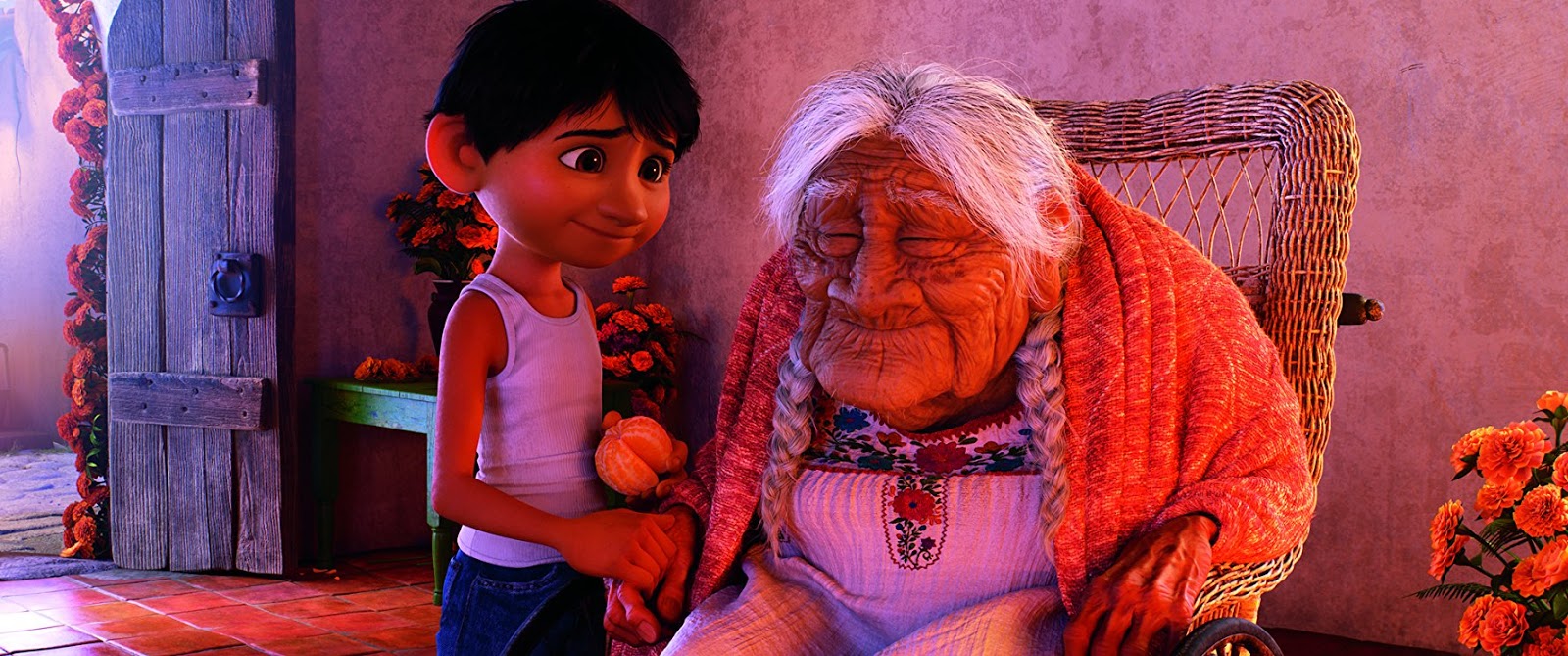

I won't mince words; Coco is my second-favorite film to come out in 2017 and I hate that I procrastinated so long in seeing it. It's a true masterpiece, one of Pixar's best (which, despite a few less-than-stellar entries, still remains high praise for any animated feature). The music is incredibly well-crafted, even by Disney standards (and then there's Remember Me, which is so thematically brilliant it's on a whole other level). And that's to say nothing of the art direction and animation, which is just spellbinding to look at, bursting with vibrant colors and liveliness. I'm not sure if this is standard for all screenings, but there was a lovely little bumper before the film began in which several of the filmmakers showcased how much work it took to animate certain shots and sequences, before thanking all of us for coming out to see Coco in an actual movie theater. It really offered some insight into the process of modern animation and helped remind me that, even though Disney is a company with essentially bottomless resources, movies like Coco are still the cumulative result of mountains of individual care, effort, and imagination. 

If you haven't seen it by this point, I'm afraid you might be out of luck for a theatrical screening (like I said, I just happened to luck out and catch the final show in my neck of the woods), but in hindsight, I'd say that Coco is worth the effort. If you can find a theater that's still showing it, take the journey and settle in for a lovely time. I came away from it feeling like I did after seeing Inside Out; in that it gave me a good cry that I didn't know I needed to have until I'd had it, and I feel like that's the true magic of Pixar movies. To clarify, this isn't a good movie because it made me cry; the same result can be achieved with a swift kick to the groin or a hefty ball of wasabi. No, Coco is a good movie because it earns its emotional response without feeling cheap. You can get cheap tears as easily as you can get cheap laughs; it's sad when an animal dies in the same way it's funny when Melissa McCarthy falls down some stairs. But when we have a genuine, emotional reaction to the experiences of the characters on screen; when we form a connection to what we're seeing and these fake, imaginary people cease to be cartoon characters and become real, that is when you can rest assured that true artistry is taking place.

December 22, 2016

REVIEW: Dr. Seuss' How the Grinch Stole Christmas (2000)


At first, I'd considered writing this Review in rhyme, but I honestly doubted I'd be able to get across everything I had to say about this movie while putting such whimsical limits on my choice of words (plus, it's been done before). Released in the year 2000, Ron Howard's Dr. Seuss' How The Grinch Stole Christmas is an hour and 45 minute long adaptation of the classic children's short story. It's also completely and utterly baffling on every conceivable level. I watched this movie for the first time when I was about five or six. Nearly two decades later and I'm still not entirely sure what to make of it. As a kid, I loved how it was a wacky, "cooler" version of the classic 1966 television special; now that I'm older, I mostly loathe those aspects but can appreciate the oddball artistic vision the whole thing has going for it. It's a conflicting, surreal, weird mess of a film, and I'm honestly still kind of fascinated by it to this day.

The plot should be familiar to anyone who had an even slightly-literate childhood; there's a hairy, green creature known as the Grinch (Jim Carrey) who lives atop Mt. Crumpet, just north of the town of Whoville. It's a cheery little village full of cheery little people who just adore everything about Christmas; it just so happens, however, that the Grinch absolutely despises everything about them (and, by extension, Christmas itself). Fed up with the constant bombardment of noise and holiday cheer, the Grinch decides to disguise himself as Santa Claus, sneak down to Whoville in the middle of the night, and straight-up steal Christmas (or at least what he perceives Christmas to be). Having pilfered all of the presents and decorations in Whoville, the Grinch is stunned to find out that the Whos are able to still find worth in the holiday on Christmas morning. He learns that Christmas is moreso about friends, family, and togetherness than it is about material goods, returns everything he stole, and joins the Whos in their celebration. Like basically everything Dr. Seuss wrote, it's a nice, simple little story that delivers a surprisingly mature moral by way of imaginative, sing-songy prose. Naturally, this children's picture book (whose beloved prior adaptation clocks in at a whopping 26 minutes) was the perfect property to adapt into a $123 million blockbuster.


You might be wondering how the filmmakers stretched a book that can be read in a matter of minutes into a feature-length film; to be frank, they basically just accomplish this by adding an entire hour of shameless filler. The first half of the movie is devoted to the Grinch being invited to Whoville's annual Christmastime celebration by Cindy Lou-Who (Taylor Momsen, who is a good couple years older here than "two"). It seems for a moment as though he's actually embraced the Christmas spirit and made good with his festive neighbors, until he's provoked by the Mayor, played by Jeffery Tambor. The Grinch snaps and goes on a rampage, ruining the Whos' celebration in a manic, expensive-looking action sequence. Immediately afterwards, however, he returns to his home on the mountain and the Whos immediately repair all the damage he did. The Whos are hyped for Christmas and the Grinch hates them all; an hour into the movie and absolutely nothing has changed in regards to the story or character dynamics. Everything we've had to watch so far is inconsequential, the movie equivalent of busy-work until we get to the iconic "the Grinch steals Christmas" scene that everyone remembers so fondly from the book and cartoon. This isn't the only issue I found with this movie, but it's by far the most glaring and insulting.

Despite the first half of the movie being an unapologetic waste of my time, I can actually sort of respect what the filmmakers were going for here. The best way to make a short story into a long story is to expand upon its themes; unlike The Lorax (where the moral of the source material is completely thrown out the window in favor of another upbeat musical number), this is an adaptation that completely understands what the book was saying and tries its best to do that message justice in its own unique way. The movie takes the idea that "maybe Christmas doesn't come from a store" and runs with it. The Whos, with the exception of Cindy Lou, are portrayed as borderline unlikable. They're totally obsessed with the commercial aspects of the season, buying up gifts and assembling decorations while completely ignoring friends and family. Everything in Whoville looks as though it's made out of washed-out plastic, giving the impression that, while the set design is whimsical and festive, this is a town that lacks a soul.


The colors are drab and dreary, the picture is constantly cloudy, and every other shot is taken at a dutch angle (honestly, this movie and Battlefield: Earth are the first things that come to mind when I think of tilted cameras). While it's true that this off-putting aesthetic serves to enhance the film's message as a kind of overarching visual metaphor, that doesn't mean that it's at all appealing to look at. By making the Whos into a community of materialistic consumers, the Grinch is given some degree of moral high-ground, which is something that I feel just totally misses the point of the original story. We're not exactly supposed to relate to the Grinch, at least not entirely; the entire crux of his character is that he's clearly the bad guy. By giving us a clear villain in the form of the Mayor, we lose the impact brought on by the Grinch's change of heart in the end. As far as we're convinced, the Grinch is the endearing protagonist from the very beginning. As much as this movie devotes itself to the anti-consumerist message of the source material, there are many other areas where it completely misses the mark.


For instance, there's a number of blatant sexual innuendos that really feel out of place. Never have I ever wanted to see Christine Baranski channel Jessica Rabbit while expressing her carnal desire for Jim Carrey in a Grinch suit, and I'm fairly certain no one else wished for that either. I also never imagined I'd see a Dr. Seuss adaptation with the line "the sun is shining and the powder's bitchin'", but as I said, this is a very surreal experience. There's a flashback featuring the musical stylings of Smash Mouth, anything goes in this wacked-out and radical adventure. It feels as though it can't decide whether it wants to be a sardonic take on a classic kids' story for the older crowd or a live-action cartoon for the whole family. Instead it just sort of double-dips and the entire thing feels very inconsistent in terms of tone and execution. 

The only thing I feel is at all consistent is Jim Carrey; rarely have I ever seen an actor so completely disappear into a role. It probably helps that he's covered in pounds of seamless, incredible makeup and prosthesis (care of special effects master, Rick Baker), but Carrey really goes the whole nine yards in this part. That's not to say that he's flawless; as good as the makeup is, I can't help but imagine pages upon pages of the script which simply read "the Grinch mugs at the camera". Carrey's enthusiasm is infectious, but his rapid-fire Sean Connery/James Cagney impression tends to border on grating and incomprehensible from time to time. Thankfully, the Grinch's dog, Max, is endlessly endearing (played by a rescued stray); this may come off as something of a tangent, but this is a remarkably cute mutt with a real knack for acting. It's almost enough to make me forget the scene where the Grinch tricks a sleeping Jeffery Tambor into kissing said dog on the butthole.


What else can be said about Ron Howard's Dr. Seuss' How the Grinch Stole Christmas? It's a thoroughly weird movie. That's honestly the only way I can describe it. It's unpleasant to look at, the tone is all over the place, and it can't seem to decide exactly what it wants to be. Most of what it does doesn't work at all, but I also have to give Ron Howard and company an enormous amount of respect for going with such an out-of-the-box artistic vision with what could have easily been a very cut-and-dry children's adaptation. But then again, the original television special was as cut-and-dry as you can make it (only straying from the narrative of the book for the sake of the few musical numbers, all written by Dr. Seuss himself), and that adaptation is undoubtedly the more iconic take on this classic story. So would this have been a better movie, had the filmmakers dropped all pretense of aesthetic and just made a simple, by-the-numbers kid's flick? While I'm not sure anyone can answer that, I do know for a fact that the film we do have is in no way boring or uninteresting. There's a new, computer-animated adaptation in the works, to be released by Illumination Entertainment in November of 2018, so maybe that will hit closer to the mark (and hopefully be devoid of Minions). Regardless of how that turns out, I doubt anyone is liable to forget this particular version of the story, for better or for worse.

December 1, 2016

REVIEW: Scrooged


What exactly is it about Dickens' A Christmas Carol that makes it so endlessly adaptable? This one simple story takes up so much real estate in the realm of holiday specials to the point that it boggles the mind. Is it because the story is so ingrained in the public consciousness that we simply can't get enough of it? Is A Christmas Carol just the yuletide monomyth? Personally, I feel as though it's just an easy out for content creators; need a Christmas episode that writes itself? Christmas Carol parody! Need something to rake in those holiday weekend box office dollars? How's about a star-studded Christmas Carol remake? Need a story to tell your kids on Christmas Eve? Dickens, baby. It's always Dickens. When it comes to entertainment, A Christmas Carol is the bread and butter of the holiday season. It's an adaptation that not only writes itself, but which can be revisited year after year after year. It's one hell of a racket. Thankfully, this laziness can be subverted with a hefty dose of ingenuity, such as in the 1988 Richard Donner film, Scrooged.

Bill Murray stars as Frank Cross, a bloodthirsty TV executive charged with airing a live production of A Christmas Carol on Christmas Eve; he's inconsiderate, arrogant, and completely blind to the plights and tribulations of his employees. An effective Scrooge stand-in if ever there was one. As one might expect, he is visited by three ghosts who hope to convince him to change his ways before it is too late to save his immortal soul. It's A Christmas Carol. The key factor here is how creative the filmmakers got in presenting this time-honored tale in a new and unique way. It hits all the beats of the story without feeling derivative; instead of Tiny Tim, we have Calvin, the son of Murray's overworked assistant. Rather than sporting a crutch, he's been mute for the past five years after witnessing his father's murder. This is a film that is definitely not all tinsel and gumdrops. It goes to some truly dark places and, while I found this tone more or less refreshing, I admit that it may be too dour and mean-spirited for some.


The film is very much a character study, rather than an ensemble piece. We have actors such as Karen Allen, David Johansen, Bobcat Goldthwait, and John Forsythe, but none of them really get much of an opportunity to leave a huge impression, considering the focus is always on Bill Murray. He does a good job, considering he takes up so much of the spotlight, but it would have been nice to see a little more of the people he has such a negative effect on over the course of the film. It almost spreads itself too thin with the cast, to the point where we need to tie up too many loose ends by the end of the third act. Characters who are made to feel very important (such as Grace, Frank's assistant played by Alfre Woodard) are given the same amount of closure and attention in the end as characters like Brice Cummings (John Glover), an LA slimeball gunning for Frank's job. This is, by nature, a very intimate story, looking at exactly what led a generally kind, good-natured man to become a real genuine dirtbag. We can feel that intimacy and emotion in regards to Murray's life, but those feelings are somewhat absent for the members of the supporting cast.

The humor, for the most part, works well. As I said, it may be a little too mean-spirited for some, but I personally had a blast with it. Few can play sardonic and exasperated as effectively as Bill Murray, and the film is just oozing with his token personality. It's when the movie veers into more traditional fodder for jokes (like the uncharacteristically slapstick stylings of Carol Kane's Ghost of Christmas Present) that the film falls flat. Murray commands the humor in this film, and its when the comedy attempts to steer itself out of his sarcastic, irreverent wheelhouse that it suffers and stalls. There's tons of subtle little touches that make this a joy for anyone remotely familiar with the television industry (such as the studio head's insistence that he's found "a study which shows that cats and dogs are beginning to watch television"). It's subtle moments like these that raise the film up and really make it something special. It's a dry, irreverent idea for a film to begin with, so the humor works best when it's matching that tone. 


That said, the one glaring issue with this film is without a doubt the rampant tonal inconsistency. There's an undercurrent of cynicism and subversion that comes with adapting a classic Christmas story in such a modern, hard-edged kind of light. At the same time, it is also attempting to pass as a straightforward Christmas Carol adaptation. There are moments when the schmaltz required by the story actually works (such as when Frank unwraps a handmade picture frame from his brother), but these moments are few and far between. This disparity really only becomes obvious during the final act, when everything falls apart. Up to this point, the film had been subversive and sardonic in a fun, coherent kind of way. Everything meshed together well, since the more emotional aspects of the story so far had been just as dark as the comedic aspects. It is in the third act, however, that everything goes utterly off the rails. Bill Murray, normally cool as a Christmastime cucumber, plays his change of heart with all the vigor of someone suffering a psychotic break. He interrupts his own live broadcast to give a rambling, tonally all-over-the-place speech about the true meaning of Christmas that doesn't mesh with the rest of the film in the slightest.

We're made to believe that this is a beautiful, inspiring moment, yet I couldn't stop myself from thinking that there's no way this has a happy ending, especially for Bobcat Goldthwait's character (who, after getting fired in the beginning of the film, had gone completely postal and was holding the channel's control room at gunpoint). Going by the film's sense of logic, I can only assume that Frank got fired, Bobcat went to prison, and no one's situation improved in the slightest. Despite all the ghostly hijinks, this feels like a very grounded film. It had never been afraid to present the audience with the grim reality of a situation; Frank is forced to find out that his actions lead to a homeless man freezing to death and his assistant's child ending up in an asylum. Not to mention Bobcat Goldthwait showing up at the office with a loaded shotgun. But then immediately after presenting us with these bleak, pessimistic possibilities, the film expects us to believe that everything works out like a Christmas miracle. It leads to a real sense of tonal whiplash, considering that the movie doesn't adhere to its own established sense of logic. This is the one time I actually would have much preferred the movie stick closer to the source material, with a generally reserved, intimate finale that tugs the heartstrings and more aligns with what we'd gotten used to over the past hour and a half.


It's a real shame that Scrooged fumbles with its ending as roughly as it does; had it pulled it off, it would have easily been my favorite Christmas Carol adaptation, hands down. As it is, the rest of the movie is really quite good regardless. It's definitely not for everyone, but I found its brand of mean-spirited irreverence to contrast nicely with the usually saccharine Christmas season. Then again, I'm the type to watch Gremlins or Krampus this time of year, rather than It's a Wonderful Life, so take my words with as many grains of salt as you deem necessary. It's a subversive take on a holiday standard that makes for a solid good time that I can't help but recommend, despite its flaws. It's an example of real creativity on display in what could have been a painfully milquetoast experience; for that alone, I feel as though it's worthy of praise.

December 25, 2015

REVIEW: The Star Wars Holiday Special


The Star Wars Holiday Special is the kind of thing that honestly sounds like a joke the first time you hear of it. Why wouldn't there be a Star Wars Holiday Special? It's just a stupid enough idea that it has to be real; sure enough, in November of 1978, the world was introduced to Chewbacca's family by way of an utterly baffling television event that appears to be the product of every ounce of cocaine the decade had to offer.

The special operates around the framework of Chewbacca (Peter Mayhew) attempting to return home to his family on Kashyyyk for Life Day, a non-secular Wookiee holiday that can be marketed to Star Wars fans of all creeds and religions. While his wife, son, and father wait for Chewie to arrive, viewers are "treated" (I can't put enough quotation marks around that word, so I won't even try) to a number of variety show-style segments. There's an alien cooking show (hosted by Harvey Corman), an art-deco space circus, an android instructional video (hosted by Harvey Corman), a performance by The Jefferson Starship, a look inside the Mos Eisley Cantina (starring Bea Arthur, but featuring Harvey Corman), and many more. Each of these segments is about ten minutes longer than it has any right to be; this is saying something, considering most of these segments are about five minutes long. It's just such an awful premise. When one hears the phrase "Star Wars Holiday Special", a number of things come to mind (most of them completely idiotic). One would hope that, if this special positively needed to exist, the creators would take the absurd "He-Man and She-Ra" route. Something involving the cast of Star Wars all uttering the phrase "CHRISTMAS? WHAT'S THAT?", a plot where Darth Vader tries to stop Santa Claus from bringing joy to the galaxy, and maybe Han Solo ends up delivering presents in the Millennium Falcon; something that, while awful, is at least so absurd that it becomes entertaining. What we got instead basically amounts to "Wookiees watch directionless skits on various monitors with Art Carney for over 90 minutes, not including commercials".


It honestly makes you wonder, what kind of diseased mind came up with the segments found in this special? Who sat down with the intention of writing an entertaining comedy sketch for the whole family, only to end up with a sequence in which an elderly wookiee watches virtual reality porn starring Diahann Carroll? Or perhaps this was written by some unfortunate, yet altogether sane soul who was simply forced into a position of having to deliver a finished script, the first twenty or so pages consisting of nearly nothing but remixed animal noises? The mystery isn't why The Star Wars Holiday Special exists; Star Wars was (and still is) a cultural phenomenon. It makes perfect sense that such a profitable property would be milked dry in any way possible, no matter how ridiculous. No, the real question here is why did the people who made this decide to make it... like this?

Now to be completely and totally fair, I will say this; the special is not entirely without worth. Aside from satisfying my morbid curiosity and being generally fascinating in a horrifying, circus sideshow kind of way, there are a few bits here and there that I actually appreciated. First off is a cartoon animated by Canadian studio, Nelvana. While the short itself is nothing to write home about (considering it looks like a budget kids' show version of Heavy Metal), it's worth noting that it was this special which featured the totally canon first appearance of Boba Fett. To be frank, Boba Fett does way more in this shoddily animated short than in Empire or Jedi combined; while he's essentially reduced to the role of a Saturday-morning villain of the day, it's fascinating to think that one of the most popular Star Wars characters of all time got his start in something as ridiculous and infamous as this special.


If I had to name a part of this special that isn't quite as awful as every other part, I'd definitely have to go with the segment taking place in the cantina in Mos Eisley. Bea Arthur appears as the gruff, singing bartender who serenades her drunken patrons after the Empire imposes an immediate curfew on the entire planet. The only reason the bit works at all is directly due to Bea Arthur herself; it seems that she and Harvey Corman are the only people actually trying here. For most of her screentime, she's working off of extras in mute, emotionless alien costumes. It's like a bizarre one-woman show that actually manages to be somewhat engaging and heartwarming, all because Bea Arthur is just giving it her all. I think it's important to let what I've just said sink in for a moment; out of all the segments in The Star Wars Holiday Special, the best moment is the Bea Arthur musical number with all the puppets. If a Bea Arthur musical number is the best thing your special has to offer, it's probably a reasonable idea to scrap everything and start over. Or just scrap everything and never try anything remotely like this ever again.


With all this talk of wookiees and Bea Arthur and Harvey Corman, one would be forgiven for forgetting that the actual stars of Star Wars make appearances here. We have Mark Hamill as Luke Skywalker (obviously recovering from his tragic car accident, as he's positively caked in makeup), Carrie Fisher as Princess Leia (who appears to be riding high on literally every illicit substance under the sun), and Harrison Ford as Han Solo (who really wishes he was anywhere else). Peter Mayhew, Anthony Daniels, and Kenny Baker appear as Chewbacca, C-3PO, and R2-D2 as well, and I feel as though the only reason we can't see their shame is because they are for the most part obscured by their costumes (though there is a legitimate kind of sadness to be found in Mayhew's eyes).


The Star Wars Holiday Special is a genuine curiosity to me. It's objectively terrible in every way, yet I can't not recommend it. It's just too insane, something that must truly be seen to be believed. It's the television equivalent of those Silver Age comic books where Superman fights Mohammad Ali; someone decided that there was money to be made, so common sense was thrown clean out the window. It's just so mind-bendingly stupid, to the point that it's almost kind of amazing. If you consider yourself a real Star Wars fan, you owe it to yourself to mix up a strong glass of eggnog and give this baffling, confusing, absurd thing a watch at least once.

December 10, 2015

REVIEW: A Very Murray Christmas


In recent years, Netflix has been working hard in establishing itself as a legitimate entertainment network, complete with original programming. However, one thing has been noticeably absent from the streaming service's lineup; an exclusive Christmas special. At long last, the gap has been filled with A Very Murray Christmas, Sofia Coppola's festive throwback to the variety shows of old. The question still stands, however; does A Very Murray Christmas have the chops to become a holiday staple? The answer is a resounding "eh, sorta".


The story begins promisingly enough; the city of New York is effectively closed for the holidays thanks to a raging Christmas Eve blizzard. With the streets deserted and the airports closed, there's hardly anyone to attend poor ol' Bill Murray's Christmas special, broadcasting live out of the Carlyle Hotel. It's a strong start; Bill Murray manages to embody pure loneliness and discomfort while still managing to elicit genuine laughs. It gives off the impression that this is going to be a sardonic, cynical Christmas special about making a terrible Christmas special. We get some excellent cameos from the likes of Amy Poehler, Michael Cera, and Chris Rock and the stage is set for a hilariously dour good time, packed to the brim with songs and tinsel. But then it moves into the second act and the tone takes an abrupt, sloppy 180 out of nowhere.


Once a power outage dashes any hopes of actually finishing the special, Bill Murray (along with his sidekick/musical accompaniment for the evening, Paul Shaffer) finds himself snowed in with everyone in the Carlyle's bar. Whereas the first act was dark and funny, the second act is essentially just twenty minutes of celebrity cameos and musical numbers framed around the plight of a young couple played by Jason Schwartzman and Rashida Jones. It's a tonal shift roughly equivalent to an episode of Louie suddenly diverting into A Muppet Christmas Carol; while it's not necessarily bad, it feels like an entirely different kind of special. Act One is Murray lamenting how alone he feels while forcing Chris Rock to engage in a stunning duet of "Do You Hear What I Hear". Act Two is him dispensing schmaltzy, saccharine wisdom in a dimly lit bar. There's no blending between the two, causing the whole thing to feel scattered and disorganized. It's not entirely without merit, seeing as how this segment contained my two favorite songs of the special (a cover of the Beach Boys' "Alone on Christmas Day" by the band Phoenix, and Maya Rudolph putting on a spectacular, powerful rendition of "Baby Please Come Home"), but if A Very Murray Christmas has a low point, it's definitely this.

Things are brought back into focus for the third act, which is composed of an absurd dream sequence featuring Miley Cyrus and George Clooney (the latter of whom got what may have been the biggest laugh of the evening, but I won't dare spoil it here); it feels like this is more in line with what the beginning set up so well, so it's a shame that everything in the in-between ended up plodding along as it did. It hooked me, lost me, then hooked me again, but by then it didn't matter because the special was already over.


A Very Murray Christmas is a perfectly adequate Christmas special. There are parts of it that are good and parts of it that are bad. Everyone seems to be having a nice enough time, turning in good performances, though nothing to write home about. While some of the songs end up feeling somewhat uninspired, there are a few musical numbers here that really steal the show, despite the fact that the cast features only a few celebrities known for their singing ability. A Very Murray Christmas is the kind of thing that manages to be just alright, not by being just alright consistently, but by either being quite good or quite bad in more or less equal amounts. In the end, it averages out to something totally, well, average. I've added a few of the songs to my Christmastime playlist and I absolutely adore that it references The Monument Men more than once, but I don't think this is one that I'm going to be revisiting next year.

November 19, 2015

REVIEW: Planes, Trains, and Automobiles


I've always wondered why there never seem to be any movies focused on Thanksgiving. There's dozens of films about Halloween and likely even more about Christmas, but Thanksgiving seems to forever be the redheaded stepchild of the Autumn/Winter holiday trifecta. It's not as if it's a holiday with no potential for entertainment or storytelling; it's a time of the year that revolves around often chaotic family gatherings, absurd amounts of food, and the barbaric blood-rite known as Black Friday. Along with all of that, it's got a strong moral center of togetherness and thankfulness while not allying itself with any particular faith or religion. Thanksgiving is by all intents a perfectly marketable subject for a feature film, so one has to wonder why there are so few movies that take advantage of this. After having watched John Hughes' 1987 comedy, Planes, Trains, and Automobiles, I can only guess it's because no one expects to top what is essentially the perfect thing to watch with the family once the turkey's been devoured.


Neil Page (Steve Martin) is an ad executive working in New York; it's two days before Thanksgiving and he's promised his wife and children that he'd be home in Chicago in time for the family dinner. After a streak of bad luck, Neil finds himself stranded in Wichita alongside Del Griffith (John Candy), a chatty traveling salesman. The two embark on a journey to be home in time for Thanksgiving (a journey that, as one would expect, involves planes, trains, AND automobiles) which quickly devolves into pure and utter chaos at every single opportunity. This is one of those films like Bringing Up Baby or National Lampoon's Vacation; every possible thing that can go wrong, does. Our protagonists are put through a comic gauntlet, where their simple holiday commute becomes more of a biblical trial, a voyage worthy of Odysseus himself. Just when things start looking up for Neil and Del, yet more punishment and misfortune is heaped upon them, testing both their will and their sanity.


This is the kind of film where the comedy is born from a deftly orchestrated relationship between our characters and the situations they find themselves in. The movie takes the time to set up the joke, let the scene play out, and then spring the punchline on us; we know the payoff is coming, but the execution is what catches the viewer off-guard and makes the film work. It's far from high-concept, but it runs like a well-oiled comedy machine, generating consistent laughs for essentially the entire runtime. 

As well-written as it is, a buddy-comedy is only as strong as the dynamic between its two main characters. Thankfully, Martin and Candy work brilliantly off one another. At first glance, it appears to be your standard straight-man/funny-man setup, but the film goes for something a little deeper than that. The characters of Neil and Del are fleshed out more than one would expect, each one showcasing individual moments of brilliance and buffoonery. Neither of these characters ends up becoming a cartoon, so we still feel some sense of connection with both of them; we care about who they are and where they're going, despite their personal faults and failings. It's because we relate to them and want to see them succeed that the comedy works in a fantastically cringe-inducing sort of way. It's emotional slapstick; it's funny because it's not you, but it's endearing because it easily COULD be you.


Planes, Trains, and Automobiles is one of those utterly timeless films that's definitely earned its reputation as a classic. No matter who you are, we've all felt that pressure of being late or delayed; this is a film that blatantly feeds off of those feelings and makes comedic gold out of our anxiety. John Candy and Steve Martin give some of the best performances of their careers, bouncing wildly quotable bits of dialog off one another in every hilarious, heartwarming, memorable scene. If you're burned-out on football and can't stand the thought of surfing through a sea of commercials hawking Black Friday deals and Christmas savings, then I highly recommend you gather the family around and pop this gem in for a watch. Like a good Thanksgiving dinner, there'll be smiles, laughter, and good feelings all around.