
Showing posts with label Michael Fassbender. Show all posts
Showing posts with label Michael Fassbender. Show all posts
May 25, 2017

April 27, 2017
REVIEW: Prometheus

It's a testament to the quality of both Alien and Aliens that we hold this franchise in such high-regard. These first two films rank among the best ever made, yet everything since has ranged from merely okay to pure garbage. Prometheus was a film that I (and I'm sure many other Alien fanatics) was greatly looking forward to. With Ridley Scott back in the director's chair and a viral marketing campaign that promised something more in-line with the original 1979 film, I was sure that this would be the film to restore this franchise to its former glory. As Noomi Rapace's Dr. Elizabeth Shaw says, "I was wrong. We were so wrong." Perhaps I'm being a tad harsh; the last and only time I watched Prometheus was back when it released in the summer of 2012. Like with Batman V Superman, I left the theater feeling as though the film was passable at worst (albeit a tad unsatisfying), only for that feeling of middling acceptance to quickly sour into outright contempt. The more I thought about it, the more elements of the plot and characters disintegrated before my eyes like so many buff, albino spacemen. However, as hard as it is to believe, that was just about half a decade ago. I decided to give Prometheus another chance, to see if it holds up better upon a second viewing. It does, though only slightly, and I'm still very much inclined to chalk this one up as yet another 'miss' for the Alien franchise.
Taking place well before Alien (and retconning those god-awful AVP movies out of series canon), the film follows the crew of the Prometheus, a research vessel commissioned by the eponymous Weyland Corporation. Archaeologists Elizabeth Shaw (Rapace) and Charlie Holloway (Logan Marshall-Green) have discovered star maps in several locations across the Earth, believing them to be directions to the origins of mankind's makers. Intent upon finding these so-called Engineers and uncovering the purpose of human life, the crew travels to a planet known as LV-223 (not to be confused with LV-426 from Alien and Aliens), only to find a massive pyramid filled to the brim with a strange, goopy alien pathogen. Instead of answering the questions posed by Alien (mainly regarding the origin of the iconic xenomorph), the film instead poses a host of new questions and chooses to answer exactly zero of them.

In some ways, this was a functionally flawed film from the get-go. Part of the appeal of Alien was the sense of mystery and uncertainty. We knew as much about the creature that terrorized the crew of the Nostromo as they did; the alien represents the unknown, and the unknown is always inherently terrifying. That is, until you attempt to explain it. Really, we don't need to know where the xenomorph came from. Any origin they could present would just feel unsatisfying compared to some thirty-plus years of speculation and conjecture. Luckily, however, the xenomorph gets to retain its mystique because it doesn't appear at all in this film. Instead, we're given an unsatisfying (and canonically dubious) explanation for the Space Jockeys (now called Engineers). Being that the xenomorph has existed in pop culture for so long, it's understandable why Ridley Scott chose to omit the creature from this entry in the series; people love the big chap, but we've had nearly four decades to look at the monster. Safe to say he's lost a bit of his initial shock and awe, so it's important to innovate and keep things fresh. Unfortunately, the film forgets that there's a difference between being mysterious and simply being ill-defined.
In Alien, we're able to understand how the creature functions, even if we know very little about what it actually is. We can gather that it reproduces by implanting an embryo inside a host and that it's got pressurized molecular acid for blood. It's incredibly resilient but, like most animals, is averse to fire. There's just enough there that the xenomorph is still strange and terrifying, but coherent enough in concept that it remains conceivable. We aren't distracted by this fantastical creature skulking around a ship knocking off space truckers because it feels like something that could very well exist in the cold depths of space. That's precisely what makes it terrifying.

Meanwhile, in Prometheus, we know all the wrong things about the Engineers. We know that they created human life, we know that their DNA is somehow a direct match to ours (despite them being an ancient race of alabaster giants), we know that they want to destroy us for whatever reason, and we know that they possess a sinister black goo that you certainly don't want to get near any mucus membranes. We don't know, on the other hand, what the black goo even does; as is, it basically functions in whichever way is most convenient for the plot. Sometimes it causes life to disintegrate, sometimes it causes rapid evolution, and sometimes it just turns people into zombies. While we assume the creature in Alien is just acting on animal instinct, the Engineers are clearly intelligent. So why don't they operate under any sense of logic? Why do they want to destroy Earth so badly? We have some sense of what the stakes are, but we don't know what motivates any of it. I was so busy trying to make sense of all the plot holes and oversights that I completely forgot to be emotionally invested.
I could spend a great deal of time picking apart the insane amount of plot holes in this movie (and I would, if a certain pair of hackfrauds hadn't perfectly summed everything up five years ago), so I'll instead pick apart the characters. Whereas Alien spent the entirety of its first act familiarizing us with a small crew of normal, everyday people, Prometheus instead opts for a comparatively larger cast of sci-fi cartoon characters. Logan-Mashall Green is completely unbelievable, playing the part of a doctor of archaeology with all the impulsiveness of a boorish frat-boy. He's completely unlikeable and I felt nothing but joy upon seeing him bite the dust. Rafe Spall's biologist character is a jittery coward for the entire film, up until the point he sees a phallic alien snake and decides to try and shake hands with it. Apparently there was a cut scene in which he encounters a decidedly non-hostile version of these creatures, establishing the idea that they pose no threat to him; why this scene was cut, I have no idea. We also get to watch Sean Harris comically smoke weed out of his space helmet while trapped in an ancient alien pyramid. This movie features the most appallingly incompetent excuses for scientists I think I've ever seen, and that's aside from the scene towards the end of the second act where Idris Elba explains the premise thus far to any audience members who might be having trouble keeping up.

That said, the film is not without its highlights. Noomi Rapace is totally believable in her role as Elizabeth Shaw (even if she's just a tad too spry immediately following a last-minute cesarean). The idea of a character struggling to hold onto their faith despite literally meeting their maker is leagues more fascinating than every other bit of sci-fi schlock the film throws our way. There's also Michael Fassbender as David the android, by far the best takeaway of the entire film. The theme of creations rebelling against their creators is about the only thing the film gets across well, and that's almost entirely thanks to Fassbender's incredible performance. He displays such a subtle turn from helpful and innocent to jealous and spiteful, completely commanding attention while on-screen. It's actually kind of stunning; few films display such an aptitude for wasting talent like this one does, yet I'd go as far as to say that David is right up there with Ripley as one of the best characters this franchise has ever produced. Fassbender earns every bit of praise he gets for this one, and he's one of the few things I'm certain will be good about Alien: Covenant.
Visually, this movie is stunning. The cinematography is gorgeous, the special effects are holding up nicely, and the reliance on practical sets and creatures is greatly appreciated. For as much as I gripe about the story and characters (care of Lost's Damon Lindeloff), I can't deny that this is a superbly good-looking film. Everything aesthetic, from the lighting to the score, is top-notch. I can even respect the film for daring to be as ambitious as it is; it goes to some truly far-out places, yet rarely scuffs the atmosphere that it builds. The first act is a strong preamble to a massive-yet-gorgeous letdown. With a better script, this really could have been a masterpiece to rival the first Alien. Instead, it will just have to join the long line of interesting films that were ruined during re-writes.

Prometheus is a film that I truly wish was as good as I wanted it to be. It sets lofty goals for itself and falls far from accomplishing them, as admirable as the attempt was. Unfortunately, there's just too many things wrong with the story being told on a fundamental level to save the film as a whole. Michael Fassbender is incredible and the visual direction is truly a sight to behold, but beyond that it's a disappointingly vague, shallow mess of a prequel. It may be somewhat unfair to compare it so vigorously to Alien, but I feel as though such comparisons are inevitable when both films are not only in the same franchise, but share the same director. There's so many cut corners and lazy plot holes here that were completely absent in Alien, so one has to wonder what changed in the interim.
In the past, Ridley Scott has expressed frustration that Alien has become yet another blockbuster franchise, with schlocky sequels and a ride at Disney World. In many ways, Prometheus feels like an attempt by a director to reclaim an idea that has since gotten away from him; in the process of doing so, he ignores everything that made the original idea good, just for the sake of separating himself from the past that everyone knows and loves. I've seen the original draft of this film, back when Prometheus was known as Alien: Engineers. It certainly sounded like something better than what we got and it's unfortunate we'll never get to see it reach fruition. Hopefully he'll have more luck with Alien: Covenant.
May 30, 2016
REVIEW: X-Men Apocalypse

"Everyone always knows the third movie is the worst," quips Jean Grey (Sophie Turner), as she and fellow teen mutants Cyclops (Tye Sheridan), Nightcrawler (Kodi Smit-McPhee), and Jubilee (Lana Condor) exit a showing of Return of the Jedi. Ironically prophetic words, considering that X-Men: Apocalypse is the third in the semi-new line of X-Men movies (a line that started with the quite good First Class and was followed by the all-around excellent Days of Future Past). While it's likely that this joke was meant to be a dig at Brett Ratner's heavily-derided entry in the series, X-Men: The Last Stand, it still doesn't change the fact that it manages to predict where Apocalypse falls in relation to its siblings.
The year is 1983 and Professor Charles Xavier (James McAvoy) has begun transitioning his family home into a bonafide school for gifted youngsters. Meanwhile, the powerful mutant En Sabah Nur (better known as Apocalypse, played by Oscar Isaac), buried in ancient Egypt by those who feared his power, has emerged after millenia of slumber. Believing that humanity has lost its way and wishing to reclaim his place as god-king of all mankind, Apocalypse gathers four "horsemen" (Storm, played by Alexandra Shipp, Psylocke, played by Olivia Munn, Angel, played by Ben Hardy, and Magneto, played by Michael Fassbender) to assist in his conquering of planet Earth. As one would expect, it's up to the X-Men to stop him.

The heart of any good X-Men story is the relationship between mutants and average people; what fears and prejudices are brought to the surface when homo-sapiens are faced with homo-superior. Since the very first X-Men comic, the premise has involved special people who are dedicated to protecting a world that hates and fears them. Unfortunately for Apocalypse, that conflict is almost entirely absent here. Sure, there's the odd remark from Scott Summers or Jean Grey about how difficult it is to be a teenager with such fantastical powers, but human-mutant relations does not lie at the crux of the story here, as it did with First Class and Days of Future Past. The X-Men are not called into action to prove themselves before a world of bigots and naysayers, but rather because Apocalypse is a big evil dude who wants to rule the world, and they don't want that to happen. As I mentioned before, there's a scene where several of the students (including the demonic, blue-skinned Nightcrawler) take a trip to the mall to see a movie; this is the most obvious X-Men setup ever, clearly leading to a scene where we get to experience not only the culture of the 1980's, but the culture of intolerance and distrust towards mutantkind that is perpetually relevant in modern society. Instead we see none of it, aside from the aformentioned wink to the audience.
It's this facet of the movie that keeps Apocalypse from achieving true greatness; this is a movie that is massive in scale, but miniscule in scope. There are moments of brilliance, such as the setup for Michael Fassbender's Magneto, or the comedic return of Quicksilver (Evan Peters), or even the likely studio-mandated appearance by Wolverine (Hugh Jackman) that manages to somehow NOT feel shoehorned into an already dense plot. However, these individual moments aren't enough to change the fact that the primary conflict here is yet another braindead "powerful guy wants to rule everything, levels cities to do so" summer blockbuster plot that we've seen a million times before.

This is typically where I'd bring up the cast, but there are so many characters who do so little that I was hardly able to get a feel for their personalities by the time the credits rolled. Naturally, McAvoy and Fassbender are both spectacular as Xavier and Magneto, giving the strong performances we've come to expect from the two by this point (if the rest of the movie was on-par with Fassbender's story and performance, this might have been the best X-Men movie to date). Kodi Smit-McPhee is fun (if underused) as Nightcrawler, and Nicholas Hoult makes for a fine Beast, but the rest of the cast of merry mutants (Cyclops, Jean Grey, Mystique (Jennifer Lawrence), and ESPECIALLY Jubilee, Psylocke, and Angel) have very little to do in terms of characterization or relevance to the plot. Sure, the former three are present for the majority of important story beats, but I still wouldn't necessarily classify them as main protagonists. The pacing in this movie is a complete mess, as it can't decide whether it wants to focus on the established characters of Professor X, Magneto, and company, or build the more iconic team of characters that headlined the original series of movies back in the early 2000's.
It's the Phantom Menace problem of stretching itself too thin over too many characters, and as such the movie lacks an emotional pillar for the audience to identify with and latch onto. Cyclops would be the ideal choice, seeing as how he's a fish-out-of-water thrust into Xavier's School after his mutation manifests, yet we see him instantly acclimate to this massive change in environment and lifestyle immediately after being given a pair of ruby-quartz Ray Bans. Professor X played a large role in the two prior movies, yet here he's left without an arc; he's a wise mentor who contributes to the plot, but the events of this film leave him essentially unchanged, save for a lack of hair. Even Jennifer Lawrence's Mystique, while a very prominent and vital character to both First Class and Days of Future Past, has surprisingly little to do here. Not that I'm complaining, considering how evidently phoned-in her performance is, but it would have been nice to have someone to latch onto. We feel the most for Magneto, but the things he does over the course of the movie greatly outweigh any empathy he may have earned. And while Evan Peters once again steals the show as Quicksilver, he's not given enough screentime or development to be anything other than "the jokey member of the team".

Oscar Isaac really does the best he can with what he's been given here. As the name would imply, Apocalypse is a fairly theatrical villain. I expected lots of dramatic monologues and villainous posturing and an ego of biblical proportions. I of course got all of that, but the way the movie is shot degrades the effect to a monumental degree. At 5' 9", Oscar Isaac isn't exactly an impressively tall guy. In order to make him appear more intimidating as Apocalypse, the forty-pound bodysuit he wears involves a fair amount of padding, as well as lifts in the boots. This wouldn't normally be an issue, as such techniques have been used for ages. However, the cinematography takes what should have been a physically imposing villain and makes him look more like a cosplayer with limited mobility. Not to make the obvious comparison to the MCU, but Marvel Studios has proved that there is a way to make silly, complicated comic book designs translate well to the big screen, so long as they are shot appropriately. Characters who dress as absurdly as Thanos and Loki don't lose an ounce of their gravitas, despite the oddball accoutrements. This sadly isn't the case for Apocalypse and his horsemen, who all appear passable at best, undeniably comical at worst. Not since Life is Beautiful have I laughed so hard at a scene taking place in a concentration camp, but I guess when your antagonists look like the Village People decided to pursue careers as Power Rangers villains, it's simply to be expected.

X-Men: Apocalypse is not a bad movie. Despite its problems with pacing and story, there are several moments sprinkled throughout that keep this from being a boring, mindless slog. That said, it certainly isn't a good movie either. It's entirely middling, a solid 5/10 with strong moments and performances scattered throughout. While it doesn't commit the same sin as Batman V Superman of spending far too much time hyping up future movies rather than improving the one we're currently watching, it does feel as though the editing process could have been much more thorough. The pacing is all over the place up until the climax, some of the CGI is simply embarrassing, and the whole thing just feels overstuffed; like it either should have been longer to flesh out what is already there, or trimmed down to give us a stronger sense of focus. It's far from the worst X-Men movie, but it's certainly not the best.
February 11, 2016
REVIEW: Frank
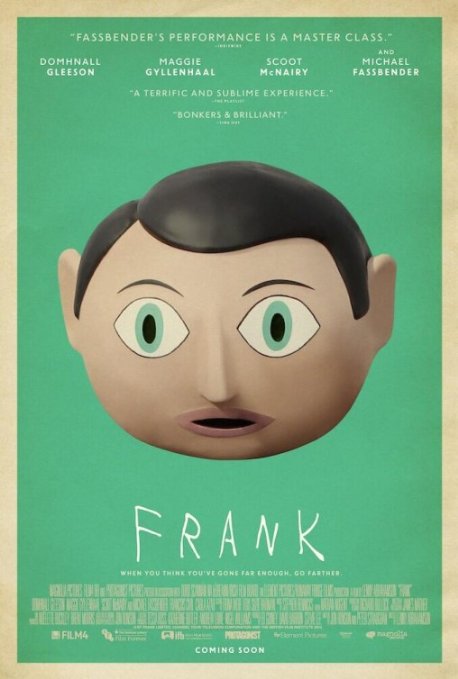
I honestly didn't know what to expect when I decided to watch Frank. I'd seen it around Netflix for a while now and the description was absurd enough to pique my interest. A comedy about a musician who wears a big, papier-mâché mask all the time. Sure, why not? Little did I know that there was a lot more to this indie flick than just its oddball premise.
Frank tells the story of Jon Burroughs (Domhnall Gleeson), an aspiring musician working day to day, struggling to find inspiration. By a stroke of fate, he finds himself as the new keyboard player for Soronprfbs, an experimental rock band led by the enigmatic Frank (Michael Fassbender), a man who never removes his giant, papier-mâché head. Together, this quite literal band of misfits travel to a cabin in Ireland to record their new album, all while Jon attempts to find his creative voice by way of following his mysterious new mentor.

The first thing that bears mentioning here is the film's sense of humor; those who don't appreciate comedy on the drier side will find little worth laughing about in the escapades of Frank and company. The majority of the comedy here is strictly situational; the whole thing feels at least partially inspired (at least tone-wise) by the films of the Cohen Brothers (one scene in particular seems like a loving homage to the infamous Folger's can eulogy from The Big Lebowski). It's dry, witty, clever, and a little off-the-wall, but I don't know if I'd define Frank as conventionally "funny". However, to focus exclusively on the comedic elements of this film would mean ignoring the dramatic elements, and that is something I simply cannot abide.
One of the driving questions behind this movie is "why does Frank wear the mask?" The more Jon comes to learn about who Frank is, the more he infers that there must have been something special, something haunting, that made Frank into the musical genius that he is. Jon comes from a perfectly average neighborhood. He holds down a boring job and lives with his parents. In his mind, he is wholly unremarkable, and that is the reason that musical inspiration eludes him. Without giving anything away, Frank is a movie which explores the ins and outs of the various masks that we all wear in our day to day lives.

The cast is as small as one would expect from an indie film such as this, the clear standouts being the three actors who receive the most focus; Domhnall Gleeson, Michael Fassbender, and Maggie Gyllenhaal. Gyllenhaal plays Clara, the band's temperamental theremin player, with venomous energy. Only once the film is over do we start to understand what makes her such an aggressively mean person, in particular to Jon. The energy she shares with Gleeson is impressive to say the least. Domhnall Gleeson is a well-rounded protagonist for the audience to latch onto; he's the outsider, the everyman, tailor-made to escort the audience through the madness of the band's ups and downs. However, Michael Fassbender's turn as Frank completely steals the show. The man is unrecognizable throughout the majority of the film, completely disappearing into the character. He always has an air of approachable mystique about him; you never quite know what's going around inside that big, fake head of his, but it's safe to assume it's something worth hearing. Make no mistake, everyone else gives a strong performance and helps to sell the overall theme of this movie, but no one does so better than Fassbender.

Frank is a wholly unique little picture. It honestly took me by surprise at just how thought-provoking it all managed to be. It's a relatable theme relayed by well-rounded characters, all set to a mysteriously endearing soundtrack. Really, "mysteriously endearing" sums up the entire movie. Frank is a reservedly good time that will make you smile and think at the same time and, though its charms may be lost on some, I simply can't not recommend it. Definitely check it out.
Subscribe to:
Posts (Atom)