Showing posts with label Pixar. Show all posts

June 21, 2018

REVIEW: Incredibles 2


It's about damn time. After fourteen long years of waiting, The Incredibles finally has a sequel. Really, I should talk briefly about the first film before we get into the nitty-gritty on Incredibles 2. Released in 2004 and directed by animation legend Brad Bird, The Incredibles turned the superhero genre on its head well before the MCU came to town. Stylish yet down-to-earth, the film was arguably Pixar's most mature film to date, earning the studio its first PG rating. I personally consider the first Incredibles to be Pixar's best film, as well as one of the greatest superhero films ever made. Suffice to say, this sequel has some big shoes to fill; Brad Bird had always said that he would never return to make a sequel unless he had a story he felt he needed to tell, a respectable display of restraint in this day and age (especially considering that Disney is involved). So after all this time, is Incredibles 2 a good movie? Yes. Was it worth waiting nearly two decades for? Ehhh...

In a move no one could have predicted, the plot picks up immediately after the end of the first film, in which we see the city of Metroville menaced by the fiendish Underminer (Pixar's good luck charm, John Ratzenberger). Naturally, the Parr family springs into action, only to find themselves arrested after their heroism causes its fair share of very expensive collateral damage. While parents Bob and Helen (Craig T. Nelson and Holly Hunter) discuss their concerns over raising three super-powered kids in a world where superheroes are illegal, they are approached with a business proposition by an eccentric magnate by the name of Winston Deavor (Bob Odenkirk). A longtime fan of superheros, Deavor would like nothing more than to see the laws keeping them underground overturned. Determined to show the supers' side of the story, he and his sister, Evelyn (Catherine Keener), outfit their suits with body cameras; the supers would go out and do what they do best, with the Deavors' considerable PR connections and insurance plans keeping their images clean. In order to get the project off the ground, Winston proposes that they lead with Elastigirl, as she's routinely caused the least collateral damage out of the bunch (which makes sense, compared to her human wrecking ball of a husband). This leaves Mr. Incredible, typically comfortable with being the breadwinner for the Parr clan, out of his element, staying at home to raise the kids while Elastigirl tracks down a new supervillain threat known as the Screenslaver (Bill Wise).


I'd like to apologize in advance, since a good deal of this Review is going to involve me comparing Incredibles 2 with its predecessor, but I feel like that's somewhat unavoidable when discussing sequels (especially sequels with such a large gap of time in between them). The first Incredibles featured some remarkably mature themes for an animated superhero film targeted at children; it's not difficult to see Mr. Incredible's complaints about society "celebrating mediocrity" as a critique of No Child Left Behind, and the stakes presented had a very real-world weight to them. Before finding out that her husband is sneaking away to play superhero, Helen has a legitimate fear that he's having an affair. Later on, she has a heart-to-heart talk with her children, in which she explains that the people they're going up against won't hesitate to kill them, if given the chance. Hot off the heels of Finding Nemo, The Incredibles was a surprisingly heavy film for Pixar (but then again, it was brought to us by the man who made The Iron Giant). It's because of this that I found myself disappointed in some respects with Incredibles 2; it's a fun time, but it feels very much conceptually watered-down. Whereas the first film just oozes atmosphere ripped straight from pulp spy stories and Golden Age comics, Incredibles 2 feels much moreso influenced by Saturday morning cartoons. It deftly avoids simply being a rehash of things we've already seen, but there isn't a single moment in Incredibles 2 that even approaches the tension, atmosphere, or emotional weight of the iconic "Missile Lock" scene from the first movie.

It doesn't help matters that the Screenslaver, despite an intriguing origin story, amounts to little more than the most recent in Disney's growing line of predictable Scooby-Doo twist villains. I won't spoil the Screenslaver's true identity, but I'll say this; I had figured it out before I even walked into the theater, simply by virtue of looking at the names of the main characters. It's a twist so painfully obvious and overly-telegraphed that I honestly thought the film was trying to pull one over on me, but alas, it really is just that simplistic. Granted, we're talking about an animated family film primarily marketed to children, but I still have a hard time believing that anyone above the age of 9 would have any difficulty in putting the pieces together before the other shoe drops. The surprise villain reveal worked well in Wreck-It Ralph and Zootopia, but it feels like this is a trope that appears in nearly every single animated Disney film released nowadays. When you go into the theater expecting a twist... well, it's not much of a twist anymore, is it? Granted, the first Incredibles had a twist villain in the form of Syndrome (formerly Mr. Incredible's number one fan, turned to a life of villainy after being rejected by his idol), but Screenslaver doesn't even come close to matching Syndrome's level of complexity and ambition. For those who need a refresher, Syndrome's evil scheme essentially involved murdering countless superheroes (both to gain revenge and to field-test his gadgets and equipment), then asserting himself as a new superhero, saving the day from threats that he himself engineered. After he grows old and retires, he plans to market his tech to the general populace, effectively making superheroes an obsolete concept; "when everyone's super, no one will be."

Screenslaver, on the other hand, basically just wants to hypnotize people into ruining the legislation that will make superheroes legal again, ensuring that they stay illegal. And that's about it.


I also have to say that I wasn't a fan of the new group of heroes introduced as part of Winston's endeavors to legalize hero work. While I usually adore the character design and art direction found in both Incredibles films, these new supers just totally missed the mark with me, clashing painfully against the already-established retro art-deco look. It also doesn't really help that, like other aspects of the film, they feel more than a little conceptually shallow. One of the strongest subtextual aspects of The Incredibles is the relationship between the main characters' personalities, roles, and powersets. Fathers are meant to be strong, so Bob can bench-press a locomotive without breaking a sweat. Mothers have a habit of stretching themselves thin to keep everyone together, hence Helen's innate flexibility. Violet (Sarah Vowell) is an insecure teenager, who wants nothing more than to disappear; her powers include invisibility and the ability to put up psychic barriers. Dash (now voiced by Huck Milner) is a hyperactive ten-year-old with super speed and baby Jack-Jack (Eli Fucile) is a polymorph with a whole host of powers, representing the unrealized potential an infant possesses. Even Frozone's powerset feels subtextually appropriate, considering he's something of a "cool" uncle to the Parr children. Meanwhile, among this new group of heroes, we have characters like Screech, who is just an owl-man. I have nothing against owls, owls are cool, but it feels like the design session for this character started and ended with the phrase "what if one of them was an owl?"

The only member of this group of second-stringers who has anything close to a personality is Voyd (Sophia Bush), an awkward and insecure fangirl who can create portals. Even though she's the only one of these new superheroes to get more than one or two actual lines, she still doesn't really have much in the way of a character arc (or even a character, really). She's just sort of there, her only purpose being to participate in one of the better fight scenes later on in the third act. If anything, I'd have much preferred to see some of the older superheroes who were forced into hiding step back into the public eye; there was a fantastic bonus feature on the DVD of the original Incredibles that I highly recommend anyone with even a passing interest in these movies check out. It really gives some insight into the level of effort Brad Bird and company put into the worldbuilding of the first movie, constructing backstories and personalities for every single superhero we only see briefly mentioned in the first film. One super is implied to have been a closeted homosexual, leaving his five adopted children in the custody of his "roommate" after dying due to a cape malfunction. Another views superheroes as a superior race and uses his good looks and charisma to seduce female supervillains before killing them on behalf of the government. Another is stated to be a recovering alcoholic. Each of these background characters are given more personality and characterization within the span of a 24 minute DVD special feature than any of these new superheroes are throughout the entirety of Incredibles 2.


With all the negatives out of the way, let's move onto the things I loved about Incredibles 2, namely literally everything else. Sure, I have my gripes, but this is still an Incredibles sequel written and directed by Brad Bird; even though this is definitely a movie with flaws, I feel like Brad Bird is the kind of person who would have to actively try to make a bad animated film. First off, the animation is absolutely stunning, really highlighting just how far the medium has come in the years since the first Incredibles. I'm not exaggerating in the slightest when I say that Incredibles 2 has some of the best superhero action ever put to screen. I wish I was joking when I say that the scene in which Jack-Jack harasses a wild raccoon is leagues better than any fight scene in the DCEU, but I'm so glad that I'm not. I praised Infinity War for getting creative with its fight scenes, but Incredibles 2 is on a whole other level when it comes to making superpowers look both cool and fun. It's so obvious that the people behind this had a ball just mashing all these different powers together and seeing how far they could push the creative envelope, all in the name of making the most visually-engaging action setpieces they could manage; there is no weak link when it comes to the action here, it's all brilliant. Even though the new superheroes are bland and half-baked when it comes to their characterization, their powersets make for some truly memorable action in the latter half of the film. Not to mention, a surprising amount of the action (especially during the Underminer sequence in the beginning of the film) is dedicated to actually saving people. You know, that thing that superheroes used to do? Right there, the film gets tremendous brownie points from me just for that; it's easy to make a superhero look cool when all you have them do is punch a bad guy, it's far more impressive when they manage to make assisting a little old lady look both dynamic and heroic.

We also get to spend more time with the Parr family, which is really the main draw here. Brad Bird's strategy of blending the fantastical with the mundane has resulted in some of the most down-to-earth and realistic portrayals of human beings I've ever seen in an animated film, naturally helped along by the stellar voicework. Even if Dash and Frozone get the short end of the stick in terms of character growth, it's still great seeing this family dynamic back in play. Craig T. Nelson and Holly Hunter knock it out of the park, bringing forth a chemistry that perfectly sells the idea that, while their marriage isn't always ideal, it's most certainly perfect in its own special way. Sarah Vowell is indistinguishable from her first turn as Violet 14 years ago, which is no small feat; if I'm being honest, she ended up being one of my favorite characters this time around. Maybe it's just that, in the time since the first Incredibles film came out (in which I could only really relate to Dash), I've been able to experience life as both a teenager and an adult, but Violet's interactions with Bob made for some of the funniest (not to mention, most heartwarming) moments in the entire film.


I remember hearing the initial plot synopsis for Incredibles 2 some time ago; how Elastigirl would be off doing hero work while Mr. Incredible stayed at home with the kids, and being terrified that it was going to fall back on the same tired old clichéd scenario we've seen a million times before. Where the dad is reduced to a simpering buffoon, horrified and baffled by things such as diapers and cooking dinner. Thankfully, the situation presented in Incredibles 2 couldn't be farther from that played-out stereotype; despite all the focus on Elastigirl tracking down the Screenslaver, I have to say that I honestly preferred the B-story about Bob bonding with the kids more than anything else. Mainly because, despite a bit of a learning curve, it turns out that he's a legitimately good parent.

 This doesn't play out like a hack sitcom, where dad is too pigheaded to admit that he needs his wife to "deal" with the children; he's Mr. Incredible, and that means he rises to the challenge, even if that challenge happens to involve learning New Math. Sure, not all of his approaches towards being a stay-at-home-parent work out (a scene in which Bob takes the kids out to dinner at a family restaurant where Violet's would-be boyfriend happens to work is pure perfection; hilarious, heartwarming, and cringe-inducing in all the right ways). And granted, he eventually has to admit that he needs a bit of help here and there (understandable when you're dealing with a baby who can phase through dimensions and shoot lasers from his eyes). But it's the sheer enthusiasm and effort he puts into being a dad that sells this storyline. Make no mistake, this is a very Elastigirl-centric movie in regards to the majority of the action and adventure, but Bob bonding with his kids is where the true heart of the story lies. It's no coincidence that this was released on Father's Day weekend, and it's great to see a cartoon dad who isn't an incompetent moron who feels "stuck" with his children. Sure, he's a little disappointed he doesn't get to go be Mr. Incredible right away, but it's made abundantly clear that he doesn't view raising his kids as a chore or an inconvenience; it takes a lot out of him, but he pushes through because he legitimately loves his family. I feel like this kind of unironic emotion is (unfortunately) a rare thing to see from father-figures in works of fiction nowadays, but if Incredibles 2 has a strong suit (or would that be super suit?), this is definitely it. 


At the end of the day, I can still safely say that I prefer The Incredibles over Incredibles 2 any day. But there's also no way I'd call Incredibles 2 disappointing or lackluster; sure, I wish it had gone for something a little more conceptually ambitious (considering how groundbreaking the first film was), but the simple truth is that I am absolutely in love with this world that Brad Bird and company have managed to create. The characters are as endearing as they are relatable, the action is fantastic, and did I mention how legitimately funny this movie is? Put simply, it's a continuing adventure in the world of The Incredibles, and that's never a bad thing, even if parts of it can feel a little watered-down. It's really a testament to how talented Brad Bird and pals are, considering something that feels like their B material easily ranks head and shoulders above most everything else we've got on the market. If it wasn't for Infinity War, I could safely say that Incredibles 2 would be an easy lock for my favorite superhero film of 2018; as it stands, the two are just about neck-and-neck, so take that as you will. No, it doesn't reach the mythic heights of its predecessor, but the same can be said of many quality films (and many quality Pixar films, at that). It's funny, it's action packed, and it's full of that patented, down-to-Earth Brad Bird charm that leaves me hoping it won't take another 14 years to get Incredibles 3 off the ground.

January 12, 2018

REVIEW: Coco


I know, this is over a month late, but Coco honestly couldn't have come out at a worse time for me; it released right around Thor, Justice League, The Disaster Artist, and Star Wars, and since then I've experienced multiple holidays, a bout of wintertime sickness, and a bomb cyclone (whatever that is). With everything I had on my plate, I just couldn't find time to get out and see Pixar's latest film until just this week (in what I'm fairly certain was the absolute last showing in my hometown). On the bright side, I'm overjoyed I got to catch this one before it left theaters (unlike some other animated films); I've been a Pixar fan from the day I was born, and it always feels weird whenever I miss the theatrical run of anything that isn't Cars. However, I'm also left with the bittersweet realization that last week's 2017 Retrospective is already outdated. I wish I had seen Coco when it released back in November, or at least before I started compiling my rankings of everything I watched last year. Had I not put it off for so long, I can guarantee that it would have landed right next to Logan as one of my favorite films of 2017; trust me, it's just that good.

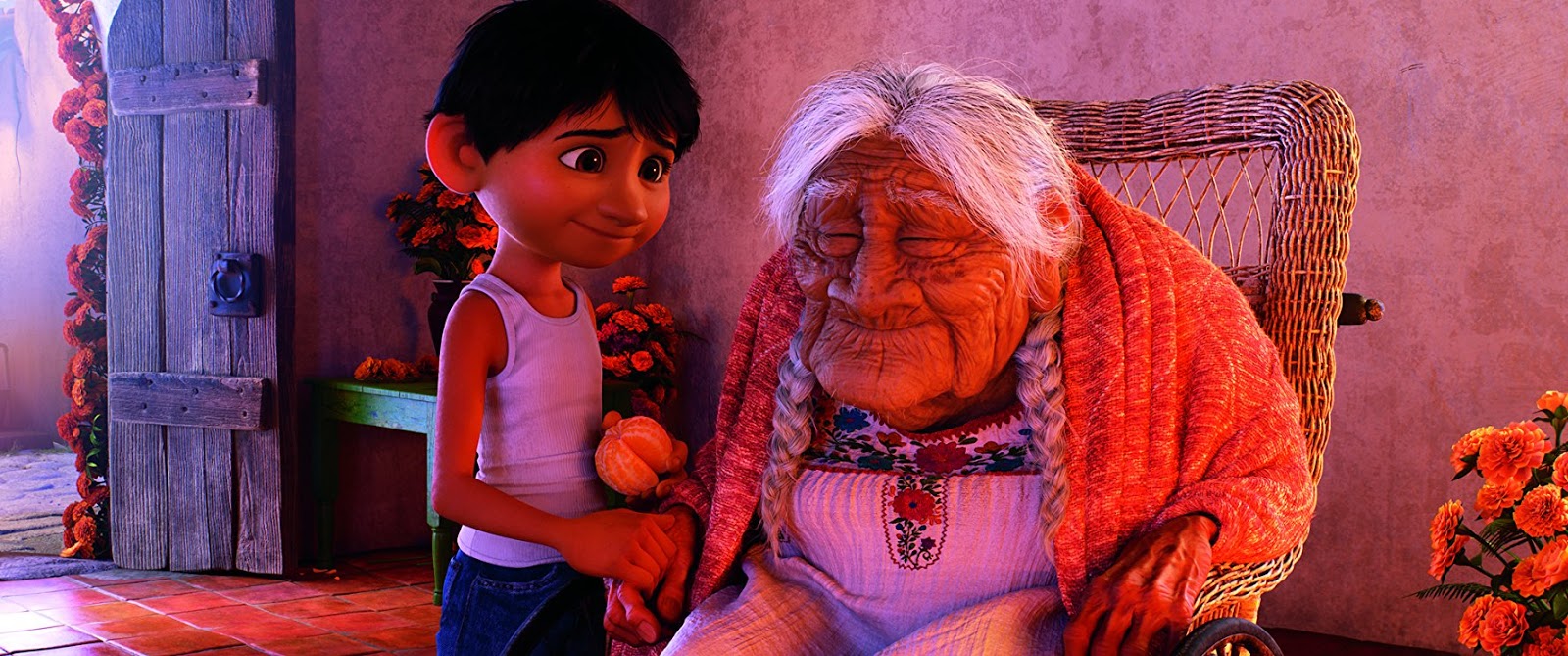
Set in the Mexican town of Santa Cecilia, the story follows a young boy by the name of Miguel Rivera (Anthony Gonzales). An aspiring musician in a family of shoe-makers, Miguel dreams of following in the footsteps of his idol, Ernesto de la Cruz (Benjamin Bratt); unfortunately for him, music has been banned in the Rivera household ever since his great-great-grandfather left his wife and child to pursue a career in the music industry. After a family spat on Dia de Muertos (The Day of the Dead, a Mexican holiday where offerings are made to the spirits of departed family members), Miguel finds himself trapped in the Land of the Dead amongst his ancestors; if he doesn't receive a blessing that allows him to return to the Land of the Living before sunrise, he'll be stuck knee-deep in the dead for all eternity. What follows is a colorful, emotional adventure that explores the messy, complicated relationship between familial responsibility and duty to one's own dreams and passions.


I'll admit, I wasn't exactly excited for Coco in the months leading up to its release. The character design didn't thrill me (particularly the choice to add eyeballs to the skeleton characters) and the plot seemed extraordinarily basic for something from Pixar. In hindsight, I wasn't being entirely fair to Coco; it works much better from a visual standpoint now that I've actually seen it in practice (to the point that it might just be the most visually-impressive Pixar film to date) and the story (as I should have expected) had much more to it than your standard "child gets lost in fantastical place, has to race against the clock and learn a lesson" plot. 

It feels like so many movies of 2017 (even ones I've enjoyed) run into the same problem of either falling into a painful slump during the second act or outright losing all steam by the time the climax rolls around; Coco, it seems, has the opposite problem. This is a film that takes quite a bit to properly get going; until Miguel enters the Land of the Dead, I was honestly getting a bit worried. The film opens with an upbeat first-person narration that doesn't return at any other point in the story, so it ends up feeling like it's specifically addressing the kids in the audience who don't know anything about Mexico. It comes off as so cheery and overly-earnest that it comes dangerously close to crossing the line into "anyone over the age of 12 is going to feel embarrassed to be watching this" territory, but that luckily all changes once Miguel is flung into the afterlife. From that point on, the film only gets stronger as it goes, culminating in one of the most emotionally-resonant third acts I've seen all year. Again, I'm referring to the same year that gave us Logan, so keep that in mind.


Despite its almost overly-kid-friendly opening, the atomosphere of the movie matures alongside its protagonist. Miguel starts off as a rambunctious, impudent kid; at 12 years old, he's right on the verge of casting off childish flights of fancy in favor of more adult responsibilities, hardly a smooth transition for most young people. The idea that, sometimes, you can't be whatever you want to be is a bitter pill to swallow, especially when it feels as though your own family is standing in the way. The conflict between Miguel wanting to become a musician and his elders wanting him to take up the family trade isn't exactly the most original, but it's how it's handled here that makes it stand out. Unlike The Last Jedi, this is a movie where characters actually sit down and talk with one another; both sides make valid and flawed arguments, and sometimes they don't reach a consensus that makes everyone happy. It's not an ideal situation, but the emotions at play make it a relatable one; whether or not we agree with these characters' stances, we can 100% understand and sympathize with how they came to these conclusions, and that attention to detail makes all the difference in the world.

As the plot continues and the tone grows more somber, we see the shift in Miguel's priorities (as well as those of his ancestors, who want nothing more than for him to give up his dream of being a musician and return safely to the Land of the Living). Every character has a lesson to learn, so the message of the story never feels one-sided. We don't get a moral that reads like a lecture ("Always listen to your elders, they know what's best for you"), but we also don't get a moral that feels like a cynical appeal to a sense of prepubescent rebellion ("Up yours, old man! What the world really needs is to learn how to dance!"). Instead, we get something more in the middle; you should always be willing to do anything for your family, but your family should never be willing to let you give up on your dreams. Instead of feeling wishy-washy, it strikes just the right chord, presenting two flawed-yet-understandable arguments and reconciling them in classic Pixar fashion.


I suppose I should talk about what inspired me to give Coco a watch after over a month of procrastination. While I was off seeing Justice League like a sucker, my compatriots at The Long Run Podcast went to see Coco (side note, fellas, what gives? Y'all had a month-long head-start on me and I put out my Coco Review first? Get it together). Their reactions floored me; here I was, looking at a movie I expected to measure up alongside Pixar's more lukewarm entries like Brave and The Good Dinosaur, only to be told that this was the most emotionally-impactful Pixar film since Toy Story 3. That this movie contains scenes as tear-jerking and sob-inducing as the first 5 minutes of Up. That, not only was this one of the best films Pixar has ever put out, but that it was one of the best films of the year. So yeah, high praise.

I entered the theater, expecting some of those good ol' Pixar feels. I left not-quite two hours later, whistling mariachi music and trying to hide how hopelessly bleary my eyes has become. I need to reiterate, this is not your stock plot about an average kid who no one understands. This is a tale about life, death, family, tradition, and legacy. It's a story about how what we amount to, at the end, is the memories we leave behind with those we've loved in life. Coco pulls no punches and goes right for the jugular; when you're sitting there during the third act, quietly weeping into your popcorn, you can rest easy knowing that Lee Unkrich and company have earned every single teardrop.


I won't mince words; Coco is my second-favorite film to come out in 2017 and I hate that I procrastinated so long in seeing it. It's a true masterpiece, one of Pixar's best (which, despite a few less-than-stellar entries, still remains high praise for any animated feature). The music is incredibly well-crafted, even by Disney standards (and then there's Remember Me, which is so thematically brilliant it's on a whole other level). And that's to say nothing of the art direction and animation, which is just spellbinding to look at, bursting with vibrant colors and liveliness. I'm not sure if this is standard for all screenings, but there was a lovely little bumper before the film began in which several of the filmmakers showcased how much work it took to animate certain shots and sequences, before thanking all of us for coming out to see Coco in an actual movie theater. It really offered some insight into the process of modern animation and helped remind me that, even though Disney is a company with essentially bottomless resources, movies like Coco are still the cumulative result of mountains of individual care, effort, and imagination. 

If you haven't seen it by this point, I'm afraid you might be out of luck for a theatrical screening (like I said, I just happened to luck out and catch the final show in my neck of the woods), but in hindsight, I'd say that Coco is worth the effort. If you can find a theater that's still showing it, take the journey and settle in for a lovely time. I came away from it feeling like I did after seeing Inside Out; in that it gave me a good cry that I didn't know I needed to have until I'd had it, and I feel like that's the true magic of Pixar movies. To clarify, this isn't a good movie because it made me cry; the same result can be achieved with a swift kick to the groin or a hefty ball of wasabi. No, Coco is a good movie because it earns its emotional response without feeling cheap. You can get cheap tears as easily as you can get cheap laughs; it's sad when an animal dies in the same way it's funny when Melissa McCarthy falls down some stairs. But when we have a genuine, emotional reaction to the experiences of the characters on screen; when we form a connection to what we're seeing and these fake, imaginary people cease to be cartoon characters and become real, that is when you can rest assured that true artistry is taking place.

June 18, 2016

REVIEW: Finding Dory


It's been said that the problem with film as an art is that it's a business, while the problem with film as a business is that it's an art. If something is financially successful, you can be sure to see more of it; see Michael Bay's Transformer movies. Finding Nemo was a charming entry from Pixar's golden age (odd how we live in a time where "Pixar's golden age" doesn't range from the release of Toy Story to present day, but I digress); a successful classic in every sense of the word. It in no way required a sequel, seeing as how everything was wrapped up in a neat little package by the time the credits rolled. However, thirteen years and a couple billion dollars later, here we are with Finding Dory, a follow-up that essentially no one asked for. It's a film placed in a curious position; without a doubt, Finding Dory would not exist today if Nemo somehow turned out to be a box office dud. The original film was clearly not made with the intention of starting a franchise. When a film like Finding Dory comes along, a sequel that doesn't necessarily need to exist, it must fulfill at least one of two criteria in order to justify its existence; the first and most obvious is to introduce something new and original that expands upon the world of the first movie. The second is to prove itself as an enjoyable film in its own right. While Dory struggles with the former, it definitely succeeds at the latter.


The plot should be familiar to anyone who's seen Finding Nemo. After the amnesiac Dory (Ellen DeGeneres) recalls vague snippets of her early childhood, she realizes that she became lost from her family years ago and decides to set out and find them. With the help of Marlin (Albert Brooks) and Nemo (now voiced by Hayden Rolence), she journeys to California's Marine Life Institute in search of her long-lost parents and home. While it's a fun adventure with plenty of great new characters (the clear highlight being Ed O'Neil as Hank, a curmudgeonly octopus), I couldn't help but draw parallels between the plot of this film and the plot of Finding Nemo. There's a spooky action sequence where our protagonists are chased by a glowing monstrosity, there's a running gag involving comedic relief characters who hang around a harbor and repeatedly shout their catchphrase, there's a general anti-captivity vibe to the whole thing, characters are transported about via bird; I could go more in-depth with this, but this is definitely a sequel that takes the "same, but different" approach to story structure. Whereas a movie like Monsters University gave us a whole new movie with a whole new message that just happened to feature the same characters we've come to know and love, Finding Dory definitely plays it a lot safer. It's not a total retread, but the value here isn't exactly to be found in the plot.


Right from the get-go, the film places immediate emphasis on Dory. What was once the clear comedic relief in the first film is immediately given a much more tragic spin. Make no mistake, Dory's short-term memory loss is no longer a hilarious quirk; here, it is treated like a genuine mental illness, and it's honestly quite heartbreaking to watch within that context. Unfortunately, Marlin loses all character growth he'd gained over the course of the first film, remaining the brash, cowardly foil to Dory's more aloof savant, but the degree of characterization we're given for her here more or less balances things out. If Dory wasn't your favorite part in the first movie, she's definitely more endearing here (which is to be expected I suppose, seeing as how she's the main focus this time around).

As strong as DeGeneres' performance is here, I'd be lying if I said the new characters we meet weren't my favorite aspects of the entire movie. There's Fluke and Rudder (voiced by The Wire alums, Idris Elba and Dominick West), a pair of cockney sea lions who essentially serve as less one-note surrogates for the seagulls from the first movie. We also meet Destiny (Sweet Dee herself, Kaitlin Olson) and Bailey (Ty Burrell), a nearsighted whale shark and a neurotic beluga who live in the Institute; the two have great comedic chemistry and the worst thing about their inclusion here is that we hardly see enough of them. As I mentioned before though, the clear breakout here is Hank, the seven-limbed octopus (or more accurately, "septopus"), voiced by Ed O'Neill. This character was just great, world-weary and ill-tempered, an excellent match for Dory's blind optimism. O'Neill and DeGeneres work together sublimely, resulting in some of the best moments and funniest lines out of the entire movie. Not to mention, the animation employed on his fluid movements and on-the-spot camouflage abilities exemplify the absolute best visuals in an already gorgeous movie. The film sticks a bit too close to its predecessor, but its strongest moments definitely come from when it branches out and revels in trying something new.


Finding Dory is a movie that doesn't really need to exist. There were no real burning questions or loose threads at the end of the first movie, and it's clear that the only reason this film came to be is because we all love these charming, memorable, supremely profitable characters. Motivations for its inception aside, however, Finding Dory justifies its existence by being a fun, charming, sweet movie in its own right. While it does play things a little too safe and at times toes the line of being a retread of Finding Nemo, I still found it to be an enjoyable time. I didn't leave the theater unhappy in the slightest, and that's really all I can ask of a film. It's nothing groundbreaking, especially for Pixar, but it certainly wasn't disappointing or aimless. If you're looking for something gorgeous and funny with a surprising amount of heart, Finding Dory certainly fits the bill.

March 4, 2016

REVIEW: The Good Dinosaur


Despite the concept of a Pixar film about dinosaurs being a literal childhood dream come true, The Good Dinosaur ended up being one of the more low-profile releases of last year. Following the monumental success of Inside Out is hardly an easy position to be in, especially when it found itself sandwiched between the final installment of The Hunger Games and the yearly onslaught of holiday fodder. Wholly under-promoted following a troubled production, the film made lackluster numbers at the box office and disappeared quietly back into Inside Out's shadow. In my opinion, a fate undeserved; while The Good Dinosaur is hardly Pixar's strongest feature, I feel as though it is easily one of the studio's most visually impressive (and possibly most daring) films to date.

The setup is delivered within the opening moments of the film; what if the meteor that wiped out the dinosaurs... missed? Rather than face extinction, the terrible thunder-lizards continued to evolve and develop in a similar fashion to early man, forming farming communities and cultivating the land to suit their needs for survival. Our story focuses on Arlo (Raymond Ochoa), the cowardly runt of a family of apatosaurs who grow crops on their meager homestead. After an accident concerning a feral caveboy (Jack Bright) sends Arlo floating downriver, he's forced to join forces with the troublesome critter in order to survive. Dubbing the neanderthal "Spot", the two try to make their way home, all while facing that eternally merciless gauntlet which is Mother Nature.


Right off the bat, detractors will point out how this plot is similar to so many Pixar films which came before it. Toy Story, Toy Story 2, Finding Nemo, and even Inside Out, released the same year as The Good Dinosaur, all focus on an unlikely pair or group trying to find their way back to where they belong. It's reasonable to say that it's a formula for the folks at Pixar by this point, though I see no real issue with continuing the trend so long as they continue to make it work as consistently well as they're able to. "Road trip" is a fairly broad label to apply to such a number of films; there is a journey involved, yes, but the actual adventure takes a backseat to the emotions at play. This is a film about loss, forgiveness, acceptance, and overcoming one's fears. Above all, this is a film about a boy and his dog (even though the dog in this case is a human being).

Make no mistake; while The Good Dinosaur doesn't quite reach "Toy Story 3 incinerator scene" levels of dire, this is a strong contender for Pixar's heaviest film to date. Our adorable protagonists are constantly battered and bruised and death is a ever-present danger out in the wild. While nature itself is the primary antagonist at play here, there are still a number of unseemly characters introduced who have absolutely no qualms about attempting to murder and/or devour Arlo and Spot. While I enjoyed the backwoods charm of the cabal of cattle-rustling velociraptors, I must call particular attention to the band of fanatical pteranadons led by Steve Zahn, channeling a legitimately threatening mix between a cult leader and a serial killer.


I found the tone of the film to be heavily reminiscent of the works of Don Bluth; while there are moments of very well-executed comedy and whimsy, this is very much a film that takes itself seriously for the most part. Despite the cartoony design of the cast, the near-photorealistic environments give everything a heightened sense of grit. Arlo is soft and thoroughly huggable, but when he bruises himself after slamming into a rock, we are able to feel the impact. This is a world which has genuine weight to it in every sense of the word. I honestly cannot gush enough about what a feast for the eyes this movie is. We live in an age where CGI films are commonplace; it feels as though a computer-animated feature can't be considered impressive anymore unless it manages to think outside the box in regards to its aesthetic, such as with The LEGO Movie. This is a film that, instead of using the technology available in a new and interesting way, simply generates some of the most stunningly gorgeous visuals I've ever seen in a film of this kind. I'm not sure if I've ever let out an audible gasp in response to a shot of running water before, but The Good Dinosaur might just be the prime example from this point on.


As I mentioned, Steve Zahn is wonderfully intimidating as Thunderclap the pteradactyl, and I really enjoyed Raymond Ochoa as Arlo. It's a role that very easily could have been grating and irritating had the wrong voice been cast, so it's a good thing to note that our primary protagonist is endearing until the end. The highlights by far, however, had to be Jeffery Wright as Henry, Arlo's father, and Sam Elliot as Butch, a raspy tyrannosaurus patriarch who ranches longhorns. Both exude grizzled, distinctly paternal wisdom with every line, really helping to seal the country-fied tone the film has going for it. As dark as things get, this is a film rife with feel-good moments of growth and responsibility, like a southern coming-of-age novel that happens to star talking dinosaurs.


All in all, I find The Good Dinosaur to be one of Pixar's most underrated works of all time. Though the plot tends to meander and not all children may be endeared to its rough, emotionally-heavy tone, I found it to be a rewarding experience all the same. It has its flaws, but it also represents significant risks taken by a studio that could easily live comfortably off of lackluster Cars sequels until the heat-death of the universe. While it's not perfect, I feel as though the risks taken in terms of story and tone paid off, resulting in a powerful, heartfelt, and visually gorgeous film. It's hardly destined to be anyone's favorite Pixar movie, but I strongly believe that, despite all the production issues and meager box office earnings, The Good Dinosaur is most definitely a good film.

June 19, 2015

REVIEW: Inside Out


It's been a long time since I've actually been really excited to see a Pixar movie. Monsters University was fun and Brave was gorgeous, but we haven't really had that classic kind of Pixar film since Toy Story 3; the studio really needed a return to form. Something packed chock full of that patented Pixar emotional punch that resonates with kids and adults alike. Something that would make you laugh, make you cry, and wrap everything up with an honest but comforting message that manages to be totally universal without sounding clichéd or contrived. If you've felt the same way, then it gives me great joy to say that Inside Out is most definitely that return to form.

The story follows a young girl by the name of Riley (Kaitlyn Dias); as the film opens, we see her as a newborn infant in her parents' arms. She begins cooing and gurgling as babies do, and we witness the birth of her first real emotion, Joy (Amy Poehler). Without warning, Baby Riley suddenly bursts into tears; it's here that we see another emotion has joined Joy inside Riley's head, Sadness (Phyllis Smith). Over time, more and more emotions join the two in Headquarters; Fear (Bill Hader) keeps everyone safe, Anger (Lewis Black) ensures everything is kept fair, and Disgust (Mindy Kaling) prevents Riley from being poisoned (both physically and socially). Riley grows up a normal and happy human girl; Joy usually runs the show and Sadness rarely gets to touch the control panel that dictates Riley's moods and actions. However, everything is thrown out of whack after the family moves from snowy Minneapolis to San Francisco; Riley finds herself in a new town, living in a new house, and going to a new school. Everything is strange and different, her friends are all back home, and her parents appear visibly stressed for the first time ever. While everyone at Headquarters attempts to keep Riley happy, an accident causes Joy, Sadness, and a bundle of Core Memories (which determine the primary facets of Riley's personality) to be flung deep into the recesses of Riley's mind; without Joy or Sadness, the young girl's personality is dictated exclusively by Anger, Fear, and Disgust. While Riley adjusts poorly to her new surroundings, it's up to Joy and Sadness to find their way back to Headquarters before Riley's life completely crumbles around her.


The first thing you'll notice is the absolutely flawless casting on display here; who better to portray personified anger than Lewis Black? It feels as though each one of these characters was written specifically with each of these actors in mind, considering how everyone completely disappears into the role. Amy Poehler and Phyllis Smith get the most attention out of the primary ensemble, so it only makes sense that they'd be the clear standouts here. It's by no means a new concept, the two mismatched opposites on a great journey, but the context of who these two are and what's at stake manages to make their relationship a really interesting one. At first glance, Joy is objectively positive while Sadness is objectively negative; while this is somewhat true at face value, nothing here is totally black and white. While Joy is literally responsible for allowing Riley to feel happiness, she can be a little shallow, treating Sadness with utter condescension most of the time. While Sadness usually causes doom and gloom, she's also the most down-to-earth and empathetic of all Riley's emotions. If you're noticing the subtext here (in that the descriptions of these characters can also be easily applied to the emotions they represent), you'd best get used to it, since that kind of underlying definition is this movie's bread and butter.


The group of emotions are by no means the only inhabitants of Riley's head; there are various blue-collar workers who keep the lights on and make sure everything's up and running, as well as an entire movie studio that produces dreams (or nightmares). There's also Bing-Bong (Richard Kind), Riley's forgotten imaginary friend. Special praise needs to be given both to the filmmakers and to Kind, seeing as how this character is definitely one of the major highlights of the film. He's utterly ridiculous when it comes to his appearance and his mannerisms, but his thoughts and motivations feel very real and nuanced; you can't really get a bead on him until you finally come to understand him and what he wants. I can't speak for anyone else, but I was really surprised by this character; both by his role in the story and by just how much he adds to the whole picture. If I say anything else I'm definitely getting into spoiler territory, so I'll just reiterate that Bing-Bong is fantastic.

I had high hopes for this movie the second I heard the premise; this is a movie about how Joy and Sadness are present in every life. The two emotions are linked; in order for us to feel happy, we sometimes need to feel sad. Sometimes sadness can lead to happiness, or vise-versa. The human experience isn't composed of absolutes; we are complex, fluid beings who change and evolve over time. Things that once made us laugh may eventually make us cry; times of hardship and sorrow may be remembered fondly when we think of the comfort and growth that those hard times brought down the line. This is the kind of message that we are given by Inside Out. This is a movie that tells us that it's not only okay to feel sad sometimes, it's actually healthy. It's the cinematic equivalent of a warm blanket, and good lord does it feel nice.


Inside Out manages to be everything I wanted it to be and more. From the compelling story to the gorgeous animation to the amazing subtext behind it all, this is Pixar firing on all cylinders for the first time in years. So much thought and imagination clearly went into this film and the way its portrayal of the human mind works, it's impossible to not find something to love here. If you're looking for a Pixar film that's less Cars 2 and more Up, definitely give Inside Out a watch; this is one that'll be remembered for a long, long time.