Showing posts with label anime. Show all posts

August 27, 2018

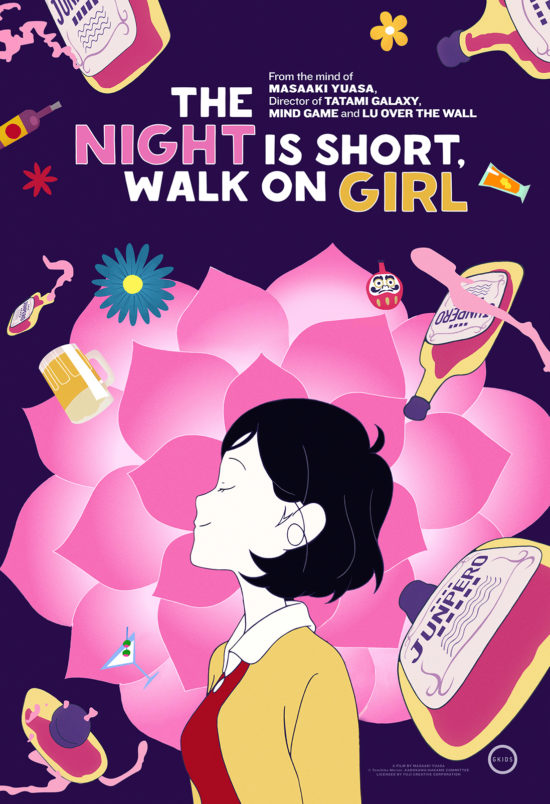
REVIEW: The Night is Short, Walk On Girl


For as much as I like to say I enjoy anime, the irrefutable truth of the matter is that I'm basically just a novice; I've watched Fooli Cooli and Gurren Lagann  a couple of times and I'm currently enjoying My Hero Academia, but it's safe to say that there are vast parts of the medium that I still need to explore. I was, for example, completely unfamiliar with the work of Masaaki Yuasa; that is, until I decided to check out The Night is Short, Walk On Girl (loosely adapted from the Japanese novel of the same name). I saw the trailer on Facebook just by chance (or perhaps it was fate), but the fluid animation, whimsical art design, and catchy music told me that I just had to go check this one out (especially since it would be in US theaters for two nights only). 90 minutes later and I'm not only convinced that I need to seek out the rest of Yuasa's work, but that The Night is Short, Walk On Girl is my personal pick for the best movie of 2018 (even though it was technically released in 2017, though only in the UK and its native Japan).

The plot is, shall we say, difficult to describe. This is one of those situations where I feel as though I'd be walking a fine line between describing the premise and simply recounting every scene; it's very much like Alice in Wonderland or The Wizard of Oz, where our protagonists move from situation to situation, encountering a host of unique characters as they go on their journey. The film follows a nameless girl with black hair (typically just referred to as Otome, the Japanese word for "maiden", and voiced by Kana Hanazawa) on a night of heavy-drinking through Kyoto. Meanwhile, a similarly nameless classmate of Otome's (referred to as Senpai, voiced by Gen Hoshino) is determined to confess his feelings towards her on this fatefull night. As he explains, he's implemented a long-term plan of crossing paths with Otome as often as he can manage, under the guise of their encounters being sheer coincidence. When the time is right, he will reveal his true intentions and it will seem as if the two had always been intertwined by the red string of fate. What follows is a delightfully charming, psychadelic rom-com that utterly annihilated my expectations in the best sort of way. This is just one of those movies that feels like a vivid dream, boasting the kind of atmosphere I'd like to curl up inside of for the rest of my life.


While the movie is, aesthetically-speaking, undeniably gorgeous, the real draw for me was the thematic subtext underneath it all. This is one of those films that focuses in on that sort of "quarter-life crisis" that twenty-something college students tend to go through. We've seen so many coming-of-age stories, but what happens after the protagonists have already grown up before the plot truly began? We're told from high school onward that we're "young adults", but that feeling honestly didn't kick in for me until after I'd completed my undergrad, got a job, and moved into a place of my own. For those who go right from high school into college, the question of what comes after is something that really starts to weigh on you after you get acclimated. We act like the transition from high school senior to college freshman is a massive change, but it's really nothing compared to spending the first 22 years of one's life adhering to a more or less consistent system of schooling and socializing, only to finally cross the finish line into the stage of your life when you have to start thinking about taxes and rent and insurance. You get your degree, then what comes next? Graduate school? A career? Or just another job to pay the bills? Should you get married? Start a family? Buy a house? Do you even have the means to do any of those things? These are all the questions you start to mull over as you begin to fully and finally transition into the adult world, and said questions tend to weigh heavily on the minds of chronic over-thinkers like Senpai (or myself, for that matter).


The character of Senpai manages to transcend the usual "awkward nerd who's hopelessly smitten with the girl of his dreams" trappings by really delving into his mindset. He isn't just another gawky buffoon in pursuit of his manic pixie dreamgirl; he's insecure to the point that he outright questions if he even deserves to have his insane plan work out, or if it would be more fitting that he just shrivel up and die alone. He's become accustomed to failure, putting up walls to protect himself from the terrifying idea of what might happen if he actually gets what he wants for once, the only outcome he's completely unprepared for. Otome, meanwhile, is in the exact opposite situation; she's naturally talented at everything she tries, resolved to simply go with the flow and see where the night takes her. While she hardly has to put in any effort in order for things to go her way, she's left with a life that, compared to Senpai, lacks any semblance of drive, ambition, or purpose. The film establishes that her easy-breezy attitude towards life tends to leave those around her in the dust, leaving her with her own kind of loneliness to deal with. They're two sides of the same coin, yin and yang, but that doesn't mean they don't need to grow and change in their own ways before they're fit to be together.

The film hypothesizes that who we are is but an amalgamation of those we meet in life; whether we know them for the rest of our days or just for one drunken evening, the impact and influence they leave us with is what determines who we are and how we grow as people. The emotions these people inspire and the stories they leave us with are the things that life is made of. Feelings of isolation, loneliness, and disassociation are hardly rare for young people, especially those who find themselves in the midst of a great transitory period in their lives, and The Night is Short, Walk On Girl goes to great lengths to remind us that no man is an island. Whether you believe in fate or not, your existence is immutably intertwined with those around you (and even those you've yet to meet). We're all players in the funny, tragic, oddball play that is the human race; everyone matters, no one is truly alone, and happiness will always inevitably win out over nihilism.


Although it's obvious that the underlying motifs this movie set forth resonated with me on a deep emotional level, I want to make it clear how much I adored everything else in this movie. Like I said before, the animation is absolutely stunning (putting Masaaki Yuasa on my radar in a big way) and I really love the use of color and sound to establish a sensory experience that's at the same time fantastical and immersive. As the night goes on, an entire year seems to pass; we begin on a warm spring evening, transition into summer heat, and by the time the climax rolls around, all of Kyoto is stuck inside with the flu as unforgiving winds and snow rip through the empty city streets. I also found myself surprisingly invested in the stories of the various side-characters Otome and Senpai come across, absurd as they are. My personal favorite would have to be Don Underpants ( Ryûji Akiyama), a writer and hopeless romantic who has pledged to not change his underwear until he reconnects with a girl he had a fated encounter with some time ago. At first we assume he's just there for a one-off joke about his self-appointed nickname, but then he shows up again much later on, setting up guerrilla plays at the student festival as a means of attracting his mystery love's attention. These side-characters are all bit players compared to our two main leads, but their stories are told in such a way that it truly feels as though the plot thread doesn't end the moment they walk off-screen. We really get the feeling that this isn't just an extraordinary night for Senpai and Otome; everyone has their tale to tell, and that's really the entire message of this movie in a nutshell.


The Night is Short, Walk On Girl is really just a remarkable little movie. It's a surprisingly conventional, feel-good love story that's conveyed in the most unconventional of ways; pair that with sublime animation, supremely comfy atmosphere, a killer soundtrack, and loads of endearing and memorable characters, and you've got a winning recipe for my personal favorite movie of 2018 thus far. Yes, I know, it technically came out in 2017 everywhere but the USA, but I'd be outright lying if I said that, out of everything I've seen in theaters this year, The Night is Short, Walk On Girl wasn't my favorite. If it wasn't clear already, I absolutely adore this lovely, lovely film and would like nothing more than to just immerse myself in all the charm and good vibes it's constantly putting out. If you're a fan of anime or animation in general, you owe it to yourself to give this one a watch.

July 22, 2018

REVIEW: Redline


I've been on something of an anime kick as of late (getting up to speed on both Konosuba and My Hero Academia in less than a week), so it felt appropriate to finally tick off a film that's been sitting in my backlog for a good couple of years now; 2009's Redline. I normally tend to avoid summarizing movies as "X crossed with Y", but I simply can't help myself in the case of Redline. This is Speed Racer crossed with Wacky Races in the style of Mad Max: Fury Road, but in space. It's a film every bit as absurd as that description, more than making up for what it lacks in plot with some of the most stunningly engaging animation I've ever seen.

Set in the far reaches of space, the film follows "Sweet" JP (Takuya Kimura), a rockabilly racer with a checkered past whose driving skills are nearly as impressive as his pompadour. When JP finds himself voted in as a participant in the titular Redline race (a highly anticipated annual event using traditional motors only), he can't help but say no, even though the race is set to be held on the aptly-named Roboworld, a planet populated entirely by cyborg zealots. The president of Roboworld (Kōsei Hirota) is staunchly against hosting the Redline on his planet, as he fears the broadcast of the race could reveal a number of illegal military operations (which would undoubtedly violate a great number of treaties); as such, he has pledged to terminate any and all racers he finds on his planet. As if that wasn't enough, JP is oblivious to the treachery of his longtime partner, Frisbee (Tadanobu Asano), a mechanic who's gotten in deep with the mob. Not only does he need to win the Redline, he has to survive, all while pursuing the heart of fellow racer, Sonoshee McLaren (Yû Aoi). It's a romance/drama/action/sci-fi extravaganza and I honestly had so so much fun with it.


I tend to use the term "feast for the eyes" regrettably often whenever it comes to discussing animated films, and Redline is definitely no slouch when it comes to visuals. I love everything about the way this movie looks, feels, and moves. The character designs are imaginative and endearing, never getting too silly or outlandish so as to distract from the action. Along with JP and Sonoshee, we have a dirty-cop gorilla man (chasing after the other participants for speeding, naturally), a pair of bounty hunters that definitely aren't parodies of Batman and Robin, and a well-mannered robot who literally is his own car (among others). It feels trite to say something like "this film is bursting at the seams with pure imagination", as if something as abstract and subjective as imagination could be measured, but I really can't think of a better way to express myself here. It's an animated feature that most definitely leaves a big impression. There are obvious influences from existing works (see the initial Speed Racer/Wacky Races/Mad Max comparison), but it's got its own distinct identity as well. The designs of everything from the racers to their vehicles to the various planets themselves are just so vivid and creative; it's one of those films like Wizards or Fantastic Planet, where I just want to completely immerse myself in the art direction and design.

With such fantastic designs, it should go without saying that the animation here is also top-knotch. I don't know if I've ever uttered, "wew, that looked expensive" at an animated film as often as I did with Redline. According to my rudimentary research, the film was in production for some seven years, and took over 100,000 individual drawings to complete; rest assured, the final project looks it. I especially loved the fish-eye effect used to convey mind-blistering speeds (a winning combo when paired with JP's towering hairdo). If you're into psychadelic visuals like those found in FLCL or Yellow Submarine, you'd be doing yourself a disservice not to add Redline to your "must watch" list.


If I have any real criticism, it simply has to do with the plot. Redline is by no means a complex or thematically-heavy movie; there's a race, our main character wants to win said race, said main character drives really really fast. That's about it. It's most definitely more about the visuals here than it is the plot, which I honestly feel is somewhat forgivable, given the circumstances. The entire plot of Redline focuses in on this one race, and damned if it isn't one hell of a race. It doesn't attempt to be anything more than it is by spouting off pseudo-intellectualisms in an attempt to trick the viewer into thinking that there's anything close to a healthy balance between style and substance. This is a film that 110% knows what it is about, and I honestly respect that. The filmmakers knew that they were making a movie about really cool-looking cars that drive really quickly across stunningly-detailed alien planets, and that's exactly what we get. 

Even then, with how simple the plot is, I found myself surprisingly invested in the drama between JP and Frisbee; the film does slow down at points to give us some insight into their history together, allowing us time to breathe between the insanely engaging action beats. For as simplistic as the plot is, the character interactions are given a good amount of attention (at least moreso than one might expect with a project as visually-focused as this). The time we spend with our main cast isn't just a formality before we can get back to the fast cars and hellacious crashes. Rather than having the characters outright state what their motivations are, the audience is left to piece everything together from implicit details after the credits roll; some might call this lazy, I call it efficient. Both the film and the audience are on the same page, the movie's strongest suit is the manner in which it liberally doles out speed and adrenaline. Additional exposition would have just weighed everything down, so I appreciate the film's confidence in its audience to figure out why certain characters act the way that they do without spoon-feeding it to us, getting in the way of the main event in the process.


I don't really have much else to say about Redline. It's an awesome little flick. If you're a fan of animation (or anime specifically), consider this mandatory viewing; the same goes for those of you who are into cars. It's not an overly-complicated movie, it's just an all-around good time. The plot isn't much to write home about, but Redline more than makes up for its lack of subtextual depth with its positively stunning animation and art direction; watch it on a big screen with a good sound system and all the lights turned off, it'll blow you away.

May 26, 2018

REVIEW: Batman Ninja


Outside of the realm of comic books and video games, it's fair to say that DC is in big trouble. With their awkward attempt at a shared universe film franchise knocking on death's door and their home-video animated releases hosting one of the worst things I've ever seen, it's safe to say that the executives at Warner Bros simply don't know what to do with the timeless heroes and villains of Detective Comics. We live in an age where the best Batman movie of the past half-decade stars a bunch of animated LEGO toys; they couldn't even get The Killing Joke right, weighing down the whole experience with uncomfortable romantic subplots, camp gay stereotypes, and embarrassingly sloppy animation. When it comes to DC properties, if it's not a comic book or video game, I've got little reason to be excited for it. But then, out of nowhere, we get a new direct-to-video release. A co-production between WB and a handful of notable writers, animators, and producers from Japan's anime industry. This is Batman Ninja, and it's goddamn crazy.


The film opens at Arkham Asylum, where we see the Bat-Family trying to put a stop to Gorilla Grodd's (Fred Tatasciore) latest scheme. It seems that the super-intelligent ape has built a time machine, which he promptly uses to fling the Dark Knight (Roger Craig Smith) back in time to Feudal Japan. It's here that Batman learns that he wasn't the only one sent back to the past; a number of his greatest enemies took the trip as well, and have since established themselves as daimyōs, each controlling a different section of the island. Most notable is the Joker (Tony Hale), who keeps Grodd's time machine locked away in his towering castle; if the Clown Prince of Crime is able to defeat the other daimyōs and unify Japan under his rule, the entire course of history will be changed. It's up to Batman, Catwoman (Grey Griffin), and the rest of the Bat-Clan to stop the villains, saving Japan (and their future) in the process.

Comparing Batman Ninja to other recent efforts from Warner Bros Home Entertainment (such as Batman & Harley Quinn and The Killing Joke), the difference is night and day (and not just because of the obvious cultural shift). While those efforts both featured the talent of industry veteran Bruce Timm (who, along with Paul Dini, spearheaded the DC Animated Universe of the late 90's/early 2000's), his talent felt very much squandered. Compare that to Batman Ninja, which comes to us from Takashi Okazaki (the creator of/character designer for Afro Samurai), Junpei Misuzuki (a producer on Jojo's Bizarre Adventure), and Kazuki Nakashima (a writer for Kill La Kill, Kamen Rider, and my personal holy grail of anime, Gurren Lagann). If none of those names or titles sound familiar to you, then you may want to reconsider giving Batman Ninja a watch. Simply put, if you haven't seen at least one of those series I just mentioned, you're not the target audience for this film.


I am a huge fan of how crazy things can get when it comes to anime; my favorite anime of all time, Gurren Lagann, is about robots that are powered by machismo who throw galaxies at each other. I want my anime to get crazy from time to time. That said, there are some moments in Batman Ninja (specifically during the final 30 minutes) that are even a bit too ridiculous for my tastes. The premise itself is an insane idea, the kind of thing I'd have come up with when I was seven, hopped up on Fun Dip and Tang, bashing my Batman and Power Rangers toys against each other on my bedroom floor. I absolutely hate to use the old "just turn your brain off" excuse for anything, but when it comes to Batman Ninja... well, what did you expect? Were you looking for high art? For something as politically-charged as The Dark Knight Returns, or as engrossing as Whatever Happened to the Caped Crusader? This is a movie where Nightwing (Adam Croasdell) looks like a cross between Vegeta and Sasuke and the Joker pilots a moving castle with a pair of robotic arms. It's absolutely nothing more than an excuse to see Batman and his assorted cast of characters duking it out in a Feudal Japanese setting, and it's awesome.

Right off the bat, the most striking thing about this film is its art direction and animation. Okazaki's interpretations of these classic DC heroes and villains feel both familiar and wholly original, lending themselves wonderfully to the style of animation on display. It may take a moment or two to get used to everything looking like the opening to the first part of Jojo's Bizarre Adventure, but once you adjust, you can fully start to appreciate just how gorgeous this movie really is. It's a far-cry from the stilted, lifeless, and often off-model animation seen in the more recent DC home-video releases; everything here is colorful, expressive, and just bursting with detail without appearing at all overwhelming or busy. It's a distinctly home-grown Japanese spin on a Western property that feels right at home against the Feudal backdrop in which our story takes place. And that's not even mentioning the action. Oh ho ho, the action.


It's not at all an exaggeration to say that Batman Ninja has some of the most exciting, engaging, and just flat-out badass action I've seen from any DC movie, let alone their efforts from the past decade or so. The use of CGI allows for animators to operate with a greater deal of versatility than they would be able to with more traditional techniques, and that's something that Batman Ninja takes full advantage of. It's so refreshing to see a Joker who can actually go toe-to-toe with the Dark Knight (rather than just an edgy mastermind who is soundly beaten down without incident), and their numerous clashes ended up being some of the highlights of the entire film for me. The climactic duel between the two (featured in most of the trailers) is everything I wanted this film to be since I'd heard of its existence. 

I also adored the characterization of Harley Quinn (Tara Strong) this time around, feeling much more in-line with the mischievous hench-wench of the old 90's animated series than she has as of late. Her confrontations with Catwoman were equally as thrilling; if I have one action-related complaint, is that there wasn't enough of it. Yes, what this movie puts forth as "plot" is basically just an excuse to move things from fight scene to fight scene, but so many of them involve some combination of Batman, Catwoman, the Joker, and Harley Quinn. The other iconic members of Batman's rogues gallery hardly get the amount of screen time we'd hope for (considering how great their designs are), and when it comes time for each to throw down with a member of the Bat-Family, the vast majority of the non-Bat/Cat-related action is handled off-screen.


Now it's important to note that, at the time of writing, I have only seen the English dub; as I would later find out, it turns out that the English and Japanese versions of Batman Ninja are radically different in terms of plot and dialog. Apparently, the Japanese team went about animating the film before any of the dialog was written or recorded (not an uncommon practice in the anime industry). This is, however, the exact opposite of how things are done stateside, leaving the English localization team with nothing to work with besides a series of rough storyboards and a translated script that totaled a whopping six pages long. This forced writers Leo Chu and Eric Garcia to more or less wing it, and while the end result isn't exactly pure poetry, it wasn't quite enough to distract me from all of the jaw-dropping art design and pulse-pounding action. If anything, I'm excited to have an excuse to revisit it in Japanese (besides, of course, hearing "Joker" pronounced as "JEEYOOOOOKAAAAAAH" over and over again).


Is Batman Ninja a good movie? Therein lies the question; it's not especially thought-provoking, or even all that coherent. If I'm being honest, I checked out of the plot well before things got truly convoluted, but then we're not exactly here for the plot, are we? We're here to see Batman have a samurai fight with the Joker in ancient Japan, and that's exactly what we get. This is not an intelligent or clever movie by any stretch of the imagination. It is, however, immensely entertaining. Batman Ninja is like Gurren Lagann meets Naruto meets Zoids meets Power Rangers meets Jiro Kuwata's Bat-Manga; it's an exercise in light-hearted nonsense, and the result is the kind of fun experience that Justice League only wishes it could provide. If you like anime and want to see what would happen if a really kickass piece of fanart came to life for 85 minutes, I can't recommend this enough. Grab some friends and a case of your favorite Japanese beer, check your mind at the door, and enjoy the ride.

February 25, 2018

REVIEW: Fullmetal Alchemist


There's a trick to getting live-action anime adaptations right; you see, the trick is to not even try. There are a scant few exceptions to the rule (though right now, the only one that comes to mind is 2008's Speed Racer, and even then that's definitely an acquired taste), but anime as a medium is just something that seldom ever translates well to live-action. It's a genre packed full of characters with over-exaggerated features and displays of emotion, with manic, physics-defying action sequences; something like Gurren Lagann would never work in live-action, just considering the scope and scale alone. The only way anime can work in live-action is if the filmmakers are prepared to get silly and inventive with their presentation (such as with Speed Racer); as Pan Pizza once suggested, it wouldn't be impossible for someone to pull off a proper live-action take on something like Dragon Ball Z or Fist of the North Star in the style of something like Kung-Fu Hustle. But such an undertaking would require equal amounts of talent and flair, a balance that Fullmetal Alchemist (the latest anime adaptation to get dumped on Netflix) sorely lacks.

Adapted from the manga and anime series of the same name, Fullmetal Alchemist follows the adventures of Edward (Ryôsuke Yamada) and Alphonse Elric (Atom Mizuishi), two brothers who attempt to resurrect their dead mother through the power of alchemy. You see, the story takes place in a fictional European country around the start of the 20th century (despite the fact that the entire cast is Japanese, but whatever) where alchemy has been refined into an advanced science. However, the ritual goes awry; due to the Law of Equivalent Exchange, the attempt at human transmutation costs Ed an arm and a leg (literally) while his brother, Al, loses his entire body. With Alphonse's soul trapped in a massive suit of armor, the two search far and wide for the legendary Philosopher's Stone, a mysterious maguffin that may hold the key to restoring their bodies. This is about all we get in terms of plot as our characters meander about from location to location for upwards of two hours, never truly advancing the narrative until the last 30 or so minutes when the film suddenly remembers that it's telling a story.


For transparency's sake, I suppose it's only fair that I admit I've never watched the anime this film is based off of. And here we come to our first major problem; this isn't an adaptation for anyone but the fans. The vast majority of dialog here is exposition used to set up a messy, confusing plot that attempts to condense however many volumes of a manga series into a single feature-length film. As a newcomer to the franchise, I was just barely able to keep up, but even then I was left feeling like this was made to be nothing more than supplementary material for those already in the know. It's less of a standalone film and more an excuse to see the events of the source material play out in live-action, so one really has to wonder why this film was even made. Considering how well the film did at the Japanese box office, it's hard to see this as anything more than a cash-in meant to make a solid chunk of change off of the curiosity of fans.

I can't imagine this was made with the intention of introducing the world of Fullmetal Alchemist to a new audience; I've heard nothing but wonderful things about the anime and manga (specifically Fullmetal Alchemist: Brotherhood), but this movie takes a world with such a novel concept behind it and conveys it all in the most mind-numbingly boring way imaginable. Roughly the first 40 minutes is nothing but exposition and world-building, there's far too much telling and not nearly enough showing for this to really be worth anyone's time. Longtime fans will already know how everything works, so they likely won't get anything out of the plodding, clinical dialog exchanges about the rules and principles of alchemy. At the same time, it does a really poor job of selling the concept to newcomers like myself; it's an imaginative concept, but it's never really used in an interesting or entertaining way.


These are all symptoms of a greater problem, namely that the film can't decide what it wants to be. It presents this imaginative fantasy world, yet gives us exactly one entertaining action scene before the climax. There's moments of more reserved character drama, but all of it feels forced and manufactured, since our characters don't really have anything to do in terms of development. One of the best scenes in the movie is a haunting look at the darker side of what alchemy can create (fans of the series will immediately know what I'm talking about), but it comes completely out of nowhere. We start out with a boring but overall upbeat fantasy story, then take a hard turn into outright body-horror for a few minutes, and then it's never mentioned again. I'm not saying that every movie has to have the universally safe appeal of a Marvel blockbuster, but some tonal consistency would be nice. 

It's only exasperated by the fact that our protagonists don't really have much in the way of personality. I suppose Alphonse is nice, whereas Edward... well, Edward is really just kind of there. He wants to fix his brother's body, I get that, but he really doesn't have anything resembling a personality. He's just a bland excuse for a protagonist; despite all the dramatic yelling he does, he felt entirely devoid of any and all passion. Maybe something was lost in translation, but I honestly felt like the true star of the show was Colonel Roy Mustang (played by Dean Fujioka). A no-nonsense military official with the power to manipulate flame, Mustang is briefly introduced in the first act before being all but forgotten until he reappears in time for the climax; the climax, I should specify, is the one part of this movie that actually works. The action isn't especially spectacular, but the film had all but completely deprived me of characters with personality and stakes and emotions up until this point. I understood Mustang's motivation, I sympathized with his position, and above all, he actually does stuff, unlike Ed and Al. I wouldn't be surprised if Mustang got more screentime during the last 30 minutes than the titular character does, he just completely steals the movie. This should have been called Flame Alchemist, I'd gladly watch an entire movie about him. Unfortunately, it's all just too little, too late.


To give credit where credit is due, the special effects are quite solid for a film out of Japan; Japanese CGI has never been anything spectacular, but one could be forgiven for assuming Alphonse's suit of armor is a practical effect. The idea of using alchemy like a superpower is pretty inventive; characters make walls and pillars burst out of the ground, using the environment itself as a weapon. While the special effects somewhat limit things, you still get the feeling that the filmmakers were very excited about pulling off this kind of action with a cast of physical actors. However, the half-decent CGI doesn't change the fact that every member of the cast looks like they're wearing the cheapest pre-made cosplay the studio could afford. Edward in particular looks especially ridiculous, Yamada's natural hair poking out underneath one of the worst wigs to hit the big screen since Fant4stic's Invisible Woman. I can only assume this was a big-budget blockbuster, so one really has to wonder why the costumes look worse than the majority of what you'll find at your local anime convention. I know it might sound cheap to knock a film for something as seemingly inconsequential as the quality of the costumes, but it was something that never ceased to pull me out of the movie. 


Like Death Note, this is a project that apparently meant a lot to the people making it; director Fumihiko Sori has been quoted as saying "It is my dearest wish to turn this wonderful story into a film, and it is not an exaggeration to say that I am living for this reason", and that he "wants to create a wonderful film that uses techniques that challenge Hollywood". While this kind of attitude is nothing but admirable, it doesn't change the fact that Fullmetal Alchemist just doesn't have much to offer anyone other than hardcore fans of the original series. The tone and pacing are all over the place, our protagonists have next to nothing interesting to do, and worst of all, the entire thing was just so boring. This isn't even a spectacularly bad movie; it's semi-competent, and that almost makes it worse. I actually had a better time watching Death Note, since that was at least so bad it was hilarious. Meanwhile, Fulllmetal Alchemist ends up feeling like nothing more than a chore to get through. The last thirty minutes is pretty solid, but that's about the highest praise I can offer it. Judging from the movie's box office returns in its native Japan (and the supremely confusing post-credits stinger), I can only assume there's going to be a sequel, so maybe they'll get it right next time. In the meanwhile, if you're a Fullmetal Alchemist novice like myself, save yourself the trouble and just watch Brotherhood.

August 31, 2017

REVIEW: Death Note (2017)


Death Note might just be the best comedy of 2017. It might sound like I'm joking or just being smarmy, but I simply refuse to believe that the impeccable sense of comedic timing in director Adam Wingard's direct-to-Netflix adaptation of the classic anime/manga series was nothing more than a happy accident. If you want to laugh, and I mean really laugh, then I can't recommend this movie enough. Stop reading, get a nice buzz going, and go watch it right now. If you're looking for a more true-to-the-source adaptation, however, well... I haven't seen or read the original Death Note, but something tells me it's less laugh-out-loud hilarious than what I just watched.

The plot follows the insufferably-named Light Turner (Nat Wolff), a bumbling moron who comes into the possession of a mysterious book known as the Death Note. As the book's keeper, the mysterious death god known as Ryuk (portrayed by Jason Lyles and voiced by the magnificent Willem Dafoe), explains, whosoever has their name written within the Note will die in whatever manner the writer chooses. Things start simply enough, with Light testing the book's capabilities on a school bully (and later the man who killed his mother), but soon escalate, as Light (along with his girlfriend, Mia, played by Margaret Qualley) begin enacting large-scale vigilante justice on terrorists, drug traffickers, and child molesters. Drunk off of their own power, the two hide behind the pseudonym "Kira", painting their school-shooter-esque antics as the work of a mysterious demigod. This attracts the attention of an enigmatic detective known only as L (Lakeith Stanfield), and thus begins a convoluted game of cat and mouse run by some of the most boldly idiotic characters ever written.


The most immediately striking thing about this film is probably the cast, for obvious reasons. In the original Death Note series, Light "Turner" was originally Light Yagami and his father "James" was originally named Soichiro. Really, the only thing that carried over from the original story was Ryuk, and surprise, he's by far the best thing here (though that's moreso due to how wonderful Willem Dafoe is than the obvious ties to the property's Eastern roots). There's been a lot of controversy and criticism surrounding this film, as it's been accused of "whitewashing" a foreign property. This film has a lot of problems, but changing the backdrop from Japan to Seattle is the least of them. It's essentially a non-issue here, especially since Japan does this sort of thing to Western properties literally all the time and no one seems to care. Death Note isn't hilariously bad because Light is played by a white guy or because L is portrayed by a black guy; no, Death Note is bad because the characters are cartoonishly incompetent, the tone is all over the place, and the plot (while a legitimately intriguing concept) thinks it's way smarter and more nuanced than it really is.


Let's start with the cast; Nat Wolff is simultaneously the best and worst thing about this movie. Light is an awful character, a hopeless idiot with a God complex who is way too eager to toy around with the Death Note, a plot device that may as well be made of red flags (seriously, the only way this object could be more of a bad omen is if it appeared to the tune of a Rod Serling monologue). At the same time, he's a major part of why the comedy (both intentional and unintentional) works as well as it does here. Wolff has a knack for over-exaggeration; everything he does, he does to the rafters. When he's meant to be scared, he shrieks like a little girl. When he's feeling edgy, he glares like Anthony Perkins at the end of Psycho. This is a movie that is meant to explore ideas like the frailty of human life and the moral quandry of using death to make the world a better place, yet Wolff treats the whole thing like a mid-90's Jim Carrey vehicle. Subtlety escapes him and the film is better off for it.

Then we have L, played by Lakeith Stanfield. He tries very hard to fill the role of "snarky oddball who is by far the smartest man in the room", yet just comes off like the only non-white kid at a high school anime club meeting. He provides an entirely different comedic angle than Light, rattling off pseudo-intellectual zingers like a preteen who just discovered internet memes and nihilism. He wears a hoodie and face mask that marketing execs might describe as "urban hacker chic" and, for reasons that escape me, perches on every chair he comes across like he's about to frog-splash the Fabulous Moolah at Summerslam. Every aspect of this character, from his appearance to his mannerisms, is meant to make us think "what a mysterious nonconformist", yet he just comes off like the kind of kid that would wear a trilby and cape to class. The kind of kid who claims to be "part of Anonymous" and buys all of his clothes at Hot Topic and Spencer's Gifts. You know exactly the kind of kid I'm talking about. L is that kid.


There's also Mia, a character who, as far as I can tell, is so different from her manga counterpart that she may as well be an original creation altogether. Margaret Qualley actually does a fairly decent job with what she's given, nicely selling that gradual shift from edgy high school girl to total psychopath. This character's issues all lie less within the performance and much moreso within the story; it's made very clear from early on that she's totally unhinged and should never be let anywhere near something as potentially dangerous as the Death Note, yet Light just keeps on trusting her again and again and again. Adolescent lust aside, to any young men reading this, take note; if a girl suggests you use a magical tome to murder your own father, she's probably bad news. You should dump her and cut off all communication, and you should definitely not let her continue using said evil book (that is, need I remind you all, capable of killing literally anyone the user desires).

The only legitimately good part of the cast is, you guessed it, Willem Dafoe as Ryuk. Aside from the base concept, this is the only part of this movie that works as intended; Dafoe is both menacing and mysterious and the film suffers for not giving him a bigger focus. He's not only the best actor performance-wise, he's the most interesting character. You could cut out Mia and L and have the majority of the character interactions be Light dealing with an invisible death god breathing down his neck, tempting him with great and terrible power, and I honestly believe the movie would be stronger for it. The special effects are also quite good for a low-spectacle Netflix release; Ryuk looks perfectly accurate to the source material and the gore is (as far as I can tell) more or less entirely practical. That's one genuine point I can give this movie, it uses its resources well. Ryuk is a great creature design, but he's also kept in shadow and/or out of focus, helping to sell the special effect while creating a sense of atmosphere. The movie stays within its means and understands what it has, so no part of it looks in any way cheap or unprofessional. The Dawson's Creek level cast and cinematography put a damper on things, sure, but for the most part this is a fine-looking mess of a movie.


At the end of the day, would I recommend Death Note? It's stupid, it's silly, and it's altogether an unnecessary cash-grab that really didn't need to be made. It's full of lofty ambitions and bloated subtext, all conveyed through some truly awful performances working off of a truly awful script. Would I recommend Death Note? Yes, absolutely. I know this movie is bad, I know I just tore it apart, and I know the phrase "so bad it's good" gets tossed around a lot these days; so many SyFy Originals aspire to that title, confusing ironic quality with a total lack of effort, but Death Note is one of those few bad movies that truly gets it. A movie doesn't get to be "so bad it's good" simply by being terrible. The viewer needs to feel a genuine sense of effort, that an attempt was made to make something good. The idea that a group of people legitimately tried their best, and this was the result. You have bad movies like Dragonball Evolution, that are bad because not a single person involved cared in any way, shape, or form. They're not "so bad they're good", they're so bad they're bad and the whole thing ends up being a painful experience for everyone involved. But when you get a movie like Death Note, a movie that is a complete and utter (and above all, genuine) mess, you can't help but laugh along at the magnificent failure taking place before you. Death Note is one of the funniest movies I've seen in recent memory and I foresee it becoming an enthusiastic go-to on many a bad movie night to come. By all means, go check it out.

February 23, 2017

REVIEW: Dragonball Evolution


There are some films that come along once in a lifetime. Films that make you ask, with 100% seriousness, "what the hell were they thinking?" You may be surprised to know that this question does have an answer of sorts. As Garson Kanin once said, "The problem with film as an art, is that it’s a business." 20th Century Fox had the live-action rights to the Dragon Ball franchise and there was money to be made. Several drafts and $30 million dollars later, Dragonball Evolution was unleashed on defenseless cinemas worldwide, just barely making its money back. As Garson Kanin also said, "the problem with film as a business is that it’s an art." Dragonball Evolution is a lot of things (bland, cheap, uninspired, lazy, insulting, boring, and terrible are words which come to mind), but "art" is not one of them.


The plot is a veritable smörgåsbord of the most cost-effective plot points and details from the classic Dragon Ball manga thrown together with the most derivative teen movie clichés imaginable. Goku (Justin Chatwin) is a teenage loser with an Edward Cullen hairdo and one doozy of a forehead vein. He lives with his grandpa Gohan (Randall Duk Kim) in Japan/China/Mexico/California and has to deal with your average high school problems; bullies, girls, and defending ancient artifacts from alien demons who were sealed away in the center of the Earth by Ernie Hudson 2,000 years ago. Somehow, the evil Lord Piccolo (James Marsters) escapes his Mafuba prison and sets out to gather the seven Dragon Balls; when assembled, they summon an ancient dragon who will grant the user one perfect wish. The task falls to Goku to find the Dragon Balls, stop Piccolo, and most importantly, get the girl. I really can't understand why anyone would try to take "Journey to the West but with dinosaurs and punching" and turn it into a teenage rom-com, but I suppose there was money to be made. So who even cares what it's about, right?


I seriously can't overstate how stupid everything in this movie looks, sounds, and acts. Casting scrawny little Justin Chatwin as a character who once trained comfortably under 100 times Earth's gravity is just an all-around bad idea. Why not get an actual martial artist? Someone who actually LOOKS the part of the strongest fighter on the planet? But then I suppose that wouldn't work in a high school setting, which is really the core problem with this movie. Contrary to popular belief, you COULD do a Dragon Ball movie well if you wanted to. The only requirements are a reverence for the source material and a massive budget. This film had neither.

Characters like Pilaf, Oolong, Turtle, and Puar are completely absent; the closest things we get to any kind of creature effects are Marsters as Piccolo, a split second of the mystical dragon, and a brief but laughable appearance from Ōzaru, the great ape (and some  nameless disposable Power Rangers henchmen who I literally only just remembered were in the movie). Why were the bombastic ki attacks reduced to nothing more than gentle farts of wind and light? Why were iconic characters like Krillin and Kami dropped in favor of Carey Fuller and Hildenbrand, the generic high school bullies? Probably the same reason why a large amount of this film was shot in an abandoned Mexican jeans factory; the budget just wasn't there. When it comes to Hollywood adaptations, the "do it right or don't do it at all" philosophy generally doesn't apply. This was the same era that gave us Street Fighter: The Legend of Chun-Li and X-Men Origins: Wolverine (two films which were, coincidentally, also distributed by 20th Century Fox). If there's a popular franchise prime for milking, you can bet a studio will try to collect. 


I really tried to find something positive here, even ironically so. It's harder than even I expected, and I love trash like this. Justin Chatwin gives one of the worst performances I've ever seen; I mean he's bad in this. This is the film that basically killed his career, and while there's a chance it was just incompetent direction paired with a godawful script, I'm still not sure anything of value was lost. Emmy Rossum tries very hard to be a confident femme fatale, despite looking like a cyberpunk Topanga Lawrence. Jaimie Chung may as well have not been in the film for all the impression she left and Chow Yun Fat just makes me sad. He plays the part of Master Roshi, and while I appreciate that they retained his character's fondness for swimsuit magazines, he still gives an awkward, half-baked performance, mumbling out vaguely Eastern platitudes about ki and balance and energy. 

Joon Park shows up as Yamcha and is so terrible he might just be amazing. His bad is transcendental, which is actually a pretty apt description of Yamcha himself. James Marsters was also a passible enough Piccolo, I suppose. He doesn't really have much to do, but I get the impression that Marsters was fully aware of how silly he looked in his green make-up and plastic muscle chest. It feels like he's just having fun playing Darth Badguy, so that makes his scenes somewhat more bearable than everything else. He also sounds close enough to Chris Sabat while yelling, so that's something. 


I feel like complaining about this movie for being an American remake of a Japanese property is the low-hanging fruit of criticism; there's so much actual, authentic bad here that can be picked apart and scrutinized. The performances, the sets, the special effects, the dialog, the way the actors say the dialog, the long, awkward pauses taken in between each line of dialog; this entire movie feels like a bonafide hatchet job. Like it was a Producers-esque scheme to make a quick buck, quality be damned. When we look at movies like Fant4stic, it's clear that studios (especially 20th Century Fox) aren't above such practices, so the real question becomes less "why would they make this" and more "why would anyone agree to be in this insurance scam of a movie"? It's like buying real-estate in the arson district, it just doesn't make sense unless someone is feeling especially desperate. Having finally sat through Dragonball Evolution, I can say that, objectively, no one should ever feel this desperate.

September 10, 2015

REVIEW: Princess Mononoke


Only recently have I begun getting into the works of Hayao Miyazaki; I've known about his films for what feels like all my life, seeing Totoro dolls in Disney World and remembering commercials for Spirited Away on Toonami. Even though I hadn't seen a single one of his movies until relatively recently, these films were omnipresent in my view of pop culture; for as long as I can remember, I've known about the likes of Howl's Moving Castle and Kiki's Delivery Service. I've always been fairly familiar with anime in general, but it was always evident that the works of Studio Ghibli were something more. Something bigger and better, beyond the scope of the stuff I would watch on Cartoon Network or Kids WB as a child. Whenever anyone talks about the best Ghibli films, Princess Mononoke is a name that invariably comes up every single time. Having finally seen it, I can completely understand why.

The plot involves young Prince Ashitaka (voiced in the English dub by Billy Crudup); after saving his village from a rampaging demon, his arm becomes infected with a curse; while it greatly improves his strength and fighting ability, it will also eventually kill him. Exiled from his village, he sets out on a journey to find the cause of the corruption in hopes of stopping it and saving himself from a horrible fate. In his travels, he comes across Irontown, a formidable stronghold operated by Lady Eboshi (Minnie Driver), a powerful and self-assured leader who finds herself and her people constantly at odds with the inhabitants of a nearby forest. Their continual clearing of trees and mining operations have disrupted the balance of nature, causing conflicts with the forest gods who reside within. San (Claire Danes), a young woman who lives amongst the wolves within the forest, continually disrupts Eboshi's plans, attempting to assassinate her at every given opportunity. As this conflict between nature and human industry reaches a head, the duty falls to Ashitaka to restore balance. If it isn't evident by now, I watched the English dub released by Miramax. Like one would expect from Ghibli, it's an excellent dub, retaining nearly everything from the original Japanese version, save for some cultural terms or references here and there that add nothing and would be lost on a western audience, had they remained.


Everyone here does an excellent job, particularly Gillian Anderson as Moro, a forest god in the form of a giant, white wolf. There's just something in her voice that sounds so completely ancient and powerful; as she growls out her lines, you get the impression that this is a being who demands and deserves respect from all. Minnie Driver is also quite good as Lady Eboshi, lending the character a real air of authority. No matter what happens, she sounds in control and confident, which perfectly compliments both the character's position in life as well as her personality. The only addition to the voice cast that I'm not totally sold on is Billy Bob Thornton as the shrewd monk, Jiko-Bo. He nails the character's down-to-earth nature, but the tiny smidge of southern drawl that remains clashes both with the Muromachi-era aesthetic as well as the rest of the voice cast. He does a good job, but he sticks out like a sore thumb.

As good as the voice cast here is, it's by no means the main selling point of this movie. The animation is utterly stunning, imbuing everything with a feeling of organic life. The forest is so verdant and earthy, you can almost smell the moss growing on the trees; this is a movie where every frame is a masterpiece. The fight choreography and cinematography are more impressive than most live-action films I've seen; even though this is animation, the hits and movement have weight and gravitas to them. It all flows in a way that only animation can, but at no point does it look like a simple, silly cartoon. In the most basic terms, this is a movie about nature. Therefore, it is important that it feels natural; the forest feels like a real place, teeming with all forms of life and energy while Irontown has a much colder, inorganic feeling about it. It uses light and color to draw a very distinct line between the world of man and the world of nature; and it's this facet, the relationship between these two worlds, that I feel is the film's greatest strength.


As I mentioned, the main conflict in this film arises between the natural and human world's inability to live in harmony. This film shines in that there is no black or white morality to be found here; even the characters that stray closest to becoming villains have some manner of redeeming quality about them. Eboshi is literally waging war on nature, attempting to kill the Great Forest Spirit in order to suit her business interests. However, she also provides lives for women rescued from brothels and lepers who have nowhere else to turn. Her actions aren't motivated by a cartoonish sense of greed and entitlement, but rather by a desire to provide a good life for her people. She sees the forest as an adversary, so she does all she can to get it out of the way in the name of her community. While Moro fights for the survival of the forest, she and her fellow forest gods show little regard for human life. Again, they act not out of malice, but in defense for those they swore to protect. There are no objective good guys or bad guys here, just two sides that cannot see how intertwined they truly are. San and Ashitaka are the bridge between these two worlds; humans who are tied to nature at their core. So often, films that claim that humanity is harmful to nature fail to point out that humanity is nature. We aren't a hostile alien race that invaded a beautiful planet full of greenery, but rather one of countless species of animals that depends on nature to survive. This is a film that shows both sides of nature and civilization; while nature is pure and innocent, it is also harsh and uncaring. Humanity may be greedy and destructive at times, but we also possess empathy and reason. Both sides have something to contribute in tandem with each other because, at the root of all things, they are the same. By the end of the film, the "winner" isn't the humans or the forest, but rather life as a whole. It's a mature look at environmental issues that films of this type could really learn from.


Princess Mononoke is a masterpiece in every sense of the word. Packed to the brim with both style and substance, it is undoubtedly one of those films that everyone needs to see at least once in their lifetime. If you're uninitiated to the works of Miyazaki as I once was, Princess Mononoke is a stellar place to start your journey.